Home Blog Page 263

Arnab Goswami, article 370, triple talaq et al: What the youth has to learn

0

We saw the world coming down on its knees in the year gone by, there was mass despair and panic and I am sure each one of us must have felt very small and insignificant to a certain extent at some point in the middle of this pandemic. The beginning of the year was up to scratch but by the end of March the planet became motionless and after a lull of almost 6-7 months, humanity has started to get back on track. Despite this one hell of a roller coaster ride, politics is a subject which was ineluctable, omnipotent and never out of relevance. Along with Covid-19 there were hectic political developments happening in our country throughout 2020.

Politics and current affairs are topics which are often discussed, debated, argued and at times fought upon at home between my mother, father and me on the dinner table while watching news and debates on television. This political enthusiasm and has been transmitted to me by my over enthusiastic parents especially since the 2014 General Elections when I turned into a major. The change in the dispensation since 2014 has definitely brought a paradigm shift in the political history of India.

The 2nd term of the UPA which is 2009-2013 was brimming with scams. I was a schoolgirl back then and my school had a wonderful tradition of reading out the headlines after the morning assembly was done i.e. just before we would disperse for our classes. I remember every morning we would hear something sensational about some or the other scam. The list of scams and the amount involved was copious – the Adarsh scam, the Augusta Westland scam, the CWG scam, the 2G scam, the Wakf Board land scam, and then the mammoth Coal scam. There was never a dearth of debates at home or in school about the headlines of the day.

Almost 7 years down the line I believe there is something very huge that today’s youth has learned from this paradigm shift which is – ‘Challenge the status quo’. A great example for the youth to understand what challenging the status quo means is to observe the good fight that Mr. Arnab Goswami and his team have put up in the past couple of months. Like I mentioned in my initial paragraph that we would watch news debates on TV as a family on the dinner table, it used to be Mr. Arnab Goswami’s show at 9 p.m. I believe he is one firebrand journalist who asks the kind of questions which every common man wants to ask and that’s the reason he enjoys so much of fanfare and hysteria. When he came back to his studio from an illegal arrest he looked even more indomitable and determined to fight the persecution and harassment faced by him individually and his entire team because they had the fortitude to ask uncomfortable and blazing questions to the government of the day in Maharashtra. His deliverance captured the imagination of the nation. It was fiery, full of conviction and confidence.

This speech of his has been etched in the minds of every honest journalist, students of journalism and every high-minded citizen. He roared, “Their problem is with our kind of journalism and I want to tell them that we don’t owe an explanation to these politicians to decide what our journalism will be! Hum kabhi samjhauta nahi karenge! Nation first, no compromise!”. It takes an immense amount to hardihood for anyone to make such a thunderous statement. It is common knowledge that editors, news anchors and owners of nearly all mainstream media channels are mere stooges of various politicians and most particularly that of the ‘grand old party’ of India. Ironically, this party was founded by a Britisher and currently chaired by a European and time and again it claims sole ownership of granting Indians freedom from the British Raj.

Every right thinking and progressive society undergoes transformation with changing times. Hindus used to follow the practice of Sati till 1829 however, Raja Ram Mohan Roy – a social reformer was successful in abolishing it. In the following years India saw a number of legislations aimed at ending social evils such as untouchability, female foeticide, gender inequality and the recent landmark judgment of decriminalization of homosexuality shows that our society is ready to embrace diversity and inclusivity. One such social evil which was never abolish due to lack of temerity and minority appeasement tactics to secure a vote bank was Triple talaq (Talaq-e-biddat or instant triple talaq).

In fact, the nullifying of the Supreme Court judgement by Mr. Rajeev Gandhi’s government in the infamous Shah Bano case by passing the Muslim Women (Protection of Rights on Divorce) Act, 1986 was repugnant to say the least. The Modi government passed the Muslim Women (Protection of Rights on Marriage) Bill, 2019 on July 30, 2019 making instant talaq a criminal offence. Though, it is considered as a victory by most but I believe it to be a partial victory as only instant triple talaq has been criminalized. Muslim women can be still divorced through the traditional way of “Talaq-e-sunnat” which gives only the husband the right to divorce his wife where a period of three months is given to both the parties to settle their differences and/or reach an compromise. This still pushes the Muslim women to a corner as they have no say after three months if the husband decides to go ahead with the divorce. However, at least there seems to be an intent by the current dispensation to work towards gender equality and empowerment of women.

I believe till a couple of years back the entire nation was convinced that Article 370 can never be repealed because the Abdullah and Mufti dynasts created a perception to this effect. Mr. Farooq Abdullah infamously told a reporter with steely conviction that Mr. Modi will not be able to “touch” Article 370 even if he is elected to the Prime Minister’s post for 10 consecutive terms. Mr. Abdullah is also very hopeful of getting aide from China to restore Article 370.

Well, Mr. Farooq Abdullah is definitely quite an entertainer, there are numerous videos of him on the internet where we can listen to his brassy singing and also of him dancing on his 11 left feet. This statement of his was equally amusing and entertaining. Ms. Mufti is the other side of the same coin. She once infamously proclaimed at a rally that those who will dare to “touch” Article 35A will turn into ashes. Ahem ahem, cut to today, these lotus eaters and discarded scrap of Indian politics have come together to form the Gupkar Alliance whose agenda is to bring back Kashmir to what it was before 5th August 2019. They are flogging a dead horse and even they know it. Well, if we have to explain to them using their phraseology we would say that India is robust and vibrant democracy and no support from Xi Jingping or from the neighboring failed state which exports donkeys to China and terrorism to the world at large can “touch” a law that has been passed by the Indian Parliament.

Not long ago, being inept in the English language was looked down upon. However, according to the much needed New Education Policy, 2020 (the last one was passed in 1992, by Mr. Narsimha Rao’s government) there is an emphasis on learning in our respective mother tongue till the 5th grade and Sanskrit will be available as an optional language at every grade. It has been proven that when a child learns in his/her mother tongue their ability to understand a concept intuitively increases manifold. A lot of European countries have a policy to impart education in their respective mother tongue and the results are for the world to see. Europeans are extremely proud of their respective native language. Regrettably for years we have been fed this notion that the languages of the western hemisphere of the globe are superior and the practice of speaking our vernacular languages is inferior. Interestingly, Sanskrit and Tamil are considered to be amongst the oldest languages of the world and we have scant regard for them. The policy looks very potent on paper but implementation is going to be an arduous task as always for the Modi government.

I neither intend to eulogize the right wing nor berate the left wing. I am for INDIA wing. I believe due to this binary debate of left vs right, pro-Modi vs anti-Modi, Congress vs BJP, the answer to the elementary question of whether a particular policy/law is beneficial for the country or not does not get answered. I simply tried calling a spade a spade. As a 24 year old I am convinced that for our country to grow and prosper, we need to learn from our history, protect, promote our heritage, celebrate and be proud the culture we belong to, believe in the civilization we come from and most importantly keep challenging the status quo which entails questioning wrong practices and have the gumption to change them. Jai Hind!

You can follow me on my personal blog at what-i-think.co.in for more such articles.

Who gets to decide?

0

As we all witness the protests at Delhi’s Borders by a group representing Farmers from Punjab, Haryana, and Uttar Pradesh, it brings forth a pertinent question for all to ponder-bwho gets to decide?

The democracy is defined as a governing system in which the government is chosen by the people, for the people, of the people. With a pre-defined frequency, an election is held, and votes are counted and political party getting majority number of members forms the government

Once sworn in, the Prime Minister and his cabinet colleagues ponder over the pending issues, reports, analysis and decide to make certain laws which should serve the people of the country. Once cabinet approves a proposal, same is passed in Parliament after discussion and views are shared from Opposition Members and their amendments are discussed, approved, or rejected. After parliament passes a particular bill, there is still a chance of judicial review and honorable court can still quash the bill as un-constitutional

The above with obvious deviations in a humane and democratic society is a generic template for any law to be made and practiced

Now we come to the agricultural field and note that hardly any reforms have been brought in this sector in last forty years or so since Green Revolution.

It is common knowledge and repeating here with grief that condition of farmers in our great country is beyond pathetic. The farmers earn little to nothing and whatever they earn also come in small installments with repeated request to commission agents or sugar mills or government departments as the case may be

It is not a surprise that farmers commit suicide as unable to pay back their debts, send their kids to school or able to find two meals a day

Something had to be done for the farmers, someone had to come forward and think out of the box. Thus, the present government under the leadership of Prime Minister Mr Modi brought forward three laws for agricultural reforms. The basic template of these laws appears in most prominent political parties’ manifesto and most political thinkers, farmer unions and experts agree that agricultural reforms are necessary in our country for the farmers to have a decent living

So, the Government discharges its constitutional duty and follows the due process of laws formation and laws are passed in the parliament. No law is perfect, and all laws have its own set of flaws, misuse or amendments are needed. Dowry law, SC/ST law, Domestic abuse laws, rape laws are just few examples how such laws can be mis-used and put someone entire life in jeopardy

Let us come back to farm laws as these are popularly referred in public now. A group of farmer unions who anyway are known for anti-government stance have decided to protest the new laws. They have a right to their opinion and can protest peacefully under the democratic set up in our country.

Protesters have also gone to the court for these laws to be reviewed by the honorable justice and to decide if these laws are good for the people and meet the merit criteria from the constitutional point of views.

However what I am unable to understand is protesters blocking highways and access to Delhi and bent on complete roll back of these laws as they don’t agree with these laws. There comes the root of this article—who gets to decide?

If there are number of farmers protesting these laws, there are also other farmers who appear to be satisfied with the new laws and want them to remain in-forced. Under such drastically opposite views, would it not be acceptable to let the court decide the issue and till then protesters can call off their protest and go home. This weather is not good for the elderly to be out and about on the road without proper warm clothing’s.

There comes the twist in the tale as all opposition political forces join the protest and mislead the un-informed farmers to continue the protest. The opposition leaders have nothing to lose as only the farmers, common people or the government ministers are having issues to resolve.

Such sad state of political opportunism which is obviously harming the other associated business by blocking the highways, causing health issues for protesting farmers and creating a poor reflection of India as a nation where mature decision regarding the reforms cannot be taken by the government with consensus among all concerned.

Do we expect too much from Political parties or unions?

Your guess is as good as mine

Religion, jokes, and freedom of speech: A ninja technique to defame Hindus

0

It was in 1924 in Punjab when a pamphlet making distasteful remarks for the Prophet was criticized by the Father of Nation and this led to the insertion of IPC section 295A which laid down the remedy to solve the issues related to ‘hurting religious sentiments’. Today the same blasphemy laws are used by the liberal gang according to their own choice. Stand-up comedians bring out the laughter from your surroundings. They represent the voice of the public and can speak against the rituals, the practices, and even social evils too! It is today only our poets and a handful of journalists and stand-up comedians who can expose the politicians in a very subtle way. All this is still fine and healthy for a democracy. But at the same time, stand-up comedians just to fetch some 4-5 touches of laughter in a show have made it a regular exercise of defaming Hindu religion! And the irony is, that most Hindus themselves laugh at the jokes and attend such shows and comedians! 

Using the concept of freedom of speech, you can easily pass pathetic comments on Chief Justice of India, you can use words like ‘f***k and bitch for Lord Ram and Sita Mata, but you will be killed if you speak anything against the Prophet! The Liberal gang has termed almost every media channel as ‘Godi Media’ and cries foul of freedom of the press but when a channel shows a full detailed report with truth facts – The Sudhir Sharma Show on Jehad, then FIR is lodged against him.

So, I would recommend that if you really want to make jokes on religion and if you are secular in the true sense, then next time, make one Joke on Islamic God, one Joke on Christ, and one Joke on Sikh Gurus too! And the retaliation will tell you how intolerant Hindus are. 

The beating up of the comedians in public is not an act to be supported. We have laws for each and everything. But at the same time, you will see liberal gangs asking to delete the blasphemy laws. Even France didn’t have any blasphemy laws but we saw the Charlie Hebdo case! And surprisingly, the Muslims are quoting the same case today! Twitter is still trending with #IStandWithMunawar but was it trending with #IStandForKamleshTiwari? He was stabbed 15 times but not a single protest could be observed? 

This is not just with the stand-up comedians, the same virus is in the DNA of Bollywood too! They are happy making movies like OMG Oh My God and PK for showing the flaws in Hindu religion but won’t utter a single word on Nikah Halala, Burqa System, Triple Talaq, etc. Recently, news came that Saif Ali Khan will be justifying the abduction of Sita Mata by Ravan in his upcoming movies. 

The problem then further lies in our education system too! Our history books taught in the school syllabus are focused on glorifying the Mughal rulers but not more than a paragraph can be seen on Rajputs, Subhash Chandra Bose, Hindu Rulers, Bhagat Singh, Chaar Sahibzade, etc. One of the books recommended in the DU BA course says ‘Sita was born out of the sneeze of Ravan’! So, when such things are taught in our schools and colleges, will you expect the youngsters to follow religion and respect your country? Of Course not! You will find them saying, ‘Afzal Hum Sharminda Hain, Tere Kaatil Zinda Hain

The hatred against Hindu religion is rising exponentially. The machinery works throughout the year by writing pathetic articles and videos on every Hindu practice and religion. One media house terms ‘Karva Chauth Vrat’ as not good for health while terms ‘Ramzan’ as best for health! You will find thousands of articles everywhere on how Diwali is a festival of fats and oils but not a single one on Moharram. This rationale doesn’t mean that we want media houses to print the same articles and mock other religions too! But the basic question is, Why Target Any Religion? 

What does the Supreme Court Say?

“Insults to religion offered unwittingly or carelessly or without any deliberate or malicious intention to outrage the religious feelings of that class do not come within the section,“ a bench of Justices Dipak Misra, A M Khanwilkar, and M M Shantanagoudar said. And these stand-up comedians along with the support of liberal gangs have normalized the process of defaming Hindus. It is high time that Courts must take cognizance of such acts and an example needs to set to be set up by the law itself. 

“Everything has a limit and Munawar crossed it”

Unfortunately, we remember our fundamental rights but forget our fundamental duties

0

The idea of citizenship has acquired a new meaning, content and purpose in the democratic world. While emphasising on rights, it is very important that one is also sincere about one’s duties towards the society at large and the country, especially its safety and security imperatives.

Universally, great emphasis has been laid on citizens’ duties. Article 29(1) of the Universal Declaration of Human Rights states: “Everyone has duties to the community in which alone the free and full development of his personality is possible.”

Many nations across the world have transformed into developed economies by embodying the principles of “responsible citizenship” — all the responsibilities and duties that citizens of a nation should exercise and respect. The United States of America is a classic example in this respect. The Citizens’ Almanac, issued by the US Citizenship and Immigration Services, details the responsibilities of its citizens — a copy of this document is given to every person on becoming a citizen of the country. Every year, during September 17-23, Americans celebrate the “Constitution Week”, using the time to reflect on the rights and responsibilities of citizenship and what it means to be a US citizen.

Another example is Singapore, whose growth story has been fueled by its emphasis on the relentless pursuit of duties by its citizens. As a result, Singapore has transformed from a less developed nation to a highly developed one in a short span of time.

India is one of the few countries in the world with a glorious tradition of democracy since ancient times. Eminent historian K P Jayaswal remarks that the concept of republic in ancient India is older than of the Roman or Greek republican system. The ancient republics or janpadas such as Vaishali, Kapilavastu and Mithila — and their constitutions — date back to 600 BC. These form the foundation for the constitutional democracy that India is today — as well as for the role of Indian citizens in making democracy a success in India.

Since ancient times, people in India have had a tradition of performing their duties — even in partial disregard of their rights and privileges. Since time immemorial, an individual’s “kartavya” — the performance of one’s duties towards society, his/her country and his/her parents — was emphasised. Describing the role of a king, Chanakya stated, “It is a king’s utmost duty to look after the progress and welfare of the people of his country”. Modern civilisations, sadly, do not offer many inducements for the performance of duties — they certainly don’t teach people that the real reward for responsible citizenship is the preservation of a free society.

Traditionally, the fundamental impulse to accept responsibilities and perform duties, in every society, has been religious. Performing one’s duties with sincerity, is in fact, a worship mechanism. As a line from the Rig Veda notes,”O, citizens of Bharat! As our ancient saints and seers, leaders and preceptors have performed their duties righteously, similarly, you shall not falter to execute your duties”. (Rig.10.191.2)

The Bhagwad Gita and Ramayana also ask people to perform their duties. In the Gita, Lord Krishna ordains, “One should do one’s duties without expectation of any fruits”. Mahatma Gandhi once said, “I learnt my duties on my mother’s lap. She was an unlettered village woman… She knew my dharma. Thus, if from my childhood we learn what our dharma is and try to follow it our rights look after themselves… The beauty of it is that the very performance of a duty secures us our right. Rights cannot be divorced from duties. This is how satyagraha was born, for I was always striving to decide what my duty was.” Gandhi further said that the true source of right is duty. He said, “If we all discharge our duties, rights will not be far to seek”. Swami Vivekananda rightly observed, “it is the duty of every person to contribute in the development and progress of India”.

The authors of the Constitution, under the able leadership of Babasaheb Ambedkar, put their hearts and minds into drafting an inclusive Constitution for a diverse India. As chairman of the Drafting Committee, Ambedkar displayed utmost clarity on one point — the purpose of the Constitution. He stated, “the Constitution is not a mere lawyer’s document; it is a vehicle of life and its spirit is always the spirit of age”.

A very significant feature of our Constitution is that it balances citizens’ rights and duties. These are social concepts that have grown through time, tradition and usage. The citizens’ duties as enshrined in the Constitution are essentially a codification of tasks integral to the Indian way of life — they focus on tolerance, peace and communal harmony. A close scrutiny of the clauses of Article 51A of the Constitution, indicate that a number of them refer to values, which have been part of Indian tradition, mythology, religion and practices.

Devil’s advocate; Raja Man Singh I, sinner and a saint

The name evokes strong dislike and disdain for this most accomplished General of the Mughals in general and Akbar in particular. His service spanning more than six decades for the Mughal Empire has made him one of the most hated Man of the medieval Indian history. Most of the dislike, hate and criticism has its genesis in the Battle of Haldighati between the Mughals and Rana Pratap, where Rana at the zenith of spiritual power imbibing love for his motherland takes on the mightiest empire in the World. The battle in itself was a stalemate but stories connected to this sanguinary battle have presented Raja Man in a poor light. Most of the stories have their sources much later than the actual time period, especially, Rana challenging Man Singh to bring along his Uncle Akbar when he visits Mewar next time. Rana did refuse to share meal but rest is historical concoction. Often, Raja Man is compared to yet another historical farce, calling Maharaja Jaichand, “a Traitor”!

Raja Man Singh I was son of Raja Bhagwant Das, who was already in service of Mughals as a Panch Hazari mansabdar long before Raja Man came in the service under Akbar. In fact, Biharimal of Amber had accepted suzerainty of the Mughals, Raja Bhagwant Das served in the Siege of Chittorgarh in 1567-68 with his Kachawahas. Raja Man enered Mughal service as a young man at the age of twelve years. His service of six decades in itself is a subject of intense historical debate. He proved to be one of most able generals of his times, brave and tactically sound. In fact, historians have stated that “ reign of Akbar can’t chronicled without the contribution of Kunwar Man, later Raja Man Singh not just in expansion of Mughal Empire but also in the field of art & architecture.(Ref; JN Sarkar, History of Jaipur)

History has not been fair to Raja Man, with modern day historians and narrative makers trying hard to paint a picture all BLACK. Newer studies have tried to bring out not just his contribution to expansion of Mughal Empire and his military conquests but his other side which presents him as a devout and traditional Hindu, proud of his ancestors, his Gods, his beliefs and his defiance of Akbar. It will be prudent to present a holistic perspective on Raja Man from his journey as Kunwar Man to Mirza Raja. Medieval history has been pictured into rigid frames, the obdurate binaries have deprived us of the liberty to objectively analyse a character in entirety, leading to demonising of a historical figure negating his good deeds to suit our narratives. This is not an attempt to wash the sins of Raja Man neither an assay to portray him as an Apostle. But, definitely an endeavour to put history in perspective, to allow readership to asses the character of one the Navratnas of Akbar.(Rajiv Nain Prasad, Raja Man Singh I of Amber)

His military career began with the imperialists attacking the Afghans in Gujarat, his father accompanied Akbar in his Gujarat campaign, so did Kunwar Man. He was in the Van of the force which was sent to Surat in 1572. But the notoriety he earned was after his battle with the Doyen of Rajputs, Rana Pratap who was called Rana Kika by contemporary historians. Kika was a name given to young princes of Mewar. On his return from Gujarat and subjugation of Rana’s vassal of Dungarpur, Man Singh made a visit to Udaipur, where the famous incident involving Rana Pratap and Kunwar Man supposedly took place as claimed by Col Todd, which seems out of place, because the code of honour among Rajputs will never allow for the deprecating language employed by Rana Pratap for Kunwar Man Singh. However, Rana did make an excuse for not sitting at food with Kunwar which bears historical evidence. Even today there’s a saying in Rajasthani which goes like this “कुत्ता भेलि खीर” signifying the sweet dish prepared for the lunch was thrown to Dogs as Kunwar and other Rajputs felt offended by refusal of Rana to share food with Kunwar. All know that Raja Man attacked Rana earning for himself eternal infamy but how many know that Kunwar Man forbid the Mughal Army to loot, plunder or destroy anything during his march to Haldighati, in fact, even Akbar did not fully trust Kunwar and sent formidable Muslim commanders with him to Mewar. His act of not allowing the Mughal armies to indulge in loot and plunder got him a censure from the Emperor, Akbar banished Kunwar Man for sometime from his presence and the Mughal Court !( Ref; Rajiv Nain Prasad, Raja Man Singh…)

Rana represents the spiritual zenith of Dharma and love of his motherland, only one to stand against perhaps the greatest living Monarch of his times. The vilification of Kunwar and later Raja Man begins with this incident and reaches its apogee in the Battle of Haldighati. House of Kachawaha has the eternal blemish of capitulating without resistance which has put an ignominious mark on Amber besides giving their daughter to a Turk, a mleccha. Man Singh cannot be faulted for the actions of his fathers nor his service of Mughal was singular example of servility, every single one of the so called rulers submitted to Akbar except the Hindua Suraj, Pratap.

His military exploits are so numerous that would require a book in itself to mention them. He was governor of Kabul in 1585, where De Laet calls his tenure as period of peace after years of chaos and turmoil. Does the readership have any idea why the Raja was removed as Governor of Kabul?Because, Muslims and Mullas at the Mughal Court complained that the Raja was cruel to the Afghans, fellow Muslims. The subjugation of supposedly brave and ferocious Afghans by the Kachawaha Raja was intolerable for fundamentalist elements of Mughal Court.(Ref; Abul Fazl, Akbarnama)

Man Singh led the Mughal armies to complete subjugation of Bihar, Bengal and Odisha. Despite his services to the Mughal Empire and Akbar, Raja Man remained a man truest to his faith, his beliefs and his Gods.

Reign of Akbar was an age of experimentation, where he believed himself to be the man chosen to lead the faithful, not just the Muslims and experimented with a cult calling it Din i Ilahi or Divine Faith and make it the universal religion in his rule. Akbar wanted his most trusted and able general to adopt Din i Ilahi, to this endeavour he offered Raja Man the title of Khan i Khanan, not realising that Raja was made of a different matter, he declined the lure and stayed true to his faith unlike the other Navratnas, Birbal and Tansen. Raja was a patron of Dharma his temple in Benaras, the Bindu Madhav finds mention in Memoirs of Jahangir, “ Raja built a temple at Banaras costing 8-10 lakh rupees… of which Raja spent ₹1 lakh of his own…”, in fact Jahangir complained to the Emperor who did not take any offence at building of temple by Raja or notice of complaint of Jahangir!

His most famous gift was the temple of Govind Dev at Brindaban dedicated to the presiding deity of Braj, Bhagwan Shri Krishna. This most beautiful piece of architecture has been considered as “the most impressive religious edifice that Hindu art has ever produced at least in Upper India” Growe in his book, Mathura. Fergusson, “one of the most interesting and eloquent temples built in India and the only one perhaps from whom an European architect may borrow some hints” smacks of racism but still provides an insight on the temple. It probably took thirteen years to complete the construction owing to Kunwar, later Raja Man’s preoccupation with governorship of Kabul, Bihar, Bengal. It was started in 1577 and completed in 1590 when Man had a preponderant influence in the Mughal Court.

British gazetteers have credited Raja Man with repair of many temples in Bengal. Mr Beglar, an assistant of Archeological Survey Department of India in his report has credited Raja Man with building and repairs of temples at Baidyanath Dham, an important pilgrimage centre of those times. Mr Coupland, gazetteer of Manbhum District Gazette accepts the report of Mr Beglar and confirms that the temples were built by Raja Man. He founded the town of Manpur, presently in Gaya, Bihar where he inflicted a crushing defeat on the Muslims who objected to his building of Mahadev Temple and digging of seven tanks, of which one is extant. He built temple dedicated to Shiv at Baikatpur, Barh, called Bhawani Shankar, then a subdivision of Patna district. He made ample provision for upkeep and maintenance of the temple and the Priest. He brought Shila Devi from Jessore in East Bengal and installed it as Protecting Deity of Amber. There’s a famous couplet in Jaipur,

सांगानेर को सांगो बाबों, चाँदपोल का हनुमान, आमेर की शिला देवी, लाया राजा मान “

His munificence to learned people was exemplary, in an incident, poet Gaang wrote to him to give ₹1000 as alms to a beggar who accosted Gaang, Raja replied, “you have ashamed me with the pitiable amount”.

His campaign in Odisha is perhaps a shining example of his trust in his Faith. He rescued the Temple of Jagannath from evil and tyrannical occupation of the Afghans, not once but twice. First in 1590 and again in 1592 and made Raja of Khurda Raja Ramchandra Deva, later Puri, as the custodian, the tradition continues to the present day. His campaign in Bihar, Bengal and Odisha finished the threat of Afghans to local Hindu rulers and Zamindars. His campaign led to killing of some 80,000 Afghans as Governor of Bihar, Bengal and Odisha.(Ref; Jaipur Vamsavali)

A narrative was built by the leading lights amongst Left historians in creating Demons amongst Rajput community by fake alignment of evidence taking bits and pieces to paint a picture wholly incongruous with the facts. One is Jaichand of Kannauj, another is Raja Man Singh I of Amber. It is left to the better judgement of the readership to glean facts from fiction and assign a place to Raja Man. The blasphemy committed by his fathers or the continued service to Mughals do not discount his achievements as a soldier, a builder, patron of arts and architecture, above all his unflinching faith in the religion of his Forefathers. He refused his employer and the Emperor to become his disciple, follow Din i Ilahi.

Science diplomacy and Vedic knowledge

0


India’s Vedic Literature is known for it’s deep knowledge about various branches of Science and even Mathematics, Psychology, economics and environment. Factually, many western scientists used different Vedic literatures to invent or discover many scientific concepts, laws, mathematical modelling, medicinal studies, astrology, cosmology, metallurgy and life science such as mind, intellect, memory, ego and soul.
It has been realized that modern day inventions, discoveries, concepts and laws were already mentioned in Vedic literature thousand of years back. Many scientists have studied Vedas, used in building concepts and verified the same.

After the conversations about Indian philosophy, some of the ideas of Quantum Physics that had seemed so crazy suddenly made much more sense…Werner Heisenberg, German Physicist.

Our ancestors, Sages had this great knowledge not on just paper but implemented many concepts practically on ground with best skills and design at that time. We can see various temples, buildings, metal work, architectural beauty, mathematical calculations…few examples..

• Modern metallurgists have not been able to produce iron of comparable quality to the 22 foot high Iron pillar of Delhi, which is the largest hand forged block of iron from antiquity.
• *In 2009, the Swiss people voted to add a new article to its constitution for the recognition of complementary and alternative medicine (CAM). Switzerland is thus the first Western country to implement the integration of CAM in its public health system and to institutionalize Ayurveda in its complete span, covering the fields of clinical practice, professional training, research and availability of medicines. In 2010, the World Health Organization (WHO) published the benchmarks for professional training in Ayurveda. The content is inspired by the syllabus for Ayurvedic doctors in India (Bachelor of Ayurvedic Medicine and Surgery, BAMS). Further Indo Swiss are working towards recognition of Ayurveda as full fledged medical system for the world.
• Acharya Chanakya, political thinker, Economist, Management Guru and Philosopher, Management is also a science, he was the first to visualize the concept of a ‘nation’ for the first time in human history. During his time, India was split into various kingdoms. He brought them all together under one central governance, thus creating a nation called ‘Aryavartha’, which later became India. He documented his lifelong work in his book Kautilya’s Arthashastra and Chanakya Niti. For ages, rulers across the world have referred to the Arthashastr for building a nation on sound economics, based on spiritual values.

Management has been recognised as a science since the 1950s. One of the fathers of modern management is Peter Drucker. As a nation we have over 5000 years to our credit. Did we not have management scientists in our country before the 20th century? In the ancient Indian scriptures — Ramayana, Mahabharata, the various Upanishads — we found brilliant discussions of management strategies.

Acharya Chanakya’s management philosophies/principles were used to make modern principles and are being used worldwide.

• **The Vedic Scriptures are scientifically, historically proven truth. More than 5,000 years ago, in the Vedic scripture called Srimad Bhagavatam (3rd Canto, Chapter 31) the unique information on the development of the embryo was already explained beautifully. Aristotle (384 – 322 BC) was the first westerners to describe the concept of embryology but his research was very limited compared to the literary description mentioned in Mahabharata, Srimad-Bhagavatam, Garbhopanishad.
• The thousand pillar hall of Madurai Meenakshi Amman Temple has absolutely Zero ECHO. We can very well gauge the knowledge of our ancestors about concepts of sound.
• Benefits of Cow urine has been mentioned in our Vedas and being used as medicine from many centuries, many scientists have studied the benefits especially on chronic diseases and noted the benefits. Today, Seven international companies have taken patents of cow urine.
• Many spices which are used in India are also patented by many international companies knowing their benefits on physical and mental level.
• Law of Gravitation, Newton’s laws of motion, Pythagoras theorem, timing of eclipses, distances of stars and planets from the earth and many such laws, theories, inventions and discoveries have been found quite accurate by modern scientists when they referred Vedic literature.

We as a global citizen, need to work more closely towards better human life in terms of physical, mental and social health at the same time we need to preserve and better our environment for our future generations, in global scenario. Today, somehow our focus on physical needs/desires created a society of poor health and depleted environment.

It is our duty as a global citizen to use knowledge of Vedic Literature and talent of global experts/scientists, researchers to use and develop such scientific methods which are in accordance with the betterment of human being and of environment.

Countries should not work in isolation as it results in short term gain but long term loss. It is better to follow India’s slogan “Vasuddhaiv Kutumbakam” for the welfare of the whole world using scientific methods coupled with ancient Indian wisdom.

Any new scientific discovery/invention if it is taking too much time or taking toll on environment and other countries is not a good sign so it has to be in accordance with India’s Vedic culture which will definitely enhance the value of each other with balancing the use of natural resources and maintaining the environment.

There are many challenges for the whole world, recent challenge is that, we are going through “Corona Pandemic”. Global experts have realized that good Immunity is achieved using Indian herbs and spices (Ayurvedic Medicines), likewise, next challenge for humanity might be superbug, we need to be ready beforehand to counter it effectively. It will be possible only if we all work together and taking help from the Indian ancient knowledge.

We have bigger challenges on global warming and other environmental,social and economic issues which can be positively worked out and solved in correlation with Indian Vedic philosophy.

It is important for world leaders realize the importance of India’s deep knowledge on different scientific aspects and work together for betterment of our planet.

We are proud of great scientists/experts globally such Aryabhatt, Maharishi Kanad, Acharya Chanakya, Albert Einstein, Newton, Michael Faraday, Maxwell, Gregor Mendel, C. V. Raman, Homi Jahangir Bhabha, Ramanujam, …List is long….

Our ancient knowledge about science can bring the harmony among nations, Positive Growth and development for all, Positive health benefits and balanced environment.

We welcome all world leaders to work in harmony using Indian ancient scientific knowledge to bring out the best.

  • C. Dwarakanath. 1990. Dhanvantari. In Raghvan, V. (Ed.) Scientists: Cultural Leaders of India. New Delhi: Ministry of Information and Broadcasting.
    **[Excerpt from “??? ??????? ?? ????? & ????? — (???????? ???????? ??????? ?????????????? ????????? & ????????? ??????? — ?????? 5)” by Kr. Ayeshwar Reang

Mahabat Khan and the Rajputs; A rebellion that seized Mughal empire for 100 days

0

Zamana Beg, originally from Shiraz (Persia), was a loyal and most trusted General of Jahangir, he was honoured by Jahangir with the title ‘Mahabat Khan’ and a mansab of 3000. He gradually rose in stature at the imperial court after successfully defeating prince Khurram and curbing his coup attempt in 1623-1624. However he was a staunch critic of the growing power of Noor Jahan and her being the controller of the decisions at the imperial court. It lead to animosity between the two and somehow Noor Jahan and her brother Asaf Khan, persuaded Jahangir to make Mahabat Khan, the general of Bengal, far away from the Mughal capital at Lahore.

Treachery of Mahabat and its consequences

Representational image of War elephants

While being the Governor of Bengal, he failed to send the promised number of elephants captured in Bengal; he also began holding back a huge amount of revenue from the imperial treasury. Despite this misbehavior, Jahangir turned to Mahabat Khan in 1625 and asked him along with prince Parvez to march to Deccan and relieve the Mughal forces that were defeated by Malik Ambar at Ahmadnagar and Burhanpur. While Mahabat Khan was away, Jahangir already angry about the missing revenues and elephants, was further irked to learn that Mahabat had married his daughter to the descendant of an eminent Sufi, without first asking him for the customary imperial blessing. Jahangir sent for Mahabat’s son-in-law and publicly dishonored the young man by binding his hands to the neck and taking him bareheaded to the prison in Lahore. Jahangir directed to confiscate the gifts and cash that Mahabat had given to his son-in-law and deposit them in treasury. He further ordered Mahabat’s daughter, to appear in court.

Rajputs’ vow to help Mahabat Khan

While Mahabat was in Deccan, unaware of the incidents that happened in the court, Jahangir called him back in the early 1626 and commanded him to appear at the court with the revenues and elephants he owed. After he summoned Mahabat, Jahangir set off on a journey to Kabul accompanied by Nur, Asaf, Shahryar, Ladli, the inner circle of royal women, servants and soldiers. Mahabat en route to north from Deccan, found that the emperor had arrested his son-in-law and ordered his daughter to appear in court- acts that he considered a vile attack on his daughter’s reputation and his ownEnraged by the act, he stopped to gather troops in Rajasthan, there he met the Rajput nobles who were close allies to him and told about the dishonour of his daughter.

“She is our daughter and as long as we live, we do not send her” 

said the Rajputs.[3]

Outbreak of rebellion against Jahangir

Representational image of Rajput vs Mughal war

Mahabat along with an army of approx. 6,000 men where 4,000 were Rajputs, and the rest were Indian muslims, Afghans and Mughals, marched towards Lahore, from there they moved towards Kabul. Jahangir along with his men and Noor was camping on the banks of river Jhelum on his way to Kabul in March 1626, where suddenly Mahabat Khan along with his 4000 Rajputs arrived. Rajputs surrounded the camps while Mahabat solicited Jahangir and asked for redress of his grievance. Rajputs chivalrously but ill-advisedly allowed Noor to cross the river, where she met Asaf Khan in his tent and planned for the rescue of Jahangir. Next day, Asaf khan along with his troop decided to rescue Jahangir but as the boat bridge were burned down by the Rajputs, imperial army chose ford to cross the river. As they struggled towards the bank, they meta firm array of around 700 Rajputs with their armoured war elephants. Around 2000 Mughal soldiers were slained by the Rajputs and 2000 had drownedtheir bodies mingling with the carcasses of horses and elephants, in the chilling, swirling, blood-flecked waters. Asaf Khan and other fled to the safety of a stout fortress.[1] Noor had participated in the attack where she had been caught in a storm of arrows and Rajput throwing spears, which lacerated her elephant’s tough hide. Seeing the bloody chaos and upon learning that her brother had fled, she surrendered to Mahabat but insisted to join Jahangir in captivity. Within days, Asaf khan was also captured and took into prison.

Deceit with the Rajputs

Although taking Jahangir and his close aide under his captivity, Mahabat was still a loyal subject to Jahangir. He took the charge of Mughal affairs, told Jahangir what to do and pushed Noor to the sidelines. Mahabat became the virtual power and his rule lasted for about 100 days, though he never took the throne. Rajputs had done, what they had vowed to do; but now they fell out among themselves and had lost their confidence on Mahabat. One day when some of the Rajput had left their camp for hunting, Noor deceitfully ordered her loyal men (Ahadi archers) to attack them. In the attack around 900 Rajputs were killed, several of them were close associates of Mahabat, whom he was said to “love more than his own offspring”Mahabat set out to join the battle, but changed his mind halfway. Fearing that he might be killed in the fray, he returned to the safety of his compound. On return to Lahore from Kabul, Noor Jahan arranged for an army to meet them, with the help of her eunuch Hoshiyar Khan. On Noor’s advice Jahangir convinced Mahabat that he wished to see Noor’s cavalry and asked him to march ahead with his own soldiers, to avoid any kind of scuffle between Noor’s army and Rajputs. Seeing the opportunity as Mughals over-numbered Rajputs, they cowardly attacked Mahabat and his men from both the sides in which 3,000 Rajputs were killed and others were heavily wounded. Mahabat fled to Deccan and remained unpunished with the death of Jahangir shortly thereafter.

Rebels shrouded in obscurity

The Rajputs who survived the attack were settled in the forests of Gorakhpur by Mahabat Khan with the help of Raja Natth Mal of Majhauli.

Those who had once shaken the plinth of Mughal empire were now living in such an obscurity that their unparalleled glory lost in time.

References: –

[1] A Teardrop on the Cheek of Time: The Story of the Taj Mahal by Diana Preston, Michael Preston.

[2] Kings and Queens of India by Anu Kumar.

[3] Empress: The Astonishing Reign of Nur Jahan by Ruby Lal.

[4] A Comprehensive History of India: Comprehensive history of medieval India by Pran Nath Chopra, B.N. Puri, M.N. Das

हिंदुओं की पुराने अनुपात में वापसी ही कश्मीर घाटी की चिंता का समाधान है

0

केंद्र सरकार भले ही कश्मीर घाटी में आतंकवाद, अलगाववाद और राजनैतिक परिवारवाद से निपटने के लिए धारा 370 और 35 ए को हटाकर खुश है, लेकिन कश्मीर घाटी की आग को शांत करने का आखरी और एकमात्र उपाय है कश्मीर घाटी को उसके मूल जनसंख्यात्मक ढांचे में लाना। कश्मीर को शांत वादियों में बदलना है तो उसे अस्सी के दशक में मौजूद रहे जनसंख्या के मूल ढांचे में लाना ही पड़ेगा। इसके अलावा बाकी सारे उपाय फौरी तौर पर तो सफल हो सकते हैं, लेकिन वह लंबे समय तक कारगार नहीं हो पाएंगे। और इसकी असल वजह है वहां के तथाकथित अल्पसंख्यक (जम्मू कश्मीर में बहुसंख्यक) समुदाय के भीतर सुप्त और जाग्रत अवस्था में रहने वाली अलगाववाद की भावना। सियासत इसे भले ही पोलिटिकली करैक्ट होने के चक्कर में स्वीकार नहीं करे, लेकिन कबूतर के आंखें बंद कर लेने से बिल्ली उस पर झपट्टा नहीं मारेगी, ऐसा सोचकर लंबे समय तक चुप नहीं रहना घाटी की चिंताओं को बढ़ाना ही है।

हाल का ताजा उदाहरण सबके सामने हैं। पिछले चार दशक से श्रीनगर में रह रहे ज्वैलरी व्यवसायी सतपाल निश्चल की पाक समर्थित आतंकी गुट टीआरएफ ने हत्या कर दी। सतपाल निश्चल को हाल ही में केंद्र सरकार द्वारा बनाए डोमिसाइल कानून के तहत कश्मीर का डोमिसाइल सर्टिफिकेट दिया गया था। यह बात आतंकवादियों को रास नहीं आई और उन्होंने 31 दिसंबर को सतपाल निश्चल को सरेआम गोली मारकर हत्या कर दी। अब ढूंढते रहे टीआरएफ को। यह एक घटना मात्र नहीं है। यह कश्मीर के अमन चैन की हत्या की कोशिश है। केंद्र सरकार की सकारात्मक पहल की हत्या की कोशिश है। यह केंद्र को संदेश देने की कोशिश है कि डोमिसाइल का प्रयोग इतना आसान नहीं है। तो फिर? इस नीति को तेजी से, अग्रेसिव ढंग से और प्रभावी ढंग से लागू करने की आवश्यकता है।

1989 में कश्मीरी हिंदुओं के घाटी छोड़ने के बाद घाटी का जनसंख्यात्मक ढांचा पूरी तरह एकतरफा हो गया था। जिसका नुकसान पिछले 30 सालों में पूरे देश को भुगतना पड़ रहा है और यह इस बात का गवाह इतिहास है कि जहां-जहां हिंदू अल्पसंख्यक हुआ है और मुस्लिम समुदाय बहुसंख्यक हुआ है वह हिस्सा अलगाववाद की आग में झुलसने लगता है। झुलसते झुलसते धीरे धीरे टूटकर अलग हो जाता है। अफगानिस्तान, बांग्लादेश, पाकिस्तान इसके प्रत्यक्ष उदाहरण हैं।

कश्मीर घाटी में पिछले तीन दशकों से चल रहा अलगाववाद और आतंकवाद देश के लिए नासूर बन चुका था। हालांकि पिछले कुछ सालों से उस पर अंकुश जरूर लगा है, लेकिन उस पर नियंत्रण पा लिया, यह कहना जल्दबाजी होगा। सत्य तो यही है कि यहां से अलगाववाद कम से कम वर्तमान परिस्थितियों में तो कभी खत्म नहीं होगा।

बड़ा सवाल है कि क्या टीआरएफ जैसे छोटे-मोटे आतंकी गुटों से डरकर हम अपने कदम पीछे खींच ले? फिर उपाय क्या है? इसका सीधा और सरल उपाय है घाटी का जनसंख्यात्मक ढांचा पूरी तरह बदल दिया जाए और इसे 1990 से पहले की स्थिति में बहाल किया जाए। लेकिन यह कैसे संभव है? इसका तरीका आसान है। इसके लिए भारत के सेवानिवृत्त फौजी और देश की मार्शल कौम को आगे आना होगा।

केंद्र सरकार को एक नियम बना कर सेवानिवृत्त फौजियों को घाटी में बड़ी संख्या में बड़ी मात्रा में भूमि आवंटित कर उन्हें वहां स्थाई रूप से बसाने की पहल करनी चाहिए और उन्हें जम्मू कश्मीर के विभिन्न रक्षा, सुरक्षा जैसे अनेक संस्थानों से जोड़कर उनकी कुशलता का लाभ लेना चाहिए। इसके साथ साथ देश भर में अपनी बहादुरी के लिए जानी जाने वाली मार्शल कौम को भी वहां बहाने और उन्हें व्यापार करने की छूट देनी चाहिए। इन लोगों के बीच में ही कश्मीर घाटी को छोड़कर गए कश्मीरी हिंदुओं को वापस सुरक्षित ढंग से बसाना चाहिए।

90 के दशक में आतंकवाद के माहौल के कारण रातों रात निकल कर आए कश्मीरी हिंदुओं की जमीनों पर से स्थानीय लोगों के अवैध कब्जों को पूरी तरह मुक्त करके उन पर कश्मीरी हिंदुओं को बसाना सरकार की प्राथमिकता होनी चाहिए। कश्मीरी हिंदुओं के आवासों, भूखंडों और उनके बाग बगीचों को स्थानीय समुदाय के लोगों ने या कब्जा लिया है या उस पर नया निर्माण कर लिया है। तत्कालीन अब्दुल्ला सरकार ने कश्मीरी हिंदुओं को घरों और उनकी जमीनों पर स्थानीय लोगों को कब्जा करने की भरपूर छूट दी थी। वर्तमान में बहुत कम संख्या में हिंदुओं के घर शेष रहे हैं। उन घरों को पुननिर्माण के लिए सरकार को सहायता देनी चाहिए। ऐसे सेवानिवृत्त फौजी, जो कश्मीर में रहकर अपना बिजनेस करना चाहते हैं, उनके लिए स्थानीय सरकार को आवासीय कॉलोनियों का निर्माण करना चाहिए। इसके अलावा कश्मीर में खेती और कारोबार के लिए देश की दूसरी मार्शल कौम के लोगों को बड़े पैमाने पर बसाकर घाटी में एक सकारात्मक माहौल बनाना चाहिए।

हम घाटी में कितना ही हीलिंग टच कर लें, हमें यह कभी नहीं भूलना चाहिए कि जब तक कश्मीर घाटी का जनसंख्यात्मक ढांचा अपने मूल स्वरूप में नहीं आएगा कश्मीर घाटी में अमन और चैन एक दूर की कौड़ी ही रहने वाली है।

GST: The “other” massive subsidy to Punjab

0

After the Punjab “farmer” protests began, the average newspaper reading Indian, who probably had not even heard of the acronym “MSP” slowly learned what MSP is: a subsidy (since it is much higher than market price) offered by the Government of India to farmers growing any of 24 crops, but substantially mostly spend on the farmers of Punjab growing wheat and paddy. It had its roots in food-shortage era India of the 60’s and was meant to incentivize the production of basic food grains. In food-surplus era India of today, it is a liability: a huge cost that the government incurs to procure foodgrains from farmers who now have become entitled and think it is their right to sell their produce to the government at a good price, even when there is insufficient demand for this produce. Result: the FCI spends a lot of money procuring these grains, and build up huge surplus stocks (of 2+ years worth of demand) which are economically non-sensical and ruinous.
By now, the average newspaper reading Indian has figured out this big subsidy that goes to Punjab.

In this article, we will discuss a far less known “subsidy.” Recall that India has moved to a GST taxation regime. This blanket taxation is supposed to revolutionize our tax structures, increase government revenues, and make it easier to comply with tax codes. Initially viewed with skepticism by many (especially on the left), GST has come along rather nicely. Just recently, the government released its latest figures: for the first time, in the month of December 2020, GST revenue has exceeded Rs. 1.15 Lakh Crore in a single month. Good news indeed for anyone who wishes well for our country.

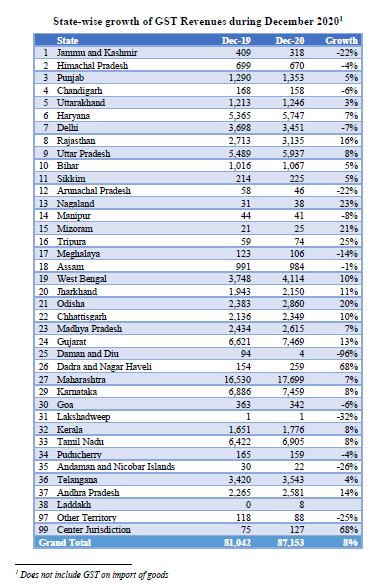
Let us drill into the details though. Here is the statewise breakup of GST collection. Source is most recent GoI statement on GST.

Image
Increase of GST revenues by state.

The data shows the increase of GST revenues, by state, over the past year, for the month of December. The increases are impressive and consistent. Now, let’s look at the states contributing the most to GST. Industrial powerhouse Maharashtra leads by a long distance, with 17K crores. Gujarat, Karnataka, Tamil Nadu are the follow-up pack, with over 6K crores each. Next come the states of Haryana (important, as I will point to shortly) etc. with almost 6K crores. Then Delhi, and so on.

Where is Punjab? Did I miss it? No. Punjab’s GST contribution is a measly Rs 1353 crores. It is less than a tenth of Maharashtra! It is less than a quarter of the likes of Gujarat, Karnataka, and Tamil Nadu. And, coming back to the state that is most “like” Punjab—Haryana, it is about a quarter of Haryana’s collection! This is indeed very puzzling, and disappointing. Why is this state not contribution to GST collection. Could it be that this is because the data I have shown is only for December? No, one can check that the trend remains similar for full annual data as well.

So what gives? It is not the scope of this article to investigate fully the reasons for this abysmal GST contribution of a state whose farmers frequently make chauvinistic statements about “feeding the country” etc. (when in fact Punjab only produces about 13% of India’s wheat, less than Uttar Pradesh’s 18%). We merely want to point out that there is a severe discrepancy here too that goes in favor of Punjab. Another big sop that other states do not enjoy. One reason is that agri-implements are exempt from GST (no prizes for guessing which lobby this was intended to appease). But that itself does not explain why Haryana is able to raise so much more GST revenue than Punjab.

Recently, the Punjab government declared that it was about 45% short of its GST target. It cited covid as the reason. On this, firstly covid is not a problem specific to Punjab, so this in itself does not explain why Punjab is so far behind in GST collection. Secondly, even if this 45% were accounted for, Punjab still falls far short of what might be expected from one of India’s richest states as far as GST contribution.

There is an increasing awareness among India’s thinking population that Punjab is getting too sweet a deal: selling nearly all its produce to the GoI at high MSP, freebies such as free electricity, freedom from penalty for stubble burning that makes Delhi into a gas chamber. These are known. We hope that with this article, another major imbalance that favors this one state will also be inserted into this national discussion. It is clear to anyone who wishes well for the country that Punjab must play on a level playing field with other states in the new economic system we are trying to progress into. The days of subsidies and freebies, often maintained for political purposes, are going away. It is time we had a serious discussion on why Punjab is always accorded special treatment.

As but one example: Maharashtra contributes the most to GST, and YET has the most farmer suicides because its farmers are not being subsidized massively at national cost the way Punjab’s farmers are. And that is simply not fair, and it must end.