Thursday, April 2, 2026
Home Blog Page 803

Has activist Irom Sharmila proved that she has immense potential to be the next Kejriwal in the queue?

Indians recently heard some ridiculous reasons for defeat in elections from political parties who lost the battle against the BJP. Irom Sharmila’s justification given for her demoralizing defeat in recently held Manipur election is equally absurd. Her uninformed comments made during her Thiruvananthapuram visit may trigger anger among family members of BJP workers who lost their loved ones due to political clashes in Kerala.

On March 20, Irom Sharmila interacted with journalists in Thiruvananthapuram. She visited the city and also met CPI (M) leaders as well as Kerala Chief Minister Pinarayi Vijayan. The activist plans to spend some time with the tribal population in Palakkad district’s Attappadi Reserve Forest Area.

During the event, Irom spoke about why she opposes the AFSPA–Armed Forces Special Powers Act in Manipur and wants it to be repealed. She thanked CPI (M) and other left outfits for supporting her in this matter. At one point, she claimed she has decided to quit politics, but her outfit-Peoples’ Resurgence and Justice Alliance (PRJA) will remain active.

Terming political situation in Kerala as ‘a ray of hope’ sounds barmy!

In her speech, Irom shared her opinion that politics in Kerala offered a ray of hope, while other states were under the influence of muscle and money power.  This is spurious logic and the point where the absurdity began in her speech.

Our constitution created with Dr. Ambedkar’s great contribution has given voting power to every citizen. State Governments have been formed with the help of democratic process. Thus, claiming that all other state elections except for Kerala are won with money and muscle may not prove to be appropriate.

Related: Politics taken over by money, muscle power but situation hopeful in Kerala: Irom Sharmila

Often referred as “next Kejriwal in the queue,” Irom claimed during the event that her intention is to protect democratic values and human rights. If so, why has she preferred to ignore all the political murders in Kerala and gave a super-honesty certificate to CPI (M) Government?

Kerala and WB report a maximum number of cases involving political clashes, mostly, victims are BJP workers.

In January this year, CPI (M) workers in Kerala attacked a DALIT BJP worker-Suresh and threw his ten-month-old baby out of the car. Leftist workers were later arrested by police and it was also confirmed that the workers already had similar political violence cases against them. Those behind Rohith Vemula and other Dalit protests did not even utter a word against CPI (M) goons who threw the baby out of the car because of political rivalry.  They probably did not show any interest because this Dalit was associated with the BJP.

Former RSS office bearer-Kundan Chandrawat had recently pointed out that more than 300 RSS Pracharaks have been murdered by CPI (M) in Kerala. In fact, 2016 alone saw the deaths of 31 BJP-RSS workers. It seems that Irom Sharmila is not bothered about all these deaths and such incidents are a ray of hope for democracy according to the human rights activist.

Irom says humans should show mutual honor and respect towards each other. Many people consider her an inspiration and a hero. Her 16 year struggle for Manipur is remarkable and she has won multiple awards for her work. But, why is it that she preferred to ignore political murders in Kerala? Is it that CPI (M) members can get away with brutal political murders because they support her propaganda? How can the government that failed to act on so many political murders offer a ray of hope? Killing political rivals is democracy’s murder. It’s unfortunate that even the Supreme Court and the Election Commission of India have turned a blind eye towards such incidents reported from Bengal and Kerala.

Anyway, getting back to the topic, people in Manipur have already shown her place to Irom Sharmila by giving her just 90 votes. CPI (M) won’t be able to purify itself from its sins with Irom’s certificate. Now, it’s up to the people to decide if the political scene in Kerala is a ray of hope for democracy or a black spot.

From bovine-centric to canine-centric; it’s a culture reversal

vidyā-vinaya-sampanne
brāhmaṇe gavi hastini
śuni caiva śva-pāke ca
paṇḍitāḥ sama-darśinaḥ

The humble sages, by virtue of true knowledge, see a learned brahmana, a cow, an elephant, a dog and a dog-eater  with equal vision.
–Bhagavad Gita 5.18

If protein is all that matters then dog meat has served as the nutritional needs of the terribly downtrodden since the times of the Gita.

A woman embracing a garlanded cow

Just as some human relations are classified as near and dear, animals too have a hierarchy in the eyes of humans based on their relative utility. For example, the cow and bull were extremely useful and were the backbone of a pre-modern agrarian society; they were accorded the highest importance in our society to the extent that killing of cow is seen as sin. Against such a background, one wonders how the cow that was subject to reverence and worship since times unknown has now become a slaughter-able animal. Any argument or sentiment against such slaughter is painted as a communalism.

It has long been argued by the so-called liberals that cow is like any animal fit for human consumption and treating it as mother is mere superstition. While from a biology point of view it may not make a difference, they conveniently ignore the fact that our entire agrarian economy was once powered by the cow family- with cows giving milk and the bulls tilling the soil. It is only in a country like India, one finds expressions like Ksheera Sagara (ocean of milk), Dadhi Sagara, Navaneeta loka (world of butter) etc., referring to the abundance of milk and milk products that the country has been able to produce since times unknown. Desert hordes can only dream of flowing streams of water even in their highest heavens. Cow is intertwined with our lore and tradition. It is but a matter of common sense that an animal of such an importance should not be killed.

In contrast, the dog has never occupied a great place in Indian society. The relative importance of dogs to our society is very minimal. Also, it is seen as an unclean animal. In its natural habitat, dogs eat their own excreta and vomit while cows don’t. The canine is only worshiped in its terrible form as Kalabhairava, an aspect of Shiva. This is attributable to the overarching Vedantic philosophy that propounds no one is unworthy of worship as God is in all- is all.

New studies indicate that cows and farm animals are far more intelligent than popularly perceived. Research found that dairy cows could follow sound through a maze in order to find food, suggesting heightened executive function and decision-making abilities. The cows that were studied also showed remarkable emotional sensitivity and were deeply affected by emotional and physical pain of early separation from their mothers and dehorning, which changed the brain in a way that led to a negative cognitive bias akin to pessimism.

Beef curry served with lime and mint.

Empirical evidence shows that domesticated cows develop deep attachment to their owners, often displaying signs of distress including a serious drop in appetite when their masters are away for long periods. The loyalty aspect that the modern society attributes to dogs has been denied to cows for the simple reason that it will be morally wrong to kill something that is as loyal and loving.

Our traditional experience has been denied and our sentiments of treating cows as family members has been rubbished by a culture that hardly understands sustainable farming and cattle rearing. Some hundred years ago, it would be almost impossible to find a household without domesticated cows. Now that is not just a reality but we have banished our cows to the mercy of cruel dairy farms and slaughter houses.

Draught power of Ongole bulls on display in a competition. Draught animals help sustainable agriculture

In return, we have taken the animal of our oppressors, the canines that they imported from Europe. In many native cultures, the dog is seen as offensive animal. When George Foreman, arrived in Zaire to fight Mohammad Ali at the famous ‘Rumble in the Jungle’ fight, the locals were deeply offended by the German Shepherd that he brought along with him. The German Shepherd reminded them of the Dutch who used their dogs to hound the locals. The animal doesn’t fare well even in common idiom of India. The famous Sumati Satakam (anthology of 100 poems) in Telugu talks about a dog’s character of going back to its old ways even when it is crowned on throne in the following poem.

Kanakapu simhasanamuna

Sunakamu goorchundabetti subhalagnamunan

Vonaraga battamu gattina

Venukati gunamela maanu vinaraa sumathee!

A woman embracing a pet dog

Times have changed, we have been brainwashed, insulted, coaxed in to believing that cows are just meant to be eaten. The households that once had at least one cow and that would not wait for an opportunity to buy or donate a cow are now ridden with animals like dogs and cats.

In the wake of proper implementation of illegal slaughterhouse ban in the UP, the prices of other meats have reportedly gone up making it difficult for poor people to access necessary protein. While long term measures to provide cheap nutrient rich food for the masses need to be taken care, the Govt. must consider introducing new meats into the market that are cheap, nutritious and are readily available.

Those who fiercely argue that cows cannot be mothers of human beings are probably right. Just add to it that if cows are not mothers of humans then neither are dogs friends to humans; therefore fit of human consumption. Stray dogs are widely and readily available and can be slaughtered without additional investments in slaughterhouses. In addition, research in to dog breeding for human consumption as an industry must be conducted to identify the best and the most productive breeds.

As Justice Markandey Katju argues, it is just a superstition to treat any animal as a relative/friend of human beings. We should explore all possible animals that can be consumed by humans. A quick look at this Wikipedia page gives an idea of the cultures that traditionally eat or have recently acquired taste for dog meat. In some parts of India and many part of the world dog meat is a delicacy.

Dog meat in Hanoi, Vietnam

About 25 million dogs are killed each year for human consumption. A simple back of the envelope calculation suggests that breeding dogs for human consumption will lead to lesser carbon emissions as compared to rearing cattle for meat. Scientific studies in this matter must be conducted to either confirm or reject this observation.

Nutritional value per 100 g (3.5 oz) of dog meat
Energy 262 kcal Thiamine (B1) -0.1 Minerals 270 mg
Carbohydrates 0.1 g 0.12 mg Calcium -0.01 Sodium -0.05
Dietary fiber 0 g Riboflavin (B2) -0.15 8 mg 72 mg
Fat 20.2 g 0.18 mg Iron -0.22 Other constituents
Protein 19 g Niacin (B3) -0.13 2.8 mg Water 60.1 g
Vitamins 1.9 mg Phosphorus -0.24 Cholesterol 44.4 mg
Vitamin A equiv. 0 Vitamin C -0.04 168 mg Ash 0.8 g
3.6 μg 3 mg Potassium -0.06 270 mg

Dog meat might sound outlandish. However, it is only a matter of developing a taste for it. If not, how come beef becomes a delicacy which is served in restaurants across India while it was a taboo a few decades ago? Moreover, from the sloka stated above it is clear that dog meat is the staple food of underprivileged classes of our society. Those who claim to be working for the upliftment of the underprivileged sections of society must actively promote dog meat which has for centuries served as their everyday food.

Draught power of sled dogs on display. Norwegian explorer Roald Amundsen was known to have eaten sled dogs during his expedition to the South Pole.

In addition, the sheer number of dog breeds at our disposal allows for rich culinary variety. Unlike farm animals, dogs can be bred in-house like garden cucumber allowing the possibility of having unadulterated non-industrial meat. If dogs are to be avoided for religious reasons by certain communities, alternative sources of protein for such communities should be explored. While camel meat may be impractical, cat meat is not impossible; certain insects are certainly nutritious and sustainable, as per new research.

Progressive and scientific minded individuals must counter the propaganda of animal rights activists and pet lovers who will jump in to the fray to protect these so called best friends of man by educating the masses about the nutritional, economic and anti-superstitious value these new meats have and promote diversity of consumable proteins.

All discourses demeaning the livelihood and culture of those minorities in India and outside India that have survived on dog and other non-conventional meats for centuries must end once for all and they should accorded an equal and dignified status in the society where they can proudly eat their food without fear of ridicule and social alienation from predominantly western acquired prejudices.

A post-modern society should be able to question before embracing culture reversals (from bovine-centric to canine-centric or vice-versa) with utmost scientific zeal leaving no space for superstition of any kind.

The Lal Krishna Advani column: Understanding the timing of Demonetization

0

Nameste folks,
Today I am going to tell you the reason for the timing behind demonetization. Several reasons have been put forward on why Narendra Modi chose 8 November 2016 as the date for implementing demonetization.

However, from our vast experience, only my colleague in the Margadarshak Mandal, Murli Mahohar Joshi and I can give you the real reasons.

Murli Manohar Joshi thinks that 8th November was chosen because it is my birthday.

Yes, I turned 89 on 8th November 2016 and Murli Manohar Joshi thinks that this was Modi’s way of expressing gratitude to me, a lifelong crusader against corruption. He even thinks that Modi renamed the RCR to Lok Kalyan Marg because LKM means Lal Krishna Margadarshak.

However, I have my own views. I think Modi chose 8th November for demonetization because this was the day of the US Presidential Elections. Confused? Let me explain.

It is I who have groomed and mentored both Narendra Modi and Arun Jaitley to what they are today. So I can visualize the conversation they must have had when they finalized demonetization.

Arun Jaitley: “So we are all set. Just 1 thing Narendrabhai.”

Narendra Modi: “Yes, tell me.”

Arun Jaitley: “Just before you announce demonetization, I will go on NDTV and give a live and exclusive interview to Barkha Dutt about it.”

Narendra Modi: “Sure.”

(Then, on 8th November 2016)

Narendra Modi: “Let’s announce demonetization today evening.”

Arun Jaitley: “Sure. (Dialing the phone) Hello Barkha, I have exclusive breaking news for you. I am coming over the NDTV studio.”

Barkha Dutt: Yes, I know. Hillary Clinton is tonight going to break the highest glass ceiling in the world. Busy cheering her. Talk to you later. Bye.

So, folks, that’s the real reason why 8th November was chosen. See you soon with more insights from our Margadarshak Mandal.

Regards,
Lal Krishna Advani

Is Aadhaar Card worth considering an essential identity proof?

0

Not against it, for the sake of it

In a country where more than 40 per cent people defecate in open, people live under the sky and yet make babies, share ALL their identity proofs even when one would suffice, it is understandable why Aadhaar is just another identity proof for them; just another piece of laminated paper that will accompany the existing oxidized bundle of identity proofs.

In fact, because it incorporates biometric data, it brings an additional layer of notional security with the instrument. Most of my well-read friends see no reason why I should have an issue with this Godsend, err, I mean Nilekani send solution that promises to do away with all the miseries a land of 1.25+ people faces.

If God could design so many faces, we can sure do better. So, what is it, that we don’t know (probably ‘they’ don’t want us to know) about Aadhaar?

a. Aadhaar for everyone, how?

Chapter I, Section 5 of the Aadhar Act states:

The Authority shall take special measures to issue Aadhaar number to women, children, senior citizens, persons with disability, unskilled and unorganised workers, nomadic tribes or to such other persons who do not have any permanent dwelling house and such other categories of individuals as may be specified by regulations.

Disabled: The Act is unclear how it intends to deal with disabled people, leprosy patients, amputated limbs, and people born with deformities. The form does not entail any column for such cases, implicitly excluding them from the scheme. Also, do we have door-to-door Aadhar for the immobile?

Homeless/Nomads: The form has no provision where one may identify themselves as homeless or nomadic. Although the form does not make address fields mandatory, if Aadhaar is envisaged as the means to transfer benefits, those without an address are left at the mercy of the data operator to start with, and excessive discretion of PDS officer to end with.

b. Aadhaar for Anyone

Proof of Identity: Identity proofs that can be used for document based introduction are very basic. For example, “Photo ID issued by Recognized Educational Institution” being the easiest of all.

Proof of Address: There is no background verification, like that in passports to verify if the applicant is indeed residing at the said location. Acceptable documents like electricity bills are easily available to terrorists operating in the country.

Date of birth documents: Using the option of “Declared” and citing absence of documents related to date of birth, an unintended applicant does not have much to worry about.

We have colourful reportage of terrorists possessing sim cards and fake documents, even operating bank accounts. If this instrument is espoused as the elixir to identity crisis, control should have been the repeated theme.

Aadhar Form

 c. Aadhaar is not an address proof, or is it?

Chapter III, Section 9 of the Aadhar Act states:

The Aadhaar number or the authentication thereof shall not, by itself, confer any right of, or be proof of, citizenship or domicile in respect of an Aadhaar number holder.

On the contrary,

The passport office mentions Aadhaar as an acceptable proof of address. It goes on to say, Furnishing of Aadhaar card will expedite processing of passport applications.

We established in the above point that Aadhaar can be obtained easily by non-Indians. Using Aadhaar, I am able to open a bank account and avail utility services, which in turn help me completing documentation required for an Indian passport.

d. Spurious Aadhaar cards

The existing technology does not differentiate between the iris of a human being or an animal. Similarly, the detection of fingerprint will capture the paw print of your pet too. If Aadhaar is to be used to transfer benefits only to intended people and ensure it is follows a one to one mapping to control DBT leaks, existing systems being deployed are failing at their game.

Your iris + Your fingerprints = Aadhaar 1
My iris + my fingerprints = Aadhaar 2
My iris + your fingerprints = Aadhaar 3
Your iris + my fingerprints = Aadhaar 4

If the Aadhaar machine operator is my dear friend, let’s get this growing exponentially. The stuff frauds are made of. There is very little control exercised by UIDAI on data collection agencies.

Even MS Dhoni’s data is not safe.

Come to the other leg of implementation. When I use Aadhaar 3 or Aadhaar 4, and my fingerprints or my iris, respectively don’t match, I negotiate for a benefit of doubt and blame technology for endless glitches. Moreover, there is little clarity on the composite unique key being used to match, while transferring of benefits.

2 people with 4 Aadhaar cards. N people, N^2 cards of which only N are genuine. Depending on the number of people who decide to thrive on this racket, this can be a nightmare in the wings. Increasing biometric identifiers only increases the problem, further.

e. Aadhaar is not a one-time activity

Chapter II, Section 3.3 of the Aadhar Act states:

The Authority may require Aadhaar number holders to update their demographic information and biometric information, from time to time, in such manner as may be specified by regulations, so as to ensure continued accuracy of their information in the Central Identities Data Repository.

The Act takes cognizance of the fact that our biometrics alter with age and health. This necessitates periodic updating. The Act does not spell out the timeframe after which a subscriber needs to revisit the Aadhaar centre for the same. Imagine, a hospital denying admission to a critical patient because her biometrics don’t tally or PDS distributor harassing the intending beneficiaries because the detection machine is not functioning.

Cannot deny benefits in the absence of Aadhaar:

There has been recent fear mongering that those without Aadhaar may be deprived of entitled subsidies, benefits and services. We may safely put them to rest, on the back of the following caveat mentioned in Chapter III of the Act:

“Provided that if an Aadhaar number is not assigned to an individual, the individual shall be offered alternate and viable means of identification for delivery of the subsidy, benefit or service.”

In the absence of the Act not posing querying regarding the absence of Aadhaar, one cannot chained to subscribe for one.

We can either go ahead with full-fledged implementation and adopt yet another instrument that will suffer from the same follies as its many other counterparts. Alternatively, test it for all cases and strive for highest standards of security till it truly deserves to be the Aadhaar of everything.

150000 villages in India to have internet connectivity: Is it finally time for Rural Startups?

0

India being second in row after China in population has laid a master plan to break new ground for radical growth by using these ever growing figures of population hike, judiciously. India aims to convert its latent population into combatants of GDP by tossing them over the internet. In the Annual Budget, Arun Jaitley, the finance minister of India,  propagated to extend high-speed internet connectivity to 1,50,000 villages across the nation.

However, with around 450 million people, India is already the second largest internet market in the world. India already has 1,55,000 km long optical fibre cable and will further invest $1.4 Billion in a play to win approach to seek a different radical path for development.

After, India outstripped the U.S. last year for having the most “Facebook” users in the world. India now looks forward to tap into its unconnected population of more than 1.3 Billion spread evenly throughout the nation. The Government, having taken a cue from the Silicon Valley giants, plans to provide free Wi-Fi to rural villages across the nation.

Out of the total population, around 864,676,587 Indians are facing the Digital Divide.

Is Internet just a hype?

The Internet, not only empowers the techno geeks to emerge as Silicon Valley giants; rather it has the potential to modify the entrepreneurial psyche of the individuals. It has lead to the creation of a new parallel economy i.e., Sharing Economy.

Also, it acts as a proactive catalyst for Economic Growth. When the entire nation hits the Internet, it gives them new avenues to explore new capabilities for profitable growth. When the nation’s farmers access the unapproachable world, from an internet-equipped smartphone to anticipate the fair prices for their toil. Or when the government goes live in providing the basic documentary services to remote stratas of the country. You rightly get to know internet’s contribution in restricting the growth patterns. It is essential to know that out of 3,424,971,237 worldwide internet users 462,124,989 are in India. Out of the total population, around 864,676,587 Indians are facing the Digital Divide.

Internet contributed more than 10% of the total GDP growth in India. It increased the real per capita GDP. The effect of iGDP can be measured through:

  • Private Consumption: Goods and Services consumed via internet.
  • Public Expenditure: Expenditure by government in software/telecom etc.
  • Private Investment: Investment in internet related technologies.
  • Trade Balance: Expenditure in E-commerce, Import and Exports.
  • Internet has not only empowered Web-based companies, rather its scope is much tremendous. It provides Indians with platforms to voice their outlooks and tap their unexplored realms.

Internet drive in India:

India captures about 13.5% share of the world’s internet. The Government has taken a front foot in digitalizing the nation under its Make In India campaign. The government has taken certain initiatives and few are in pipeline to help bridge the gap by Internet Leapfrogging.

The Visionary roadmap incorporates the following:

Digital India: Government will make attempts to provide Free Wi-Fi hotspots as a basic fundamental right to the citizens of the nation. It will connect all loose rural ends to transform key 25 sectors.

Digi Gaon: The Government will offer facilities across an online portal to educate and retrofitting into Smart Cities.

Startup India: The aim is to encourage a new craze of start-ups by providing a user-friendly platform.

Sectoral Impact of Internet: Internet access to rural areas, leads to exploiting new sectors by deploying solutions for resource oriented, sustainable growth which leads to offspring, start-ups in the following sectors.

Finance: Reduce accessibility and Transaction cost of Funds
Education: Access to reservoir of content
Health: Efficiency in Health spending
Retail: Open new shopping experiences
Agriculture: Enhance Turnover with innovation.
Government: Provide Automated Information systems

These sectors were previously characterized with pitfalls. Internet helped to overcome service delivery challenges, lack of content, mass outreach and the fill market gaps. The availability of Internet will lead to exciting innovations in these sectors.

Stumbles in the journey:

In spite of having a huge scope, it is still in a nascent stage.

Lack of Education: Imparting education is still a taboo in the remote areas. Villagers give more importance to skill development. Sadly, the lack of literacy acts as a major pitfall in excelling entrepreneurial skills.

Lack of Marketing Infrastructure: Farmers face a tough time negotiating for perishable commodities. Villagers tend to face exploitation by settling at marginal margins.

A catalyst is required to open good roads for good connectivity with wholesale markets. A better negotiation not only acts as an intensive to excel but gives a path to expand the scope.

Poverty: The rural population face tough time in making the ends meet. Their low incomes are not even sufficient to fulfil their daily needs.

Internet might provide them with an additional source of income. Moreover, it also gives them new opportunities for start-ups. Rural connectivity is a small step that can culminate a giant leap in solving roadblocks in the economy or call it the advent of a new start-up era.

Why western criticism of Indian democracy is flawed

0

Democracy is a western concept, invented by the westerners, modified by them and supposedly also being preserved by them. It is the westerners who get to decide what is democratic and what is not and how is democracy to be sustained. Being the inventors and sustainers of practical democracy and with democracy being the major form of governance in the world today, these western nations have become the unwanted mentors for the developing democratic countries.

Post-Cold War people realized that communism and socialism were not the right forms of governance and that only democratic capitalism could bring about progress and prosperity for the people. The illusion has lasted for around a couple of decades but with the rise of global population and scarcity of resources, democracy too seems to be failing. The worst effect of this fallout is bound to be on the western democratic capitalist nations which have been slurping all sorts of profits from the developing world by the means of democracy. Thus, the westerners are leaving no stone unturned in their attempt to sustain liberal capitalist democracies around the world.

Countries which tend to deviate from the stated norm are criticized, internationally shammed and forced to re-align to the western idea of democracy. The western world has such vested interest in sustaining their form of democracy that they dare not miss out criticizing any event in the developed countries which could possibly sway that nation away from the profitable norm. These criticisms have proved to be quite fatal and have in fact successfully managed to prevent leaders of developing and underdeveloped world from taking crucial, innovative and revolutionary steps.

The wind of change seems to be blowing in India right now, the most important castle of democracy. Indians in 2014 elected a strong headed and fearless man (Narendra Modi) to lead their nation out of smothering crisis and stagnancy. What followed was a string of innovative reforms which not only helped the country move forward but it also somewhat established the validity of majoritarian form of democracy as a form of governance where the government might seem to represent the a majority community but the policies designed by this government are such that they impact all sections/communities equally and similarly.

The tweak in democracy received excessive criticism from the western world and also from those nationals who think the way the westerners do. The support from citizens because of visible results of reformative policies helped the leader bear all criticism and continue his march towards progress.

The recently concluded state elections in our country yet again established the supremacy of the leader his party received unparalleled support from the masses. Procedure and protocol was followed and the party elected one of the elected members as the Chief Minister of the state. This time the western media went crazy and criticized Modi for appointing a religiously colored (Yogi Adityanath) man as the head of a state.

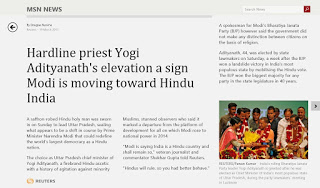
Douglas Busvine working for Reuters even wrote an article titled ‘Hardline priest Yogi Adityanath’s elevation a sign Modi is moving towards ‘Hindu India’. The most interesting part of the article was that its promo did have a question mark while the article did not. So it was actually a statement which was cowardly promoted as a question to attract readers. The pictures of the promo and of the article are given at the end of the post.

Let us for an instance consider that Modi is actually trying to convert India into a Hindu India and that the elevation of Yogi as the CM is a step in that direction. Let us even consider that at instances he tweaked conventional democracy, not constitutional democracy, to give way to development. Even in such a case, the alien westerners do not get the right to publish such lethal and insensitive statements which can potentially lead to chaos and civil strife in our country. Moreover, cloaking such statements as questions to attract readers and mint monetary profits is the lowest any writer could stoop.

Leaving the lows of journalism aside, let us address two important questions that arise at this juncture in the essay. First question is, is democracy/conventional democracy a virtue, the only and ultimate form of governance? And the second question is, why does the world expect us to be democratic the way they are, to bear the burden of conventional democracy and compromise on development?

The universally acceptable description of democracy is the one given by Abraham Lincoln who described it as ‘government of the people, for the people and by the people’. This description led to the evolution of democracy that we see today. And, democracy that we see today is undoubtedly full of loopholes which are impossible to plug by a liberal constitution, yet another requisite of conventional democracy. Thus, the modern liberal democracies that we see around us are not free of vices like political opportunism, political hypocrisy, communalism and various other evils.

In fact, those who claim the appointment of Yogi Adityanath as a murder of democracy by the ruling Bhartiya Janta Party (BJP) must understand that the appointment was possible only because of democracy and the blame, if any, must be on democracy and not on the BJP. This gives us the answer to our first question, democracy is not virtue and many political vices that we see today are a result of democracy and the inability of a liberal constitution to plug the loopholes. It is time we start questioning the golden, decorated and conventional system of governance and think of other ways.

China came up with its own unique form of democracy; Israel too is not a conventional democracy yet the world aspires to achieve the kind of growth that these nations have attained in an extremely short span of time. I do not say that we need to copy their form of democracy but yes deviation from conventional democracy can probably initiate the much needed process of growth and development in our country.

The world has burdened us by appreciating our ability to keep the world’s largest democracy functional. World leaders have called us an inspiration for the developing and underdeveloped nations which despite being less populated are still struggling to establish democracy. Our country has been struggling to move ahead with this burden and it is time for us not to think of what the world would say about us if we deviate from what we are but of what legacy do we plan to leave for the future generations. The world does appreciate us for being democratic but at the same time there are departments in their government which ponders upon the amount of aid to be sent to us.

Conventional Democracy is neither a virtue nor a burden for us to bear any longer. We need to look for alternatives and we need to come up with a form of governance which the world may or may not find fancy but one which could make every Indian (irrespective of their religion) proud of their country. I do not call for an overhaul of the existing system but yes we must not be too possessive about democracy and we must welcome policies which would boost our growth and lead to equal and similar growth of all citizens of all religions even if the policy challenges the principles of conventional democracy because conventional democracy is not a virtue but a burden for us.

उ.प्र. का योगी आरोहण: मात्र एक घटना से परे, इसके बहुआयामी प्रभाव

अगर आप किसी घटना, या व्यक्ति, का प्रभाव देखना चाहते हैं, तो उसके विरोध को देखें। विरोध की गंभीरता, विरोधियों की संख्या, और विरोधत्व काल (कितना लंबे समय तक विरोध चला) से अंदाज लगाया जा सकता है कि घटना, या व्यक्ति, का महत्त्व क्या है। वैसे तो इतिहास भरा पड़ा है ऐसे उदाहरणों से, किंतु समयाचीन उदाहरण है आज के प्रधान मंत्री नरेंद्र मोदी का।

सन 2002 से लगातार एक इंसान का इस कदर विरोध हुआ कि जो इंसान सामान्य तौर पर एक मुख्यमंत्री पद से रिटायर हो जाता आज भारत का प्रधानमंत्री है। आख़िर मोदी भाजपा के कई मुख्यमंत्रियों में से एक थे। मुख्यमंत्री बनने तक शायद बहुत से लोग जानते भी नही होंगे। सब कुछ शायद सामान्य जैसा ही रहता।

लेकिन इतिहास गवाह है कि हुआ क्या- मीडिया, विशेषकर अंग्रेजी मीडिया, के एक वर्ग ने निहित-ईर्ष्या और निहित-स्वार्थ वश मोदी-विरोध का एक आंदोलन चला दिया, अति कर दी। ये गलत था। परिणाम सबके सामने है, आज मोदी भारत के प्रधान मंत्री हैं। मेरा आशय ये नहीं है  कि  मोदी जी जहाँ हैं वहां अपनी योग्यता से नहीं हैं, वह जरूर योग्य हैं, लेकिन वही अकेले योग्य हैं, ऐसा भी तो नहीं है ना। मोदी के उत्थान में कहीं न कहीं मीडिया के वर्ग विशेष द्वारा जो अनर्गल, अप्रत्याशित और अनैतिक आक्रमण किया गया उसका भी योगदान काम नही है।

आज, जबसे योगी मुख्यमंत्री बने हैं, वही अंग्रेजी मीडिया, उसी तथाकथित छद्म-सेकुलर गिरोह ने योगी-विरोध में दिन रात एक कर रखा है।सोशल मीडिया हो या दूसरे मीडिया माध्यम सब के सब योगी-विरोध से भरे पड़े हैं। बात विरोध तक होती तो ठीक है, कुछ स्वनामधन्य पत्रकार तो योगी-घृणा में इस स्तर तक गिर गए हैं कि झूठमूठ पर उतर आए हैं। खैर, ये (कलुषित पत्रकारिता) न तो आश्चर्य जनक है और न ही अप्रत्याषित। मोदी विरोध मैं, जैसा मैंने ऊपर उद्धृत किया, ऐसा पहले भी हो चुका है। आश्चर्य ये भी नहीं है कि ये सब उसी पारिस्थितिकी तंत्र (इको-सिस्टम) के द्वारा हो रहा है। आश्चर्य ये जरूर है कि इस बार तीव्रता अधिक है, बौखलाहट अधिक है, संताप और प्रलाप अधिक है। इसी अतिरेकी योगी विरोध के कुछ बिंदु-

  • क्या योगी का चयन विधि-परक नहीं है? आखिर, जैसी कि विधि है, चुने हुये विधायको ने ही उन्हें अपना (मंत्री परिषद् के नेतृत्व का) नेता चुना है।
  • क्या ये सच नहीं है कि योगी लगातार पांच बार सांसद चुने गए हैं? चुनने वाले आमजन, जनता ही तो थी, स्वाभाविक है कि लोग उन्हें पसंद करते हैं, आखिर गणतंत्र में ‘गण’ की इच्छा का इतना अनादर क्यों?
  • क्या योगी सिर्फ इसलिए “उपयुक्त” नहीं हैं की वह विशेष प्रकार के कपडे पहनते हैं? आखिर दिल्ली (लुटयन गिरोह) को भगवा रंग से इतनी चिढ क्यों है?
  • क्या इसलिए कि वह आभिजात्य नहीं है, अंग्रेजी नहीं बोलते? किसी कुल विशेष से नहीं आते? अंग्रेजी माध्यम विद्यालयों में नहीं पढ़े हैं? या “पार्टी सर्कल” से सम्बंधित नहीं है?
  • छद्म-सेकुलर तंत्र  को शायद ये अखरे लेकिन भारतीय परम्परा में योगियों, ऋषियों, मुनियों का स्थान बहुत आदर और सम्मान का रहा है  जनमानस में आज भी सन्यासियों, गेरुआ वस्त्रधारियों, का अंतर्निहित सम्मान बरक़रार है। हमें नही भूलना चाहिए कि महान योगिराज जनक भी राजा थे हमारा तो इतिहास भरा पड़ा है जहाँ राज्य-संचलन धर्म (राज धर्म) का ही एक अंग होता था। भारतीय संविधान और भारतीय जनमानस अगर किसी योगी को पद विशेष के अयोग्य नही मानता तो इस छद्म-सेकुलर तंत्र को पेट में  मरोड़ क्यों हो रही है? बल्कि ये तो अच्छा है कि आजकल की लुटखसोट और स्वार्थ की राजनीति में सन्यासी (दिल्ली में) और योगी (लखनऊ में) के रूप में नि:स्वार्थ, अति ईमानदार और कर्मठ जनसेवक हमे मिले हैं। छद्म-सेकुलर तंत्र का अति-प्रलाप कहीं इसलिए तो नहीं है कि ये ‘जनसेवक’ उनकी लूटखसोट का ज़रिया ही बंद कर देंगे।

मुझे तो इस अतिरेकी  योगी विरोध के तीन प्रमुख कारण लगते हैं-

  1. मोदी विरोध के काल में, इस छद्म-सेकुलर तंत्र को लगता था कि वह आसानी से मोदी को नेस्तनाबूद कर देंगे। वह सही थे, आखिर उन्होंने कितनोको जमींदोज़ किया भी था। जिन्होंने अटल बिहारी वाजपेयी के राजनीतिक जीवन को नजदीक से देखा है, जानते होंगे कि ७० के दशक के अटल आज के योगी या कल के मोदी से भिन्न न थे (भाषा शैली भले उदात्त हो)। इन्ही अटल को १९९९  आते आते नेहरूवादी अटल में बदल दिया था इस तंत्र ने। इस छद्म-सेकुलर तंत्र की असीमित शक्ति तो है किन्तु मोदी ने जिसप्रकार इस तंत्र को इसका स्थान दिखाया, जाहिर है, अगले मोदी (आज के योगी )  के विरोध में ये तंत्र पहले से अधिक प्रयास करेगा।
  2. बात अब सिर्फ विरोध से अधिक  छद्म-सेकुलर तंत्र के ‘अस्तित्व’ की है।  मोदी ने जिस प्रकार इस तंत्र की जड़ों पर चोट शुरू की है, अगला मोदी स्वाभाविक रूप से इनका अस्तित्व ही समाप्त कर देगा। ये अतिरेकी  योगी विरोध महज  स्वाभाविक विरोध नहीं है बल्कि ये लंबी लड़ाई, इस छद्म-सेकुलर तंत्र  के अस्तित्व की लड़ाई है। योगीजी ये भूल न कर बैठे कि उ.प्र. का विकास  करके वे इस तंत्र को खुश कर देंगे। उ.प्र. में अगर सोने की सड़कें भी बनवा दी जाएं, तो भी योगी का भगवा रंग इस तंत्र को अखरेगा, चुभेगा, और विरोध भी होगा। विरोध के नए और अप्रत्याशित  तरीके देखने के लिए तैयार रहें – योगी निपटने को, बाकि हम सब दर्शक दीर्घा से इतिहास को देखने को।
  3. उपरोक्त कारण तो बाह्य कारण  हैं, मूल कारण तो उस विचार धारा से विरोध है जिसे मोदी या योगी प्रतिनिधित्व देते हैं। एक अकेला योगी इस वैचारिक संघर्ष के लिए न तो अपरिहार्य है और न ही अप्रासंगिक। युग-युगांतर के इस लंबे संघर्ष में योगी न तो प्रथम हैं और न ही अंतिम। आचार्य शंकर से लेकर स्वामी विवेकानंद तक अनवरत, विचारधाराओं के इस संघर्ष में, सनातन  संस्कृति  का कोई न कोई योगी राक्षसी प्रवृति से संघर्ष करता हुआ मिल ही जायेगा।

अब देखना यह है कि इस एक घटना (छद्म-सेकुलर तंत्र के लिए दुर्घटना) के कितने बहु आयामी प्रभाव पड़ते हैं। ये तो भविष्य का इतिहास बताएगा कि वास्तविक प्रभाव क्या  होते हैं, किन्तु मुख्यतः तीन प्रभाव, सामाजिक,राजनीतिक और अंतराष्ट्रीय संभावित हैं।

सामाजिक

कुछ 15-16 वर्ष पूर्व भारतीय समाज में, तत्कालीन राजनेताओं द्वारा, मंडल और मंदिर की खाई डाली गयी थी। ये विवाद का विषय हो सकता है कि पहल किसने की-मंदिर ने या मंडल ने, आज ये सब अप्रासंगिक है, किन्तु सत्य यह है कि इस विभाजन ने समाज का बहुत नुकसान किया। सामाजिक समरसता, जोकि स्वाभाविक लक्ष्य होना चाहिए था, के स्थान पर इस प्रयोग से सामाजिक वैमनस्य ही बढ़ा है। योगी के उ.प्र. आरोहण  से  इस खाई  को पाटने में मदद मिलेगी। कुछ स्वाभाविक बिंदु-

  • योगी सामान्यतः जाति-निष्पृह होते हैं। भले ही छद्म-सेकुलर तंत्र योगी की जाति बताने में दिन रात एक किये हो, सामान्य भारतीय जन मानस में ऐसी धारना है और स्वाभाविक रूप से सत्य भी है कि सन्यासी जाति विहीन होते हैं।
  • योगी के अनुभव इंगित करते हैं कि वह जाति, और संप्रदाय से भी, ऊपर उठकर कार्य करते रहे है। उनके मठ, और विशेषकर नाथ संप्रदाय जिसका वह नेतृत्व करते हैं, में मूलतः सभी जातियों के लोग, पिछड़े और अति पिछड़े विशेषरूप से, सामान रूप से सम्मिलित रहते है।
  • योगी के नेतृत्व में यह स्वाभाविक और अवश्यंभावी लगता है कि समाज की जाति पाँति आधारित क़ुरीतियों को अगर पूर्णत: नही भी मिटाया जा सकता है तो कम से कम कमी ज़रूर आएगी।
  • मंडल और कमंडल का जो विभेद १५ वर्ष पूर्व वी.पी. सिंह और मंडली ने बनाया था, आज उसका विधिवत मिलन हो गया है। मंडल और कमंडल मिलकर योगिमंडल हो गया है। सामाजिक समरसता के इस महान कार्य को आने वाली पीढियां सुखद अनुभूति से याद करेंगी।
  • मेरा  दृढ़ मानना है कि योगी के शासन काल में  उ.प्र. अभूतपूर्व उन्नति करेगा। सामाजिक उन्नयन का एक प्रमुख वाहक है आर्थिक उन्नति। उ.प्र. की आर्थिक उन्नति अंततोगत्वा भारत की उन्नति में भी सहायक होगी।

राजनीतिक

१९८९ के आम चुनाव कांग्रेस के लिए विशेष और ऐतिहासिक महत्त्व वाले रहे हैं। एक- कांग्रेस ४०० सांसद से (१९८४ में) धड़ाम से १९७ सांसदों तक पहुँच गयी, दो- इसके बाद कभी भी कांग्रेस की पूर्ण बहुमत की सरकार नहीं बनी। २००४ और २००९ में स.प्र.ग. (यूपीए) शासन के समय भी कांग्रेस स्वयं से सामान्य बहुमत नहीं जुटा सकी। लोकसभा चुनाव जीतने के लिए उ.प्र.का महत्त्व किसी से छिपा नहीं है। योगी का यूपी की ताजपोशी कोई सामान्य घटना नहीं है बल्कि यह एक लंबे समय का राजनीतिक दांव भी है। मोदी और शाह की जोड़ी ने जिस फार्मूले से २०१४ का चुनाव जीता (यूपी: ८० में ७५ सीट), ये उसी फार्मूले की अगली कड़ी है। सामान्य तौर देखा जाये तो, मोदी-शाह फार्मूला कुछ ऐसे है:

  • जातियों को जोड़ो, हिंदुओं को एक करो, पीड़ित, प्रताड़ित और नजरअंदाज किये हुए बहुसंख्यक वर्ग को राष्ट्रवाद से जोड़ो।
  • विकास को आगे रखो, पारदर्शी और न्यायसंगत प्रशासन प्रदान करो। अगर भाजपा शासित राज्यों को देखा जाये तो यह सामान्यतः स्वाभाविक ही है, आखिर भाजपा की कुछ, गुजरात, म.प्र., प्रदेश सरकारें लगातार चुन कर आ रही हैं। स्वाभाविक है भाजपा का नेतृत्व उ.प्र. में भी ऐसा ही करना चाहेगा

प्रदेश स्तर के उपलब्ध नेताओं में योगी निश्चित रूप से इन मानको पर खरे उतरते है। उनकी अपनी एक छवि है और उनका अपना खुद का वोट बैंक भी है।

इससे ये भी साफ परिलक्षित है कि मोदी-शाह की जोड़ी कहीं से भी छमायाचनात्मक अनुचेतना (अपोलोजेटिक सिंड्रोम) का शिकार नहीं है। जाहिर है, इस प्रचण्ड बहुमत में उन्हें ऐसा करने की न तो आवश्यकता है और न ही नेता द्वय इस बात के लिए जाने जाते हैं।

इसके इतर, निवर्तमान चुनाव के परिणाम और उसके बाद योगी के मुख्यमंत्री बनने से कुछ स्वाभाविक राजनीतिक उथल पुथल अवश्यम्भावी है। राजनीतिक भविष्यवाणी कठिन होती है,  फिर भी विवेचना अवश्य इंगित करती है, कि-

  • अगर भाजपा का गैर-जाटव अनुसूचित जातियों और गैर यादव-अति पिछड़ो (जैसे सुहेलदेव-बसपा, अपना दल आदि) का गठबंधन, जैसा कि पिछले २०१४ के आम चुनाव से चल रहा है, आगे भी जारी रहता है, मायावती जी के लिए आगे के दिन मुश्किल भरे हो सकते हैं। व्यापक जनाधार में मायावती सपा के मुलायम सिंह औए अखिलेश यादव के जोड़ के आगे कहीं नहीं टिकती। बसपा के पास दो ही विकल्प दिखते हैं, एक- अकेले लड़े और अंततोगत्वा राजनीतिक शून्य में जाये , या, दो- मुलायम की सपा के साथ मिल कर भाजपा का मुकाबला करे। दूसरी स्थिति में  ये गठबंधन भाजपा को हरा तो सकता है लेकिन मुलायम सिंह बड़ी आसानी से बसपा को निगल जाएंगे। ये बात मायावती जी को बेहतर मालूम है, और मुझे नहीं लगता कि कभी भी सपा और बसपा का विलय होगा। राजनीतिक स्थितियों के अनुसार  जाये तो, सपा भी रहेगी, बसपा भी रहेगी और  निकट भविष्य में  तो सरकार भाजपा की बनती रहेगी।
  • इसी सन्दर्भ में योगी की ताजपोशी महत्वपूर्ण हो जाती है। यदि योगीजी 2 साल  (योगी की परीक्षा २०१९ है, २०२२ नहीं)  में उ.प्र. में आमूल चूल परिवर्तन नहीं कर पाए, भाजपा जल्दी ही नैपथ्य में भी जा सकती है। मत भूलो की सीटें भले ३२५ आयी हों वोट प्रतिशत मात्र ४०% ही है (सपा और बसपा मिलाकर ४४%), जो न तो  कोई लहर है और न ही कोई सुनामी।
  • यदि योगीजी चमत्कार कर देते हैं, मुझे तो लगता है कर देंगे, तब भाजपा एक मैराथन दौड़ के लिए अपना रास्ता साफ़ कर लेगी।  उ.प्र. विजय का अर्थ भारत वर्ष पर भाजपा का लंबे, बहुत लंबे, समय तक शासन  हो जाए। आनंद की बात ये होगी जब छद्म-सेकुलर तंत्र के खिलाडी एक एक करके केशरिया धारा में जुड़ेंगे- ये जुड़ेंगे क्योंकि इनका (छद्म-सेकुलर तंत्र) लगाव किसी विचारधारा में नहीं बल्कि ‘सत्ता’ धारा में है।
  • भले ही देश में अन्यत्र कांग्रेस का नामोनिशान बचा रहे, लेकिन यदि उ.प्र. में कांग्रेस का अस्तित्व समाप्त हुआ तो ये मान लें कि केंद्र में कांग्रेसनीत सरकार दूर की कौड़ी होगी। कांग्रेस के पास अब दो ही उपाय हैं, या तो राहुल की ताजपोशी करें और महात्मा गांधी की कांग्रेस मुक्त इच्छा पूर्ण करें या फिर किसी और को कमान दें, और वेंटिलेटर पर कुछ समय पार्टी को और चलायें। मोदी-शाह-योगी की तिकड़ी से अगर किसी को सबसे अधिक राजनीतिक नुक़सान हुआ है और होने वाला है तो वह है कांग्रेस पार्टी और नेहरु-गांधी परिवार। १९६९ के बाद की पारिवारिक-व्यक्ति विशेष निहित कांग्रेस के ज्ञात-अज्ञात अत्याचारों का अंत तो होना ही था, नियति ने योगियों और सन्यासियों को इसके लिए चुना, कौतूहल का विषय हो सकता है।

अंतर्राष्ट्रीय 

देश, समाज, परिवेश से परे बड़े सामाजिक परिवर्तन सामान्यतः सार्वभौमिक होते हैं, मानव जीवन के विकास क्रम में कमोबेश यही प्रक्रिया देखी जा सकती है। एक उदाहरण देखें- २०वीं सदी के मध्य के ३० वर्षों में औपनिवेशिक चक्र से बाहर आने की एक ऐसी लहर चली कि दर्जनो, संभवत: सौ से ऊपर, देश आज़ाद हो गए। ऐसी ही लहर कभी साम्यवाद और कभी बाज़ारवाद की भी चली थी।

आजकल भी एक ऐसी ही लहर चल रही है, अति राष्ट्रवाद की। वैश्वीकरण के इस युग में और मूलतः उसके आदर्शों के इतर, विभिन्न देश, समाज अपने स्थानीय हितों के प्रति सजग हो रहे हैं, संगठित हो रहे हैं। अमेरिका में ट्रम्प को चुना जाना कोई एकल घटना नही है, ब्रिटेन का यूरोप से बाहर आना, फ़्रान्स और जर्मनी में दक्षिण पंथी पार्टियों की बढ़त (लगभग पूरा यूरोप दक्षिण पंथी विचारधारा में बहता दिख रहा है), फ़िलिपींस, तुर्की, रूस, भारत आदि देशों में नए दक्षिण पंथी शासक वर्ग का चुना जाना इसी परिवर्तन की कहानी बयान कर रहा है।

उ.प्र. जहाँ विश्व की ३% जनसंख्या निवास करती है, जहाँ की आबादी ब्रिटेन फ़्रान्स और जर्मनी की सम्मिलित जनसंख्या से भी अधिक है, अगर इसी वैश्विक रुझान को प्रदर्शित कर रहा है, राष्ट्रवाद की ओर झुक रहा है, तो इसमें आश्चर्य कैसा? आख़िर जो कारक अमेरिका में ट्रम्प को लाते हैं, फ़्रान्स में लीपेन को बढ़त दिलाते हैं, वही सार्वभौमिक कारक पहले मोदी को और अब योगी को नेत्रत्व पटल पर लाते हैं।

उ. प्र. के निवर्तमान चुनाव परिणामों का एक और अंतर्राष्ट्रीय  प्रभाव भी पड़ा है। शायद कम ही होता होगा कि भारत के किसी प्रदेश के चुनाव जीतने पर विदेशी शासनाध्यक्षों से भारत के प्रधानमंत्री को बधाइयाँ मिलें। लेकिन ऐसा हुआ। कारण साफ़ है। इन चुनावों ने मोदी के हाथ बहुत मज़बूत कर दिए हैं। अंतर्राष्ट्रीय मंच पर मोदी की छवि पहले से ही एक ताकतवर शासन-प्रमुख की रही है। २०१८ तक राज्यसभा में भाजपा को पूर्ण बहुमत, वर्तमान अपार जन समर्थन और मज़बूत प्रशासक की छवि के चलते मोदी की अंतराष्ट्रीय जगत में और अधिक शक्तिशाली छवि बनी है। इसके दूरगामी परिणाम भी देखने को मिलेंगे। केवल प्रादेशिक राजधानियों में ही चुप्पी नही छाई है, बेज़िंग से लेकर इस्लामाबाद तक उ.प्र. के चुनाव और योगी के आने का गुणा-भाग लग रहा है। कुछ तो ख़ास है कि एक मुख्यमंत्री को वीज़ा देने में आनाकानी करने वाले आज मोदी के बड़े चेले, भगवाधारी योगी, के मुख्यमंत्री बनने से न केवल ख़ामोश बैठे हैं बल्कि नए सम्बन्धों की पींगे बढ़ा रहे हैं।

संक्षेप में, योगी का रंगमंच पर आना न तो एक सामान्य घटना है, और न ही इसके परिणाम सामान्य होने वाले हैं। आने वाला समय रोचक तो होगा ही, इसके दूरगामी विशेष परिणाम भी अवश्यम्भावी हैं। २२ करोड़ जनसमुदाय का ही नहीं अपितु सम्पूर्ण भारत भूभाग भी प्रभावित होने वाला है। आप चाहे तो इस राजधर्म के यज्ञ में आहुति दें, धर्म और विकास के संगम के भागी बनें, प्रयाण को सफल बनाएं, या फिर तटस्थ होकर इतिहास बदलते देखें। लेकिन राष्ट्र कवि दिनकर की पंक्तियाँ याद रखें-

‘समर शेष है, नहीं पाप का भागी केवल व्याघ्र।
जो तटस्थ हैं, समय लिखेगा उनका भी अपराध।।’


योगी के आने से उत्तरप्रदेश में मचा कोहराम

0

योगी आदित्यनाथ के उत्तरप्रदेश मुख्यमंत्री पद की शपथ लेते ही, प्रदेश में चारो तरफ कोहराम मच गया है। जौनपुर जिले में बक्सा सराय के पास दिन दहाड़े दो कुत्तों ने खरगोश को खदेड़-खदेड़ कर जान से मार दिया। कौमी दंगो को भड़काने वाले पत्रकारों ने इस घटना को हिंदुत्व से जोड़ दिया है।

पत्रकार मोटुमल दत्त ने अपनी रिपोर्ट में बताया है कि खरगोश इस्लाम धर्म का अनुयायी था और जिन कुत्तों ने इस खरगोश को अपना शिकार बनाया, उन्हें कई बार हिंदु लोगों के तरह ही और शादी में कूड़े में पड़े जूठे पत्तल पर जीभ चलाते देखा गया है।

आल इण्डिया इस्लाम झगड़ा संगठन ने इस बात पर मानव अधिकार का दरवाजा खटखटाया है और प्रधानमंत्री मोदी से इस मामले में सीबीआई जाँच करवाने की माँग की है। हमेशा की तरह इस घटना पर भी प्रधानमंत्री मोदी ने अपने मन की बात कार्यक्रम में कुछ भी कहना सही नहीं समझा।

हिंदू तोड़ फोड़ परिषद ने दोनों कुत्तों को अपने संगठन में शामिल कर लिया है और उन कुत्तों को भी जल्द से जल्द नेता बनाये जाने के जुगाड़ में जुट गया है।

योगी आदित्यनाथ ने इस मामले को विपक्ष और मीडिया की साजिश बताकर ख़ारिज कर दिया है।

From JNU to Ramjas: What we need to understand

0

Last year, when the videos of students raising anti-India slogans in Jawaharlal Nehru University aired on television the whole nation was shocked and surprised. For them it was an accidental case and it must not happen again. But, then something similar happened in Bangalore and now the same thing is happening in Ramjas College. So, it’s clear that it was not an accident, but an action deliberately done and what we need to understand is the mechanism behind it.

As we know the persons as well as the slogans it is not difficult to identify that what are the forces behind these incidents. But what is difficult is to understand that how the Communists and Jihadis who were once at the loggerhead in Afghanistan are moving hand in hand in India or at least in the university campuses. The answer lies in the understanding that how after the disintegration of Soviet Union the communists scattered all over the world, who were in a desperate need of financial and international support, joined their hands with the Islamic regimes as well as the radical Islamic forces.

This gave them a reach to the petro-dollars and political support of gulf countries and the despotic rulers of these countries got advocates to defend their misdeeds on the international forums. The very first thing which came out from this alliance was that the Sharia rules were justified saying that western democracy doesn’t fit with the eastern traditions second that Islam became an ideology of opposition to the west. As per the use of force by the rulers of gulf countries is concerned, communism never had a problem with that as it is equally comfortable with the use of violence on their own citizens and is equally intolerant of opposition.

In India as recognized by B R Ambedkar also that there are certain elements in Muslim society who use to think that the Hindus and Muslims must perpetually struggle; the Hindus to establish their dominance over the Muslims and the Muslims to establish their historical position as the ruling community- that in this struggle the strong will win, and to ensure strength they must suppress or put in cold storage everything which causes dissension in their rank. So, for the communist the only thing which they needed to do is to fit this idea of communal struggle being advocated by the radical Islamists with the idea of class struggle. And, they did it successfully by shifting the blame of backwardness of Muslims on the state and brand it as a Brahmanical state. With this new conceptual tool the communists got a new strength in their fight against the Indian State. With which they are fighting right from the independence.

There always has been a debate within the Muslims over the idea of Qaum and Watan. Islam calls for only one loyalty (or at least supreme loyalty) that is loyalty towards Allah and it considers all Muslims as brothers belonging to one Qaum. But at the same time, they are also divided in different countries i.e. Watan. So, there has always been a debate between Qauamparasti and Watanparasti and nationalism sits comfortable with Watanparasti but not with Qauamparasti. So, for the Muslims it is a matter of which comes first? Is it religion or nation. But this debate of religion or nation is a not an universal debate within the Muslim community.

Here radicals are very clear that for them it is religion. And this is what makes them a strategic ally to the communists. Who has always been ready to make alliances to fight against nationalism.

Ernest Gellner says that Marxist basically like to think that the spirit of humanity or human consciousness made a terrible boob. The awakening message was intended for classes, but by some terrible postal error was delivered to nations. In the words of Eric Hobsbawm, “There is not much likelihood that peasants would identify with a ‘country’ that consisted of community of the lords who were, inevitably the chief targets of their discontents”.

Now this whole design is coming face to face with the nationalism almost across the campuses, where the radical Islamists are using communist framed arguments against the Indian state to propagate their hidden agenda of communal struggle and communists who has been wiped out in the terms of number is trying to make a comeback with the help of cadres of radical Islamists. The evidences for these arguments can be found from the demography of the mob who was raising the slogans at JNU as well as Ramjas and the leadership. In both the cases the mob was not from any single university and the presence of radical elements cannot be denied. As per the question of leadership is concerned, in both the cases it was provided by the communists with one difference that in JNU the people leading the mob were communist students whereas in Ramjas where they don’t have much standing in the students the provocation of Azadi slogan came from the comrades in faculties.

And what makes this fight most interesting is that this is the centenary not only of the greatest success which communism ever got, the Russian Revolution but also of the period of the first World War in which in whole of Europe – except Russia – communism was defeated badly by the nationalism.

The Lal Krishna Advani column: The UP elections and why Yogi Adityanath was chosen as CM

0

Greetings mere Deshvasiyo! Those old enough to know better of course know me. To those who don’t, let me introduce myself. You may have not heard much about me. I am Lal Krishna Advani. I just turned 89 a few months back. You may be wondering why I am writing this column here. What will I have to say that you the smart generations of today do not already know?

Let me tell you something. I have either been a participant in, or a ringside viewer of, almost all the seminal developments in independent India’s history. I have groomed, nurtured and mentored several trainees who today hold top position in India’s polity; for example Narendra Modi, Arun Jaitley, Rajnath Singh and Sushma Swaraj to name a few. Despite my political differences with leaders from other parties, I have shared a very good personal rapport with them. Today, sitting in the Margdarshak Mandal, I can look at all leaders and events with equanimity. That’s the reason, I can offer you, the younger generation an unbiased and insightful perspective no one else ever can. That’s why I have decided to write for you. My today’s topic is about the UP elections.

As soon as the UP election results started trickling in and showed that the BJP was poised for a landslide win, I was both happy and sad. Happy that the BJP was sweeping. But why sad you may ask. Well, I have worked tirelessly for several decades to change India from a one party monopoly to a sustainable two party democracy. And Narendra Modi and Rahul Gandhi were undoing my life’s efforts in just a matter of months!

While everyone was surprised with Modi picking Yogi Adityanath for CM, I was not. I am his Guru. I know my Shishya well.

Several reasons have been given for Yogi Adityanath being selected; his popularity, the RSS support, the appeal across castes, appeasing the rightwing and several others. But let me tell you, all these reasons may be true but not one of them is the main reason.

The main reason Yogi Adityanath was chosen as CM was because he wears saffron. Modi wanted to pander to his Twitter vote bank and nothing delights this vote bank more than the liberals losing their bearings. And since Yogi Adityanath wears saffron, he really has to do nothing. Waving saffron in front of an Indian liberal has the same effect as waving red in front of a Spanish bull. You don’t even have to wave it, just wear it. When our liberals see saffron, they see red. Why India liberals, even liberals in UK are shocked to an extent that they have graduated from showing an angry saffron clad extremist to a dancing saffron clad extremist as you can see here.

Narendra Modi occasionally does something silly like wearing a monogrammed suit which the liberals can visualize and mock him. But every time the liberals try to visualize Yogi Adityanath, they visualize saffron and lose all their senses. One liberal wanted to type “affront to the idea of India” but when he visualized Yogi Adityanath instead wrote “Saffront to the idea of India”.

I attended the swearing ceremony of Yogi Adityanath with a childlike curiosity. Not that I have not seen a chief minister before, in fact, I have appointed many chief ministers, including Narendra Modi who these days appoints chief ministers. But most chief ministers I have seen are ones who both apply Tilak and wear topi. A CM wearing saffron was a novelty for me.

Alright then Mere Deshwasiyon. See you soon with another post.

Regards,
Lal Krishna Advani

References:
Inspiration for this post is the autobiographical book by L. K. Advani “My Country My Life” and the following 2 tweets from Bhavesh Kansara: