Home Blog Page 656

Why the queue for alliance with DMK?: Is DMK weak, strong or an attempt to weaken?

0

Most of the insignificant political forces in Tamil Nadu are showing great desperation and hunger to align with DMK. Those who once abused the DMK and its present leader so barbarically have started to praise the maturity of DMK leadership and want to align with the party. What could be the reason for the sudden change of mind and how all these insignificant political forces discovered their new love for DMK?

Three possibilities people of Tamil Nadu can draw from the sudden love gain for DMK by most of the fringe players in the state. The first possibility is that the fringe players may be of the view that today DMK alone is strong in the state so by aligning with DMK they can increase their winning prospects and also can enjoy power. So before their political party die naturally (most of these parties are in the brink of extinction) they can reserve some victory to ruminate in future.

The second possibility is that some of these insignificant players may be assuming that DMK is quite weak after the demise of Mr. M Karunanidhi and if they join the party they can strengthen it. But this possibility appears foolish but such foolish possibility we cannot discount because some fringe players in the state may still think they are quite strong. But the bitter truth is that they are neither recognized in Lanka nor in Tamil Nadu.

The third possibility is quite curious and appears prima facia true in logical sense. May be to weaken the DMK all these fringe players want to join DMK. Most of these insignificant players know that AIADMK is weak, neither any leader of Amma’s stature nor the party is in the sight so they have no reason to worry about AIADMK. As a result of the collapse of AIADMK, naturally it is assumed that DMK has become strong although DMK cannot offer leadership to the state but the dynastic culture of the party gives hope to the party.

If all these fringe players align with DMK this time, the chance of their winning election is almost certain and naturally their victory shall come at the expense of DMK but it will be always interpreted as grand alliance has won and not DMK. Such situation is bound to create an aura that DMK has won purely because of grand alliance and if the grand alliance is broken that would weaken DMK. Through such an alliance formation, they can weaken the DMK and at the same time they also can create mist about their party as formidable force. If DMK for some reason snap ties with these parties in future, they all can rally against DMK and can cause some small level of damage to DMK because DMK at best may remain only as a united party but can they unite people of the state to elect them at a time Kamal Hassan and Rajnikanth are entering state politics is a game we should leave to future. Narendra Modi led BJP is also gaining grounds in the state significantly in urban areas.

It looks like the desire and agog shown by most of the fringe players to align with DMK is only going to weaken the DMK. Further the pre-existing baggage of DMK, the invisible national party may not like the new chemistry of different insignificant players hobnobbing with DMK.

It looks like DMK does not have much choice either to accept these parties to its fold or to accept. If they are not taken, they might join the opposition rank and might weaken the party and if they are taken, naturally that too cost the party so dearly. DMK is between devil and Dead Sea and only coming days will prove which of the above probability is going to be true.

The undercurrent in the state is clear that people are fed up Dravidian politics and want a party with national vision, spiritual spirit and corruption free governance to lead the state. A leader of the stature of Narendra Modi is needed for the state. If the state chose the same old political culture to continue, the state may not have much future.

The Wire calls Nationalism as toxic and suspects Uri attack

0

The trailer of the much-awaited film ‘Uri’, based on Uri attack and it’s revenge, the historic surgical strikes has finally been released. It was 18 September 2016 when Indian Army base camp in Uri (J&K) was attacked by 4 terrorists, which took lives of 19 soldiers of Indian Army. The 4 terrorists were also neutralized. This attack was very big loss for the Indian Army.

Everyone was in shock after the Uri attack and were demanding for action. Revenge was required to be taken and within 11 days after the attack, ‘Surgical Strikes’ were conducted against the Pakistani forces and terrorists on 29 September 2016, which took the entire nation as well as the world by storm.

Movie trailer got 7.5 million views on this platform in just 1 day. It has been directed by Aditya Dhar and produced by Ronnie Screwala and set to release on January 11, 2019 starring Vicky Kaushal, Paresh Rawal, Yami Gautam etc Film is a tribute to the soldiers who sacrificed their lives and for the valour of the soldiers who conducted surgical strike.

Screenshot (Twitter)

The Wire recently published an article in which it tried to tell that ‘Uri’ never happened. It called the trailer as a medium of promotion for BJP. What more we can expect from such groups who are a part of ‘Yellow Journalism’ itself. The Wire was also the part of the group which was demanding proof of the ‘Surgical Strike’.

The Wire has tried to set a propaganda against any film of Nationalism and Patriotism. Article written by Tanya Jha says , ‘Uri’ trailer is a symbol of how ‘toxic’ the ‘hyper-nationalism’ campaign has become. Further says that “The film’s timing will help the BJP market the surgical strike in the 2019 elections as its unique contribution to Indian security — a claim belied by similar army actions taken under previous governments. The fact that a key official shown in the trailer is a dead ringer for national security adviser Ajit Doval is a giveaway”.

Article have explicitly attempted to downplay the terror attack and Indian Army’s image. As it mentions “Uri is based on the 2016 surgical strikes carried out by the Indian army in retaliation to an alleged terror attack in Kashmir.”

Article mentions “From a blaring background score to beast-like soldiers who want nothing but the enemy’s blood, this war film is another addition to several other military dramas that are cashing in on our contemporary hyper-nationalism”.

This type of Journalism is not new with The Wire, it has did this multiple times in past.

It’s not only the alone, there are many others which are in the same category doing the same type of journalism. There are certain ethics which are required to be followed. Interference of any ideology is quite dangerous, distorting the facts or spreading any propaganda develops distrust in people.

किसान: अन्नदाता का दर्द

0

“ए हरिया, किसान रैली में जाना है, तैयार रहना।”

“ये रैली-धरना से हमको क्या लेना-देना भइया? घर-खेत संभालें या नारेबाजी करें?”

“उ सब हमको नहीं पता। पार्टी-कार्यालय से कहलाया है। अमावस के बाद वाले दिन शहर जाना है। ये लो ये झंडा, उस दिन लेकर चलना है।”

– – – – – – –

“बेटा, खटिया जरा सी सरका दे, आंख ना खोली जा रही”, माँ ने हरिया से कहा। चार महीने पहले जो गिरने से पैर की हड्डी टूटी थी, अब तक खुद से हिल डुल नहीं पाती थी। टूटी छत से धूप उसके मुंह पर पड़ रही थी।

हरिया ने खटिया सरकाते हुए कहा, “बरसात से पहले सोचा था इस बार छत ठीक करवा ही लूंगा लेकिन तेरे इलाज में जमा पैसे लग गये। छगन से बीस हजार लिए सो अलग। कल रात से जो बेचैनी है तुझे, सुई-दवाई मंगानी होगी शहर से। हजार बारह सौ रूपये लगेंगे। कहाँ से लाऊँ।” उसकी आँखें भीग गई।

“हरिया ओ हरिया”, छगन की आवाज आई। “भाई मेरे पैसे दे दे।जोरू बहुत बीमार हो गई है, शहर ले जाना पड़ेगा।”

हरिया पसीने से भीग गया। लज्जा, चिंता, बेबसी, सारे भाव एक साथ उसके चेहरे पर उभर आये। हाथ जोड़कर बोला- “पैसे तो ना जुटा पाया मैं। इस बार खड़ी फसल पर जो कीड़ा लगा, सारी फसल खराब हो गई। बड़ी कंपनी के प्रचार को देखकर दो साल से जो नयी किस्म के बीज बोने लगा, पहली साल तो फसल डेढ़ गुना हो गई, मगर भइया दूसरी साल ज्यादा दाम में वही बीज लेने पड़े, फसल भी ना बढी, कहते हैं पानी ज्यादा देना पड़ता है इस बीज में। बारिश भी कम हुई। सेठ के कर्जे में ही सारी कमाई चली गई। कर्जा है कि खतम होने का नाम ही नहीं लेता। ये तो दुलारी का दूध बिक जाता है तो भूखे ना मरे।”

छगन गुस्से में बोला- “तुमने कहा था कुछ ही दिनों में पैसे लौटा दोगे। सेठ और पैसे देने को राजी नहीं, माँ को शहर ले जाना पड़ेगा। मैंने अपना समझ कर मदद कर दी। मगर मेरी हालत भी तुमसे छुपी नहीं है। एक ही बेटा था। काला बुखार लील गया उसे। तब से उसकी माँ मानो सुध-बुध खोयी सी रहती है। पहले ईंट के भट्टे पर माँ-बेटा दोनों काम करते तो गुजर बसर जितना जुगाड़ हो जाता था। अब अकेला रह गया हूँ। बीमारी का खर्चा अलग। कैसे भी कर के दस हजार ही दो तो शहर जाऊँ।”

“दो दिन समय दो छगन। तुमने मुसीबत में मदद की थी। भूला नहीं हूं।”

– – – –

“दस हजार अभी दे दो। अमावस के बाद उसे पहुँचा दूँगा तुम्हारे पास। तब बाकी पैसे दे देना। बस एक बिनती है। दुलारी मेरी बेटी भी है, माँ भी। कसाई को ना बेचना उसे कभी।”

– – – –

उस रात हरिया सो नहीं पा रहा था। अमावस का अंधकार मानो उसके मन को घेरे बैठा था। अचानक बाड़े से कुछ आवाजें आई। उसने उठकर बाहर जाकर देखा। अंधेरे में कुछ परछाइयां भागती दिखी। हरिया के मुँह से शंका भरी आवाज़ निकली – “दुलारी”। दौड़ कर गया तो खाली डोरी बँधी थी खूंटे से।

जल्दी में झंडे वाला डंडा ही हाथ में लेकर हरिया भागा परछाईयों के पीछे। काफ़ी दूर जाकर उसने एक के सर पर डंडे से मारा। मगर बाकियों ने उसको पकड़ लिया और मार पीट कर भाग गए। बेहोशी की हालत में उसके मुँह से एक ही शब्द निकल रहा था- “दुलारी, दुलारी”। झंडा फटकर मिट्टी में पड़ा था।

होश आने पर उसने खुद को सलाखों के पीछे पाया। हवलदार कोतवाल को बता रहा था- “गोरक्षक है साहब।”

“साहब जल्दी आइये”, सुबह हवलदार घबराहट में चिल्ला रहा था, “लगता है इसने अपनी जीभ खींच कर जान दे दी।”

गाड़ी में बैठकर ही हड़बड़ी में जमकर नाश्ता करने से मंत्रीजी को हिचकियाँ आने लगी थी। कूलर की तेज़ हवा से उड़ते शाॅल को संभालते हुए उन्होंने भाषण शुरू किया- “किसान (हिच) हमारे (हिच) अन्नदाता (हिच) हैं……… “//

Campaigning: A waste of exchequer?

0

Indian general election will be conducted next year i.e., 2019 to constitute the 17th Lok Sabha. Every Indian is anticipating the afore-mentioned event. A vociferous feud will engulf the whole nation especially in the arena of politics prior to it. The saffron party will compete with Gandhi-Nehruvian party along with a tapestry of shifting alliances to wear the political crown. In today’s scenario, the saffron one is unparalleled and unmatched when compared to its weaker competitor including Congress and other regional parties to form the government. Moreover, they don’t have a public figure to present as a Prime Minister.

Now let’s consider the functioning and budget of elections in India. In the intellectual parlance, it is often said that a huge amount of money is wasted on election necessities. The armed forces, EVMs, election officials and the paperwork involved costs much; however, this is the price we pay for democracy.

Now focus on the biggest game-changer or waste of exchequer for some, called campaigning. Campaigning is always done on private money and this amount is always grand in digits. Indian left inclined intellectuals consider this as a waste of money. This fact cannot be ignored; however, we need to understand that this is a strong tenet of democracy. The world’s biggest and populated democracy has every right to do it and it cannot be termed as a waste of money in any sense.

The denizens need to know everything before casting their votes like the party they can count upon and whom to discard. It enables the electorate to judge and decide wisely whom to bring to power. They analyse the achievements and demerits of political party apiece. This mechanism works as a check and balance for the wide option available in the hands of the electorate. Campaigning also helps the national subject to make informed decision making. In addition, it generates temporary employment which acts like succour to impecunious one.

Considering the geographical and political dimension of our country, it can be bluntly stated in black and white that we need campaigning at any cost.

The Wire – Your article on ‘Uri’ Movie is SICK and it’s time for us to retaliate

0

In afternoon, One of my friends sent me a link and called me to check that as soon as possible. I asked him what it was about. He said the most awaited URI Movie’s trailer is out on YouTube and it is trending all over. 

Without wasting a moment I watched that and yes! I must say – this trailer is a must watch. I shared it with so many of my friends and relatives. Why? Not because the quality of the trailer was good but because it is based on the SURGICAL STRIKE. I even wrote a hashtag with the link which was – #SurgicalStrike #FakrHai

And after few hours what I see on Social Media is all time Modi-Hater and propaganda website, The Wire – tweeting this shit,

“‘Uri’ trailer: Brace yourselves, more toxic hyper-nationalism is coming”

The Wire Uri Attack Surgical Strike

I thought, it’s okay The Wire is like this only. But just for curiosity I opened the link and read the article and it pissed off my mood. Seriously, the filth that was written in the article made me write this opinion piece. So, here’s my point to point reply to the author of that article.

Dear, Tanya Jha

I don’t know what made you think that the two-and-half-minute long trailer attempted to perpetuate a hyper-nationalist culture and what in life made you go against our own Indian Army and sympathising Pakistani military. 

In 2016, when our 11 unarmed military soldiers were brutally murdered by the terrorists, it was not just their murder; it was murder of 1000s of other soldiers who are protecting us day and night. All the anger and feeling of revenge from an Indian is well justified in the matter. By the way, Uri is not based on some alleged terror attack on Kashmir. It is based on the actual terror attack which took lives of 11 soldiers and Surgical Strike was our response to them in their own way. 

If you want to beat someone who is in dirt – you cannot fight by staying outside. You need to get yourself dirty. Gone are those days when we used to just talk and especially when the opponent is playing with guns and bombs. It is truly a Naya Hindustan. Teaching lesson to Pakistan or terrorist in their own way is the only choice. You can’t win a game with flowers and candles in the hands when the opposition team is carrying AK-47 and Hand Grenades. 

The most disheartening thing in your article was when you wrote “The tone further builds up when soldiers shout “Jai Hind” as their leader blurts, ”They want Kashmir and we want their heads!” 

Seriously? You think JAI HIND – is hyper-nationalism? It invokes the feeling of fear and anger? Also, let this be clear in your head and tell your colleagues in the office too – IN WAR, EITHER YOU WILL DIE OR ENEMY WILL. BLOOD WILL BE THERE. Don’t forget that the soldiers risks their lives to protect us and if you think glorifying and making them heroes of our life is hyper-nationalism then, hyper-nationalism is good and we all are proud to be hyper-nationalists.

And, there’s nothing wrong in all those commercial advertisements and messages if they are promoting or glorifying or talking about love for the soldiers. It’s good and it’s needed. So that minds like you get the msg in mind that the true heroes are not the one who talks about hyper-nationalism and cry about intolerance all the time, true heroes are there on borders sacrificing their lives for us.

You also wrote that,

“After a series of surgical-strike based ad campaigns, a full-fledged three-hour film on a contested, highly politicised and acrimonious issue is only going to stoke the already-rising flames of toxic hyper-nationalism.”

Surgical Strike was not a contest, not done for political points and definitely not a acrimonious issue for Indians. Just a single word for Surgical Strike – #FakrHai

Just want to end my article with a note – 

This is NAYA HINDUSTAN. We don’t just talk, we retaliate too and after that we proudly say it on face and then, we make a movie on it to glorifying it also. Shame on you THE WIRE! Shame on you.

Thank You!

बुलंदशहर काण्ड: वामपंथी गिरोह बी लाइक- ‘दंगे नहीं हुए यार, मज़ा आ जाता’

मेन्स्ट्रीम मीडिया, और वामपंथी प्रोपेगेंडा साइट गिरोह दो-तीन दिनों से नाराज़ दिख रहे हैं। प्राइम टाइम एंकर और स्वयं को दिन में सतहत्तर बार सर्वश्रेष्ठ और निष्पक्ष होने का अवार्ड दे चुके, पत्रकारिता के खोखले स्तंभों और प्रतिमानों के पुरोधा खासे विचलित हैं। बुलंदशहर में जो होते-होते रह गया उसके न होने की टीस आप महसूस कर सकते हैं।

इनकी नाराज़गी या इनके विचलित होने का इनकी संवेदनशीलता की जगह इनकी संवेदनहीनता से बहुत लेना-देना है। राजदीप सरदेसाई जैसे मदांध पत्रकार ने जिस तरह से पार्लियामेंट पर हुए आतंकी हमले के दिन की याद करते, और हमें दिलाते हुए, बातें की हैं, वो देखकर पत्रकारिता का एक घटिया चेहरा स्पष्ट नज़र आने लगता है।

आतंकी हमले की बात सुनकर पत्रकार को मज़ा आना, लाशों की संख्या बढ़ने पर गिद्ध की तरह खुश होना, पत्रकारिता के व्यवसाय के हिसाब से एक ‘व्यस्त दिन’ होता है, मज़ेदार नहीं। राजदीप ने वह बात सार्वजनिक रूप से स्वीकारी जो हर पत्रकार जानता तो है, लेकिन कहने की हिम्मत नहीं रखता। बाद में नेताओं की तरह ‘बयान को मरोड़ा गया’ कहकर सफ़ाई दे दी।

लेकिन यह सब कहने में राजदीप की आत्मा भी सामने आ गई। बोलते हुए आँखों में एक चमक, हमले की गम्भीरता के बीच, यह सोच लेना कि गेट बंद कर देंगे तो कोई और नहीं आ पाएगा, एक अलग स्तर की गिरी हुई सोच है, जिस पर राजदीप ने गर्व महसूस करना नहीं छोड़ा। उसकी बातों में खुशी का उछाल था, और उसका पूरा शरीर अंदर से खुश हो रहा था कि हमला हुआ, और वो वहाँ था।

लेकिन हमले के हो जाने के बाद भी उस तरह से इसकी याद करना बताता है कि पत्रकारिता की नौकरी एक तरफ, और मन में किसी संस्था, व्यक्ति या पार्टी के लिए घृणा एक तरफ। मुझे नहीं लगता कि देशभक्त होना बुरी बात है, और किसी भी नागरिक को, किसी भी देश के संसद पर हुए हमले की याद में, इस तरह की खुशी दिखाना अभिव्यक्ति के प्रतिमान स्थापित करने जैसा है।

इन लोगों को बुलंदशहर की दो मौतों पर पढ़ने और सुनने पर यही लगता है कि ये लोग निराश हैं। निराश इस बात से नहीं कि एक इन्सपेक्टर और एक युवक की मौत हुई, बल्कि इसलिए कि वहाँ कितना कुछ होने का पोटेंशियल था, जो कि नहीं हुआ।

सोचिए कि कितना कुछ हो सकता था: लाखों मुसलमानों की भीड़ जुटी थी उस इलाके में। लाखों हिन्दू भी वहीं रहते हैं। गोमांस पर हर तरह के प्रतिबंध होने के बावजूद गायें काटी गईं। आज के माहौल में गायों का कटना तो छोड़िए, उसकी ख़बर सुनकर लोग सड़क पर आ जाते हैं। उस माहौल में खेतों से गायों की हड्डियाँ मिलीं। कुछ लोगों की गाय चुराकर काट दी गई, एक लोकल साइट पर ये ख़बर है। उस आदमी की रोज़ी रोटी वही गाय थी।

ऐसे में, जबकि चुनाव होने वाले हैं, उसके बाद आम चुनाव होने वाले हैं, एक बड़ा-सा दंगा कितना ‘मज़ा आ गया’ मोमेंट ले आता इस पत्रकार गिरोह के लिए। ये घटना अखलाख हो सकती थी, मुज़फ़्फ़रनगर हो सकती थी, और हुआ क्या? बस दो मौतें? यही कारण है कि ये गिरोह बौखलाया हुआ है।

रवीश कुमार ने एक पत्र लिखा है, जिनके बारे में उन्हें पता है कि वो कहीं नहीं पहुँचेगा। पत्र लिखा है उस इन्सपेक्टर के नाम जिनकी मौत तब हुई जब एक भीड़ पर किसी ने गोली चलाई और सुमित नाम का युवक मर गया। भीड़ वहाँ अपनी गायों के ग़ैरक़ानूनी तरीके से काटे जाने की रिपोर्ट लिखवाने गई थी, फिर एक शांत भीड़ उग्र हो उठी।

इस कहानी के भी कई तरह के विवरण आए हैं। कहीं कहा गया है कि दोनों को एक ही पिस्तौल की गोली लगी है। कहीं कहा गया कि अख़लाक़ के केस की फ़ाइल वही जाँच रहे थे। कहीं कहा गया कि भीड़ ने पत्थरबाज़ी की, और वो बचाने गए, उसी में पत्थर लगनेसेमौत हुई।

फिर उसी बीच कोबरा पोस्ट की रिपोर्ट, इन्सपेक्टर की मौत को भुनाती हुई, आई कि मृत पुलिस इन्सपेक्टर ने कहा था कि अखिलेश सरकार ने अखलाख मामले में उस पर ‘मीट सैम्पल’ को बदलने का दबाव बनाया था। फ़िलहाल, पुलिस जाँच कर रही है, और एसआईटी गठित हुई है। सत्य या तो बुलंदशहर जाकर पता लगेगा, या फिर जो रिपोर्ट में आए, हम उसे सत्य मान लेंगे।

ख़ैर, रवीश जी ने पत्र लिखते वक्त एक ग़ज़ब की बात लिखी, जो पत्र के मूल भाव के विरोध में दिखती है। उन्होंने इस बात पर लिखा कि पुलिस 27 में से मात्र 3 आरोपियों को पकड़ पाई है, और उन्हें सिस्टम से कोई आशा नहीं। फिर वो आगे जो लिखते हैं, वो लाजवाब करने योग्य बात है, “यूपी पुलिस को अपने थानों के बाहर एक नोटिस टांग देना चाहिए वर्दी से तो हम पुलिस हैं, ईमान से हम पुलिस नहीं हैं।”

मेरा सवाल यह है कि पूरे पत्र में आपने जिस इन्सपेक्टर के गुणों का बखान किया है, वो भी उसी विभाग का है। चूँकि उसकी मौत उस हादसे में हो गई तो क्या वो उस विभाग के उस जेनरलाइज्ड अवधारणा से ऊपर उठ गया कि यूपी पुलिस ईमान से पुलिस नहीं है? इस बात पर अगर कोई स्पष्टीकरण आ जाता तो बेहतर होता। मैं मृत अफसर की ईमानदारी पर सवाल नहीं कर रहा, क्योंकि मेरे पास उन्हें ईमानदार या भ्रष्ट मानने के लिए कोई साक्ष्य नहीं। रवीश जी के पास होंगे, जिससे मुझे इनकार नहीं।

ऐसे पत्रकार पत्र इसी कारण लिखते ही हैं कि वो इन मौक़ों पर अपनी जजपंथी करते रहें। ये जजमेंटल लोग हैं जो हर बार प्रैक्टिकैलिटी से दूर, धुँधले दूरबीन से, दिल्ली में बैठकर ये तय कर देते हैं कि यूपी पुलिस अगर आरोपियों को नहीं पकड़ पा रही है तो पूरा डिपार्टमेंट ही निकम्मा है, सिवाय उसके जिसकी हत्या हो गई।

क्या इन्सपेक्टर की मौत एक हादसा नहीं है? और क्या ऐसे हादसे देश में हर दिन नहीं होते? पत्रकारों की मौत पर आप तब तक नृत्य नहीं करते जब तक वो गौरी लंकेश न हो! उसकी हत्या तक बाईस पत्रकारों को अलग-अलग राज्य में मार दिया गया था, आपको ख़बर भी नहीं मिली होगी। चाहे वो किसी विचारधारा का हो, हर पत्रकार की हत्या अभिव्यक्ति पर हमला है, और सीधा हमला है।

आप इस बात से क्यों अनजान बन जाते हैं कि हमारी पुलिस सिर्फ एक जगह निकम्मी नहीं है? निकम्मी से मतलब यह है कि उस पर हर तरह के दबाव होते हैं, और वो भी आप ही की तरह ‘नौकरी’ बचाने का हर प्रयत्न करता है। उसी के कारण घूस, एनकाउंटर और साक्ष्यों को मिटाने से लेकर झूठी जाँच और रिपोर्ट बनाती फिरती है।

फिर आप किस आधार पर तीन दिन में सारे आरोपियों को गिरफ़्तार करने का सवाल पूछ रहे हैं? किस केस में इतने आरोपी इतने कम समय में गिरफ़्तार हो गए थे? तीन हज़ार हत्याएँ हुई थीं, और 34 साल बाद पाँच साल की सजा मिली है इस देश की राजधानी में। सामाजिक न्याय के मसीहा चुनाव लड़ते रहे, घोटाले करते रहे और पुलिस ने कितनी बार क्या केस बनाया?

आपको, और फ़ेसबुकिया जीवनशैली जीनेवाले हर व्यक्ति को एक लत है कि उन्हें आधे घंटे में हर जाँच का परिणाम समझ में आ जाता है। इसमें आप भी हैं, मैं भी हूँ, हर आदमी है। गुस्सा करना ज़ायज है, लेकिन वास्तविकता से दूर होकर मोटिवेटेड बातें लिखना, ताकि किसी की मौत को भुना लिया जाए, ये ग़ज़ब के स्तर की नीचता है।

दंगे हो जाते तो ये गिरोह दिन भर टीवी पर चिल्लाता, गले फाड़ता और शाम में प्रेस क्लब में हैप्पी आवर में दारू गटकते हुए अपनी धूर्तता पर बात करते हुए आनंदित होता। समाज या देश से इन्हें कोई सरोकार नहीं, इनका एकसूत्री लक्ष्य है एक सरकार के ख़िलाफ़ विषवमन करना। इन्होंने अपने मतलब के लिए सामाजिक अपराधों को राजनैतिक और साम्प्रदायिक रंग दिया है। इन्होंने हिन्दुओं की भीड़ हत्या पर हमेशा चुप्पी साधी है। इन्होंने सीट के झगड़े में गोमांस डालकर घंटों प्राइम टाइम शो किया है।

इन ज़हरीली प्रजाति के घटिया लोगों की नीच बातों को सुनकर कम से कम यह तो पता चल ही जाता है कि इनकी सेलेक्टिव रिपोर्टिंग और दोहरेपन की गंध में नहाए ऐसे पत्रों के पीछे की मंशा क्या है। ये पत्रकार नहीं, गिद्ध हैं, जो ऐसी मौतों के इंतज़ार में रहते हैं। फिर ये जुटा लेते हैं तमाम विशेषण जिनमें दलित, मुस्लिम, सवर्ण, हिन्दू का ज़ायक़ा हो।

तब मरनेवाला सिर्फ़ इंजीनियर नहीं होता, वो मुस्लिम इंजीनियर हो जाता है। दंगों की रिपोर्टिंग बस तभी होती है जिसमें हिन्दू नकारात्मक दृष्टिकोण से उभारे जा सकें। बंगाल के दंगों पर इनकी रिपोर्टिंग और फ़ेसबुक पोस्ट में बंगाल की मुख्यमंत्री का नाम तक नहीं आता। जब दिन भर लोग गाली देकर पूछते हैं कि इन दंगों पर क्यों नहीं लिखते, तब वो लिखते हैं कि संवेदनशील मुद्दों पर लिखने से मामला और भयावह हो सकता है।

ग़ालिब का एक शेर है, “बाज़ीचा-ए-अत्फ़ाल है दुनिया मेरे आगे, होता है शब-ओ-रोज़ तमाशा मेरे आगे’। मतलब खुद ही ढूँढकर पढ़ लीजिएगा।

No more abibliophobia: All thanks to technology

0

I drop yet another book halfway unfinished with no intention of finishing it. I have got quite selective in what I read, dropping books in between when a book fails to interest and inspire me.

A colleague recommended a book by the author, “Haruki Murakami”. I instantly placed an order on amazon; seems so convenient today. You want to read something; then order it and have it delivered within a week; or receive immediately on Kindle. This is the one I plan to read next.

There are millions of books to read, why waste time on the ones which do not engage oneself?

Once upon a time many years ago, I read everything I could get my hands on; there were not enough non-academic books to read. I got jittery and nervous when I was on the verge of finishing a book. There were withdrawal symptoms. My biggest concern- what am I going to read next? I had to go hunting for the next book I would read. Usually it would be anything I could lay my hands on by means of exchange or borrowing. It meant eagerly waiting while my friends finished reading before they would lend or exchange. Growing up in a rather small town my book woes were three-fold.

I went to a school which did not have a decent library substantially restricting my access to good literature. Books were precious and expensive. My school was wary of lending too many books for fear of them getting lost or not returned. Once I was given the responsibility of cleaning the school library. I spent two days doing that. I got sick from dust allergy, but those were two very happy days.

The town I lived in had but one good fiction book store. This served as more a hangout store for young people. The store stocked gift items, birthday cards, albums and such fancy stuff fas well. There was a British library in the town. I had no idea how to get membership or if I was even eligible for a membership. In general, memberships needed some beaurocratic strings to be pulled.

In those days, the Indian middle class did not spend on non-essentials. Books were not an essential commodity. Any non-academic book was definitely not an essential and could be lived without. Reading was considered a “good habit”. However, any non-academic reading was not considered fruitful towards preparation for a stable career, therefore was not encouraged.

These facts are also indicative of the fact that the town lacked a literary culture among the general populace. That meant that access to second hand books, which could be procured cheap, was also limited or practically non-existent.

The silver lining, if one can see that, to this situation was that the lifestyle of those times left little time for reading fiction. The distractions of today were still not known; but we lived in joint families giving us much less individual or alone time. The focus on academics was high as is today. Career options, for which reading non-academic books would help much, were not as popular as they are today.

My personal acceptance for e-books came after a prolonged struggle. It cannot compare to the feel of a book in hand- the design, layout, the jacket, the cover, forwrard, authors bio at the end. And all the paraphernalia which indicated that the moment you open a book, the world we live in fades into background and another alternate universe is created. It was hard to create the same universe with an e-book.

Technology has the most perceptible impact on my reading habits. Reading multiple books simultaneously, opposed to one read at a time as was my habit, has become a norm for me. It used to be quite often the case that I had certain titles in mind, but did not have the means logistically (and otherwise) to procure them conviniently. This situation certainly has altered. Notwithstanding the negatives and drawbacks of ebooks, the comfort and convinience it has brought to me is enormous.

I possibly belong to the last of the generation of Indians who have seen and experienced the comparatively claustrophobic pre-internet days. My kindle refreshed and “Murakami“ downloaded and waiting for me, those days seem far away.

Kartarpur Corridor: A Bhindranwale redux

0

Kartarpur is the place where the first Guru of Sikhs, Guru Nanak, spent his time after returning from his journeys to various places of religious importance.

The place and the Gurudwara assumes significance as Guru Nanak spent the last 18 years of his life at this place which is just about six kilometres from Dera Baba Nanak on the Indian side.

Kartarpur today stands in Narowal district of Pakistani Punjab. The Gurudwara was built by the devotees in 1539 CE to commemorate the place where Nanak breathed his last. The Gurudwara is one of the holiest shrines of Sikhism and an important centre of Sikh pilgrimage in Pakistan. The present structure was enhanced by a liberal donation of Rs 1,35000 by Maharaja Bhupindar Singh of Patiala. The govt of Pakistan repaired the Gurudwara in 1995 and a complete renovation was done by the Pakistan Shiromani Gurudwara Prabandhak Samiti in 2004.

Kartarpur is in news because of an unprecedented decision taken by BJP govt to allow a Corridor for visitors from international border on the Indian side to Kartarpur in Pakistan. Politics over Kartarpur Corridor isn’t new. The visa free entry of Sikh pilgrims from India was offered by Pakistan govt in 2000 however, the Indian government refused this offer citing Cross Border Terrorism being perpetrated by Pakistan.

In 2017, NDA government once again rejected the Pakistani offer. Recently, Congress MLA and Minister, former Indian cricketer Navjot Sidhu visited Pakistan on the Swearing In ceremony of Imran Khan and raised the opening of Kartarpur Corridor. The Pakistani govt was more than prompt in responding to this request by Sidhu.

In such a scenario NDA ally, the Shiromani Akali Dal felt that it was left out in the bargain and Navjot Sidhu has hijacked the important Panthic Vote in Punjab. The traditional Akali support has been the rural population among Sikhs which sees this opening up of Corridor as one of the fulfillment of Sikhism.

Narendra Modi government had refused to provide the Corridor in 2017 but under political compulsion and electoral arithmetic besides, the straining ties with SAD made the government agree to this historic decision.

Leaving the Credit Taking business aside, the capitulation of BJP Government to this blatant blackmail by the likes of Sidhu portend dangerous repercussions to the Internal Security apparatus in the country.

The opening of Corridor per se doesn’t mean anything but the ceremony on the Pakistani side which was presided by the Pakistani Prime Minister Imran Khan was an eye opener. It had among others, the COAS of Pakistan Army, Gen Qamar Bajwa, the de facto Power in Pakistan as also the PSGPC Chief Gopal Singh Chawla, an avowed Khalistani and a virulent anti India element, so was the so called Prime Minister of Pakistan Occupied Kashmir.

Surprisingly, Narendra Modi government also obliged, not to be outdone by Sidhu, it dispatched two of its cabinet ministers, Harsimrat Kaur Badal and Hardeep Puri to the ceremony at Kartarpur. The ministers are guilty by omission as they continued their stay in spite of presence of likes of Chawla. Sidhu, who was asked by the Punjab CM, Capt Amarinder Singh not to go is guilty of Commission by posing with Chawla.

Sidhu it seems is backed by anti Amarinder elements in the Congress Party who wants to project him as an alternative by pandering to the radical elements in Sikh society. Pakistan, which is feeling the heat in Kashmir is trying its old politics of Khalistan which died a natural death as it lost its zeal.

Pakistan after losing the battle of perception in its fight against Terrorism is almost a Global Pariah, its record is less than encouraging and with the US along with its allies breathing down the Pakistani neck, Imran Khan is in more than a spot of bother.

US has stopped $3 billion in aid to Pakistan in the year 2018 and is mulling further cuts in aid.

Faith cannot decide the manner in which the internal and external affairs of a sovereign state are to be conducted. BJP made a mess of its politics to woo the Radical Sikh elements in Punjab with 2019 General Elections looming large on the horizon. BJP to placate its ally Akali Dal has tread this dangerous path of appeasement of radicals.

A sense of Déjà vu prevails with respect to opening of Kartarpur Corridor, it is fraught with dangerous possibilities of Pakistan once again playing with smouldering fires still burning in Punjabi hinterland with support from Sikh elements in Canada and the USA. Pakistan cannot be trusted with any sincerity in matters of security and India should not have granted any concessions even under the garb of Faith.

The opening of Corridor is the bridge that has all the potential to reignite the fires which burned down Punjab in the 80s. The fires have subsided but haven’t died down, Pakistan in recent years has been trying very hard to stoke Khalistani elements into action.

Indira Gandhi had miscalculated when she propped up Bhindranwale to counter the Akalis in Punjab. She created a Frankenstein who had to be killed but not before he successfully radicalised the Sikhs in a way not seen in independent India. Operation Blue Star still rankles the Sikh community, it led to unrest even among the Armed Forces, where sections of Sikh troops mutinied.

The Sikh militancy dragged Punjab to its lowest in terms of industrial development, the missing Punjabi on the sports podiums was a constant factor visible even to a layman, an entire generation was lost to militancy. And it just wasn’t militancy alone, Pakistan further destroyed the State by pushing in drugs easily available from its Strategic Depth partner, Afghanistan, Punjab became part of the international drug trade, a transit point for onward journey to Bombay. Not all consignments went to Bombay, it created a market in Punjab itself, the effects of drugs in Punjab is so endemic that it will require a super human effort to eradicate this menace.

The last assembly election was fought entirely on the issue of rampant drug abuse by the Youth. All parties are complicit in ignoring the perils of the abuse of drugs in Punjab.

BJP and Akalis may have won a small prize by the opening of Kartarpur Corridor, they may have earned some brownie points with the Radical Sikh elements, they may even have been seen as reciprocal to the overtures by the new Pakistani Prime Minister, Imran Khan, but the fact that Pakistan cannot be trusted is written in stone.

Whenever, there’s been a way forward to normalise relations, everything comes undone by the so called Deep State, obliquely referred to the Pakistan Army. No civilian Prime Minister in Pakistan can sing his own tune unless the COAS allows him. The entire Kartarpur Corridor episode has the fingerprints of a larger devious design by the Army in Pakistan. Its perceived failure in Kashmir, its inability to control the things in Afghanistan and its own restive tribal regions has forced the Deep State in Pakistan to look for other similar endeavours to reimpose the writ of the Armed Forces in deciding the trajectory of its future politics.

Surprisingly, Modi government has taken the bite when it is amply clear from the shenanigans of the opening ceremony that it was anything but a gesture of genuine respect for Sikh Faith. 

Hope, the hoopla over this dies down and a more mature insight would bring things out in a different light. Modi at the helm of affairs has shown remarkable discerning abilities in matters of foreign affairs as well as geopolitical alignments, maybe there’s something here which missed the eye.

Mary Kom speaks to Arnab: Her story of struggle to success and glory

It has been just days since boxer Mary Kom, aptly and popularly known as ‘Mary kom-The Magnificent’ made our country proud, yet once again, by winning the sixth gold medal in world championship on the morning of Saturday (22 of November), defeating Hanna Okhota of Ukraine in a unanimous 5-0 verdict in the 48 kilos category summit clash.

Soon after her victory, several celebrities, politicians and sports-persons took to Twitter to congratulate the ‘Wonderwoman’ for her big win.

Here’s what the Prime Minister had to say,

There’s a question that usually comes to my mind everytime I see this ‘star’ of a kind, punch her way to glory and win away many a boxing bout so easily, bringing laurels to our country everytime. It is this,” A mother of three children? Unbelivable! How is it be possible for her to win even the toughest bouts? She is a ‘Wonderwoman’ for sure!”

Of course,we’ve all known her well for ages and have also read about her. Some of us must have watched her biopic Bollywood movie too. But not much about her struggle and determination, the zeal to rise above all the odds in her life, I knew until I watched this episode of the interview she graciously gave to Arnab Goswami, the Editor-in-chief of Republic TV, which went on air on Saturday night (on the 1st of December) at 9 PM IST on the channel.

On November 29th, the channel tweeted,

Following this, there was a tweet from the boxer too,

At 9 PM on the 1st of December, was the first broadcast of this interview, which I believe is one of the best interviews the journalist has taken so far. It makes one wonder if this woman, one of the country’s and undoubtedly, one of the world’s best sportpersons too had to go through so much in life including the financial insecurities back at home and lots of negativity and discouragement from her critics. But ‘Where there’s a will, there’s surely a way’ and she only proved this with her efforts and her tireless striving stretching its arms beyond perfection, leading finally to Magnificence.

In the interview where she took many a question from Arnab, she made sure that she answered each question exceptionally well. As relevant as possible and appropriate were her answers, that in this more or less 30 minute episode, she let the nation know all it wanted to know about her tough journey to finally become a champion. Watching this interview, one realises that she is not just a champ inside the ring, but a bigger champ outside it too. If it is her opponents she has punched to victory inside the ring, it is her difficulties and obstacles she has punched and defied them,outside the ring. One also realises that none of these could come in her way of achieving what she wanted to. This is what the self-made champion had to tell.

The episode began with Arnab referring to her as a ‘National icon’ and a ‘Global icon’, arising from the grassroots level, from a very humble background,battling every single challenge and winning bouts effortlessly as if the title is always meant for her. On being asked if she was exhausted, she replied that she has given at least 20 to 30 interviews and all the non-stop speaking has tired her out. When he questioned her of how she manages her stress or nervousness during or before the matches, she said, the several World championships, Asian championships, tournaments, matches she has fought so far has given her great experience and that she plans very well, strategises things, motivates herself often and listens to music during the preparation sessions. “I train in a flow, I focus and I don’t train unnecessarily”, she said.

Apart from motivating herself this way, she also spoke of how she believes in and keeps praying to God and said that, if one would simply ask God to help without actually working hard, God wouldn’t be happy. This one’s a great message for each of us too. Further she made a metaphorical reference to the ‘David and Goliath’ story from the Bible, where she referred to herself as the small David inside the ring and the other big countries as Goliaths.

When asked to let the viewers know what went through her mind before the big fight, she answered that she had trained really well and she thus knew the game plan well before the fight. Since she already has a clear picture and an idea of the opponent’s gameplan well, that enables her to win the game. “My right hand is very quick. I read my opponent’s mind”, she replied. She also revealed to Arnab that she considers boxer Muhammad Ali one of her main sources of inspiration, who is a Hero to her who inspired her to take up boxing.

On being questioned further,she spoke of how the determination comes from within you and from your experience when you are really hungry to achieve something great and that she used to get very angry during the initial days of her career. A lot of boxers,only concerned about winning, at times punch incorrectly and the decisions by the referee too, are at times unfair. She justified this with an incident of how, once, a judgement was against her, though she had actually won the bout and also said that when she went to that place where her opponents were present, she found them rejoicing and celebrating after the wrong verdict which was clearly a plan made by them that she had to lose that bout. This made her very angry and she blasted them to such an extent that she was banned for the following 2 weeks, she recalls. The Bollywood biopic movie too made her very angry because it did not bring out her real emotion well, she said.

Later she spoke about how she felt very bad and angry when her critics wrote negative articles about her even without asking her or checking their facts and information correctly. They say things without knowledge and it really hurts her when someone writes negative about her she said. She also spoke of how several told her that she could not box after marriage. There are several critics who go after her, write her off and speak behind her back whom she has always proven wrong with her winning. When she choose to train, there were several local boys who bullied her. In the beginning,she says how due to the financial insecurites back at home her family members and her father stopped her initially. Later he let her begin her training and encouraged her to make sure that she trained properly and with full focus on her game.

During her maternity,she was away from the ring for two years and found it a little hard to make her comeback again she said, talking about her comeback. At once I was reminded of the very famous saying, “She who rocks the cradle, rules the World too.” Mary Kom is the very personification and the most appropriate example of this. Not easy to have twins and box she said, and added that she wanted to continue boxing because it was her passion. The treatment, huge respect that she receives from her fans and the happiness while signing autographs for them leaves her very happy and motivated, she says. Fans consider her as family, she added.

It is surprising how this ‘gem’ of a kind managed to literally bulldoze her way to glory through all these difficulties in her life.

Her tale of zeal, determination and struggle to become one of the World’s best boxers is indeed a source of great inspiration for each one of us.

Kudos to this absolutely graceful self-made superstar and also to the journalist for this splendid interview!

You may watch the entire interview episode here,

https://youtu.be/WjNNgGzAJMs

Entangled Kashmir: A web of poor and selfish decisions

0

Which among the two (A. Indian National Congress or B. Bhartiya Janta Party) can solve the Kashmir problem?

Like it or not, you are going to answer this question in less than six months. If you vote you choose the answer consciously, if you don’t vote or use NOTA, you choose. But you choose unconsciously! but there is no option to quit.

What if, you were to answer this question today? What will your answer be? How will  you reach the conclusion?

Note: The intention of this post is not to create an opinion or perception about any person or party but to find some answers. Many readers might find the blog biased so they could skip reading it, however, please do search about Special Operations Group, Renegades or Ikhwaen and Jammu Kashmir Liberation Front.

So far we don’t have  a machine that can take us to the future and help us see what happens next, but we do have a way to read the past. We can at least find out, who among the two cannot and will not fix the problem; in short use the rule of Disjunction Elimination.

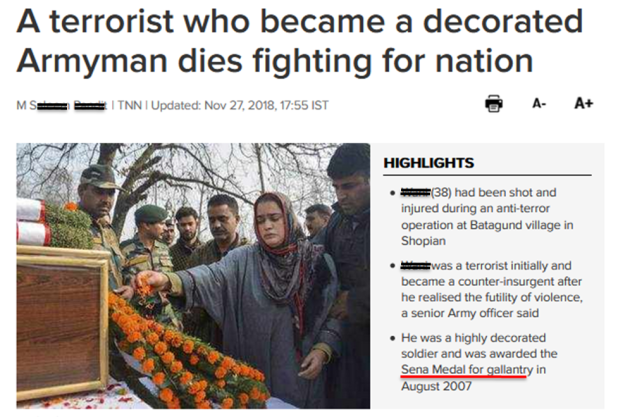
Kashmir does not have a single problem but instead has several problem threads running in parallel. This makes it extremely difficult to even find a starting point let alone reach the conclusion. Last week I got a hint for where to start from. I came across a news item that perturbed me a bit more than other disturbing news items that I come across these days:

Picture1

I struck the names out because they aren’t important (what is in the name anyways?). I had only one question while I read the complete piece and some other news articles talking the same thing from different sources:

“How was a terrorist even eligible to join Army? let alone receive an Award”

Pretty soon my internet search got me my first clue; “Ikhwan”. Turns out that Ikhwan was/is a counter insurgent group raised in 1994 (remember the year) and had Special Operations Group’s support[8]. They were ex-militants who were sidelined by some external powers (guess who).  The reports say, this helped in reducing militancy in the state. Indeed it did. They legalized a small section of militants, of course the number of incidents would reduce. Several questions pop up in my mind when I was getting acquainted with this setup that actually resembled like a Hollywood movie Sicario-2’s plot where the US authorities initiate a gang war in between two drug cartels; the only difference being that they did it in some other country and in our case some smart people did it on our own soil. Perhaps they did not consider that piece of land as their’s. Coming back to the questions, first, how was the government planning to deal with the Ikhwaen once the state was able to get rid of other militants? Or was the government hoping that the militancy would never end?

Second, did Indian Security forces and especially Indian Army earned a bad or rather a very bad reputation because of the crimes committed by a group who was not even a part of Indian Army? Indian Army and Indian Security Forces have been time and again blamed of human rights violations, how did human rights watch decide if it was the army or Ikhwaen[6]? I am pretty sure nobody would have dared to ask for ID cards to verify if the person who was committing the crime was Indian Army or some group pretending Indian Army. Indian Army is not just an army with power, but it is an army with morality. It would not commit the crimes that were pinned on it.

“Every militant killed earns the SOG Rs 35,000 to Rs 50,000, according to a police officer. Then there are the out-of-turn promotions. Hundreds of officers have risen up the ranks while hundreds of policemen have become officers in a matter of a few years, thanks to their stints in the SOG.[9]” 

So far so good, it may have been a strategy to counter militancy with a monumental collateral damage. In 1996 the government took a U-turn, it stripped Ikhwaen of all the official powers, although a lot of its member had already been and continued to be absorbed by the Special Operations Group or contested elections and joined state politics. The big question that arise now is what happened to the rest of the members? They were trained and made even more lethal. Where did they go? How were they earning their bread and butter? Were they responsible for the increase in the number of militancy related incidents? Moreover, in their two year stint they had unleashed hell in the state. What would have happened when their powers were taken away? Would the number of revenge crimes increase in such a scenario? Who was responsible for those and what were those crimes called? Militancy?

Moving on, in 2002-03 Jammu and Kashmir Peoples Democratic Party wanted to disband Special Operations Group, however, Congress was not so keen, forcing Mufti Mohammad Sayeed to mellow his tone. In fact the coalition ended up doing the worst, assimilate SOG into the state police[1]. Maybe this is when they became an inseparable part of the Indian Armed Forces. Gallantry awards are not the only award they received, some of them also received Padma Shri[6]. Is this the reason why there was an award-wapsi-gang (the people who returned their awards to prove something like their loyalties to the ones who awarded them, as they knew they did not deserve the awards)? Further, is this the reason an army personal was not listed in the national register for citizens in Assam last month? I am not saying this is the reason, I am only saying that the probability of this happening is definitely greater than 0 if is not 1.

A critical aspect of this story is still missing. Alleged blatant rigging of 1987 elections in J&K, is considered a major reason for the rise in the militancy in the state. You could easily google the parties involved. The years following was the time when ethnic cleansing in  Kashmir was carried out. Jammu Kashmir Liberation Front along with some others were held accountable for the crimes committed[7]. Now the interesting part, in the year 1994, JKLF disbanded its militant wing and adopted a “secular” stand. Does 1994 ring a bell? It was the exact same year when the elite-counter insurgency unit was formed including the ex-militants who had apparently had a change of heart (good T and bad T). Is it possible that the people who carried of Kashmiri Pandit Exodus not only receive regular salaries and pensions but also awards?  According to a 2003 report by The Hindu, nearly 350 to 500 members of Ikhwan remained on active duty with the Jammu and Kashmir Police and the Indian Army and were paid a regular stipend[3]. Appeasement politics at its very best!!!

It is true that Kashmir had problems because of partition, but the problems had clear open ends. If only the decision makers had thought it as their own, they would not have messed it up this bad. After ’90s the open ends are not there anymore, there is a web, a web of lies, a web of poor and selfish decisions. The irony of situation is that the people who spun this web are now showing their stinky teeth,  giggling at PM. Modi and his party for being able to just quarantine and not untangle the web completely in his one term.

“BJP/RSS were almost non-existent in the valley and Hindus were forcefully thrown out, who else was left to put the blame on? Indian Army, it was!”

No matter which thread I follow, I always end up finding the same entity spinning the web at the far end. Now you could decide which among the two (A. Indian National Congress or B. Bhartiya Janta Party) cannot solve the Kashmir problem?

Also readWhy Congress should lose 2019 for its own good.

References:

  1. Mufti disbands SOG, merges force with police
  2. Special Operations Group (India)
  3. India’s forgotten army
  4. The Mystery of Sopore Killings
  5. The Life and Death of a Pro-Government Militant in Kashmir
  6. Seven Renegades you must know
  7. Jammu Kashmir Liberation Front
  8. Ikhwaen
  9. https://www.rediff.com/news/2002/oct/31spec.htm