Home Blog Page 702

अभिव्यक्ति की आजादी के नाम पर सांप्रदायिकता भड़का रहे तथाकथित नेता

असदुद्दीन ओवैसी सांप्रदायिकता भड़काने के मामले में जाने जाते हैं। कई बार कार्यवाही होने के बावजूद भी अपनी आदत से बाज नहीं आते हैं। और इस बार भी उन्होंने सांप्रदायिकता भड़काने में कोई कसर नहीं छोड़ी।

असदुद्दीन ओवैसी जब हिंदू इलाकों में जाते हैं तो हिंदुओं से वोट की अपील करते हैं और कहते हैं कि उन्हें हिंदू-मुस्लिम देखकर वोट नहीं देना चाहिए बल्कि नेता देखकर वोट देना चाहिए। लेकिन जब यह मुस्लिम समुदाय के बीच में जाते हैं तो कहते हैं कि मुसलमान केवल मुसलमानों को ही वोट करें हिंदुओं को नहीं।

आज का माहौल नेताओं की दोहरी बातचीत ने ही बिगाड़ रखा है। एआईएमआईएम के प्रमुख असदुद्दीन ओवैसी महाराष्ट्र के बीड़ में कुछ मुस्लिम समुदाय के लोगों को संबोधित कर रहे थे, और भाषण के बीच में उन्होंने कहा कि मुसलमान अगर अपने अधिकारों को सुरक्षित रखना चाहते हैं तो वह केवल मुसलमानों को ही वोट करें ताकि मुसलमान राजनीतिक रूप से मजबूत हो पाए और सत्तासीन हो सके।

हम उस वक्त का इंतजार कर रहे हैं जब नेता दोहरी बातचीत करना बंद कर देंगे। यही असदुद्दीन ओवेसी हिंदुओं से मुसलमानों को हिंदू मुस्लिम देखे बिना वोट करने की बात करते हैं, और मुसलमानों से कहते हैं कि आप केवल मुसलमानों को वोट करें हिंदू गैर धर्म के हैं इसलिए उन नेताओं को वोट ना करें।

बहुत ही निंदनीय बात है।

Where Hindus have failed in the world of entertainment

0

Today, the Bollywood film industry is the largest producer of films in sheer numbers. However, it has been well understood that Bollywood has been biased against Hindus for several decades. It has consistently portrayed Hindus and Hinduism in a negative light. In the IndiaFacts article linked below, many examples have been provided of the systemic bias.

To understand the reasons behind this vicious agenda of hatred, the best bet seems to be to trace who funds the Bollywood industry. It has been long suspected that the financing behind many Bollywood blockbusters comes from notorious antisocial elements and criminals such as the Islamic terrorist, Dawood Ibrahim. Therefore, it is no real surprise that Bollywood has steadily put forth a stream of Hinduphobic films.

Where Hindus failed

Hindus have failed miserably in utilizing their own massive cultural heritage and portraying it using modern media. Though one finds the occasional classic like Chanakya on television, such series are exceedingly rare. The sad irony is that Hindus are the inheritors of perhaps the richest culture in the world in terms of history, popular stories, epic poetry, and literature. All these sources should ideally have provided Hindus the greatest source for an almost limitless series of films and television series.

As far as the potential financial viability of such films goes, the recent example of Baahubali is enough to prove the point. Based on a fictional story which draws heavily from Hindu legends, Baahubali became an international hit. This shows how a well-produced and executed film, sourced from Hindu lore, can indeed succeed wildly on the silver screen.

Dharmic source material for films and television series

For more than a thousand years, the Mahabharata, the Ramayana, and other Hindu epics have inspired many sculptures, stories and dramas in many countries of Asia such as Indonesia and Thailand.

https://twitter.com/SajithSasidhar2/status/146082797646381057

Hindus can thus draw from almost countless sources to produce an unlimited universe of novels, films and television series. Towering historical personalities such as Chandragupta Maurya, Chanakya, Maharana Pratap, Shivaji, Vidyaranya, Raja Bhoja, Ravidas, Mirabai and other luminaries can provide ample source material. Events such as the Battles of Hydaspes, Haldighat, Simhagad can be conceived as great action movies.

Many of the classic Sanskrit plays such as those by Mahakavi Kalidasa, Bhasa and others can be remade into modern dharmic classics. Many stories from the Vedas, Puranas, Mahabharata, and Ramayana can be reinterpreted in a modern way to produce entertainment series. Hindu martial arts films can incorporate traditional combat sports such as Kalaripayattu and Mallayuddha.

Film personalities such as G.V. Iyer proved to be one of the rare filmmakers who produced dharmic movies such as Adi Shankaracharya, said to be the first Sanskrit film. There should be nothing preventing today’s Hindus from following the example set by G. V. Iyer and forming a new film industry that produces modern entertainment that is rooted in universal values of dharma.


Why MEA’s Sushma Swaraj is being projected as victim not passport officer Vikas Mishra

0

Anyone who is active on Twitter in India these days must be familiar with the Passport Controversy that happened in Lucknow on 20th June. Now all the facts of the case are in public view, it is now clear that the only real victim in the case is the passport officer, Vikas Mishra, who was transferred for honestly doing his duty. But the electronic media and print media is projecting Minister of External Affairs, Sushma Swaraj as the victim. She went out of the way to help the couple get passports, for which the passport office subverted the basic laws of the Republic of India.

Now Twitter users are asking her questions on why this subversion of rules was allowed and why the investigation report is thrown into dustbin that raised serious issues on the documents presented by the couple. ‘Liberals’ and mainstream media are calling everyone questioning subversion of law a ‘troll’. Media is reporting that she is being trolled mercilessly for helping the ‘interfaith couple’ to get a passport and transferring the ‘bigoted’ officer. Even after police verification busting the fraud by the couple, the prevalent perception remains the same. The ‘liberals’ are commanding the narrative as always. Barka Dutt even wrote a piece in Washington post on how even India MEA is not impervious to online trolling and calling sane voices asking for accountability as snakes.

But the fact remains why are even sensible criticism in decent and civilized language is called ‘trolling’.  Users like Sonam Mahajan and Manak Gupta are a few examples of a vast majority of sensible people being called trolls. Why are these users clubbed together with a very few who got frustrated enough to use vile and uncivilized language against the minister for not speaking up on the real issue at hand?

But since then the focus has shifted from the primary victim Vikas Mishra to a virtual victim Sushma Swaraj. She hasn’t given a single response on the core case of passport controversy. But she tweeted, taking moral high ground, that a criticism in decent language is more effective.

But in reality she is only responding to tweets in foul language, and crying victim herself. With each passing moment, more and more people are getting frustrated and resorting to using uncivilized language in hope of getting a response because civilised once haven’t got a single response from her. Thus, in a sense, she is encouraging users to use such kind of language. In this process. she is becoming a bigger victim while the real victim is still paying the price for doing his duty honestly.

So, the question is why she is getting so much support from ‘liberals’ and so-called FOE warriors. Why is Vikas Mishra not getting this support? The answer is simple. In today’s time, it is more important to appear a victim than actually being one.  Why are such people clubbing the sane voices as ‘trolls’.

It is because ‘liberals’ are trying to preserve the culture of hypocrisy, which is under threat in this era of social media platform where anyone can be heard, not just a select few elites. Until the advent of social media, these ‘liberals’ use to peddle their skewed views as gospel truth and moral playgrounds and the general public had no platform to respond to those self-righteous “elites”.

But with a surge in usage of Twitter among ordinary citizens, these ‘liberals’ are being ridiculed for there biases and idiotic and skewed logic. When their hypocrisies are being unmasked, they are crying victims. They brand anyone against them as a member of ‘troll army’ unleashed on liberal voices by fundamental political parties. They cannot believe for a moment that their own ideas and rationale are so out of touch from reality and hypocritical that the general public is responding to it in unison.

Hence they are propagating this idea of a virtual victim, who is offended, hurt or abused. The so-called FOE warriors are writing op-eds against general public exercising their right to expression. And the case of Sushma Swaraj helps their agenda here.

There are conveniently ignoring the real question like Sushma Sawarji is, and pushing peoples buttons to get more reactions and sometimes out of frustration these reactions are not well versed and that further feeds their agenda. This cycle would continue and Sushma Swaraj would keep playing the victim, will never tweet about the real issue on passport controversy, that will further rile up people seeking justice and asking questions and ‘liberals’ would take vilest of those reactions and paint India’s image as an intolerant nation. All in all, the real victim, Vikas Mishra, will stay transferred doing his duty honestly paying the price for being born with a wrong surname.

Problems with Radical Feminism

0

No sane and educated person with a bit of common sense would say that women aren’t equal to men and they don’t deserve equality in our society. However, the tricky term in the last sentence is ‘equality’. Why is this tricky? You will get an idea in the following paragraphs.

I admit that feminism has brought a lot of positive changes in the society. It has successfully given equal rights to women in many societies around the world. Women are heard equally, if not more in media, and in judicial cases involving men and women. Many powerful women have risen out of the feminist movements. However, women empowerment is an always ongoing process and it has been happening even before the origin of the word ‘feminism’. In fact, the majority of the empowered women around the world, especially in Asian, African, South American countries, don’t even know that there exists a term such as feminism. For example, medieval India had developed many regressive practices such as Sati and child marriage (of both sexes) which were reformed and duly addressed by thinkers such as Raja Ram Mohan Roy, Ishwarchandra Vidyasagar, etc. If a society has regressive practices, thinkers of that society need to stand up to those practices and through activism, awareness and judicial framework, reforms can be and have been brought upon.

However, there is always a danger when you confine the needs of women in various societies around the world within the definition of feminism, more specifically radical feminism. This form of feminism is highly prevalent in our urban culture, movies, social, moral, speech policing and even academia (humanities).

Radical feminism is a perspective within feminism that calls for a radical reordering of society in which male supremacy is eliminated in all social and economic contexts. The justification for such strong measures is again the victimization and oppressive narrative which blames the patriarchy for seemingly unequal representation of women in the society.

Women were oppressed throughout the history by men. Due to patriarchy, women never got the opportunities to occupy higher positions. Men and women are equally capable and their outputs should be equal too. I will address this argument in the context of India. Think about your family for a moment. What percentage of its decisions (such as buying property, car, vegetables, electronics, marriages of children, etc.) are influenced by women? It is close to 83% (Women account for 85% of all consumer purchases)! Again it depends on family to family. Women have such an influence on family decision making today. Why do you think it would be any different say a 100 years ago? The structure of family in our societies have some strong, conserved, basic features.

One such feature is the influence of females on decision making of males. The influence is huge. As long a society is fairly liberal (which was the case in ancient India), has decent moral standards and isn’t oppressed or constantly attacked by other societies (medieval India), females continue to influence males on an immense scale in their decision making. Hence the quote, “Behind every successful man, there is a woman.” My question is, women influence men’s decision on such vast scales, how can one say that societal behaviours and rules of the past were exclusively determined by males with no influence or inputs from females?

How does this women’s influence on men’s decision making work? It is biologically deeply embedded in our systems. Females invite competition among males for mating and producing genetically fittest offsprings. That naturally pushes males to work hard, to fiercely compete with other males, to push for better resources, wealth, etc. What’s the role of women? Females have to present their best version to invite as many competitive males as possible. Makeups are popular because of this very reason. It enhances sexually attractive features of females. The feeling of confidence comes due to an enhancement of these sexually attractive features. For example, high heels bring changes in the stance which further highlights the sexually attractive features of women such as their breasts and hips. Height is also an attractive feature. Hence, heels overall make women sexier. Hence, they buy it as eventually that makes them feel better and confident. Something similar happens with men too. Gym going men will usually wear tight shirts, T-shirts to show off their strong hands and muscles. These are our basic biological instincts.

Many of our behaviours are derived from those basic biological instincts. This brings me to differences between males and females. Physical differences are obvious. Men are physically stronger, women are more flexible and have a higher fat percentage. Women tend to live longer. Due to such differences, large portions of physically intense tasks such as the combat, hard labourer, construction works and even trading (which involved long distance travelling) have been male-dominated. However, the most important physical task that is giving birth was exclusively women’s responsibility. And not only that but raising children after birth has largely been women’s responsibility throughout the history not only in case of humans but animals too. You might have watched, how protective female lions are of their cubs. Male lions, however, don’t seem to be as interested and involved as much as female lions in raising and giving training to their cubs.

Feminists somehow demean the task of raising children and want women to give up a good percentage of this responsibility to men in exchange for their jobs and career. That’s downright stupid. There is a reason why mothers have stronger bonds with their children. No one understands a child better than her mother, especially in the first five years. Mothers experience a surge of oxytocin during childbirth. This makes a very strong relationship with her child. This relationship comes with the responsibility of raising children, which mothers usually adore and make it their topmost priority. Replacing that with their careers and jobs isn’t an option for most women. Shifting that responsibility to fathers (who also play a part but much less) isn’t something women want or will ever do in substantial numbers. Hence they end up prioritizing their families and children while men are more willing to sacrifice their family life for their careers. Biological differences create some deep behavioural differences between the two genders.

Which brings me to the second difference between males and females: behavioural differences. Women are more agreeable than men, men are more aggressive than women. How large are these differences? Not much on an average population, say about 60-40 difference. However, when it comes to extreme cases (and extreme cases produces a chunk of output as explained by the Pareto principle), the difference is huge. For example, in a society 99 out of 100 most horrendous criminals would be males. Extreme ends of a graph are dominated by the group having, seemingly minute edge in the population on an average. Aggressive nature, however, helps men by standing up to the oppression more often than females. Men are more likely to demand higher wages, positions in a company. In the last paragraph, I discussed that men are more willing to sacrifice their family life and work harder and for longer durations. Such behavioural differences bring inequality in outcomes of males and females in the society. These are vastly due to behavioural differences.

Another example is compassion. Women are more compassionate than men. Hence they prefer compassionate jobs such as nursing, medical science. In fact, in Scandinavian societies, as they became more egalitarian, the differences in the outputs of males and females increased instead of decreasing as predicted by feminists. What happened is, when provided with equal opportunities, equal resources, an equal likelihood of getting a job; in absence of any pressure women due to their behavioural differences chose different kinds of jobs compared to men. Medical sciences, humanities, nursing jobs were dominated by women. Engineering, corporate jobs being dominated by men.
Differences in outputs of the two genders increases in egalitarian societies!


When there are so many behavioural differences in men and women which are not much significant on an average but plays a massive role in determining who reaches the top 20% positions in a field, to achieve or aim equality of outcomes in such a field is an absurd demand which isn’t well-thought off and well-researched. Such demands requiring the whole well-functioning society to change their behaviours many of which are based on our evolutionary instincts is both undesirable and impossible for both sexes.

There might be a third kind of difference between males and females which again is seemingly minute in the average population, yet can play a big role in favouring one gender at the extreme spectrum. That difference is cognitive abilities. I haven’t come across studies based on substantial data in this regard. Though I once encountered a study that discussed slightly superior abilities of men in imagining shapes, figures which amount to abstract thinking and reasoning. The gross difference in outputs of men and women in various fields suggest that there might be cognitive differences between men and women. For example, women understand emotions and body language better than men.

Men might have a slight advantage in abstract thinking and mathematical abilities. Some strong examples of gross differences in outcomes of men and women are: Men dominate physics, mathematics in academia by quite a margin. Especially the top researchers in fields of physics, maths, philosophy, logic are mostly men. There hasn’t been a single girl topper of IIT-JEE, one of the most competitive exams of India. Girls, however, top CBSE, ICSE, NEET, AIIMS and UPSC-CSE on a regular basis. Some of these exams, especially UPSC, AIIMS are equally competitive as IIT-JEE. The reason might be that IIT-JEE asks very different kinds of questions, especially in physics and mathematics sections. These questions mostly involve abstract thinking and problem-solving. Compare this to UPSC-CSE which involves a lot of answer writing, hard work and analysing current affairs, history and geography.

These exams test vastly different cognitive abilities. Another example is chess. Women chess grand-masters (GMs) are significantly weaker than men chess GMs. There hasn’t been a women chess world champion. In fact, there is currently only one woman in world’s top 100 chess players. Chess involves high levels of imagination. Some of the best chess players have learnt the chess playing skills quite naturally (the same is true for a lot of mathematicians such as Srinivasa Ramanujan). Society hardly played any significant part in the development of these extraordinary geniuses. Kids below 15 years becoming IMs, GMs are quite common. Most of these kids are again males. In the case of absolute equality of cognitive abilities of men and women, there would have been at least some women super-GMs too. The whole idea of presenting such examples was to suggest that there are differences between men and women and we are uneducated as to how deep these small differences produce differential outputs.

One should always demand equality in opportunities, justice, resources. But to demand equality of outcomes is absurd. Let the women, men of the society choose their field of play based on their own free choices. Men and women complement and cooperate with each other excellently. Their differences make this cooperation and interactions all the more fun. Which man would enjoy the company of a woman with masculine qualities? Which woman would prefer a weak man lacking masculine qualities? Not many if they only follow their natural instincts without paying any heed to nonsense ideological narratives.

Feminism and Hinduism

It was in the early months of 1986, Supreme court of India passed historic judgment for Shah Bano. It allowed her to get alimony from her estranged Husband who triple talaqed her in 1978. However, Muslim politicians mounted a campaign for the verdict’s nullification. The judgment evoked criticisms among Muslims some of whom cited Quran to show that the judgment was in conflict with Islamic law. The Indian govt headed by Rajiv Gandhi reversed the judgment under pressure from Islamic orthodoxy. What was appalling then was the support of entire liberal ecosystem towards Indian Govt and Islamic orthodoxy.

Till today none of the liberal media and intellectuals will dare to discuss that historic case but they will keep hounding Hindu women in the name of following the Indian culture and it went to such an extent that even wearing saree in the workplace was ridiculed by Left wing. But the reality is modern day Hindu kingdom existed and fought against Islam and Christianity due to the thoughts and sacrifices of women. One profound example is Jija Bai, mother of King Shivaji, who had sown seeds of freedom in young mind of Shivaji.

So to understand the animosity of the left-wing ecosystem on Hindu women let us discuss and analyze the role of women in Indic culture. Women play many roles in the society. Predominantly it can be classified into 3 categories: Women as leading Spiritual Figure, women as rulers and those performing administrative duties and finally as social reformers who fight for social justice.

Women as Goddess and Spiritual Figure:

Shaktism is the oldest form of the spiritual path in Indic Civilization in which Goddess is considered as supreme deity and every disciple is considered as a son to the goddess whose ultimate goal is to reach the mother. Shaktism dated back to the era of Vedas in which Rig Veda has verses praising the goddess.

Modern-day worship of Goddess started with the Harappan civilization where people from all places moved to Harappa and Mohenjo-Daro. The farmers there brought the culture of worshipping the Devi. Further, during Gupta period Shaktism achieved its glory with Kings belonging to Gupta dynasty patronizing and following Shaktism. It was the mother of Shivaji, the greatest King of India who influenced him from his young age to create Hindvi Swaraj against Islamic oppression.

The philosophical development of women as mother began in Vedic age. In the famous Rig Vedic hymn Devi Sukta, the Goddess unambiguously declares:

“I am the Sovereign Queen; the treasury of all treasures; the chief of all objects of worship; whose all-pervading self-manifests all gods and goddesses; whose birthplace is in the midst of the causal waters; who in breathing forth gives birth to all created worlds, and yet extends beyond them, so vast am I in greatness.”

Recent developments related to Shaktism include the emergence of Bharat Mata (Mother India), the increasing visibility of Hindu female saints and gurus. Apart from all of these most of the saints like Sri Ramakrishna, Sri Vivekananda, Sri Aurobindo worshipped this entire world as a divine representation of Mother Universe and achieved moksha by praying to the goddess.

Akka Mahadevi was a prominent figure of the Veerashaiva Bhakti movement of the 12th century Karnataka. Her Vachanas in Kannada, a form of poetry, are considered the most notable contribution to Kannada Bhakti literature. The Attukal Bhagavathy temple in Kerala is dedicated to goddess and women. It bans the visit of men during some auspicious days.

As one western commentator notes:

“Today just as 10,000 years ago, images of the Goddess are everywhere in India. You’ll find them painted on the sides of trucks, pasted to the dashboards of taxis, postered on the walls of shops. You’ll often see a color painting of the Goddess prominently displayed in Hindu homes. Usually, the picture is hung high on the wall so you have to crane your neck backward, looking up toward her feet. In India, Goddess worship is not a ‘cult,’ it’s a religion, an extraordinarily spiritually and psychologically mature tradition. Millions of people turn every day with a heartfelt yearning to the Mother of the Universe.”

The real question we need to ask is whether Islam and Christianity will accept goddess or even accept women as a leading figure in spiritual enlightenment. Remember We are living in the 21st century still left wing does not have the courage to speak or fight for the proper dignified role of women in the spiritual process of Abrahamic religions.

Women as Rulers:

In the Gupta period instances are not rare of women participating in administrative jobs. Prabhabati, the daughter of Chandra Gupta II performed administrative duties in her kingdom. Instances of women extending their phase of activities beyond the domestic circle are provided by the queen and queen regent in Kashmir, Rajasthan, Orissa, and Andhra.

Institutions were established for co-education. In the work called Amarkosh written in the Gupta era names of female teachers and professors were mentioned. They were the authors of Vedic scripts and ‘mantras‘.

Two hundred years before Alexander’s attack on India, Queen Nayanika was ruler and military commander of the Satavanhana Empire of south-central India.

In 300 BC, Princess Kumara Devi married Prince Chandragupta, and they ruled their two kingdoms as co-regents. Queen Kurmadevi of Mevad commanded her armies on the battlefield in the late twelfth century. Apart from these, there are a lot of instances in which our independence movement against British has been carried on by then women rulers of princely states like Rani Laxmi Bhai.

Islamic conquest of India started the practice of Jauhar. One profound example is killing of Raja Dahir, his wife, and daughters by Mohammed-Bin-Qasim in the 10th century, then they were sent off as sex slaves to Damascus. This type of slavery has resulted in the evolution of Jauhar in western India.

Britishers in the thirst for conquering India have taken over all the princely states who don’t have male heir using draconian Doctrine of Lapse law.

Women as Social Reformers:

India has produced so many social reformers of which notably a large section of them are Women. They have fought for social issues like any other men. In many cases, they have altered the course of our nation and influenced the opinions and even government policies.

Notably people like Savitrbhai Phule who fought for women rights for Indians during British rule. She worked along with her husband for the education of women and fought against discrimination among castes. Similarly, people like Ramabai Ranade and Sister Nivedita (born Margaret Elizabeth Noble) worked for the cause of education, medical and scientific research.

As like these social reformers, Islamism and Christianity also have produced a lot of social reformers who want to improve the livelihood of people provided if it is not antagonizing the Shariah Law and Rules laid out by Vatican’s. The harassment faced by triple talaq activists provides ample example of the how social reformers would be treated by Islamists.

So based on the above facts we can summarize the rights of women across religions as below

Hinduism Christianity Islam
Women as Spiritual Masters Women can be a presiding deity in temples Women can never become a leading deity in spiritual process Women are never allowed to become imams in mosque and conduct prayers as per Shariah Law
Women as Rulers and Performing administrative duties Women have all rights to occupy the highest throne during ancient and medieval era itself. No historical data to suggest women led any medieval era Kingdom. Introduced law to take over kingdoms in India which does not have male heirs. Women can never occupy the highest throne of the country as per Shariah law
Women as Social Reformers Women has all freedom to change the course of society Women have all freedom to change the course of society. Women have all freedom to change the course of society only if it advocates Shariah law.

See the difference of attitude among Abrahamic religions on treating Women. Due to an unholy alliance between the left and Abrahamic religions, the left wing will never criticize women rights among Christianity and Islam. But they will write journalistic articles attacking the rights of women in Hindus.

As evident from the facts, it is the responsibility of parents to educate the next generation about the rights and freedom provided by Hindu religion. Never fall prey to the so-called left-wing liberal ecosystem who have a very unholy alliance with Saudis and Vatican.

Should it not be Yogi’s choice to wear or not wear a skull cap?

As our ‘secular’ media is going berserk on the fact that Yogi refused to wear a skull cap in the Mazar of Kabir Das when it was offered by a person there. For some news channels, it was a ‘breaking news’. Many maulanas, ‘intellectuals’ and politicians of ‘secular’ parties were called by various channels to debate it. They presented various arguments to say that Yogi was ‘communal’ to not wear the skull cap.

They said that as he is the Chief Minister of the largest state of India which has around 20% Muslim population and he has hurt the sentiments of those Muslims. Some other said that he holds the constitutional position and for him, all religions should be equal. Yet others said that he hates Muslims that’s why he refused to wear the skull cap. There were other arguments as well.

Now let’s see the arguments one by one. Yes, he is the Chief Minister of Uttar Pradesh and all religions should be equal to him. Now, how is not wearing a skull cap is discriminatory to everyone? It is his personal choice whether to wear it not. As for those people who have gone berserk by saying over and over again that the ‘secularism is in danger’, there is no such Constitutional duty to wear a skull cap if offered by anyone. So, the angle of constitutional argument does not even arise.

Secondly, some said that sentiments of Muslims of Uttar Pradesh have been hurt. If we go by this argument, then we are a country of around 135 crore people and everyone’s sentiment is hurt by some way or the other every second. Someone’s sentiment is hurt by a movie based on queen Padmini. Someone’s sentiment is hurt by a book of Taslima Nasreen and Salman Rushdie, someone’s sentiment is hurt if someone else eats beef. Someone’s sentiment is hurt by a song featuring a boy and girl winking at each other. Someone’s sentiment is hurt when they see some wordings of a burger company. Someone’s sentiment is hurt by not being allowed to celebrate with firecrackers. Every day, every hour, every minute, every second someone’s sentiment is hurt.

So, should every so-called ‘hurt sentiments’ be given this much importance that it blocks the personal rights and choices of a person? Secularism does not mean that you will be forced to wear a skull cap just to keep someone’s sentiment from being hurt.

The third argument is that Modi, Yogi, and other BJP leaders do wear turbans when they visit Gurudwara so why they are refusing to wear a skull cap. Again, here the simple counter-argument is it’s their choice to wear whatever they want. Just because they wear turbans in Gurudwaras, they can’t be forced to wear a skull cap. This country and its constitution give that much of personal liberty to each and every citizen.

The fourth argument is that Yogi is communal that’s why he did not wear the skull cap. So, had he taken that skull cap, he would have been proved a ‘secular’? Are these kinds of symbolism going to define the ‘secularism’ in this country? Whoever agrees to wear a skull cap is ‘secular’ and who refuses is ‘communal’. It’s really funny and rather juvenile to take the essence of secularism to these binaries.

‘Secularism’ did not arrive in this country when Indira Gandhi as a PM introduced this word into Constitution during the emergency. If that’s the argument someone is giving then, he or she is essentially saying that our great Constitution maker Baba Saheb Ambedkar was either communal or was unaware of a word called ‘secularism’. Secularism is the essence of this country for thousands of years and this cannot be judged by one narrow incident involving CM Yogi Adityanath.

All our ‘liberals’ are so obsessed by this word ‘Secularism’ that they use it so loosely that it has become one of the most hated words by a vast proportion of the population of this country. They should understand that secularism does not mean ‘appeasement’ by wearing skullcaps and throwing Iftaar Parties. This includes RSS and BJP as well. This appeasement of one community majority or minority over a period of time only leads to hatred between the communities. This is the primary reason as to why there is so much feeling of victimhood among the majority community and when ‘liberals’ and ‘intellectuals’ and our ‘secular media raises these types of issues of CM Yogi refusing to wear a skullcap leads to more poisoning of relations between the communities as people go into a defensive mode.

So, it is my earnest request to all the ‘seculars’ that if you want to wear a skull cap, do wear it, but don’t shame a person who does not want to wear it. If you are doing that, you are further sowing seeds of hatred. This particular quote is perfectly apt to describe this incident and the people who are shouting discrimination: “When you are Accustomed to Privilege, Equality Feels Like Oppression”.

Does PM Modi have it in him to re-energise an anarchic state or will 2019 see India lapse into Nirad Chaudhuri’s state of inertia?

0

In the 1960’s I had read “Between Freedom & Anarchy,” an essay written by Nirad C. Chaudhuri, and published in the “Encounter” magazine, a literary journal published from the United Kingdom. “Encounter” began publication in 1953 with the British poet Stephen Spender and the American journalist Irving Kristol as its editors. Though pronouncedly center-right and anti-communist in its slant, the magazine attracted a large number of intellectuals who contributed a range of dazzlingly brilliant articles and literary pieces that are impossible to find in any other single publication. The “Observer” had noted, “Encounter is a magazine which constantly provides, in any given month, exactly what a great many of us would have wished to read… there is no other journal in the English-speaking world which combines political and cultural material of such consistently high quality.”

Its closure in 1991 has left a number of ardent admirers like me mourning its demise. As a student, I had collected quite a few of its issues, which got misplaced, in the course of my peripatetic life. Now, trying to recall what Nirad Chaudhuri had written, a search on the Internet yielded a link to the said article. It was published in the September 1967 issue of the magazine on pages 77 to 82. Readers can find the link to the article here: http://www.unz.org/Pub/Encounter-1967sep-00077.

I did vaguely recall that in Chaudhuri’s opinion Indian history was full of cycles of energy and inertia and that anarchy was the only system that inevitably prevailed after intervals of foreign rule. Now, after having read the article, I can fearlessly quote from it.

Chaudhuri writes the Indian people, whose extraordinary individualism in behavior is matched by an equally extraordinary collectivism in excitement and passion, create an impression of organized action when they are only driven in a herd by a shared passion. That they are generally passive does not affect their inflammability.”

Further, he opines “The force which works against the political organization in India is not any kind of motive power, but inertia, which is basically a product of the climate and arising out of the operation of that factor has become fixed in behavior and outlook. It asserts itself whenever the adventitious, political energy is spent up. Thus the conflict between the energy and the inertia gives to the political history of India alternating cycles of winding up and running down, of imperial regimes and imperial interregnums.”

The heat, the humidity and the dust of the plains contribute to this inertia that has become ingrained in our DNA. This inertia makes us disinclined to physical labor and impatient of discipline. It has affected all classes; be it the bureaucracy; industrial labor; students; or the peasantry. The political system, which is abjectly dependent on the workers for their votes, watches helplessly while productivity plummets to global lows. The noble Indian peasant, immortalized by Munshi Premchand, too has succumbed to this malaise and instead of increasing the yield of his land is content at receiving below-subsistence level handouts from the ruling dispensations, by way of frequent write-offs of farm loans.

Much has changed in the 50 years since Chaudhuri published this amazing essay. His conclusion that in the event that India goes back to its laissez-faire type of inertia and becomes an “area of low political and economic pressure” the outside world is likely to intervene as it has done in the past, is no longer a valid argument. The outside world itself has undergone a massive structural change. No matter how many cyclones are whipped up by low-pressure areas, the experiences of the coalitions-of-the-willing in Afghanistan, Iraq, and Syria should put paid to the hypothetical possibilities of imperialist interventions.

However, the 2014 General Election results in the massive mandate that Narendra Modi received from the public, has whipped up a different kind of “low political and economic pressure” in the form of a defeated Congress Party and its coalition partners, the so-called “socialists.” It also stopped the gravy train of most Media houses and NGOs that had thrived with handouts from their political masters. The external intervention sought by the likes of Mani Shankar Aiyar and Sudheendra Kulkarni from Pakistan does not amount to an imperialist intervention, but more like a Mir Jaffar defecting to Clive in order to spite Siraj-ud-Daula. Pakistan, at worst, is like an irritable mosquito that has so far been kept out by a simple net. The moment it tries to enter that net, the Indian state has the ability to crush it to a pulp.

But most of what Chaudhuri observed about Indian society still holds true. India’s administration continues to be notoriously inefficient and corrupt despite 4 years of PM Modi’s rule. Fifty years ago Chaudhuri wrote “the private citizen can no longer expect redress for any wrong from any governmental agency if he is oppressed by a local bully. The normal protection given by an administration is never available. In many places, blackmail to be allowed to live in peace has become a common practice, a form of taxation. Untraced murders are becoming increasingly frequent.” This could easily be a sentence in any current essay on the state of this nation. The police and the judicial systems have completely broken down and are heavily biased in favor of the high and the mighty. The public utility sector, still largely a government monopoly, has seen vast improvement since 2014, but the inefficiencies and corruption of 10 years of UPA rule appear to be cast in some concrete that is impervious to the wrecking balls that Modi is hurling against them.

Civil society has not yet shaken off the centuries-old apathy towards hard work and honest labor. Academic institutions are breeding grounds for certificate holders, not hard-working, and skilled individuals. Everyone is looking to break the system, be it through exam-paper leaks or by mugging up whole pages that are then regurgitated without having been absorbed. Cut-off percentages of 99 and above make a mockery of the admission process to colleges.

A majority of the engineers in India are unemployable, as the industry does not have the time and the resources to retrain these literally uneducated and unskilled graduates. The bright ones who make it to the IITs are already dreaming of a career in the West and their entire focus from the time they enter high school is on this goal. Most private institutes of higher education are captured by politicians who exact huge amounts by way of capitation fees that make mercenaries of the students who graduate from them. Education is big business and no longer a service to society. The same malaise grips almost all the other organs of Indian civil society. It is reflected in the abysmally low percentage of electoral participation among the urban voters and the tendency to press the NOTA button when a policy displeases a particular individual voter.

To break this vicious cycle that Chaudhuri has so clearly enumerated will take an enormous amount of willpower from the political leadership of the country. Does Modi have it in him to provide that? So far his record has been mixed, at best. His inner circle consists of far too many who epitomize the “laissez-faire inertia” of the post-colonial India of Chaudhuri’s essay.

His Finance Minister, a lawyer, has wasted four national budgets, and each one represents a lost opportunity at trying to break from the past. Consumer Affairs, Food, and Public Distribution continues to receive low priority and has been entrusted to a coalition minister who is politically adept at jumping loyalties and nothing more.

Does anyone have any idea about the work that this ministry has done and how it has helped the farm sector? The media continues to portray India as a dangerous place for women, minorities, journalists, anarchists-posing-as-liberals, based on nothing else but prejudicial reporting, and yet it continues to peddle these lies with impunity, as the state has refrained from calling it to account.

Modi has not been ruthless enough with both the saboteurs within his party and with the opposition. He has perhaps not fully understood what the mandate of 2014 was all about. For the first time in 30 years, the Indian electorate had given a clear parliamentary majority to a single party. The last time it happened was caused by the assassination of Indira Gandhi and not because the public was enamored of her son. His own assassination, in turn, did not even result in a win for the Congress.

So, the 2014 result was a clear disenchantment with the UPA and Manmohan Singh and not a reactive vote as 1984 was. The people want Modi to make a clean break from the past and make a completely fresh beginning. They will not mind a period of hardship if they see a decisive administration at work. It was amply demonstrated by their support for the Demonetisation policy though mostly the poor bore the brunt of the many inconveniences it caused.

Modi has lost 4 years in trying to fix the administration but has been afraid to use the full powers of his office. Tinkering like a cycle mechanic trying to fix an aircraft will only result in a huge tragedy. Narendra Modi has just about seven to eight months to repair the aircraft and to pilot it to safety. The Indian public has reposed enormous trust in him to do so, despite all the inbuilt inertia. Modi’s failure, despite all the public goodwill, will only bring to life the worst nightmare of Nirad C. Chaudhuri.

Whose fault is the Thomson Reuters Foundation survey?

0

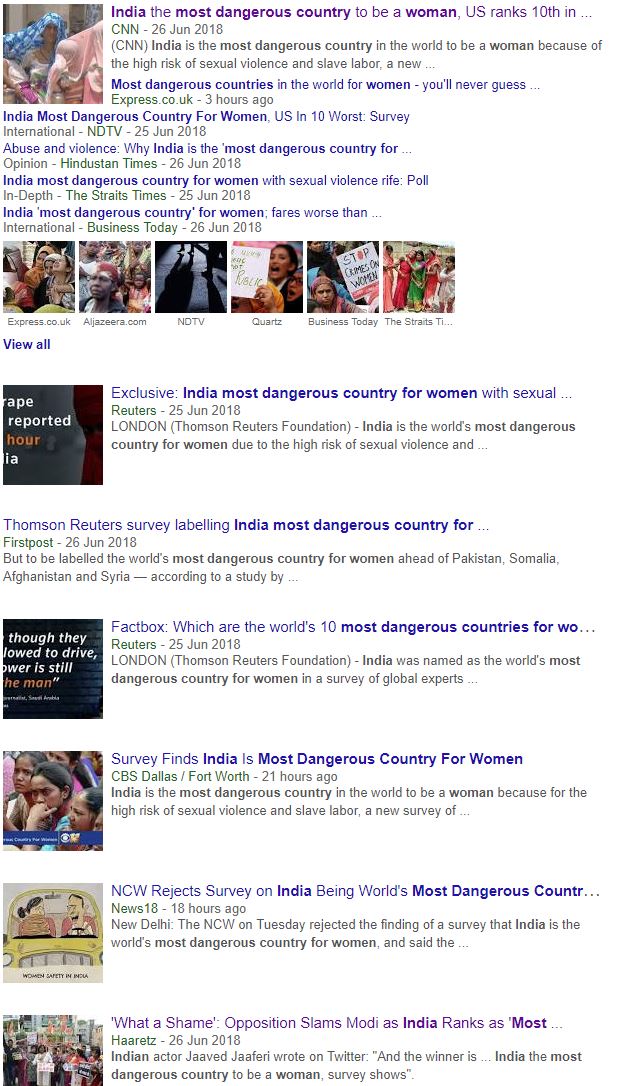
Generally, I enter ‘India’ in google search bar and select news so as to see what is happening in India. I did the same a couple of days ago, but this time I found something very upsetting and sad. Tons of different news sources were talking about some survey that declared India as the most dangerous country for women. I have quite a big monitor at my work place, and all I could see was this:

IMDFW

I was finding it difficult to digest this survey so I began digging the facts and the base for the survey. I visited the official site for the survey. I saw the ratings. Even before I would go to different factors considered that took India to first place according to the survey, I noticed something strange about the countries on the list. Except for the US and India other countries were/are either war trodden countries or under seize of groups like ISIS or Boko Haram etc.

The very first couple of  questions that came to my mind:

  1. Is a war trodden country safe for Men or anybody else for that matter? Let alone a woman. Does it make sense to include them on a list specific to women? Fix the war and the conditions would improve automatically.
  2. Can fully functional democracies like India and the US be compared with them?

There are facts, there are surveys and then there is “common sense”. 

I actually felt relieved at this point, my sadness vanished and I was pretty sure that this might be either a nicely packaged propaganda or a way to attract viewers to improve their deteriorating business. I went ahead and looked at the methodology  that was used in the survey.

They had asked some 700 representatives from 193 UN nations for their opinions on five different parameters, out of which 580 responded.  It was a perception survey and had nothing to do with the facts. Now, it made more sense. Unfortunately, the so-called news sources did not tell that. The representatives were supposed to give a list of five countries and rate them on a scale of one to five for each parameter. They claimed on their site that the survey is supported by data analysts, statisticians and so on. Even if we assume that all 580 were Indians (which is not the case) and they lived their entire life in India and covered every city, can this number be a genuine representation of 1.35 plus billion people? If it can, then, I (sample size of 1) can comfortably say that 90 members staff of Thomson Reuters Foundation are ignorant to the principles of statistics. So, even a perception survey should have a reasonable number of samples, unless they were in a hurry to make money and get webpage visitors from all over the world.

In the meanwhile, I saw a lot of people rejecting and refuting the survey, questioning and blaming Thomson Reuters Foundation for denigrating the country. This time somehow they risked being called “sanghis” or Right Wings or “Bhakts” or “protectors of rapists” and said what they wanted to say. Just a thought! If this kind of survey was released by somebody or some news channel in India what would have happened? Would anybody who had said anything be called different names? Nevertheless, why are people blaming Thomson Reuters Foundation? Is Thomson Reuters Foundation actually to be blamed? Is it only their fault?

They are not the only one responsible.

Instead of blaming them shouldn’t we be asking ourselves, how was this kind of perception created in the first place? They did not create the perception. But somebody sure did. I think we are forgetting them:


The crime happened, and what is the status now? I think none of these guys tweeted or posted anywhere that they might have actually made a mistake. People like these created the perception. They should be held accountable and not the survey. If people go ahead and wear those kinds of t-shirts at Istanbul Airport, it will be seen by the outside world. The world is not blind, it has access to Twitter and Facebook as well (if these people are unaware of this). No wonder,  many of the high-end travellers in Europe don’t even consider India as a travel destination. I have met so many Europeans who have Bhutan in their wish-list but not India.

“Bollywood is doing more damage to the nation than Indian National Congress”

This is typical “Indianism“, fighting with the consequences and forgetting the actions. Indians themselves have built this kind of perception. Different people who participated in this had their individual motives. Some wanted screen time, some wanted to get popularity, some wanted something else. The survey clearly mentioned that the social media movement #metoo had an impact on the perception of the USA. I don’t know what actually is happening in the US, who is doing what, but I can certainly say that most of the media houses are against Donald Trump and in the process, they end up denigrating their nation. The situation is quite similar in India too, the opposition parties have no sensible plan and issues to attack the ruling government and so they make up issues like #justiceforasifa. Please have a look at the article by me a few weeks ago “Misconstrued Opposition“.

“Democracy without education is like hypocrisy without limitation”

The sample size is not the only problem with the survey, going further in the methodology I found some of the parameters they included were helping their narrative but not the actual women issues. They included parameters like Healthcare as in the availability and accessibility of healthcare facility, Discrimination as in the access to economic resources. These are gender neutral issues and are due to poverty and not because they are specifically directed towards women. I don’t think a rich (not poor) person, irrespective of the gender would have those problems. Including these parameters actually divert people from the core issues, simply because these issues bring different issues with them.

Culture and Tradition is a parameter in the survey which actually affects women. But the survey did not provide any kind of details as to which traditions affected India’s rating? They should have given the exact culture/tradition because of which women are suppressed if they wanted to make any kind of change which they claim they want to. India has a variety of religions, traditions and cultures; all are not bad and if such a parameter is included it is more than important not to generalize but mention specifics. Genital Mutilation & stoning are specific to a particular community, the survey did not mention which. Why? Were they afraid of somebody?  Is lack of a uniform civil code affecting this parameter for India? Also, the survey mentioned acid attack in this parameter. Seriously? Shouldn’t it be a part of non-sexual violence parameter?

Two parameters  that largely affect women are Sexual Violence and Human Trafficking. Since the sexual violence is mentioned in the survey I would like to bring in some actual facts. According to statistics, the number of women being rape victims per 100,000 population is 1.8 which is way less than any other country you would think of. Some highlights from the stats (per 100,000) : Sweden-63, Australia-28.6, USA-27.3 and so on.  By no means, I intend to imply that we don’t have to work on this anymore. There are many changes we have to bring but India is definitely not even close to being the most dangerous for women.

Even though there are a countless number of laws protecting women rights, still rights are violated. Why? Shouldn’t there be surveys like the number of women filed complains, how many of them were genuine, how many of them got justice and in how much time? The time frame is very important, it is not a hobby that should be pursued for years. Long trials keep the wounds alive and do not let victims live their life.

The very first step towards fixing any problem is to identify, accept and acknowledge the problem. How would you feel if you visit a doctor and he starts treating your pain without even asking where exactly do you feel the pain?  I don’t see anybody protesting for improvement in the judicial system in India. There are more than  133,000 rape cases pending. This is the core issue for crimes not being controlled. Fixing the root cause which is “delayed justice” will automatically eliminate the need for themes like “Ma ruhlz ma life” , “don’t tell me what to wear”. They are useless reasons to fight, we have been doing this for years and even if we continue doing this for the next century nothing is going to change.

“It doesn’t help fighting dizziness after taking sedatives”

Further, by singling out cases like the Kathua case or any other case for that matter, the feminists today at least in India are losing their credibility. People have stopped supporting them because they don’t know what is going at the backstage. It clearly looks that they are acting at somebodies behest.  I have never seen twitter trending hashtags and feminists or any other activist groups organizing large-scale protests for sex workers in India. Organized Prostitution is illegal in India, but still, everybody knows it is there. Why?  Shouldn’t the workers and their kids be treated well? aren’t they women? Can legalizing it reduce human trafficking and HIV/AIDS. But since they do not form a large vote bank, their issues do not qualify for protests.

Every system has its flaws, so does our judicial system. The issues have been swept under the rug for quite long. Please have a look at one of my articles here. Democratic rights could be used to fix them, protests are not only to bring the nation down, get the reservation, ban or release movies. Please have a look at the article by me on the impact of current protests here. They can actually be helpful in fixing some issues which remain unfixed because of India’s Politics.

We cannot simply run away from these issues, because they are not just women issues, they affect the entire family and the entire society. You cannot expect a civilized society without educated and free women. Look around the world, the cultures, the societies which suppress women get messed up real big. If a mother is unhealthy, the baby will never be healthy. If she is uneducated, has not developed a thinking ability, sending the kid to whichever high school or university would be useless. He would turn up into what we call “padha likha jahil” (an educated illiterate). Kids are the future, their thoughts and actions would define the future. The ones who are not nurtured properly, generally grow up to become full-time criminals.


How the heinous Mandsaur rape case communalised

0
Talking about a very sensitive issue, a heinous crime committed, which has been brought down to an issue pertaining to religion just for the sake of getting the support of one community.
A 7-year-old (HINDU) girl raped by a man named Irfan (MUSLIM) in Mandsaur, Madhya Pradesh. You must be thinking why I mentioned their religion in capital letters because this is how liberals fight for rape.
This is how they choose for whom they need to raise voice and for whom they shouldn’t. Yes, they constantly try and demean Hinduism. They take only those cases where Muslim is a victim and Hindu is at fault but what about Hindu girls. Are they safe?
Any girl belonging to any community needs protection. Irrespective of their caste, creed, and color, they need to get justice but our Bollywood people won’t understand this. Liberals and Bollywood come out with selective outrage. They come with placard only when it’s beneficial to them and not to the society.
Today our very own Mr. Scindia from Congress party, who belongs to Madhya Pradesh but has zero knowledge about that place gave his statement to ANI :
It took a lot of time to lodge an FIR in the rape case of a 8-year-old girl in Mandsaur. Even today the investigation is not going in the right direction. We demand a CBI inquiry in the case. Women in my state don’t feel safe: Jyotiraditya Scindia, Congress  #MadhyaPradesh 
Now here are some points to be noted :
  • The girl was raped on 26th June,18
  • Accused was arrested on 27th June,18
  • CM calls for capital punishment on 29th June,18
But this statement of Mr. Scindia is given on 30th June,18. What was he doing from last 4 days? Where was he?
The case is already in the fast track court and accused are already taken in custody. And as per laws in Madhya Pradesh, death penalty to be given to the criminals who rape a child under 12 years of age. So what Mr. Scindia is talking about?
Now keen point to be noted, the whole matter will be politicized by liberals as elections are to be held after 6 months in Madhya Pradesh and it’s the Bhartiya Janta Party(BJP) ruling state with Shivraj Singh Chauhan (Mama) as the Chief Minister holding his grip from last 12 years.
So now to get back into power, Congress and liberals are trying their best to politicize every little topic. They are just trying to increase their vote bank but aren’t focusing on how to get rid of such sick mentality people and making India a clean place for every child.
Their focus and agenda is quite clear, all they are focusing on bringing Congress back to power by communalizing every issue.
All you need to know is that the little girl will get justice and criminals will get the punishment they deserve.

60% chance for a Congress Sarkar in Jammu and Kashmir? Hope not.

0

BJP won Tripura and formed coalition Governments in Meghalaya and Nagaland. The last two are overwhelmingly Christian. (This map is slightly truncated in the south, sorry).

Jo jeeta wahi Sikandar- Congress the Sikandar of Karnataka 2018 elections. Karnataka loss was an unmistakable political slap on the faces of Modi and Shah. No doubt Congress has the upper hand here. All those Cong-JDS coalition bickering’s are just background noises meant to fool BJP supporters and force BJP to commit an unplanned blunder.

Jo jeeta wahi Sikandar! The winner keeps it all! It is Congress and its coalition that runs the Karnataka Government and hence the clear winner.

Congress + 1 Modi/Shah 0

Modi lost Andhra and failed to win Karnataka! Haar ki jeet:– Modi gained Jammu and Kashmir by gutting his own coalition government. By gutting the PDP-BJP alliance in Jammu and Kashmir, Modi can directly govern Srinagar through his trusted lieutenants and aides. He never had this luxury when BJP was a meek partner in the PDP-BJP coalition. Worse, PDP-BJP alliance was extremely inimical to BJP’s support base in Jammu and Ladakh. In the 2014 Lok Sabha polls BJP’s Thupstan Chhewang won the Ladakh parliamentary seat by less than 50 votes! Just imagine the situation if the PDP-BJP coalition persists.

Congress + 0 Modi/Shah 1

Jammu and Kashmir’s affect on the national discourse:

Almost every Modi supporter was ecstatic when BJP withdrew its support to PDP forcing Mehbooba Mufti to quit as Jammu and Kashmir CM. Every Congress and UPA supporter was sad. Even though their reactions were diametrically opposite, both Modi supporters and opponents had almost similar reasons for their divergent reactions:

  • Modi will tackle terror with an iron fist, results may not be visible overnight but a positive pattern will be found.
  • Hurriyat Conference and all other sundry anti-India Islamist groups in Jammu and Kashmir will lose their “covert support” from a friendly Srinagar government.
  • Modi will try to give Indian and J&K armed forces a freer hand to tackle terror.
  • Modi will try to reduce the injustices meted out to Jammu, Kargil and Ladakh.
  • Modi will try to tackle Rohingya and Uyghur settlement issue in Jammu. This is one of the most sinister moves of Congress Sarkar against Hindus in general and India in particular. What are the chances that, when Rohingyas eventually become Indian Citizens, they will vote for India in an hypothetical plebiscite? Oh Congress! How cruelly you harm India with your crazy lust for minority votes! You even import them from foreign conflict zones and put them in one of the most sensitive regions of India.
  • Modi will stabilize J&K. He is rapidly building a team of experienced security personnel from across the nation. All the best PM Modi in this holy patriotic endeavor to stabilize J&K.

Congress + 0 Modi/Shah 6

Why will Congress form a government in Jammu and Kashmir:

J&K assembly elections in 2014 threw an hung assembly. In a house of 87, the magic figure is 44. The main players of the state have the following strength:

PDP 28 MLAs
BJP 25 MLAs
National Conference (JKNC) 15 MLAs
Congress 12 MLAs
7 MLAs of smaller parties which include Independents.

There are three options for Congress to reach the magic figure of 44 to form a non-BJP government :-

PDP(28)+Congress(12) with JKNC(15) giving outside support= 55
PDP(28)+Congress(12) + JKNC(15) = 55
PDP(28)+Congress(12) with 4 MLA’s from Independent and smaller parties= 44
What are the clues that this can happen?

On the very day of Mehbooba’s resignation, many Congress Chamchas like Ramchandra Guha openly called for a BJP free Mahaghatbhandan in J&K.

After the Karnataka election, Kumaraswamy left for Singapore on an hitherto undeclared visit. Later on he formed a coalition with Sonia’s Congress, against whom he had just fought a bitter election campaign. Currently Rahul and Sonia are out of India, with Rahul being in London as per some reports. London is an known base of many Kashmiri bigwigs including the Abdullah’s who control JKNC.

Do not believe something till it is officially denied. Since overtly no body in PDP, Congress and JKNC wants to form a coalition government together, can we assume that they are covertly trying to do so? The Hindu (which appears to pray for the eternal reign of Congress in almost all its news items) has a banner headline saying that BJP is trying to form a immoral government in J&K. Politically its always prudent to make a big noise about something, when you want to do the exact opposite.

There are many reasons why Congress may try to form a government before the 2019 polls. Namely:

  • To break the narrative that Modi/Shah has won J&K. To insult them and prove that they are even more weaker after the loss of Karnataka and defeats in by-elections.
  • To create the narrative that Sonia’s designated heir Rahul is a political genius, who can club a coalition even with such rivals like JKNC and PDP.
  • To assure the Jammu and Kashmir separatist groups such as Hurriyat Conference and their handlers across the border that they can tango with Congress.
  • To assure the Big Business in Mumbai that Sonia still has the killer instinct of 2004, when she clubbed an impossible UPA coalition with a mere 145 Lok Sabha seats. She smoothly ran this coalition for 5 long years. Such was the pathetic leadership of the opposition BJP leaders from the “gang of 160” , that Sonia won an even greater victory in 2009, in spite of Mumbai terror attacks and an global economic meltdown.
  • By controlling Jammu and Kashmir Congress can create as much trouble(like daily protests, fake polls, improper security narratives) for Modi as it wants. This can greatly erode the confidence of the floating Middle voters whose support Modi needs to sweep the Urban areas again. Please note Modi had swept almost all the urban areas in 2014, except those in the eastern Coromondal Coast and Kerala.
  • Congress has set its eyes on the BJP/NDA coalitions and quasi-coalitions in other states such as Goa, Meghalaya, Arunachal Pradesh, Manipur, Assam and Maharashtra. I will also include Gujarat and Tamil Nadu, where BJP has a friendly government, as both state governments have wafer thin majorities. (many BJP MLA’s are turncoats from other parties including Congress) Just imagine the narrative, BJP governments falling one after another in state after state. What a great blow this will be for the morale of BJP supporters and what a morale booster it will be to all those anti Modi forces that never want to see India developed?
  • To keep assuring radical, yet politically powerful minority groups across India(and world) that Congress is working tirelessly to insult and defeat Modi. This narrative is already helping Congress in a big way. Recently BJP lost its traditional Jayanagar seat in Bangalore, because 90% of minorities in a single ward voted Congress, thereby ensuring its victory by a slender margin.This loss was in spite of the great work done by BJP’s recently departed MLA, who was appreciated by one and all. We also saw how BJP lost the Kairana by election , when more than 95% of Minorities voted anti-BJP. Even in the coming 2019 elections, rest assured more than 95% of minorities will vote anti-BJP. Yet Congress will keep the pot boiling by controlling the J&K narrative , thereby ensuring that that minorities turn up in big numbers for it on the polling day.

Hope Congress never gains Jammu and Kashmir.
Congress + 7 Modi/Shah 0

Due to all these reasons Congress might try to form a government in J&K and even in other states.The author is not insinuating anything here just mentioning patterns and probable scenarios. Pray Modi and his team are successful in averting such sinister designs. Since as per Congress, Left and all those dynastic castist parties only minorities matter in India, let us all genuinely pray to the God of Abraham.

O God of Abraham! Please have mercy on India and prevent this travesty of Congress on the good,smart hardworking, erudite yet humble folks of India.

O God of Abraham! Please protect India from Congress’s evil machinations and give more power to Modi /Shah and all those who support them.

O God of Abraham! We know you will hear the prayers of Modi supporters, as you would want a developed,powerful and peaceful India.

O God of Abraham! We remember that way back in March you gave Modi, Meghalaya and Nagaland and now you give him Jammu and Kashmir!

Amen!