Home Blog Page 303

RUDRAM- India’s first Indigenous anti-radiation missile

0

The Rudram-1 previously known as DRDO Anti-Radiation missile (ARM) is an air-to-surface, new generation anti-radiation missile (NGARM) under development by the Defence Research and Development Organisation (DRDO) to provide an air superiority, tactical capability for the Indian Air Force (IAF) fighter aircraft.

New generation Anti Radiation Missile (RUDRAM) was successfully flight tested on 9 October 2020 – onto a radiation target located on Wheeler Island off the coast of Odisha.

  • The RUDRAM is first indigenous anti-radiation missile of the country for Indian Air Force (IAF), being developed by Defence Research and Development Organisation (DRDO).
  • The missile is integrated on SU-30 Mk1 fighter aircraft as the launch platform, having capability of varying ranges based on launch conditions.
  • It has INS-GPS navigation with Passive Homing Head for the final attack. (Passive Homing Head can detect, classify and engage targets over a wide band of frequencies as programmed.)
  • The RUDRAM hit the radiation target with pinpoint accuracy.
Significance of RUDRAM

This state-of-the-art high speed missile developed in India is first-of-its-kind in the IAF arsenal. The missile will be jointly produced by Bharat Dynamics Limited (BDL) and Bharat Electronics Limited (BEL).

  • The missile is a potent weapon for Indian air Force for Suppression of Enemy Air Defence effectively from large standoff ranges.
  • With this, the country has established indigenous capability to develop long range air launched anti-radiation missiles for neutralising enemy Radars, communication sites and other RF emitting targets.
  • It is designed primarily for suppression of enemy air defenses (SEAD), that can be launched from a range of altitudes for destroying enemy surveillance radars, tracking and communication systems. 

Reference:-

RUDRAM First Indigenous Anti-Radiation Missile

Slow moving coup of LOUDSPEAKERS

It’s a casual morning, you decide to wake up, and start exercising, you have heard roosters screaming at sunrise, but you had to wake up at 5. You had a bad sleep, from working hard, because your wife and children deserve a good life, and you, a healthy one. You are sleeping a good night sleep, and suddenly, sannate ko cheerti hui sansani, you hear the same call, that most victims of secular terrorism hear in their last moments, only louder. But it’s louder than you expected, you have heard it before, it’s not new. But certainly louder. The building you went past daily, wasn’t a shop, or factory. It was a temple of secularism. And boy, it did complete in time. Now what was 5 kilometer away, is next door. This slow moving coup to dominate you at your very home, 5 times a day reached it’s conclusion. Enjoy your stay. Or fight them, one day, it’s enough to light you up, your child has to study, and you have to work, company’s general meeting is coming up.

Due to exams all temples have decided to take it slow. All but one, so finally you decide to man up a little, and confront the police. Only to find out, police has lost the faith in system before you are going to. “It is what it is”, says the guy in khaki, who wanted to bring revolution during his interview of hawaldar. Yet you decide to go ballistic, and report a nuisance. Before you can get out, 5 men come in and tell you to shove the report, and loudspeakers will now be blown at more volume. Police does it’s duty and looks down, does nothing, ignoring the thing. You get back your house, head down, sleeves down, red eyes, swollen, LUCKILY. You just escaped certain death. You were lucky that you didn’t go to secular temple directly, or God knows, you would have actually met Him/Her in person.

This is not the story off the top of my head, something akin to this happened in Maharashtra. When a troubled lady, Karishma, asked to lower the volume, she was met by unimaginable force, of Uddhav government. Yes the same guy who hindus believed would listen to them. She was threatened publicly by congress leader to leave her residence, live somewhere else, but the volume won’t go down. What if it was a temple? What if it was a muslim who reported it? What if he / she got threats? By the way none of the liberal reporters, writers, film guys, have uttered a word. As if their mouth have been sealed by the ginormous halaal male chicken that they are eating mouthful. But they are expected to do so. What is bothering, is that she had been living there for quite some time, she didn’t complain, may be it was only that day when she realised that she actually could speaks against this practice of full volume scream.

She probably didn’t know that you could criticise Islam and live to see another day. She knows it now. She won’t. It was a lucky day, her house didn’t burn down and God knows if she lives there anymore or not. But I would say, this girl got balls of purest form of stainless steel there is in entire Maharashtra. A void left after Balasaheb death.people living there, none of the so called men ever spoke about it, forget them, BJP leaders disowned the girl. No one was in her support, except the Right wing twitter and Facebook. I can see the headlines if it were the other way round, “Muslims can’t live in peace” “how did people read ramayan without loudspeaker” “are they important” media, literati, lutyens, liberals from round the world, condemning the speaker’s for Ganesh Chaturthi.

After this girl showed nerves of steel, BJP was the first party from Indic side to throw her right under the bus. Shiv sena came next. But what was deafening the silence of media in 2 days. Yes, that’s how long it took to die down. A girl was threatened by a public figure Abu, thrashed by a community, riots were there tend to a state, and the so called clans of shivaji and sambhaji, they bent over. This is Maharashtra. The land of warriors, who gave us, akhand bharat, hindu state, Balasaheb Thackeray ji, RSS. It’s now in complete control of seculars. Where if you complain against seculars, you will have to leave, because that’s how manliness works here!

Scream at someone is easiest way to assert dominance, it seems to scientist. Research shows it works. Won’t win debate but certainly have effect on opponent. Two people screaming at two other people you know who is at bigger post. Research was done on rhesus, chimps, same result. You involved in fist fight, you scream to assert fear in opponent it works. It is supposed to. Now think of a group scream incessantly at the silent one. That’s loudspeaker prayer call. After some time, you will get used to this slavery, forget about having male hormones, you will have to forfeit your house if the screamers knock at your door. Just ask Bengaluru congress MLA. It’s a slow moving coup. And you can do nothing about it. May be with the exception of asking your BJP MLA about it. We all know their answer. But that’s it. It’s over. You lost.

Take a trip to UP, it’s no different. Except it has pure BJP government with 3/4th majority, Hindu Sanyasi as chief minister, who got votes on promise of getting rid of these things, loudspeakers and Muslim appeasement. He himself is bound by law to not infringe people rights, other wise court will punish him. But but but….Here is a catch, high court of UP , Allahabad high court (yes it’s not Prayagraj still) said, loud speakers are not an integral part of secular religion. And loud speaker could be removed without any hurdle from legal side. Now any person with common sense would guess what would hindu sanyasi chief minister do. Yes guys, he did exactly that. He bent over so as to ignore the order completely, so did RSS, VHP, BAJRANGIs. I went to police station to complain about it, they advised me to go back, and tener talk about it. So obviously, I have been talking about it ever since. I don’t have balls of steel, but certainly have normal ones. So far only Ajeet Bharti has responded to me in a live stream when I posed the question. Otherwise silence. Fear of repercussions. If it will not be done in BJP led government, it can only be done in a Islamic republic of India. Since it’s banned in most Islamic countries.

I think this is something that will unite most of the Hindus, for a short enough period. To have more topics to be united on. We can’t divide when we have less, we need to unite to get more and then divide it among ourselves. We need a solution to this dominance. No not the safe word. Solution. Economy comes to mind. Stop buying the Mlechhas product, it worked the last time, it sure will work this time. I have plans, I called for help, when I was alone in the police station. They sent me home for my own safety. Loudspeaker screamers won. We lost. It’s 1-0.

How I was saved from Love Jihad

0

On the 25th of September, I read the bone-chilling news of Priya, a 23-year-old girl who was beheaded by her husband Ejaz Ahmed and his friend Shoaib Akhtar for not converting to Islam after she married the Muslim man against her family’s wishes. Unfortunately, this ghastly incident got minuscule media attention.

The menace of love jihad has been ever-growing and this bloodcurdling news compelled me to share my own close brush with Islam through a romantic involvement. I hope young girls and parents who read this can protect themselves and their girls from falling prey to brutalities of Islam in the name of love. 

My story*

I was in my mid-20’s when Junaid came like a breath of fresh air in my life. Having had a failed relationship that was verbally and physically abusive in nature, here came this robust beautiful man who swept me off my feet with his Lucknowi tehzeeb. Though outwardly I seemed like a “free bird” who enjoyed a few beers at parties and was already financially independent, the low self-esteem that landed me in abusive patterns of the past was the dark secret of my superficially feminist and liberal urban living.

Junaid saw the vulnerability in my eyes and within a few months, we became quite intimate. Almost a year passed and soon we were officially dating. He did not drink and the influence of a good company is always good. I too put an end to my social drinking. 

Since he was older than me, our conversations often landed upon the topic of marriage. Mid-20s was still not ripe enough for marriage in the background I belonged to, however, I could consider it. Unlike my ex, Junaid spoke of family values, taking care of parents, and the beauty of living together in a joint family. I often secretly imagined myself cooking biriyani for the big joint family. His rootedness in his culture was impressive and his respect for elders made me think how much he would take care of me if we were ever together permanently.

Now my family knew about him. Though they resisted initially, I vocalized the secular values I had grown up with to justify my love affair. I knew as long as there is no “conversion” drama (which I least expected), all will be well.

Junaid started talking about the importance of sharing common values in a family and how I must start exploring Islam. I revolted at the idea but he said, “Jaan, I am not asking you to convert… just have an open mind and freely explore. If you don’t like it… we will see…”. I melted with his tender words and began to actively clarify the doubts and terrible things I had heard about Islam.

One of the things that I had heard that one is allowed to hit one’s wife in a certain way. Junaid explained that it is only natural for a man to get violent sometimes in anger and I must know that better – owing to the abuse I had suffered from Suresh. Islam considers such situations and hence, gives guidelines. The husband, apparently, is not allowed to punch in the stomach, as Suresh did to me, and neither can he hit on your face. Plus, there are only exceptional situations where hitting is allowed. My pitiable state of mind and experience made me feel this is some big “concession”.

I started covering my head often since it made Junaid smile. I also gave away many of my “sexy” dresses and mentally started preparing myself for a future adjustment that may need to be done. Junaid and I enjoyed some short travels too. His broadminded ways and care only made me more comfortable with the idea of a lifelong commitment.

I asked him about his views regarding a burqa. He questioned me back on this asking me what the issue was with a traditional “outfit”.

I was taken aback and retorted, “Who would like to be in a black tent in hot Delhi summers? What’s the grand idea?” 

Junaid changed the topic knowing this was not the right time to discuss this.

One winter afternoon, as we both were enjoying hot jalebis in the narrow streets of old Delhi, some passing youth made a cheap remark at me. Junaid was just short of getting into a fistfight and, infuriated, we left the area. The iron was hot now and a few hours after the incident he explained to me the importance of a burqa.

First, since no one can see you (and why show off your body anyway?) there are fewer chances of anyone teasing you, and second, if you are teased or commented upon while wearing a hijab or a burqa – all the Muslims in the region would protect you instantly and punish the culprits themselves. Unlike Hindus, we don’t tease our women and Muslims would become one to defend any of their girls who would be looked at badly.

Despite having good finances, Junaid and his family stayed in a crowded Muslim ghetto-like area. He explained they enjoyed the community living and the brotherhood with Muslims who came from all over the world and that their women would also be safe (in burqas or hijabs, naturally!).

“You expect me to wear a burqa?”, I asked nervously.

“Only when you are out on your own. When with me, you can wear a hijab. I want you to be safe and anyway, why to flaunt your beauty for others when it is meant just for my eyes,” he softly whispered.

I sighed, having nothing to say. I never wanted to see him get into a fight to protect me.

The idea of Islam sounded better than what I had imagined it to be. Winters were approaching and it was time for the cultural festivals to start. I excitedly got us passes to attend a Sufi music concert. To my utter bewilderment, Junaid was not too pleased about this. He told me that Sufi stuff was responsible for destroying Islam. Back in the early 2000s, he explained how the Tablighi Jamaat is trying hard to bring back Muslims to pure Islam, unadulterated by Sufi and Indian influences. He followed the middle-east calendar for Eid.

I was put off but then I also felt I am being unnecessarily judgmental since I had not studied the Quran. Must be something that I didn’t know. I too did not go for the Sufi event which was attended by other friends too. As our bond grew, my social life began to fade away.

During this period, Junaid spoke to me about meeting a trusted knowledgeable maulvi to discuss my doubts. I felt anxious and with some excuse or the other, I would postpone this meeting. At this crucial point, there was a havan in the house. Junaid was around all throughout helping us with the serving of tea, etc, like family. 

However, something absurd happened. He refused to eat the prasad after the havan and did not allow tikka to be put on him. My mother noticed and glared at me. I understood her communication and was guarded instantly. I ate beef curry made by his mother, I stopped eating pork, beer parties were over, and I covered my head mostly and deep inside, I knew I may even convert for the sake of our love.

He could not eat even prasad offered after a havan at my place?

This havan ended up being my kavach. The next week was a drag of a breakup. My blindfold of emotions was removed. Some inner strength that I was unaware of, came gushing from within and granted instant clarity. I was also shocked at my own bold step but felt liberated.

The one-and-a-half-year-old romance was over in the name of religion. Junaid broke down and cried loudly like a child. He told me how much he wanted me to go to jannat. He could not see me suffer as a kaafir and wanted to help me, save me from the doomed Hindu life. If only I could marry him and embrace Islam. Alas! All his silent wishes came tumbling out in heat of emotions. In the name of “love” he wanted us both to be saved after our death and go to this place called jannat for eternal pleasure, from the very beginning.

Reflection and learnings

Sometimes I wonder, had it not been for the havan incident, would I have converted? Probably not. My uncompromising love for freedom was very strong, though bottled up for years first with the abusive relationship and then my march towards Junaid’s golden cage of love.

Freedom had been the indispensable value that I was brought up with. The havan gave the perfect opportunity to bring out my actual “free spirit”.

The haze that clouded my intellect, cleared. Now I could see the gradual pinching away of my freedom, from the very inception of my relationship with Junaid –

1.     I got into the relationship without healing from past abuse. I was vulnerable and needy. Could a commitment that is born from such a space be healthy?

2.     On the point of hitting your partner, as discussed with Junaid – I wonder what such “exceptional” situations would be that justify some sort of hitting that is sanctioned by Islam. How is having guidelines on beating a woman, superior to having no instructions on this topic, in other religions? Hitting is just wrong!

3.     Would I listen to my mother if she asked me to wear only a salwar kameez and give up jeans, dresses, etc.? How was I okay with a burqa and hijab being imposed on me? Does this not take away my personal freedom of what to wear? And, is this a solution to eve-teasing!? How different is this from implying that a girl asked for rape by the way she was dressed?

4.     Further, how can I be okay with a community that protects girls only of their own community? Was I okay with such double standard? Where was my feminism and secularism?

5.     And, for us, Hindus – without taking law in our own hands (like Junaid claimed they do), can we not be protective towards women? Where are the real men, the kashtriyas? Are they dead?

6.     If the Muslim sect Junaid belonged to is intolerant to even Sufi music, would I ever be able to enjoy music or visit a temple if I so wished? Certainly not. Is that freedom by any degree?

7.     Respect is a mutual thing. If Junaid could not honor the religion I belonged to, by wanting me to convert – did he genuinely respect me?

8.     He had known his intention from the very start but he waited for further emotional attachment, so I would willingly convert. How come he never mentioned this necessity in the very start?

9.     Last but not the least, I woke up to the fact that I need to appreciate and be eternally grateful to my liberal Hindu upbringing that encourages searching your own answers and finding your own path. A culture that does not impose fixed ways that snatch away personal choices in any aspect of life. At times we don’t value the freedom we have until it is taken away.

This break up marked the turning point in my life. I transformed into a resilient, confident woman who had the ability to act from a space of strength. Yes, it was an effort but we all have to put in our best into living life to our true potential.

Superficial feminism, low self-esteem, misguided secularism, and lack of gratitude and lack of recognizing the immense blessings of our own Hindu culture are some aspects that make our women vulnerable and fall for love jihad.

An appeal

Let the rampant love jihad we see today, and the sacrifice made by the 23-year-old non-compromising Priya Soni – who refused to convert to Islam, teach each one of us a good lesson. 

We all must make ourselves aware of the rhetoric, indoctrinated and fanatic ways of Islam as well, as much as we indulge in the beauty of Sufi thought. Negationism or thinking that we “the educated, secular and liberal”, are immune to such incidents would be naive.

May our girls be brought up like Durga so that they understand their true feminine power and are rooted in themselves with values of freedom and wisdom, instilled from the very start. Even if they fall, they will be saved in the time of crisis by these seeds (samskars) planted by parents in childhood.

This is what saved me from love jihad when nothing else could – the hidden inner Shakti emerged from my samskars and came to my rescue at the right time.

*Names changed and portions of narration fictionalized for anonymity.

Futuristic approach to electing national leaders: Using functional-MRI to read and reveal what they are thinking

0

The electorate everywhere deserves transparency, truthfulness, integrity, and straight talk from the candidates seeking high political offices. Yet, most candidates, aided by their campaign advisors, are notorious for using the “false” narrative and rhetoric to persuade the voters to vote for their political ideologies. Such practices pose the biggest threat to the democracies like India (the largest) and the United States (the oldest) and all in between. We the people, believers in democracy, must seek evermore transparency in the elections and go beyond what we currently do. One such futuristic approach is using the Functional Magnetic Resonance Imaging (fMRI) discussed below. We discuss two examples; India and the U.S. but our arguments may apply to other countries.

For example, India’s Prime Minister is not elected through nationwide polls but chosen by the political party after the elections are done for the Parliament members. However, we generally know beforehand who s/he is going to be and is typically elected for 5 years. In the United States, the President is elected for four years and the electorate at large goes to the poll. For example, the next poll is due on November 3, 2020. Therefore, knowing these high-profile candidates anywhere, as best as possible, is critical. Their profile, political views, policies, and promises made during the campaign matter and affect us individually and collectively as nations for the foreseeable future.

We have the right and responsibility to question, not necessarily doubt, whether their promises and policies are for the greater public good and bear the truth. Do they mean what they say? We must elect the most qualified and balanced leaders who can honorably lead their country and maintain relations and build trust with the rest of the world. While each country is bound geographically, its boundaries are blurred with the emergence of the Internet and the democratization and transmission of the news, good or not so good, becoming fast and furious.

Traditionally, the candidates in India, U.S., and other countries hold rallies and make public pronouncements/ promises to sway public opinion, offer media interviews and town hall meetings. The U.S. has an added feature of holding several debates among the Presidential candidates, and typically one between the Vice-Presidential candidates, organized by the Commission on Presidential Debates (CPD), a nonprofit and nonpartisan corporation. Going forward, India and other countries should adopt this best practice of holding face to face debates by a similarly non-partisan and non-governmental organization solely funded by philanthropists and governed by various think tanks/academicians.

The Futuristic Approach to Elections: With the emergence of and advances in the scientific tool called fMRI, known to reveal what one is thinking, the U.S. must take the lead, in collaboration with other countries, in using fMRI to better inform the electorate about their Presidential candidates. I got thinking about it when I saw a recent CBS 60-Minutes episode on September 6. Lesley Stahl showed for the first time in human history how the advancing neuroscience research enables us to peer directly into the brain to read out the physical make-up of our thoughts, some would say to read our minds. Such promising outcomes of fMRI have the potential for the public to know what the candidates are thinking when they make promises and present their campaign narratives. It is about time that the use of fMRI, as a scientific tool, in the election processes be explored and R&D efforts expanded globally to reveal what the candidates are thinking and “read” their minds for the benefit of the electorate. In the U.S., it would mean to empower and strongly encourage the CPD to go beyond the traditional debates.

On one hand, I wish we could use fMRI in the 2020 U.S. elections but it is not realistic because we have only about 3 weeks before the elections. Then why raise the issue now? Frankly, any time is good to think futuristically. I am writing it now because the elections in the U.S should allow us to learn from the personal behavior and character of the current candidates (Trump and Biden). This election, I am afraid, will be judged by history as the most contentious, controversial, confrontational, and ridden with conspiracy. Arguably, there is a lot of public distrust for both, their “old” age and thus the importance and scrutiny of their running mates is critical more than ever before, and the country is highly polarized leading to a very narrow margin for the winning candidate. There is a very high probability that the election results will be contested in the court arguing the conspiracy and misuse of balloting processes and count.

This election is being held during the unprecedented challenges due to COVID 19. For example, Trump refuses to wear a mask himself and discourages others to do so, and does not require the social distance in the campaign rallies. This has clearly led him to test corona positive. Allegedly, his recovery is shrouded by mystery; facts are not being made public. It is only a small part of his own distrust in and continued politicization of scientific facts. Reportedly, the highly respected New England Journal of Medicine, a high impact journal since 1812, has for the first time, wrote an Editorial urging Americans to vote Trump out of office. It goes on to state, “When it comes to the response to the largest public health crisis of our time, our current political leaders have demonstrated that they are dangerously incompetent.” Biden, on the other hand, observes the recommended best practices of wearing a mask and maintaining the social distance in the rallies. Thus, their campaigns are characteristically very different. Reportedly, Trump has repeatedly “lied” to the public about coronavirus impact contrary to what he knew and shared with Woodward during an interview for the just-published book titled “Rage.”

While, the U.S. will survive no matter what the outcome is but it is important that the American electorate, policymakers, media houses, researchers, and political pundits are better prepared for the 2024 elections. In fact, India will also be holding elections in 2024. Therefore, we should begin to deliberate on the merits and viability of fMRI in the future elections without delay. It would require time and resources to create consensus and political will. Equally important is identifying the expertise to develop robust questions to reveal candidates’ thoughts which, until now, are considered private, secret, and unknowable by anyone else. The questions must relate to national priorities such as public health, economy, defense, and social wellbeing to the geopolitical global issues like foreign policy, interdependence in the information age, and immigration.

Equally critical is that scientific evidence must be rigorous, reliable, and reproducible. This necessitates brain imaging of diverse human subjects at a different level of the leadership ladder and not limited to just elected officials. We must collect lots of data with many different variables. Knowing that Trump was elected President in 2016 without any prior “political” experience or position, it can happen again anywhere. Equally important to note is that the scientific process is generally time-consuming, expensive, and painstakingly slow. We can’t afford to use fMRI without the credible evidence that the neurons in the brain reveal thoughts on diverse issues with a statistically minimal margin of error. Even the slightest doubt about the integrity and robust nature of science and analysis will be the likely end of fMRI for candidates’ brain imaging.

Let us be forewarned that the emergence of a political novice candidate like Trump is neither the first nor the last anywhere. The reality of politics anywhere is to use the “false” narrative and rhetoric to suit their political ideology even if may mean ridiculing science-based evidence and/or facts, create the fear of the unknown about the opposing candidate, and resort to mudslinging for political gains. There is no crystal ball that the future elections may not have a situation similar to the pandemic like.

Today, the fMRI offers the potential to quantify how astute, transparent, and engaged are the candidates politically, diplomatically, and socially. Therefore, our preparedness for using fMRI to elicit what the high-profile candidates are thinking must be no less than waging a “war” on their private, secret, and unknowable thoughts. The electorate anywhere has no control over coronavirus like situation but a toxic environment of fear, intimidation, and distrust during the election process must be avoided as best as possible. The fMRI may be an objective scientific tool to ensure transparency and integrity to the future election process and the leaders we elect. Let us learn from our past and present and build a better future by electing the candidate who the electorate understands and wants, and not guided by only the political rhetoric.

India’s Coal issue of 73 years

0

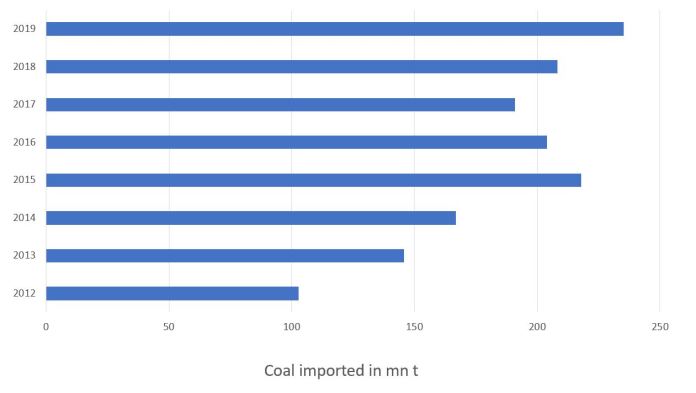
India has 5th largest reserves of coal and 3rd largest miner of Coal in world. 2nd biggest importer of coal. Coal is among top 5 commodities imported by India. India has kept Coal import large chunk every year where India spends its foreign exchange. Coal import by Indian govt in million tonnes.

Coal Import data

We agree that India’s own capacity of coal production rose from 648mn t in 2014 to 716mn t in 2018. As an input from Coal ministry has identified 40 mines which produce with an estimated production capacity of 150mn t/yr.

Why Indian govt PSU’s go for imported coal because of lower cost of coal and the quality of the coal (without added water):

Some images of vale coal mine Tete Mozambique. Which can highlight the automation in this industry and hence reducing the cost of Coal.

Vale coal mining project in Tete 2
Vale coal mining project in Tete 1

Indian govt and system need to work to make the coal industry corruption proof. Currently water added on raw coal to increase the weight and if coal is transported through trains. Then the trains are stopped/slowed at designated place by the mafia to take out the coal and sell in open market. Zero investment full income and only need to bribe the goods train driver+ Guard.

Some images from Indian coal mines which shows how we can increase manual efforts which will lead into higher cost of coal production.

Indian coal mine

Coal India is the biggest producer of coal. Indian govt holds 90% of the Indian mines and investing in abroad mines. But their issue is high cost of production means higher selling price which makes them unattractive even with Govt PSU’s like NTPC and other govt owned power plants. The only solution is getting small and effective smart companies which can bring revolution in the mining sector.

Alot of Indian engineers who have full know how of the coal mining and plant erection & commissioning work for alot of these facilities which are running in Africa.

India is forcefully ignoring to see those engineer can do for Africa and Indonesia. Coal India can look another and keeping the same way of low production and high cost of production.

Albert Einstein is widely credited with saying, “The definition of insanity is doing the same thing over and over again, but expecting different results.”

Readers’ feedback will be appreciated. Feedback is always interesting and help you to understand readers point of view.

Indian society and its culture

0

India is one of the most religiously and ethnically diverse nations in the world, with probably the most profoundly religious societies and cultures. Religion plays significant role in the life of its people. Although India is a secular Hindu-dominant country.

What is the concept Indian Society?

Whenever we try to understand society the fact that immediately comes to our mind is the people around us. With them we have relationships both of formal and informal nature.

The formal nature of relationship is defined by rules, regulations and the principles of organizations in which we live. For example in school a student learns to understand what kind of respect she/he has to extend to his/her teacher and fellow students.

Thus rules are well established that regulate their behaviors in schools. Similarly as he grows up, joins a college or the university, rules accordingly change and students learn to adjust themselves. After completing his education when he joins the service he is governed by the rules of the office.

In other words the society has a formal setting in which a person is governed by impersonal rules and therefore, he feels a degree of constrain to adjust to the rule. Therefore, a society which has formal institutions people tend to acquire the knowledge about the-
Existing procedures
Etiquettes,
Manners and
Behavior

However, in informal settings it is not the rules that govern our behavior in society but is the traditions and norms that govern our behavior and the relationships that we tend to develop with each other.

  • There are many groups which can be cited as an example of informal settings where relationships are defined by the personalized nature. Family, kinship group, village communities are some such groups where we have relationships that are defined by the norms, traditions and customary practices.​

Viewed in the context mentioned above it is said that society is all about social relationships that we have with people around us. Sociologists have also defined ‘society as network of social relationship’, ‘pattern of interaction’, ‘interpretative understanding of social action’ in which interacting individuals are aware of the positions of each other.

Sociologists are the one who try to understand a disciplined understanding of the wide range of relationships that individuals have with each other and the groups in which they live. They have talked about different types of societies termed as ‘simple’ and ‘compound.

Be it simple or complex the fact that remains unchanged is that each society has its own culture, traditions, social structure and the normative-patterns which are characterized by stability and change.

That means the structure, culture, the norms of society and its traditions never remain static. They always remain in state of flux. Two factors which account for fluidity and change are internal and external. That Means there are both internal and also external factors of change.

What is the Nature Indian Society ?

The nature of Indian society cannot be understood without having a proper examination of its culture and social structure. So far as the culture of Indian society is concerned it is considered to represent the ultimate values and the normative framework of Indian society. Normally the culture includes both the physical and non-physical aspects of people’s life.

Physical aspects refer to tangible things such as material objects.-

Non-physical aspects refer to non-tangible and non-material objects such as ideas thoughts, feelings, prejudices etc.

In this context the Indian society and its plural character has to be understood in the background of not the culture only but also its social structure and traditions. Both must be seen as a process of continuity and change.

Reference:-

  1. Salient Features Of Indian Society

Amending Article 30: Correcting a historical wrong

0

Debating, improvising the constitutional provisions and amending the inadequacies have been the essence of our constitution. And credit must go to our vibrant social society who had been continuously on forefront to raise any direct or deemed impropriety.

Article 30 of Constitution is one such area which is incomplete as well as practically undefined within the essence of constitutional propriety.

ARTICLE 30:  It says,

Right of minorities to establish and administer educational institutions in the country.

(1) All minorities (religion or language) shall have the right to administer and establish educational institutions of their choice in the country.

(1A) while making any law providing for the compulsory acquisition of any property of an educational institution established and administered by a minority, the State shall ensure that the amount fixed for the acquisition of such property under such law would not restrict or abrogate the right guaranteed to them.

(2) The State shall not discriminate against any educational institution managed by a minority in granting aid.

Who is Minority in India? The term ‘minority’ was neither clarified in the Indian constitution not has been critically examined in last 70 years. It is much later through a Gazette of India of 27 January 2014, people of Muslim, Sikh, Christian, Buddhist, Parsi, and Jainism have got minority community status in India.

To be honest, any one pursuing the constitution, should have immediately challenged this publication. The entire exercise lacked any scientific study and was in conflict with the principles enshrined in constitution. How can 14% of population of Muslim be equated with less than 2% of Sikh, Jain and Buddhist?

How come Muslim and Christian majority state Like J&K, Meghalaya, Mizoram and Nagaland be guarded under article 30 whereas the actual minority population of Hindu and Buddhist be left unguarded.

In light of Article 14 which guarantee: Right to Equality, this Gazette notification about definition of minority is in complete contradiction to the spirit and words of article 14 itself.

Violation and Gross Misuse of Article 30: Muslim Madrasa and Christian convent have mushroomed in last two decades taking advantage of article 30 and further have been granted substantial aid and assistance under article 30(2).

But question is: – Could these Madrasa and Convent be able to mainstream the student undergoing education there? Does Government have any control on the curriculum and content of book under Study? And most important, can Government control the appointment and superintendent quality of the appointment? Does there exist any regulation?

The answer is pathetic, worrisome. Some small steps to regularize and control these institution have been taken by few government like UP, WB and Assam and the same had been found to be extremely inadequate. The student who would spent nearly decades of formative age at these institution and away from overall integration would be a challenge for tomorrow`s mainstreamed world.

On top of that, the biggest injustice had been heaped upon the Hindu society, as they have been denied any Government support and assistance to run and promote their own cultural and civilizational values. Today Gurukul does not exist. The knowledge of Vedic literature and Sanskrit language is esoteric. While west is learning Ved and Bhagwat Puran Indians are watching them on “you tube”.

It is understandable that the vote bank policy of successive government has eroded the essence and spirit of Article 30 of Indian constitution. The constitution had no disrespect for any language religion and race. Yet our executive order and prejudice had played havoc with the constitutional propriety.

Today a country of 80% of Hindu population have no authority to demand their cultural and civilizational upbringing from Government and that is only due to Article 30.

So, it is time to say either abrogate the article 30 or expand the scope of this article 30 to include all religion all race and all language. Why should and how long Hindu should be denied the right they deserve?

An effective mechanism be introduced to mainstream the education. And belief should be left to be only a private Affair.

Fascism in Bengal- Now and then

0

Bengal has been the land of enlightenment, spiritual and national movement for centuries. Revolutionary ogranisation like Anushilan Samiti was based in the soil of Bengal. Luminaries like Swami Vivekananda, Rabindranath Tagore, Bankim Chnadra Chattopadhya guided Bharat during her freedom struggle. Freedom fighters like Sri Aurobindo, Khudiram Bose, Netaji Shubhash Chnadra Bose, Jatindradas Nath, Shyama Prasad Mukherjee have sacrificed their life for Maa Bharati, were also from this land. Keeping in mind, all these precedence, it was expected that Bengal would show light and path for building of nation, which was dismantled and ripped off by 1000 years of invasion and foreign rule.

Bengal has experienced three waves of Fascism and Fascist forces. Out of which the first one was existed in 1940s under the rule of Muslim League. Under this rule, the suppression of Hindu population was carried out in sophisticated way. Pogroms of Hindu population and rapes of Hindu women were carried out under the state guidance. Noakhali Massacre was perpetrated by Muslim National Guards militia resulted in killings of at least five thousand Hindus. Thousands were forced into religious conversions, arsons, abductions and rapes were carried out by this militia in Noakhali, Hajganj, Faridganj, Chandpur, Begamganj and Chauddagram. Another massacre was organised, same year under the banner of ‘Direct Action Day’, Muslim League guided this massacre resulting to forced conversion, arson, abduction, mass rapes and killings of at least four thousand peoples on the street of Kolkata. Islamo Fascist rule of Muslim League finally ended with the tragic partition of our beloved motherland.

Second wave of Fascist rule took over with the arrival of Communist rule in the state. Communism is a murderous ideology which masquerade as an opposing force to fascism but practically modus operandi of fascism and communism is very difficult to differentiate. Giovanni Gentile – the philosopher of fascism was himself a self declared Socialist. Socialism has been the poster ideology of fascist rule in both Italy and Germany. There is no difference between Hitler’s National Socialism and Stalin’s Socialism in one Nation, both massacred millions under their respective tyrannical rule. Same was the experience under Communist (fascist) rule in Bengal for 34 years. Communism’s gift to Bengal was killing and massacre of Naxalbari and Marichjhapi. Communist cadres and West Bengal state massacred hundreds of refugees, who have fled from Dandkaranya (Bangladesh) and most of them were Naamshudras. During three decades of communist rule, killings were committed under state guidance in the leadership of Communist Party. One of the common practices in the Communist rule is dissolving of state authority in the party machinery, this is practiced in Soviet Union, Yugoslavia, China, Albania and even in West Bengal. Kerala is still under the rule of this tyrannical regime where hundreds of RSS and BJP karyakartas are killed.

Bengal experienced the third wave of Fascism with arrival of TMC in power and departure of second wave of fascism. In order to consolidate its power in the state, TMC practiced the same design of manipulating the state machinery with party cadres. It can be seen in conduct of Panchayat elections where rigging was practiced in day light, ballot boxes were thrown in lakes, booths were captured and false votes were polled. Hundreds of RSS/BJP workers are dastardly killed, most of these are downtrodden dalits. Recently, BJP worker Manish Shukla is killed in his home district. Earlier, BJP MLA Debendra Nath Ray’s body was found hanged from the ceiling of verandah outside shop in Bindal village, North Dinajpur district.

What happened yesterday was the final nail in coffin of Fascist rule of Trinamool Congress. Lathicharge, chemical shots, teargasses were used against the democratic procession organised by BJYM West Bengal, karyakartas were non-violently marching to state secretariat. The march was led by BJYM National President Tejasvi Surya, State President and few other leaders. This fascist actions of TMC rule can be now clearly seen in the state capital and not only confined of country sides. Lakhs of BJYM young karyakartas joining this march is the clear sign that the fascist regime has now lived his complete life and will be overthrown by the people of West Bengal in the coming state assembly elections.

It is the singular responsibility of people to democratically get rid off this rule. No fascist regime, however powerful it may be, has survived for too long by suppressing aspirations of people. Hence, it is the most pertinent moment for the Bhadraloks of Bengal to show- What they stand for ? What their ancestors stood for? And what our freedom fighters laid their life for ? 

Justice Anand Venkatesh’s strong vaccine for medical college admission taint virus

Hats off  to Justice Anand Venkatesh, Madras High Court, for his bold, stern and masterly verdict ‘literally spewing venom on those who deserved it and more, (as a lawyer friend messaged to me). Six Puducherry Medical Colleges were fined Rs.30 lakhs for flouting the Medical Council of India (MCI) regulations and not following the Central Admission Committee (CENTAC) merit list, while admitting students to postgraduate medical courses in 2017. The court also upheld the MCI’s orders to cancel admission of 65 students, who were selected through illegal methods. These students were permitted to write the final examinations subject to the result in the writ petitions. Now that the writ petitions have been dismissed, the 65 students lost the benefit of Post Graduate Courses they had already completed. A sad, unfortunate state of affairs but one which came about not in small measure, from contribution of  their own acts or conduct or the machinations  of the college authorities, to which the  families of the students were privy and party to. It was a tragedy that was waiting to happen.

Medical Courses in India are a high stakes game. There is so much riding on it, for all the stakeholders. The vehemence with which the political class in Tamil Nadu, has sided with these institutions, on the NEET dispensation is a Neat exposition of it. The judgment of Justice Anand Venkatesh has come, not a day too soon .

At one level, the verdict may seem a ‘harsh, heartless, unsympathetic pronouncement’ as a student put it. They may claim and feign total ignorance of the taint perpetrated by the institutions and plead innocence and suggest they were the unfortunate fall guys or gals. Sorry, that would be a totally wrong inference. The students and their families cannot plead innocence for they were and would have been party to the benediction from the medical colleges, granted to them illegally.

Tamil Nadu and Puducherry have been notorious for such transgressions for long, and it is singularly unfortunate that lives and careers of young students are sacrificed at the altar of expediency. Justice Anand Venkatesh has been magnanimous enough to admit that the High Court cannot absolve itself of the blame,  for not having caught the issue by the scruff of the neck contemporaneously, and allowing the wounds to fester, to, after the students had completed their courses. The delay was attributable to the Court and the orders allowing the students to write the final exams ‘subject to the result of the writ petitions’ was a near red herring taking the students up the garden path, to be encountered by a hell hole, from the orders dt.7th Sept,2020, out of the blue.

Who is to blame? Who is responsible for sacrificing time, effort, resources and energies of the students? Would the fines imposed on the colleges be sufficient compensation for the sins committed by them? Can the students and their families plead innocence and seek equity as they have completed the courses, even if the original admissions are declared to be illegal? So many questions and the answers for which ultimately are unlikely to be satisfactory to the student community and their families. They may still harbour the mindset that the learned judge was too harsh and unfair in displaying a warped vision in being oblivious of the trials and tribulations of the students’ misery. No, they would be wrong. The learned judge was not only fully alive and aware but given good and valid reasons, as to why they did not deserve any equity on this occasion and they were not blameless for what has befallen on them. The Supreme Court was equally ruthless in the matter of candidates who had availed admissions based on false and fabricated community certificates. (Jagdish Balram Bahira case-2017).  

 n the 1980s and 1990 we had the continuing spectacle before the Madras High Court, tapping into the benevolence and munificence of the court to sit for such exams. Year on year, it happened. And then after results, they used to be back in Court, pleading mercy and equity for declaration of results. The High Court saw it as a large-hearted gesture and granted them the reliefs.  In fact, as was then known in the court corridors, these litigations were ‘all sponsored by the institutes themselves, for it mattered to their very existence as commercial enterprises’.  

Alas, there came a Judge and Bench who put a full stop to this ‘annual festivities’ as they called it. They said they cannot permit the illegality to continue ‘with the blessings of a court of law”. Someone had to pay a price for it to cease. On 22nd Mar, 1993, Justices M. Srinivasan and Thangavelu came down with an iron hand and dealt a mortal blow to these ‘pernicious practices’. With that, the annual feature of students getting permission to sit for final exams, in unrecognised ‘phantom institutes’ ceased once and for all.

This is how the Supreme Court greeted the High Court judgment. “A Division Bench of the High Court consisting of M. Srinivasan and Thangamani, JJ, dismissed the writ petitions. M. Srinivasan J., who spoke for the Bench, has given a scholarly judgment. The case-law on the subject has been dealt with in detail and the conclusions culled out succinctly .The High Court judgment has been of utmost assistance to us. These appeals via special leave are by the Teachers Training Institutes against the judgment of the Division Bench of the High Court.”  (St. John’s Training Institute v. State of Tamil Nadu).

This verdict was instrumental in elevating the author of it, Justice M Srinivasan as Chief Justice of Himachal Pradesh High Court and thence to the Supreme Court itself. It was that sort of a quality verdict, even if it was perceived to be ‘harsh, hard, heartless, unsympathetic on the lot of the impacted students’, then as now.

It was time that these institutions realise that they cannot play with the lives and careers of students and their families by enticing them to partake in an illegality and suffer the consequences. The institutions had to be made an example of. They cannot act like mercenaries and escape accountability. Their licences to carry on, must also suffer a setback .A monetary fine would be a rap on the knuckles or less. Given a choice, they may pay ten times the imposed penalty to avoid implication on the 65 students losing the benefit of their PG degrees. That says it all.

Justice Anand Venkatesh deserves our commendations for his ruthlessly cold and objective orders sticking to the letter of the law and spirit of it as well. And while students had to pay a price, the price that the colleges have been asked to pay would mean little unless Medical Council of India and the powers that be do the clean-up act. There is a lesson in it for the High Court too to show expedition in dealing with such sensitive causes. Medical education is too sacrosanct to play around with the lives of We the People. Or so we believe!

     (Author is practising advocate in the Madras High Court)

कोरोना के साथ जीने की आदत डालनी होगी

0

वैश्विक महामारी कोरोना ने पूरी दुनिया बदल दी है इस तथ्य को कोई नकार नहीं सकता। आपके ध्यान्नार्थ किंग्स कॉलेज – लन्दन के शोधकर्ताओं के विश्लेषण का निष्कर्ष यही रहा था कि कोविद-१९ छह तरह से हमला कर रहा है और यही कारण है की कोरोना संक्रमितों की संख्या दिन प्रतिदिन बढती जा रही है। अभी कुछ दिन पहले ही सुप्रसिद्ध नारायणा हृदयालय के डॉ देवी शेट्टी ने बताया कि स्थिति भयावह होने वाली है।डॉक्टरों की भी कमी पड़ जायेगी इसलिये  सरकार से अविलम्ब 5000 डॉक्टरों की भर्ती करने का आग्रह किया है और जनता को सलाह दी है कि हर हालात में भीड़ से बचें। जाँच व इलाज में देरी घातक हो सकती है।

इन बढ़ते हुए संक्रमितों के कारण आज अस्पतालों में पलंग उपलब्ध नहीं हैं। अपना कमाया धन भी काम नहीं आ रहा है। अस्वस्थ सदस्य की हम ईच्छा होते हुए भी सेवा नहीं कर पा रहें हैं यानि चाहते हुए भी सेवा करने से घबराहट हो रही है। और तो और स्थिति यह हो गयी है कि परिवार के सदस्य अंतिम क्रिया में भी शामिल नहीं हो पा रहे हैं। जिन घरों में गमी हुई है, उनको भी हम  दिलासा / संवेदना फोन पर ही दे रहे हैं। यानि हमें  इन सबको ख़ामोशी से देखने के अलावा कोई उपाय नज़र नहीं आ रहा है।

इसलिये हमें विगत दिनों की तरह लॉक डाउन के समय में जो नियम पालन करते थे, वह अब और कठोरता से पालन करना पड़ेगा, नहीं तो हम जीवित नही बच पायेंगे। हमारे सामने परिवार को सुरक्षित बचाये रखने की एक खुली चुनोती है।हम रहेगें तभी हमारा व्यापार, पैसा, परिवार और समाज सुरक्षित रहेगा ।
उपरोक्त लिखा हुआ अवश्य ही चुभता होगा लेकिन क्या यह कटु सत्य नहीं है ?

अब हमें बिना समय गँवाये “एक कठोर निर्णय लेना” पड़ेगा।

और अब हमें इसी परिस्थिति में सुझाये गये उपायों का कठोरता से पालन करते हुये जीने की आदत डालनी होगी क्योंकि सभी विशेषज्ञों ने बता दिया है कि २०२१ तक हमें इस महामारी से छुटकारा मिलना मुस्किल है इसलिये सरकार भी धीरे धीरे सभी चीजें खोल रही है। याद रखें यह साल कमाने का नहीं है बल्कि पूरे परिवार के साथ सुरक्षित रहने का है।

और सुरक्षित रहने के लिये जैसा पाठकगण आप जानते हैं कि सभी विशेषज्ञों ने कोरोना महामारी से बचने के लिये चार मुख्य उपाय बताये हैं और हम सभी उन उपायों से भलिभांति परिचित भी हो गए हैं।  फिर भी आप की जानकारी के लिये वे चार मुख्य उपाय यहाँ नीचे प्रस्तुत कर दे रहा हूँ –

1) इम्यूनिटी मजबूत बनाये रखें।

2) हर तरह से सामाजिक दूरी की पालना करें।

3) फेस मास्क का निरन्तर प्रयोग।

4) हाथ या तो साबुन से धोते रहें या सैनेटाईज कर लें।

मानसून सत्र के पहले प्रधानमंत्री नरेंद्र मोदीजी ने मीडिया से बातचीत में कहा कि “कोरोना भी है और कर्तव्य का पालन भी करना है”। साथ ही उन्होंने देशवासियों को चेताते हुये यह भी सन्देश दिया कि “जब तक दवाई नहीं, तब तक ढिलाई नहीं”। इससे पहले उन्होंने “दो गज की दूरी, मास्क है जरूरी” की पालना का आह्वान किया हुआ है ही।

एकबार फिर प्रधानमंत्री नरेंद्र मोदीजी ने 17 सितंबर यानी गुरुवार को अपने 70वां जन्मदिन के दिन रात 12.38 मिनट पर ट्वीट किया, ‘चूंकि कई लोगों ने पूछा है कि मैं अपने जन्मदिन पर क्या चाहता हूं, इसलिए मैं यहां वो चीजें बता रहा हूं जो मैं अभी चाहता हूं।’ इसके बाद पीएम मोदी ने अपनी विश लिस्ट गिनाई जो इस प्रकार है-

मास्क पहनते रहिए और इसे ठीक से पहनिए।
सोशल डिस्टैंसिंग का पालन कीजिए। 
दो गज की दूरी को हमेशा ध्यान में रखिए। 
भीड़भाड़ वाली जगह पर जाने से बचिए। 
अपनी रोग प्रतिरोधक क्षमता (इम्यूनिटी) बढ़ाइए।
इसके बाद अंत में पीएम मोदी ने कहा आइए हम अपनी दुनिया को स्वस्थ बनाएं।

उपरोक्त सभी तथ्यों को ध्यान में रखते हुए अन्त में यही निवेदन रहेगा कि कोरोना पर विजय पाना है तो जरूरी हो तभी घर से सुरक्षा नियमों का पालन करते हुये निकलें।सुरक्षित होकर पुन: स्वतः को अनुशासित करें। 

तभी हम कॅरोना पर विजय पा सकेंगे। सरकार ने तो सब कुछ खुला छोड़ रखा है,अब केवल व केवल हमे और आपको अपने आप को बचाना है।

आशा है आप सभी बतायी गयी सारी सावधानीयां बरतते हुए स्वस्थ व प्रसन्न जीवन का आनंद उठाते रहेंगे ।

गोवर्धन दास बिन्नाणी “राजा बाबू”