Home Blog Page 561

J&K Bank, Corruption & Politics

0

It all got started with the Governor of Jammu and Kashmir, Satya Pal Malik, approving the proposal for treating Jammu and Kashmir Bank Limited as a Public Sector Undertaking (PSU). The Kashmiri-Muslim politicians and traders resisted the Governor’s move claiming it to be an attack on the autonomous character of a flourishing institute. This claim resonated among common Kashmiris, who are generally skeptical about everything when BJP is in power at the centre and the state is under Governor’s rule. An earlier attempt of bringing the bank under Right to Information Act (RTI) met with the same disliking among politicians, traders and common people in Kashmir. It is also widely believed that the then Chairman of the bank, Parvez Ahmed Nengroo neither favoured bringing of J&K Bank under RTI Act nor its conversion into a PSU.

And after a lull in the events concerning J&K Bank, the government suddenly sends shock waves through the bank and the whole state by removing Parvez Ahmed, the bank’s Chairman from his position and announcing an interim Chairman (a Hindu). Shortly after his removal, the Anti Corruption bureau also searched the headquarters of the J&K Bank.

The word on social media and especially online news portals is that the Chairman has been removed against charges of corruption, nepotism and much more. In no time, people have started talking and doubting the fairness of recent recruitments in the bank and norms followed in giving loans to influential people. Journalists are going back in time and figuring out how every time a new government since 1996 (mainly formed by Kashmir dominated political parties) has got a new chairman of its liking with it. Another interesting thing brought to the notice is that since 1996 only a Kashmiri Muslim could become the chairman of the bank.

Many would see the current happenings as an attempt by BJP to please its vote bank in Jammu just before the Assembly elections in the state. May be there is some weight to that argument but it is also a fact that when it comes to corruption, nepotism, bad governance and inadequate representation of the true voices of people at proper platforms, Jammu and Kashmir is among the worst. Partly due to the unease and violence in the valley from last three decades and partly because of some people wanting to exercise unchecked power forever.

Now, while there is still President’s rule in the state and that BJP has retained power at the centre, the people of Jammu and Kashmir especially people of Kashmir seem to be faced with a dilemma. They have to make a choice between skepticism and moving forward with optimism. It is going to be an absolutely critical moment in the history of Jammu and Kashmir. People in the state have long suffered from corruption but issues of regionalism, Hindu-Muslim disunity in the state have always fogged it up.

People need to be wary about the fact that when it comes to power, there isn’t much difference between say NC and PDP or BJP and Congress. They all want power and they want it the same way. The only thing that can make a difference is our institutions, our financial institutions, educational institutions, institutions of justice delivery, our social and cultural institutions. We have to ensure we keep our institutions intact and corruption free for a free, fair and equal life.

Types of Hindus in the 21st century

0

This blog is a reflection of my personal opinion based on my reading of the types of Hindus that we see in modern India and the world. Ancient India had classified Hindus into various categories from time to time. If one uses दर्शन as the basis for categorization, classification will take the form of अद्वैत, विशिष्टाद्वैत, etc. Or we had families or even geographies aligned to specific देवता like विष्णु, शिव, शक्ति, etc with people within these zones living their lives as per the specific texts where such देवता expressions are dominant. Are such erstwhile categories valid in the 21st century too? At a personal level, in families that are passing on traditions to children, one can argue that such ancient categories remain valid today too.

However, with the break-up of family structure, movement across geographies, etc., it is reasonable to state that many Hindus have become disconnected with their earlier traditions. And with modern Indian education completely leaving out ancient Hindu ideas from education, we do have a situation where Hindus have become disconnected with their ancient ways of life. However, despite this disconnect, they do carry some of the cultural practices (food, festivals, etc) that keep their external identity as Hindus. Having said that, one cannot deny that old categorizations are no longer as relevant and one does witness new categories emerging in recent times. So what are these identities?

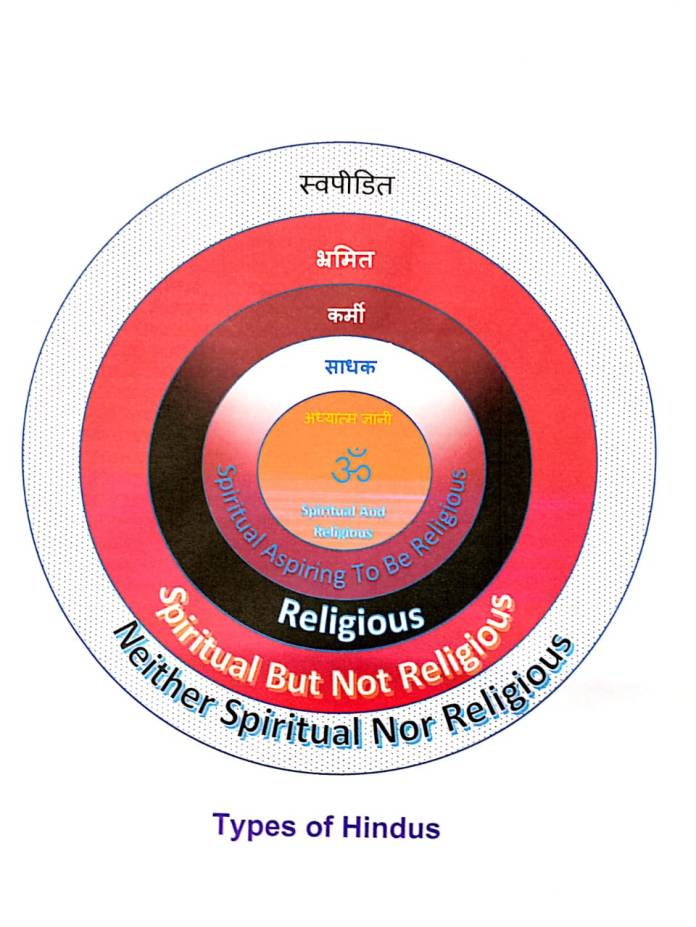
In mainstream media, we often see portrayal of today’s Hindus in a binary manner – one side expressing a modern scientific view based on rationality and reason (with claims that religion is a private domain activity) and the other expressing a religious world-view based on ancient Hindu practices and texts. Media often portrays the former as atheists or agnostics or rationalists and the latter as religious. This silly binary view does not, however, play itself out when you watch Hindus across the world. I see five categories of people who call themselves Hindus in terms of how it plays out in society. A pictorial representation of these five categories is given below:
This image has an empty alt attribute; its file name is img-20190127-wa0010-2-1.jpg

Each category given in the picture represents a thought-view, a दृष्टि that often plays itself out as a dominant view expressed by each category of people. And this has been portrayed in the form of a hierarchy with one key idea- those who profess to be Hindus are those who practice नित्य कर्म and undertake उपासना कर्म as per the ज्ञान expressed in the Hindu texts. And those others who do not practice such कर्म may be seen as farther away from the zone of the centre. Let us understand each of them better.

स्वपीडित

The word stands for self-tormentors. They associate the words Hindu only with Sati, caste abuses, untouchability and multiple gods. They are self-hating Hindus who are tormented with their Hindu identity. Their दृष्टि is based primarily on cut and paste versions of Hinduism as they may have understood from their history books, media and their parents. तमस् guides their conduct owing to which they neither make any attempt to study Hindu texts nor do they possess sufficient intellect to study the affairs of the world or science or religion. Life is seen as merely eating and entertainment and exploration in a deeper sense is never a need – but despite knowing so little about Hinduism (or anything for that matter), they do have an opinion on the topic. They tend to hide their Hindu identity or some extreme cases may even be open to conversion into other religions owing to the self-hating aspect of their persona. They would not like to be associated either with the words “Spiritual” or “Religious”.

भ्रमित

The word stands for people who tend to be deluded or confused. रजस् drives their persona and life is primarily for pursuit of अर्थ and काम and this is also their parameter for a successful life. Such people tend to be well-read and suitably informed. If one asks them to list books that they have read over the past five years, one will find a wide collection of books ranging from Politics to History to Science to Economics written by the best of global authors – and they can quote them very well. However, if one asks them if their voracious reading has ever taken them to ancient Hindu writings ब्रह्म सूत्र or writings of Vachaspati Mishra or Appayya Dikshitar or Abhinavagupta or Vidyaranya, they will draw a blank – they would have either never heard of these names or even if they have, the need to read such texts never appealed to them. Or even if they may not be well-read, they are too enamoured by technological developments are driven by modern Science which makes them take to a position that all ancient books, though having sensible words here and there, are necessarily outdated. Their world view is more geared towards aspects of व्यवहार like history, politics, power, etc – the urge to delve into परमार्थ behind the व्यवहार does not appeal to them and therefore, while they may seem informed on various matters, such breadth is not backed by depth to assimilate this vast information effectively – this is because रजस् is dominant within them which keeps them glued to व्यवहार only.

So what are the measures or variables that drive their lives? They will use the words “liberal”, “compassion”, “equality”, etc as the words that drive them and have fully invested themselves in global literature that has driven them towards such words. Maybe owing to significant inputs that their brains have received from such diverse global experiences, the exact nature of दृष्टि they adopt with regard to Hinduism itself has become muddled. Therefore, they would not like to invest themselves into Hindu rituals nor would they like to visit temples or pilgrimage places (unless forced upon them). Maybe because of this lack of connecting with Hindu variables of thought, they are very vocal in advocating the breaking of ancient social norms as they are seemingly outdated to them. They are comfortable being called as Hindus – there is no self-hate.

In fact, owing to their superficial familiarity with the writings of Swami Vivekananda or mantras like “एकम् सत्…”, etc, they often back ideas espousing world unity but while being comfortable with the ideas of Unity, the idea of diversity unsettles them and they see the expression of diversity as tribalism or nationalism. Their opinions or expressions on Hinduism may be termed as pop-Hinduism, a superficial perspective that is not that of an insider. They will never say that they are “proud Hindus” as they find this parochial but they will, in the same breath, say that they are “proudly liberal”. They like to see themselves as “spiritual”. Modern India has this bunch of people dominant in mainstream media and they are a faithful product of modern Indian education. The ridiculous phrase “Spiritual but not religious” appeals to them significantly.

(A light-hearted comment – an easy way to detect such people will be their visible discomfort with Hindu symbols (like टीका on the forehead or Mangalsutra), preference for anglicised short names (so Saptarishi becomes Satty or Padmasri becomes Paddy) and visible promotion of English at their homes with their kids (as per them, the only value of language is its utility to attain अर्थ & काम – “why fuss over native tongues” is their opinion) 😀😀)

कर्मी

Now we are getting into the zone of practising Hindus. As the word suggests, one may see them as conservatives. From a शरीर and वाक् perspective, such people to take on to the Hindu practices that may have been passed on to them by their ancestors. They thus follow Hindu rituals, they go to temples regularly and take periodic pilgrimages. They will not have a problem going around a cow or praying daily to the Tulasi plant at home. They tend to respect family traditions that have come from their parents and follow them diligently. They are comfortable with the logic given to them that following such rituals will give them पुण्य. And they will happily call themselves Hindus and “religious”. And with रजस् remaining a primary driver for a कर्मी too, this keeps them glued to पुण्य & पाप aspects of Hinduism rather than make efforts to acquire सत्व or go beyond गुण.

And this prevents them from the study of or making attempts to understand their rituals in a deeper manner. They tend to cling to rituals very strongly and are disturbed when someone questions the practices followed by them. Bulk of divide in modern India between the so-called “religious” and the so-called “modern” is the divide between स्वपीडित and भ्रमित on one side and कर्मी on the other. Since the कर्मी is usually unable to argue against people who question their beliefs, they tend to become loud and may even resort to violence when forced to adopt social change. Once they shed their excessive रजस् orientation and invest themselves deeper into Hinduism by taking recourse to सत्व,  they will become more comfortable with the pulls and pressures of modern society and will be able to make arguments in a reasoned manner. But for one too invested in पुण्य & पाप orientation, only serious episodes usually act as a trigger to delve deeper into Hinduism or else they tend to remain in their zone all their lives.

साधक

Search for Truth or Reality is the driver for this person. Not only शरीर and वाक्, such a person strives to engage his मन and बुद्धि too towards this quest for Truth or Reality. He will read Hindu texts as well as modern Scientific literature to the extent these assist in his mission or quest for knowing the truth about life. Search for Truth therefore is the साधना  for this person. He or she spends a significant amount of time learning the wisdom contained in the Hindu texts given their focus on Truth. Reading of the texts is not just for academic curiosity – it is done with the intention of cultivating साधना  of an intense kind. Even people who are part of the नास्तिक category can be included here provided that their minds are genuinely oriented towards search for Truth.

While रजस् remains the orientation of this person too, he is working to reduce this and instead cultivate सत्व on the lines suggested in the texts. He has come to the conclusion that only academic knowledge about aspects of ultimate reality is mere gathering of information which will not assist in attaining his goal of life. He therefore strives to take up specific साधना  in the form of उपासना कर्म prescribed in the texts to attain ज्ञान. He keeps himself well-versed with texts outside Hinduism too but the दृष्टि with which these texts are read are the Hindu variables (like कर्म, गुण, यज्ञ, प्रकृति, पुरुष, etc). He does not make the confusion of judging the validity of अध्यात्म using the tools of modern Science and attempts to learn अध्यात्म based on its own defined variables. A साधक strives to live life as per the four purusharthas and is always working to understand धर्म in the modern day life as per the variables of दृष्टि of ancient Indian texts. He will not hesitate to call himself as spiritual and striving to become religious.

अध्यात्म ज्ञानी

Such people are rare. They represent the people who have fully immersed themselves in the ideas of life expressed in Hindu texts. So it is not just शरीर, वाक्, मन and बुद्धि devoted to pursuit of अध्यात्म, their whole identity is geared towards reaching the goals of the शास्त्र. They are not just focused on धर्म, they are equally conscious of the सञ्चित and प्रारब्ध कर्म that are present in their कारण शरीर and are working to burn up the seeds of such कर्म present within them. We can include enlightened आत्माs like Swami Vivekananda or Ramana महऋषि or Swami Chandrasekhara Saraswathi here. We can also include here the various Swamis who are part of Chinmaya or Ramakrishna Mission or other Ashrams following the numerous संप्रदायs present within India.

And others who may not be part of these Ashrams but align their life fully to the ancient texts may also be included here. Such people form satsangs with like-minded people and discuss the ideas within the texts most of their lives and also help other Hindus to understand the message of Hinduism in a deeper manner. They will love to call themselves “Spiritual and Religious” since they follow traditions aligned to the ideas in the texts. They can confidently provide explanations of difficult ideas contained within ancient texts. They are able to orient the pulls and pressures of modern lifestyle and are successfully capable of blending ideas contained in the ancient texts with modernity.

So why is categorization important?

Categories may not be water-tight and it is quite possible that people straddle across categories in a much more complex manner. What has been given above are dominant categories that one gets to see among Hindu society today. Most people who grow from the kid stage into adults tend to remain in their chosen category all their life. And the same tunes are usually sung by people from the age of 25 to 100. Thereby, whenever people express certain views in various forums – public, private, in media – mainstream or social media, one is able to read them well once we put them into categories at least on a provisional basis.

In media of course, one witnesses two dominant opposing sides – the स्वपीडित and भ्रमित on one side and कर्मी on the other. The former calls the latter as conservative, Hindutva, outdated, loud, ignorant, etc. The latter will call the former by the names McCaulay Putras or anglicized Hindus or confused Hindus. And we are witnessing these tussles over and over again. Interestingly, even if the भ्रमित-kind writes positives on Hinduism, the arguments used by them tend to be superficial of the pop variety. And even when they criticize Hinduism, the arguments used by them reveal their low level of understanding of the subject.

How to convert a Hindu into a Hindu? Quite obviously, this task is best done by an अध्यात्म ज्ञानी. And they need to contribute positively not just for conveying the ideas of Hinduism to modern Hindus, they need to spice up domains like Economics, Psychology, History, Business models, Medicine, etc., too with ideas of Hinduism. However, this has not happened owing to which we see the space taken over by people of the स्वपीडित or भ्रमित types.

For कर्मी and साधकs, the responsibility of parenting has become more difficult as their interest in passing on Hinduism to their next generation cannot be left by them to the society dominated by the स्वपीडित or भ्रमित types. They will therefore need to be very careful in choosing the ecosystems they live in or engage with. If not careful, they can easily lapse into the domain of स्वपीडित or भ्रमित kind of lifestyle themselves. As for a person who is of the स्वपीडित, unless they shed their तमस् orientation, learning will be difficult not just about Hinduism but even about any other aspect of their life. And change for भ्रमित is equally difficult just as it is difficult to fill up a glass that is already full of water.

Above all, the responsibility of a अध्यात्म ज्ञानी is much more higher given the variety of Hindus that he is witnessing in the society but given their insight, they are capable of understanding the uniqueness of each category of Hindus an thereby tailor their message in a form and manner that may eventually turn Hindus into Hindus in the 21st Century. Let us hope to live for the day when we witness this.

ॐ तत् सत्

Invoke the sacrifices of Amma and promote the positive governance of PM Narendra Modi, a message to AIADMK

0

Need of the hour is self-restraint and remembering the sacrifices of Amma to re-build the party after the demise of MGR. The AIADMK must realize that all the cadres of the party are still with the party but unfortunately several elected representatives of the party are causing great damage to the party by unnecessarily airing their personal views and opinions.

All the elected representatives of the party must recognize the pain and agony Amma suffered at the hands of DMK in Tamil Nadu assembly, how she was ill-treated without any grace and consideration that is given to womanhood, she was beaten up, disrobed, abused, mocked and humiliated by DMK members….. all those pains of Amma, the AIADMK cadres and elected representatives must re-invoke instead of questioning dual leadership or the recent poll defeat.  AIADMK legislatures must remember that their every democratic expression is only going to further weaken the party and is going to give victory to DMK in platter.

Amma fought not only political and legal battle against DMK, but also fought personally. Amma showed undying commitments and dedications only to save Tamil Nadu from the dynastic rule of DMK. But today, after the demise to Amma, several legislatures of the party are behaving irresponsibly and directly favouring victory of DMK.

The victory of AIADMK in the recent by-poll clearly vindicates the fact that people of Tamil Nadu want the continuance of the present government headed by EPS +OPS and not DMK. Need of the hour is AIADMK legislatures must enforce self-restraint and must re-kindle the sacrifices of Amma among the cadres to work with new energy and enthusiasm to defeat DMK in future.

Victory of DMK is not good news for PMK, DMDK and other regional parties as well. Most of the regional parties have realized the above truth and therefore will not allow DMK to form government without their participation. In all probability, the alliance partners of DMK will ensure only coalition government headed by DMK is possible and not the government of DMK.

On the contrary, AIADMK alliance is considered as a positive force lead by Modi. Entire India is behind Modi and Narendra Modi is the first Prime Minister of independent India to deliver corruption and scam free governance, governance dedicated for sab ka vikas, government focused on development and national security.

Instead of expressing the democratic right, the AIADMK legislatures must promote and spread the positive governance of Modi and must expose the negative and hate politics of DMK and congress party.

PMK, DMDK and other alliance partners of AIADMK in the recent election also must realize that fighting with each other only would erode the public trust upon them and therefore all of them must collectively work with people to promote the positive politics of Modi.

Tamil Nadu is enduring a historic drought due to continuous failure of monsoon for the successive years. Lotus flower can blossom only when plenty of water is available. It means DMK when pledge that it won’t allow lotus to bloom in Tamil Nadu, directly wants the state to suffer from drought and starvation. AIADMK legislatures must, instead of fighting with each other or questioning the dual leadership, must engage with people to tell them how working with Modi can transform the state and take the state to new horizon of growth and development. 

The negative and hate politics of DMK only has brought the state to this level and thanks to MGR and Amma, the state is saved from total destruction. Need of the hour is restoration and re-builing of New Tamil Nadu, the land where no place for hate politics, politics of anti-God, anti-Hindi, anti-Brahmins and anti-Modi. 

People of Tamil Nadu who had voted for DMK must be told that they should vote for development of the state and country and not to strengthen negative politics and politics of lies and hatred being promoted by DMK.

It is not too late even today, all legislatures of AIADMK must take pledge to re-invoke the sacrifices and tribulations of Amma, the insults and ill treatments meted on her by DMK in the very state assembly and tell people how Amma has transformed the life millions of poor people in the state, how Amma was used by the Mannargudi family and trapped her into an unnecessary legal mess, all these details the AIADMK legislatures must share continuously to the cadres to revive their energy and enthusiasm.

The positive politics of Narendra Modi is needed to develop the state. Therefore AIADMK also must promote the importance of Tamil Nadu following the leadership of Narendra Modi to develop the state to next level. Let the politics of positive energy of AIADMK alliance under Modi lead the state and not the politics of hatred of DMK.

S Ranganathan

The inconspicuous syndicate

0

Knowledge is having the right answer, intelligence is asking the right question

Framing a question is not just putting a question mark “?” at the end. Good deep questions need imagination. Unfortunately Indian journalists are showing least possible imaginative skills. Either they are doing it intentionally or they have lost this skill in the course of time.

These days they are basically asking only one question although paraphrased differently, “Should Rahul Gandhi resign or should he stay?” The problem with this question is that it is irrelevant and make no sense at all.

Rahul Gandhi has already stated that he would stay with the party and work in other roles. Even if we assume that he resigns from the post under consideration and his resignation is accepted, How does this change anything at all? Are you imagining a scenario where Rahul Gandhi along with Sonia Gandhi report to some third person and take orders from him?

How difficult would it be to remote control a party president, especially when we have already seen, how easy it was to remote control the country’s Prime Minister?

This whole resignation drama is to make a fool out of the people of India. What else could the party do to stage a comeback? They never had a strategy to win this election, what are they introspecting? You can’t review a plan which does not exist. Can you?

However, having said this, Is Rahul Gandhi really the cause of Congress’ national humiliation? No, I don’t think so. Indian journalists quickly jump to the questions like “Why is there a leadership crisis in the party?” or “Is there nobody in the party who could replace Rahul Gandhi?” They subtly divert an intent issue to a skill issue. If his resignation is being rejected, it could only be one of the two things: either it is a staged drama where he comes back, it looks like he came back for the party or the senior leaders don’t want him to go away. The question now becomes “Why do the senior Congress leaders want Rahul Gandhi to stay at that top place?

Only when the right questions are asked, we’ll find the answers we are looking for.

First and the foremost, if you had observed, during the poll campaign, every leader in BJP added “Chowkidar” in front of their names on twitter. But what did the leaders from Congress do? They added a display picture of Mahatma Gandhi, Why did they add Mahatma Gandhi’s pic? Congress uses the name Gandhi as a brand.Every brand has an expiry date, the expiry date for this brand passed decades ago. You could have a look at The Magician becomes the Hat!!!: The Indian Politician doing tricks and see how and when it happened. In today’s scenario it is brand Modi, whoever, contests any elections under this brand, wins. The good thing with BJP is that it would not think twice in replacing brand Modi with someone else once it starts failing or PM Modi gets old enough. Unfortunately, Congress has failed to look beyond Gandhi even seven decades after Gandhi. Rahul Gandhi is the brand ambassador for this brand. The party does not care about the first name, they need the second name and the second name only. Sonia, Rahul and Priyanka don’t mean anything but Sonia Gandhi, Rahul Gandhi and Priyanka Gandhi do have a significant value. If Rahul Gandhi goes away, Indian National Congress would have to build a new brand. This would need, dedication, commitment and hard work. Buh!! Who has the time for all these?

Second, and the most critical, although, Congress is not a cadre based party like BJP, but it sure does have a well defined hierarchy. The family sits at the top of the food chain. A regular person can reach till the second level after a lot of hassle but the top level is simply out of reach, always unavailable. You could very well tell who belongs to the second level. Family close aides, loyalists, most of the Congress Working Committee members would form this level. If something goes wrong, you abuse the family, if something goes wrong you praise the family. Why is the level 2 in Congress is never questioned or held responsible for anything?

This level 2 in Congress resembles the Syndicate that existed in Congress after Nehru and has been on an exploitation spree since then. They always made a ton of money, their kids and grand kids lived and are living like prince and princesses.  It became visible for the first time in 1963 with a question “After Nehru, Who?” Although, Morarji Desai was the most suitable person for the top post but letting him on that position threatened their existence. Lal Bahadur Shastri, who they supported to keep Desai at bay, in his last years tried to show the syndicate its actual place, but unfortunately vanished in thin air. No body knows what happened to Shastri or perhaps no body wants to say anything. Once again, “After Shastri, Who?” This time they promoted “gungi gudiya”  the dumb doll. To their bad luck, the “gungi gudiya” started speaking. Along with this K. Kamaraj a member of “unofficial” Syndicate started harboring the desire to be the prime minister and in return the Party split in two factions.

May be this is the reason why the level 2 or the syndicate after that never aimed for the top post after that. If someone would aim for the top post, it would introduce confrontation within the syndicate. The easiest way to avoid this confrontation is to reserve the top post for the family or find some malleable, submissive person to take the top post so that they can do what they want.

The syndicate which was once clearly visible is now invisible, there are new faces and they work from the shadows. The real question that should be asked today, is “Who constitute this Syndicate in today’s Congress?” Do you think, a lady, who came from a teeny-tiny country with less than 6 crore people, with negligible political know-how was able to understand the different caste-religion-sect-etc.-etc. equations of a country with a population of more than twenty times her own country in no time? You believe that she not only understood them, but she managed and manipulated them better than the seasoned, polished politicians of India who had been doing this all their lives. I think you should stop kidding yourself.

In fact the syndicate has always made sure that somebody who would not use his/her brain or political acumen would stay at the top. Both Rajiv Gandhi and Sonia Gandhi were not or rather least interested in politics, but they were forced to. The ones who were interested and were political astute were kept away by any means possible. Be it Lal Bahadur Shastri or Morarji Desai or Sanjay Gandhi or even Rajesh Pilot or Madhavrao Scindhiya. Yeah, of course, the last three died in some “accidents” and I “believe” that.

If a person with good skills take the top place, the syndicate might be rendered powerless.

Also read: A Gandhi always comes first; By default, without a question!!!

Rahul Gandhi is the best bet for them. The moment they come to power in any of the parts of India, they will cover up all their losses. In short, it does not matter at all if Mr. Gandhi stays or goes. Having said this, in case he does want to go, he and his family should not only resign from the official positions in the party, but also quit the party. They should distance themselves from Indian National Congress or probably create another party like Indira Gandhi did.

By all means some people along with some journalists could continue saying what they have been saying since 2014- “It is a saturation point and BJP will get less seats this time” and so on. They will be found repeating the same again in 2024 when BJP would have again received a mandate bigger than before. There are still 240 open seats for BJP.

Also read: Why this Kolaveri Di?

A BJP supporter like me can’t do anything about this as we don’t vote for Congress anyhow. However, a congress supporter can do by not voting for the party until the family goes away and internal elections start happening within Congress and that too democratically. Once there is a strong leader at the top, things would automatically improve. But it would take time for sure.

The sad truth is that India’s democracy is once again transitioning from a two party democracy to a single party democracy like it was the case post independence. Single party democracy is a myth. If I assume that Pt Nehru’s intentions were pure and he had country’s best interest at heart, then, no viable opposition should be considered as the reason for the mess he and his government made by mistake.  To err is human.

May be this is Congress’ strategy. They are waiting for Modi to make a mistake. He did not make a mistake in his first term so he won again, now they will wait for him to make a mistake in his second term. If he does they will have a chance otherwise better luck next time. This is the same strategy I use while playing chess with my brother. I just make sure that I don’t make a mistake and wait for him to make a mistake. And it does work.

But Modi won’t make a mistake. Why? Because he is not run by a Syndicate. He takes the call based on the inputs from the various institutions. Have you seen the composition of NITI Aayog? It has highly qualified PhDs without decades of professional experience.

Also Read: Misconstrued Opposition; A flawed democracy that needs fixing

Thanks for reading!

2019 Elections – Is Tamil Nadu becoming the next Kashmir?

The results of the 2019 general elections came as a surprise to no one. But what really surprised many was the scale of Bhartiya Janata Party’s (BJP) victory. The BJP won 303 seats, while its allies took another 50 seats giving it a commanding majority to form the government on its own. The key factors for the victory have been a scam-free five years where the government had single-mindedly focused on executing numerous poverty alleviation and infrastructure developmental programs. The benefits that flowed were there for all to see and there was no going back.

The 2019 general election has thrown up some key facets of an emerging political ecosystem in India. This is refreshing as well as disturbing. It is refreshing because the mandate points to the yearning of the people for a strong central government.

It is also simultaneously disturbing because this election witnessed an unprecedented political violence that resulted in the death of many political workers. The violence has continued in some states even after the elections.

In his victory speech Prime Minister Modi talked about the decimation of fake political ideologies and the emergence of a fresh mindset in the people of India. The yearning for a strong and stable federal government was too loud and clear. In India’s context, that was antithetical to most political parties who for decades believed in dividing to conquer and by definition a weak central government.

The defeat, as expected, has resulted in the disarray of the opposition parties. But the spike in political violence and secessionist rhetoric in West Bengal and Tamil Nadu is worrisome. West Bengal Chief Minister Mamata Banerjee’s open defiance of the Central government and the scuttling of local political freedom by arresting supporters of the BJP in the state is a case in point.

Given the known proclivity of many of these political parties to fringe and extremist entities that are inimical to the Indian union, it is not difficult to see how easily the 2019 election drubbing could transmogrifying into violence against the party workers of the BJP.

As Prime Minister Modi settles down in his second term in office, this emerging threat to internal stability stemming from the country’s political opposition will undoubtedly be dominating his attention.

It is true that the Kashmir and Maoists problems have already been dealt with firmly by the Modi government in the last five years. The security forces have gradually but surely gained the upper hand and it is only a matter of time before these terrorists will be wiped out and peace restored.

However, for the security establishment, it appears to be a game of whack-a-mole. Just as terror is wiped out in one area, it springs its ugly head elsewhere. But this time the concoction may be deadlier since it is the enemy within.

Kerala is the other southern state that is expected to keep PM Modi’s team busy. The surge of radicalization in this state as seen by increasing numbers of ISIS recruits as well as political killings in the recent past show that the state may already be on a slippery slope. The communist government’s opposition to traditional Hindu beliefs in the customs of Ayyappa Temple was after all not a surprise. That the massive protests, mainly by women, may have settled the issue for the time being is beside the point.

The rise of jihadi and extremist elements in Tamil Nadu has not truly attracted the media scrutiny it deserves.  For many years now, the security establishment both at the center and state have been aware of the presence of extremist’s cells all over the state.

From radical Muslim groups to groups owing allegiance to the banned LTTE, the state is witness to a wide spectrum of terror groups that are openly espousing their poisonous ideology. That elements from Tamil Nadu had a link to the Easter bombings in Sri Lanka is no surprise. The political ecosystem that evolved over the decades in Tamil Nadu is probably responsible for the birth, growth and sustenance of these anti-national groups.

For too long the major political parties of the state – the AIADMK and the DMK have openly supported these groups in return for electoral gains. Even during the 2019 general elections, many politicians were seen sharing the stage at political rallies with these groups.

The state governments in these states seem to be either inept or unwilling to enforce the law. Hence all eyes are on the Central government to restore order. PM Modi, as would be expected, appears to be fully aware of the grave internal security situation.

In this context the appointment of Amit Shah as the union home minister is seen as the right man for the right job. Given his no-nonsense attitude, pundits expect him to clean up the mess with an iron hand before it is too late.

That these three states will be closely watched by Amit Shahs is a given.  One option that will definitely not be on the table is the dismissal of the state governments in West Bengal and Kerala under section 356 of the Indian constitution. The unintended consequence would be a sympathy wave in favor of the dismissed governments.

A wholescale scrutiny and review of center – state relationship as well as reforming the civil and police machinery will be an urgent task. Senior retired civil servants have revealed in private discussions that Modi has already prepared a masterplan for a largescale revamp of the ‘steel-frame’ and civilian administrative structure. These retired bureaucrats believe Modi was waiting for his return to office to execute on the plan. Given Modi’s penchant for working on a strictly ‘need-to-know’ basis, his team is expected to swiftly implement many of the recommended reforms without any publicity.

There is an urgent need to tone up the internal security of the country, particularly in these three states. The bridge to violence and extremism and hence chaos is not far away and the central government must step in quickly.

Sidhu’s stroke always stirs hornet’s nest

0

Whether it was the cricket field, or the largely attended laughter show or the hard politics, Sidhu had always stirred a hornet’s nest. At whatever time he does move his recognized tall, turbaned stature, the hot, searing debate steps in subsequently and the whole of the country begins to take an intense interest in such sort of the sudden political development. The fresh one in this regard is his much-talked-about confrontation with the Punjab Chief Minister Captain Amarinder Singh.

It had even reached a lofty flashpoint which was appearing clearly through the reports spreading out. How can it be neglected that the Congress party’s star campaigner Navjot Singh Sidhu was upset at the ministry reshuffle ongoing after the LS polls result in Punjab? He did ponder something diverse that’s why this kind of reshuffling irritated him like continuous phone buzz. Considering upon all angles he approached New Delhi to meet the party’s Working President Rahul Gandhi. Submitting his letter about his discontent, he realized that it was time to be up and doing without passing more time.

In addition to it, he does not have to feel guilty about gently sloping towards the High Command as it was supposed to have, by some means, relieved his incessantly anxious mind from the profound ache. It was a particular form of unnecessary pain as he may have said, endured by him in so many extended days. Though he had crossed over the initial hurdle in his purpose, his confrontation had been reached a flashpoint following his indirect accusations to the Chief Minister of a favorable deal with the Badals family at a recent Bathinda rally.

The CM was also quick to refer to Siddhu’s non-performance in his Local Bodies department and squarely held him responsible for the party’s bad performance in cities during the recently held LS polls. Despite being a star performer of the party he was divested of his Local Bodies, Tourism, and Cultural portfolios and given the Ministry of Power and Renewable Energy Resources. But he did not assume charge in the small hours of the day. Ultimately he met Rahul Gandhi whose office made contact with CM’s office, the reports said.

Sidhu who was so far requesting others for ‘Taali’ slogan seems to be the most disappointed man at this point in time. There is something cheesy about being distant from his portfolio when the gloom pervades over the party’s bad performance in the parliamentary elections. The world is asleep but the party leaders were busy in making the workers feel like they were in their own little world of contracted Congress. The fire appears in their eyes when they look up at one another. They did not actually need anything; however, they did feel an iota or a lot of guilt about the electoral debacle.

South India and the metamorphosis of identity politics post 2019 elections: Is it time for decentralization?

0

If there is a country that is truly linguistically, religiously and ethnically diverse it definitely is India. Long before multiculturalism became a buzzword in the Wild West, India was already a democracy that had handled diversity in a way that perhaps could never be replicated elsewhere, not to forget the magnitude of it. Many Western scholars and academicians were rather skeptical of India remaining as a single political entity primarily owing to its diversity.

Fast forward to the 2019 mandate in the general elections, it was overwhelmingly in favour of Prime Minister Modi. This was only possible because, for the first time in independent India’s political history the masses have rejected the entitled elite, rising beyond the politics of caste & religion and rejected the dynasties that ran the country for far too long. This indeed is a tectonic shift and can be seen as the beginning of the end of identity politics based on caste & religion. In fact PM Modi categorically stated in his victory speech that from here on there will only be two castes 1) the poor and 2) those that bring the poor out of poverty. PM Modi in his speech to the NDA coalition also touched upon BJP’s outreach to the minority communities of India and winning their confidence. This indeed is intended at sending a strong signal to the opposition camp that the days of vote bank politics are numbered.

Identity politics of the South

However, the identity politics in India is not restricted to caste and religion, India being a diverse multilingual society; one can foresee and predict the factions based on linguistic pride coming up in a big way in the future. The metamorphosis of identity from now on will be from that of caste & religion to that of language & region. The history of independent India is filled with instances where the identity politics of language came up to the forefront eventually paving way for establishing states on a linguistic basis starting with Andhra Pradesh way back in 1953. Potti Sriramulu’s fast unto death triggered massive riots across the Telugu speaking areas of the erstwhile Madras Province and led to its bifurcation. Similarly, during 1983 when the Telugu identity was yet again compromised, a new leader in the form of the NTR emerged with the establishment of the Telugu Desam Party, which clean swept Andhra in the following elections.

In 2014 a sub regional identity emerged leading to the formation of Telangana. The complex dynamics of the center-state relationship in India is likely to emerge again as there is a growing crescendo in the Southern states, barring Karnataka, that their aspirations, views and ambitions are being disregarded by the center under the BJP administration. People in the South are being led to believe by local parties that the political clout of the Hindi heartland is alienating the South. In fact the arithmetic of the recently concluded elections is an indication to this fact, where BJP won 300+ seats all by itself without any support from regional parties. This was the template of forming governments in the past where national parties always had strong regional coalition partners. The trend has reversed over the last couple of general elections and is being portrayed as a worrisome sign for the South. The bargaining capability of the South is diminishing quickly.

In spite of being a part of the NDA for four years during the 16th Lok Sabha, the TDP did not successfully negotiate the special category status (SCS) for Andhra as mentioned in the AP bifurcation act of 2014. TDP withdrew from NDA which had a devastating impact on TDP’s fortunes in the elections, but had none whatsoever on BJP’s electoral fortunes. Another point to substantiate the emergence of dissent down South is the vandalism of the signboards containing the Hindi alphabet in Bengaluru metro stations in Karnataka by some Kannada linguistic pride groups, ably backed by political parties like the Congress to keep BJP at bay, right before the previous assembly elections. In fact, Karnataka is the only state in India to have its own flag.

Similarly, post the results of the general elections, Y.S. Jagan, the chief minister elect of Andhra stated in several interviews as to how he prayed to god that the BJP does not cross the 250 figure in the Lok Sabha polls, so that he could become a coalition partner and bargain for the SCS. Another instance of the rejection of the northern dominance in politics is in the state of Kerala, where despite the mishandling of the Sabarimala issue by the left parties, BJP failed to make any significant impact in terms of seats won. In fact, the huge margin of victory by Rahul Gandhi in Wayanad can be viewed as the rejection of the BJP which is seen as all about Hindi, Hindutva and Hindu. Similarly, DMK leader and the chief minister elect of Tamil Nadu expressed a rather extreme view of South India seceding from the rest of the country and form another country called “Dravida Nadu”.

On the other hand, this perception of alienation of the South by BJP is being exploited by Jihadi and missionry groups for proselytizing purposes supported by political parties. There have been several reported cases of Jihadi elements murdering Hindus both in Kerala. In fact, the recent Easter day bombings in Sri Lanka were carried out by Jihadi’s trained in South India. While, one might term these incidents to be outright gross exaggerations and a false alarm, the issue is much larger.

Is it time for decentralization and a stronger federal structure?

The presidential style of campaigning that was centered on PM Modi, has worked well for the BJP. However, the same rhetoric of ousting one single individual by the opposition camp has led to their disastrous performance. This is definitely better than an unstable coalition of parties with mutually contrasting views but the representational aspect and the participation of the South in matters related to governance processes and issues of national importance to some extent is being relegated to the back burner. The question that naturally arises “Is decentralization of governance the way ahead?” In fact it has to be the modus operandi for an aspiring India. Why should the decision of the construction of a subway in South India be taken some 1000 miles away in Delhi? Or for that matter decisions like allocation of a trains connecting two Southern cities or construction of airports be taken in Delhi?

Mega projects like Polavaram in the South are taking eons for completion due to the non availability or the lack of sanctions from the center. Every time there is a shortage of funds, the state governments inevitably run to the center with their hands stretched for help. It is understood that this is a way to reduce corruption and misappropriation of funds by the politicians of the South, but this is a huge impediment to the progress as being made to believe in the South. Criticizing the center, Southerner’s come up with arguments such as, 30 percent of the nation’s tax revenues are contributed by 20% of the population down South. Hence, this treatment of the Southern politicians as a pariah with stretched hands is being made to be viewed as deliberate discrimination. It is true the Bimaru states like Uttar Pradesh (UP) and Bihar need attention, but it does not mean that the focus primarily is restricted to these states when it comes to distribution of central funds just for political gains. In fact the South that has performed well on several indicators including birth control has been penalized by the center for their efforts instead of acknowledging them.

States like UP and Bihar got away with impunity despite no significant efforts when it comes to population control. Today, the Southern states have almost equaled the birth rates of that of Western Europe, while the Hindi belt is languishing behind with high number of births per mother. What exacerbates this situation is the movement of labor down South, which is seen as opportunities galore leading to a significant shift in demographic. This will eventually lead to a tussle of identities as witnessed in Maharashtra which led to the emergence of Shiv Sena as a political entity to preserve the Maharashtrian identity.

The only solution is to strengthen the federal structure of India, similar to that of the United States of America (USA). USA is a country with 330 million people, but has 50 states, while India is a country with 1.4 billion people with just 29 states. The political monopoly of states like UP and Bihar has to be broken as their impact on the elections has a massive swing and tilts the fortunes of the rest of the political parties towards doldrums. This should be seen in a positive light and is the only way for progress by bifurcating UP into 4 different states. It is frankly quite ridiculous that one state in India holds the entire population of the nation of Brazil and 10 times the population of Australia. Similarly, funds generated in the form of tax revenue in a region need to be spent on the development of that region exclusively.

Of course the percentage revenue that is appropriated to the state and center can be deliberated upon and decided. This also will lead to reforms in taxation. In addition to this, security issues and issues related to national importance can be effectively resolved with the strengthening of police and security forces in a decentralized customized structure with each district having its own based on requirements. It is astounding to note that the number of police per 100000 people in India is just 150. India is blessed with such a long coastline of 7500 kilometers but it is astounding to note that the volume handled by all the major ports in India combined is less than that handled by the Chinese port of Shanghai. The only way things move faster and infrastructure development happens at a rapid pace is when the authority and responsibility is decentralized. Be it formation of new states or regional units of institutions or the use of technology, this is the way ahead for efficient governance in India with the world’s second biggest population.

This should be done in a methodical manner with proper vigilance and checks and balances in place. However, it has to be initiated at the level of policy by the new government on a priority basis. In fact decentralization should eventually percolate down every ministry and institutions at the most fundamental level need to be empowered. This will also lead to the much needed bureaucratic reform in the country and reduce red tape.

As so often happens in India, unless a mob causes serious damage to human lives or property, governments do not react. Even if they do, the measures are normally ad-hoc and instinctive rather than a permanent solution with a vision. Political parties down South are likely to come united on a single platform eventually by propagating the idea of a strong sense of discrimination against South Indians. This is a national security issue and should not be hijacked by anti national elements to disrupt peace and harmony. Secession movements is not something that India can afford at this point in time where it is barely taking off. The faster these issues are resolved and decentralization happens the better it is for the progress of the country and is the only key to prosperity.

After all, unless the aspirations are met and the wealth increases no real progress in attitude happens. This forms the basis of how India can realize its dreams of being a global power and immerse itself in the glory of the past as the home for spirituality and self realization.

References

Forced population control or population awareness: What does India need?

0

India is living with a staggering 1.36 billion (and counting) people according to the UN estimates and is on its way to edge past China to become the most populous country in the world by 2024 (Source: http://statisticstimes.com/demographics/population-of-india.php). A population of this kind is a double edge sword, it can make or break the country in the long run if measures are not implemented to streamline it soon. But have the prior measures to “control” the population achieved their goal or do we need another counter?

Why “forced” measures to control population failed?

In an effort to control population, countries like China started taking efforts since 1979, when it launched its controversial “One Child Policy” rule after launching the “Two Child Policy” rule in 1970. But, by the end of 2015, the One Child policy itself was controlled and terminated in view of the negative impacts on its entire demographic attire.

The One Child policy created a major imbalance in China’s population distribution where people in “senior citizens” started increasing compared to the infant and the millenial populations. China, which also majorly houses joint families, gave rise to the infamous “Four-Two-One” problem, where the single child started being responsible for his parents along with his grandparents alone. This meant leaner financial strength of such families and more expense by the government on senior citizens to support them for their welfare. Chinese families unfortunately preferred a male child over a female one and in the wake of One Child policy, girl child abortions, infanticide, disproportionate sex ratio started crippling China’s social fabric. Moreover, over the long term, China’s parents are now psychologically comfortable or have become comfortable with the idea of having one child, reasons that can be attributed to the one child policy and hence the negatives of such a policy seem to die slowly.

In the emergency era (1974-76) of India, son of then PM Indira Gandhi — Sanjay Gandhi launched the forced sterilization program which to date is regarded as one of the darkest times of Indian history. Nearly 6.2 million Indian men were sterilized in the first year of the program which is 15 times more than what the Nazis did (source: https://www.bbc.com/news/world-asia-india-30040790). The program received widespread condemnation and effectively never realized its purpose statistically, let alone psychologically and underlined the fact that forced measures to achieve social balance, only set out to fail themselves.

Why Modi 2.0 can set the stage for population control by awareness

Sometimes the messenger is greater than the message. While Indians never disregarded the concerns of rising population, the realization of its effects still don’t hold ground in the minds of its people. With a historic mandate of 2019 elections, people not only voted for non-corruption, but they also voted against the eternal “caste-politics” in line of BJP’s “Sabka Saath Sabka Vikaas” party ethos. In the wake of a refreshed “solve countries issues” awareness among its citizens, the time is perfect for the BJP government to implement population-control centric awareness schemes and campaigning. With a powerful leader at its helm, Narendra Modi, his charming speeches can now include a direct call to people to be aware of a “happy family planning”. The message should include measures to adopt girl children more, which eventually also solve “Indian women issues”, the society still wakes up with. This also conforms to the “Beti Bachao – Beti Padhao” missions and sends out a message about India’s strength of gender balance to the world.

The BJP with its dominant social media team can effectively assist in achieving this mission, spread awareness and bring in a social change at the ground by mobilizing and giving feedbacks to the government institutions which can now be reached just over a tweet. The international aura of Modi 2.0 can help in bringing innovative measures across the world to rise out of the population issues. Even a partial implementation of the awareness by the government, along with patches of its effects in the populous states of India, be an instrument in setting the stage for a Modi 3.0

‘Secular’ groups are unable to propagate their lies

0

Secular media entities and political parties are chafing on their electoral Lok Sabha 2019 defeat since the result day. Asaduddin Owaisi in his television conversations exclaimed- Modi did not rig EVMs, he rigged Hindu minds.

Some secular journalists are murmuring maybe we ignored the effects of pro-poor schemes launched by Modi Government. Still they are not acknowledging that baseless appeasement secularism will not work in India anymore.

According to secular journalists all intellectual talent is culminated in the minds of micro minority of secular elites you call them Khan market gang or Lutyens media.

If you do not agree with them then you have no intellectual capacity. In India idea of secularism repudiates Hindu beliefs, sincerity and kindness. On the other hand it labels Muslims/Christians as ‘Bechara’ and literally abuse Hindus and just shout fascism…communal…Hindu Rashtra etc etc.

During election debates all secular goons focused on how many Muslim MPs will get chosen, whom will Muslims vote, It seemed that Hindus do not have rights to vote.

Recall the media debates and Award wapsi drama during Dadri case. I am not justifying any murder but mainstream media at that time gave an impression that all Hindus are killing Muslims. Even International media started dancing which gave me an impression that most media houses in India are controlled by foreigners.

During Dadri case secular goons forgot that law and order is a state subject and at that time Uttar Pradesh was under Samajwadi state government.

National Human Rights Commission agreed to the fact that Hindu exodus took place in Kairana, Uttar Pradesh. On such issues there was no intellectual consciousness. Maybe for secular elite secularism gets enhanced after death of Hindus.

In Pune, Maharashtra a Dalit boy called Savan Rathod was burned alive by group of Muslim men. His father said that my son was burned alive because he said I am a Hindu. On this issue no Dalit group protested. No media house said that Muslims in India wants a sharia state and not constitutional democracy.

Our media expert calculate votes on the basis of caste factor. But they do not calculate Christian votes on the basis of Catholic or Protestant. They do not do electoral arithmetic according to Shia, sunni, Ansar, Qureshi, Naqvi etc.

Secular journalists/intellectuals must now realize that Hindu bashing will not work. No mainstream TV journalist analyzes Economic Survey or NSSO data to explain situation of economy to their viewers. News channels are trying to compete with Saas Bahu TV shows and only like mirchi masala in their news presentation.

I request them to analyze Bharatmala road infrastructure policy. We are investing in road connectivity beyond secular dreams.

Sources:
News on Kairana exodus
https://timesofindia.indiatimes.com/city/meerut/Exodus-of-Hindu-families-from-Kairana-a-reality-finds-NHRC-probe-report/articleshow/54451892.cms

Article on Pune boy Savan Rathod.
https://indianexpress.com/article/india/india-news-india/my-son-was-burnt-alive-after-he-said-he-was-hindu/