Home Blog Page 457

ओड़िशा: आज से बिना मास्क के घर से निकलना मना; पूरे राज्य में सख्ती से लागू होगा नियम

भुवनेश्वर: ओड़िशा में आज से बिना मास्क पहने घर से बाहर निकलना मना है। पूरे राज्य में कानून को सख्ती से लागू किया गया है।उड़ीसा सरकार ने इसके लिए एक निर्देश जारी किया है। यह कदम तब आता है जब करोना वायरस खांसी या छींकने से फैलता है। संक्रमण के जोखिम को देखते हुए राज्य आपदा प्रबंधन अधिनियम -2005 के अनुच्छेद 28 के अनुसार ऐसा प्रावधान किया गया है।

यहां तक ​​कि अगर कोई ऐसे किसी भी जरूरी काम के लिए बाहर जाता है, तो भी चेहरे और नाक को मास्क से ढंकना जरूरी है। यदि मास्क उपलब्ध नहीं है, तो आप अपने चेहरे और नाक को ढंकने के लिए रूमाल या अन्य कपड़ा, जैसे कि रूमाल या टावल पहन सकते हैं। राज्य के सभी जिला और नगरपालिका अधिकारियों को निर्देश दिया गया है कि वे इस मामले को अगले नोटिस तक शक्ति से लागु करें।

हालांकि यह पाबंदी 2 वर्ष से कम उम्र के बच्चों और स्वाश, अस्थमा मरीज या बुजुर्ग मरीज लोगों के लिए लागू नहीं होता है। यह नियम ओडिशा के गंजाम जिले में पहले ही लागू हो चुका है। यदि आप बिना मास्क के घर से बाहर निकलते हैं, तो शहरी निवासियों के लिए 1,000 रुपये और ग्रामीण निवासियों के लिए 500 रुपये का जुर्माना लगाया जाएगा।

Misuse of journalism- Washington Post

0

On 7th April one article was posted by Ms. Rana Ayyub- “Islamophobia taints India’s response to the coronavirus” but actually the same is not happening. We indians are not against Muslims but we are against those who are responsible for wide spread of Coronavirus, here, Tablighi Jamaat. Some of my points can be summarized below:

1. She is targeting Modi based on nothing
2. When an incident is linked to some group, shouldn’t the group be targeted?
3. Then she says”Indian government linked more than a thousand cases”- Actually it is not linked it’s actual figures check regular ICMR press conference.
4. In Delhi: A group of 50 people were banned by CM Kejriwal from 16th: But till 25th there were around 2700 people in that MARKAZ (place).
5. Muslims were not targeted Jamaat was, as many foreigners came to India on tourist visa but they were doing religious meetings, which is clear violation of Law.
6. Then she herself targeted Temple: for your record: there were no advisory, no press note till 25th in MP, Maharasthra, AP. 
7. PM Modi himself said to all people of India to avoid Holi festival (Holi is Hindus one of the biggest festivals) due to corona on 6th March.
8. The man who performed religious ritual is her next target but for her information there was no lockdown or ban of people until 25th in Madhya Pradesh
9. Then she is saying that Muslim men harassing nurses is fake: wow, thats a stand of a MUSLIM Woman who sees nothing beyond religion blinded by the hatred for Modi
10. https://www.bbc.com/news/world-asia-india-52151141: Muslims attacked doctors who visited for corona screening
11. Not all were fake stories: Men actually spitted, pelted stones, harassed nurses
12. 38% people are from Jamaat of total Indian infected

I think she is not doing journalism but doing propaganda and saving culprits just to be in the diary of liberals.

An open letter to all Chief Ministers of India to support Central Government’s decision about further Lockdown, in case of need

0

April 8, 2020
Dear Hon. Chief Minister

Namaste!

It is clear from whatever information is coming out in the public domain that the situation “medically”  is NOT right nor ripe for allowing the Government to lift the Lockdown on April 14th.

Discussions are now veering around to whether we should lift it for a few days or lift it partially in areas that are “NOT HOT SPOTS” so that some economic activity can begin.  

However, who is to guarantee and enforce that if such partial lifting is done on a “geographical segregation basis”people will not move between different geographies and spread the virus? Further, who is to guarantee that the“so-called  unaffected areas”, do not have cases of dormant virus which may come to life once we open up and lead to a massive Stage 3 community spread?

Under the circumstances, the best way to strengthen the Government’s hands in taking a decision is for ALL Chief Ministers to make a uniform plea to the Central Government that the countrywide Lock-down should be extended for a further 4 weeks till Mid-May”. Such a recommendation will give the Central government enough flexibility, strength and confidence to go back to the people with a decision for extension.

Of course, there is nothing sacrosanct about this 4 weeks. But giving this long extension means 

a) People will mentally get prepared for the long haul

b) If things actually start looking significantly better after 2 weeks, Government can always modify their order and reduce the lock down period extension to only 3 weeks or even earlier.

On the other hand, extending the Lock-down now by another 2 weeks and then going back to the people again asking for a further 2-week extension will be very difficult to propose and even more difficult to enforce.

All of us citizens must remember the horrible tragedy we had during the Kandahar Hijacking incident when the resentment and crying and wailing of the affected families forced the government’s hands and we had to make one of the most tragic concessions to terrorists at that time.

The Corona Virus is no less than a terrorist and we need to stand together, firm in our resolve that we are ready to accept a long period of  hardship, discomfort and monetary loss but we will NOT ALLOW CORONA VIRUS TO SPREAD!

We citizens, business community, in particular and State Governments must not try to pressurize the Central Government for a premature lifting of the LockDown, for economic reasons, which can have tragic consequences for us.

I,  therefore, urge all Chief Ministers to give a unanimous recommendation and unconditional support to a 4-week extension (as some Chief Ministers have already done) so that the country emerges stronger, safer and more united from this horrific episode which has challenged our very existence. 

Hemendra k. Varma
A Concerned Citizen

Scientific evidence of Astrology

0

What is the Scientific evidence of Astrology? Does Astrology have any Scientific basis? Is Astrology Scientific? Such questions are quite common among both skeptics of Astrology and people who love Astrology. So,coming to the point is Astrology really Scientific?

These type of questions are common among people who question the validity of Astrology. So what is the Science behind Astrology? Read the below excerpt to know the Science behind Astrology.

In March 1951, an American radio engineer John H.Nelson discovered that there was a degradation in propagation of radio waves with respect to different position of planets and at different angles.

Now,what has radio waves has to do with humans? Well, radio waves as we know is a form of electromagnetic waves. Now even human brain emits Electromagnetic waves which are better known as brain waves(EEG-electroencephalogram).

Now both radio waves and brain waves are a form of electromagnetic waves. Here brain waves are weaker form of electromagnetic waves which are very hard to measure unlike radio waves.

Now,if certain position of planets in space can cause disruption in propagation of radio waves,then it can also affect humans too.

The revolving planets orchastrates solar activity and geomagnetism.

“An English astronomer named Percy Seymour has formulated a scientific theory of astral influences that describes the solar system as an intricate web of planetary fields and resonances. The Sun, Moon, and planets telegraph their effects to us via magnetic signals, says Seymour, an astrophysicist and respected authority in the field of cosmic magnetism. Omnipresent throughout the universe, magnetism is known to affect the biological cycles of numerous creatures here on Earth, including humans. In sum, Seymour’s multi-link theory proposes that the planets raise tides in the gases of the Sun, creating sunspots and their particle emissions, which then travel across interplanetary space to strike Earth’s magnetosphere, ringing it like a bell. These planetary magnetic signals are then perceived by the neural network of the fetus inside the mother’s womb, heralding the child’s birth.”

It is observed that magnetic field of Earth changes daily and seasonally. This fluctuations in Geomagnetism have an effect on brain. The fluctuations in Geomagnetic field affects the brain.There are magnetic signals that are sent from planets,Sun and Moon where it is perceived by brain neural networks of foetus.

The Geomagnetism is caused by the revolving planets,thus the planets play a major role in brain and body development of human foetus. Scientists found traces of magnetic compounds in the human brain, specifically in the cerebellum.

The cerebellum is at the base of the brain and was, until recently, thought to only control simple movement and spatial awareness. Yet, scientists have now realized the cerebellum controls much more:
“There is increasing recognition that the cerebellum contributes to cognitive processing and emotional control in addition to its role in motor coordination”.

Scientists have also recently discovered that Earth’s magnetic field changes daily and seasonally. Magnetic shifts have a demonstrable effect on alpha waves in the human brain. Research shows that alpha waves affect personality:
“There is a link between alpha waves and personality traits, and this link implies that there is an underlying relationship:”

The Earth’s magnetic field changes regularly, thereby affecting the magnetic compounds in the cerebellum in similar ways during brain development, resulting in similar personality traits for those developing at similar times and in similar locations on Earth.

According to Dr.Harold S.Burr,Professor of Anatomy at Yale’s Medical School,states that complex magnetic field not only establishes the pattern of human brain at birth,but also regulates and control it through life.

“Dr. Harold S. Burr, emeritus Professor of Anatomy at Yale’s Medical School, states that a complex magnetic field not only establishes the pattern of the human brain at birth, but continues to regulate and control it through life. He further states that the human central nervous system is a superb receptor of electro-magnetic waves, the finest in nature. (We may walk: with a fancier step, but we hear the same drummer as the oysters.) The ten million cells in our brains form a myriad of possible circuits through which electricity can channel.”

Arthur M. Young, the founder of the Institute for the Study of Consciousness located in Berkeley, California, derived a “geometry of meaning” from the angular relationships that exist between the measure formula of physics. Starting from pure physical and mathematical relationships, Young built an elegant theoretical model that bears an uncanny isomorphism to the twelve signs of the zodiac.

Sources (refer below links): 

Humans can sense Geomagnetic field.

What magnetic fields do to your brain

Geomagnetic field encourage cellular reprogramming

There was a research where it says that there is a relation between Alpha waves(brain waves) and personality

How planets play a major role in brain and body development of human foetus

How Neuroscience researchers proved Astrology unintentionally

Why does Astrology work?

For more information on Astrology

(The copyright of the mentioned links and images doesn’t belong to me and I have used these links as a source for my article) 

Savarkar’s views on Hindu Nationalism

Sauro Dasgupta
UG 2
Department of International Relations
Jadavpur University, Kolkata,
India

Hindu nationalism has a chequered history in India. It was a product of a rising revivalism among Hindus in British India as well as a systematic policy of appeasement followed by the Colonial  State and the politicians towards the Muslims, the Sikhs, the Parsis, the Scheduled Castes and the Scheduled Tribes, the Anglo Indians, etc. The Communal Award of 1932 was a turning point in this regard. The Khilafat Movement and the Non Cooperation Movement also contributed to the rise of Hindu nationalism.

The Moplah Riots of 1921-1922, wherein the Moplah Muslims of the Malabar targeted the innocent Hindus, killing lakhs of them, affected Hindu nationalists like Vinayak Damodar Savarkar, Keshav Baliram Hedgewar and Madhav Sadashiv Golwalkar. In fact, the Indian National Congress (INC), which was initially opposed to The All India Muslim League, was getting very close to the same, in order to cosy up to the vast population of Muslims of India and indeed of the world, many of whom were inspired by the radical speeches and writings of The All India Muslim League’s leaders, particularly those of  Khwaja Salimullah, Aga Khan III, Muhammad Ali Jinnah and Hakim Ajmal Khan, which inspired many Muslims, prompting agitations in Turkey, Afghanistan and Iran.  The Indian National Congress leaders were also drifting away from the Hindus.

Mr Golwalkar was stringent in his demand for Hindu Rashtra. Mr Jinnah’s demand for Pakistan was inflexible and he had become very conservative and a hardliner by the 1930s. The British also sided with Jinnah as he was a little subservient to them. In this critical context, Mr Savarkar felt that a Hindu Rashtra alone could give the Hindus justice. Along with Mr Golwalkar, he further felt that Muslims and Christians must leave India or live as second class citizens. Mr Golwalkar criticized the Congress for siding with the Muslims, the Christians and the Communists, who were ‘our most inveterate enemies’. The Rashtriya Swayamsevak Sangh (RSS) was formed by Dr Keshav Baliram Hedgewar with Mr Savarkar’s blessings in Nagpur in 1925. Mr Savarkar is rightfully known as ‘Father of Hindutva’.

In fact, Vinayak Damodar Savarkar (1883-1966) was one of the greatest Indian politicians, writers, political philosophers, thinkers and nationalists of all time. Respectfully called as ‘Veer Savarkar’, he was born in a Brahmin family in Maharashtra in 1883 and was schooled in Satara. At a young age, he was influenced by Tilak’s Hindu nationalism and Hindu revivalism and the celebration of Ganesh Chaturthi and Shivaji’s birth anniversary. He was also influenced by the ancient Hindu scriptures like the Ramayana and the Mahabharata and the Manusmriti. He lived his life fighting for the causes of the Hindus and sought to strengthen them.

He was concerned about the tyrannical British rule in India and wanted it to be driven out of India. He led a slew of campaigns against the British imperialists as a student at Fergusson College, Poona, following which he was expelled from there.

After some time, he was recommended by Bal Gangadhar Tilak to study at the University of London under the supervision of Shyamji Krishna Verma, an Indian barrister and revolutionary in the UK, who sponsored the education and expenses of Savarkar and a few other Indian youths. These students were accommodated in a house in Central London(India House), making it the residing and meeting spot of all Indian student revolutionaries. Savarkar involved himself with radical political organizations such as the Free India Society, found under the leadership of Madam Bhikaji Cama and Shyamji Krishna Verma. He was a revolutionary at the core of his heart.

Mr Savarkar lived in London as a student revolutionary from 1904-1908. He was arrested by the Scotland Yard in 1910 at Victoria Railway Station in London for his revolutionary activities. In fact, Savarkar, as the leader of the Indian student revolutionaries, motivated PN Bapat to go to Paris and learn the art of bomb making from a Russian revolutionary and got Curzon Wyllie, the political aide-de-camp to the Secretary of State for India Lord George Hamilton, killed by an Indian revolutionary, Mr. Madan Lal Dhingra at the Imperial Institute, South Kensington, where he and his wife were attending an event organised by the National Indian Association.  Mr.Dhingra was a fellow Indian  student revolutionary of Mr Savarkar and his batchmate at the University of London. Mr. Dhingra was sentenced to death by the Old Bailey, London in July 1909 and he was hanged on 17 August 1909 for the assassination of Wyllie.

After Mr Savarkar’s arrest, he attempted to escape and swam to Marseilles after escaping from the British ship, SS Morea, that was transporting him from the UK to India. But he was re arrested, deported to India, tried by the court and sent to Cellular Jail, Port Blair, in the Andaman and Nicobar Islands, for a term of 50 years.  

Prison time gave him a solitary atmosphere. In 1909, he wrote The Indian War of Independence, a book on the Indian mutiny of 1857, which, he said, was in fact, India’s first war against the British for their independence. This book was banned even before its publication and Mr Savarkar was tortured.In 1921, he was confined to house arrest in Ratnagiri and was unconditionally released in 1937 by the Bombay Governor.

During his incarceration in Ratnagiri jail in 1922, he wrote his “Essentials of Hindutva” that formulated his theory of Hindutva. On 6 January 1924, he was released but he was confined to Ratnagiri District by the authorities. He met notable people such as Dr. Ambedkar, Netaji Subhas Chandra Bose and Mahatma Gandhi during his house arrest.

Mr Savarkar continued writing. He wrote his seminal work, ‘Hindutva’ in 1923, arguing for a militant form of Hinduism and a Hindu resistance against outsiders- Muslims, Christians and Communists. He said ‘Hindutva’ referred to devotion to Hinduism. It was a sandhi of the two words, ‘Hindu’ and ‘tatva’, meaning the essence of Hinduism. It was to defend Hinduism. He said a Hindutvavadi would know what one had to do to lead a Hindu life in reality. He felt that Hindus were too soft and open minded to regard these people as threats and foes and that anglicized Hindus like Gandhi, Nehru and Radhakrishnan were hand in glove with these people. In fact, with the initiation of the Khilafat Movement by Gandhi to mobilise the Muslims of India against the British after the fiasco of the Sultan of Turkey and the eventual abolition in 1924 of the office of the Sultan of Turkey/Caliph, whom Muslims considered the Spiritual and Political Head of Muslims worldwide, Muslims had become very strong and riotous.  

The Khilafat Movement and the Non Cooperation Movement also contributed to the rise of Hindu nationalism. The Moplah Riots of 1921-1922, wherein the Moplah Muslims of the Malabar targeted the innocent Hindus, killing lakhs of them, affected Hindu nationalists like Vinayak Damodar Savarkar, Keshav Baliram Hedgewar and Madhav Sadashiv Golwalkar.In fact, the Indian National Congress(INC), which was initially opposed to The All India Muslim League, was now getting very close to the same, in order to cosy up to the vast population of Muslims of India and indeed of the world, many of whom were inspired by the radical speeches and writings The All India Muslim League’s leaders, particularly those of  Khwaja Salimullah, Aga Khan III, Muhammad Ali Jinnah and Hakim Ajmal Khan, which inspired many Muslims, prompting agitations in Turkey, Afghanistan and Iran.  The Indian National Congress leaders were also drifting away from the Hindus.

Mr Savarkar felt that the advocacy of the spiritual values of Hinduism by Nehru, Gandhi, Radhakrishnan and others had a debilitating impact on the Hindus and was meant to subdue and weaken Hindus, with the intention of making them dumb to their oppression by Muslims and Christians and instead welcome them with open arms, forgetting the generations of torture at their hands in the form of the rule of the Aryans, the Greeks, the Delhi Sultante, the Mughals, the Afghans, the Portuguese, the French, the Spaniards, the British, etc.

Mr Savarkar emphasised on Hindu identity, Hindu solidarity and Hindu unity. He idolized Hindu leaders like the Mauryas, the Guptas, the Cholas, the Marathas, etc. Mr Savarkar felt that these and many other leaders like Puru, Prithviraj Chauhan, Rana Pratap, Shivaji, Maharani Laxmi Bai, etc. had led the glorious fight against foreign invaders and would inspire the people greatly.

Mr Savarkar felt that the rule of the Hindu rajas from the Vedic Era to the end of Prithviraj Chauhan’s rule was the golden era of the Hindus of India. The Age of the Islamic conquerors from the time of the Delhi Sultanate till the arrival of the British in 1757 was the dark age of the Hindus .He felt that the British could have done a lot for the Hindus, but did not do so. He said that the British were as brutal as the Muslims in tormenting the Hindus.

Dr Keshav Baliram Hedgewar, Mr.Madhav Sadashiv Golwalkar and Pandit Madan Mohan Malaviya, Nathuram Godse, etc. were some of Mr Savarkar’s disciples and associates with whom he had regular meetings. Dr Hedgewar was a staunch Congressman, who left the Congress after Mahatma Gandhi had called back The Non-cooperation Movement and became associated with Mr Savarkar. At the same time, when there were continuous atrocities on Hindus by the Abrahamics, Mr Savarkar impressed on Dr Hedgewar to establish a sangathan that would take care of the needs of the Hindus and would protect them everytime. The Rashtriya Swayamsevak Sangh(RSS) was formed by Dr Keshav Baliram Hedgewar with Mr Savarkar’s blessings in Nagpur in 1925. The RSS leadership was deeply inspired and influenced by the views of Mr Savarkar.

After Mr Savarkar’s release from Ratnagiri in 1937, he joined the Tilakite Democratic Swaraj Party. However, he could do nothing for Hindus in that party. He joined the Hindu Mahasabha and remained its President till 1945.

During his time as President of the Hindu Mahasabha, Mr Savarkar tried to reinvigorate the party. But Mr Savarkar resigned from the party and decided in favour of a solitary life for himself. He strongly opposed the Partition of India and blamed the Congress, the Muslim League and the British for not doing enough for the Hindus at all. The amputation of 1/3rd of India to create Pakistan angered him and he expressed his dissatisfaction with the leaders propagating Partition.

Mr Savarkar was a staunch critic of the caste system/Varna system. He felt that Gandhi’s stress on the Varna System as the backbone of Hindu civilization was fraught with mischief. He felt that the theory was flawed and promoted a divisive spirit among the Hindus. He accused Gandhi of weakening the Hindus and ensuring that the Hindus remained disunited, while promoting Pan-Islamism, militant Islam and Islamic unity.

Mr Savarkar felt that a Hindu Rashtra alone could give Hindus justice. Along with Mr Golwalkar, he felt that Muslims and Christians must leave India or live as second class citizens. He criticized the Congress for siding with, ‘our most inveterate enemies’. He felt that the Congress had done nothing for the Hindus and tried to bleaken their future by giving concessions to Muslims, Christians, Anglo-Indians and trying to divide the Hindus on the basis of caste, class and religion.

Mr Savarkar is rightly known as ‘Father of Hindutva’. His ideas inspired the rise of the RSS, the VHP, the ABVP and eventually the BJP. His nationalism was guided by the spirit of liberation of Bharat Mata and making the supreme sacrifice for the motherland. He is highly respected by most of us, particularly those associated with the Sangh Parivar. For a long time, talks have been going on to confer on him the Bharat Ratna. His ideas, undoubtedly were innovative and inspiring, but the Nehruvian State boycotted him and forced him into the exile, treating him as shoddily as they had treated Dr Ambedkar and Prof. Sita Ram Goel. That is why the later phase of Mr. Savarkar’s life was spent in isolation. He died in 1966 at the age of eighty three years. He was not awarded any pension and other old age benefits. All this disappointed him to such an extent that he was compelled to go into sanyas in the last phase of his life. Notwithstanding, Mr Savarkar’s ideas continue to inspire us till date. He remains extremely relevant in our country today.

In this article, a close study of different personalities and political leaders like Mahatma Gandhi, Pandit Nehru, Jinnah has been made. These leaders had no affinity towards Mr. Savarkar, rather he was held as provoking other religions like Islam and Christianity as if those religions were trying to attack Hinduism and Hindutva. On the contrary, Mr. Savarkar spread his views on Hindu nationalism to an extent as if to save Hindutva. It is often seen that Gandhi and Pandit Nehru praised other religions over Hinduism to project themselves as national leaders in front of millions of Indians. In this perspective, Mr. Savarkar decided to save Hinduism and instead of spreading venom against other religions and there lies his greatness. By all means, he was a true national leader of India but unfortunately he was not given the same status as that of Gandhi, Pandit Nehru and Jinnah. Only the future will make proper evaluation of the contribution of Mr. Savarkar as a national leader of India.

About the author: Sauro Dasgupta is pursuing his bachelor’s degree in Political Science with a specialization in International Relations at Jadavpur University, Kolkata, India. He is interested in reading, writing, public speaking and his writings have been published in many important magazines, journals and newspapers.

Is Imran Khan Prime Minister of thieves?

0

When the economically weak Pakistan is facing health emergency because of Corona Virus outbreak in the country, its politicians are busy in wheat, sugar scam. Punjab food minister Sami Ullah Chaudhary submitted his resignation on 6th April, 2020 after his probable involvement in the wheat and sugar scam, he is from the ruling party Pakistan Tehreek-e-Insaf (PTI).

“The sugar mafia has threatened Prime Minister Imran Khan as well as DG FIA and Chairman of the Inquiry Commission Wajid Zia to immediately stop the probe into the sugar scam otherwise the country will see a severe shortage of the commodity and its price may hit Rs 110 a kilogram”, Ansar Abbasi written on www.thenews.com.pk.

Regarding this, opposition leader Mushahid Ullah Khan of Pakistan Muslim League (N) said in the Senate of Pakistan, “…he is not our prime minister, may be yours. prime minister! if he is prime minister then why he consorted with thieves? he is prime minister of thieves, your prime minister not ours. if they behave like this then I will not allow them to talk, thief…thief…”

Impact of Covid-19 on Indian economy and the way forward

Just a quarter back when nations around the world entered a new decade of the 21st century, who knew that they would be in a complete lock down mode to avoid the loss of lives caused by a pandemic named Covid-19. The world came to know about Covid-19 only in January when Chinese officials first informed the World Health Organization (WHO) about the illness caused due to unknown sources, and later mapped the source of this virus to the Corona family and finally accepted the first death from this virus on 9th of January. However, it was too late to inform the world about this deadly virus and its consequences. Millions of people were already carrying it to different parts of this world. It is important to state here that the Chinese officials tried their best to hide news about this deadly virus initially, evidence of which has now emerged in the public domain. The first case has now been traced to the Chinese city of Wuhan back in Novemberof 2019. When some of the Chinese doctors started discussing the symptoms of the new disease in December, they were officially reprimanded by the Chinese government. Once the number of infected people in China became too high to hide, the Chinese government was left with no option, but to break this news to the officials of World Health Organization (WHO). 

Ultimately, China had to lockdown the city of Wuhan to stop the infected people from further spreading this deadly virus. As Wuhan went into lockdown, commercial activities crashed and the world felt its tremor. Wuhan is an integrated transportation, logistics, automobile, optics industry, and a major education hub for China. Out of the top 500 companies of the world, more than 300 have their presence in Wuhan and that indicates the importance of Wuhan in the world’s economy. With the lockdown, the transportation and communication link disrupted and with it Chinese exports and imports. 

Disruption due to Lockdown

The Indian government realized the scale of the problem when it got an evacuation call from Indian citizens from the locked down city of Wuhan. By that time, India had already stopped its air services to China and three other countries. Soon after, India started its preparation to fight Corona Virus. Bottlenecks started emerging in preparation. For example, it was realized that the major ingredients of the various drugs manufactured in India were imported from China. Lockdown in Chinese cities resulted in running down of input inventories in pharmaceutical industries as well as other industries heavily dependent on Chinese imports. Other nations of the world faced similar problems. 

The disruption of the link between China and rest of world did not stop the spread as millions of people carrying the virus had already left for various parts of the world. Since detection of the infection in the early stages is not possible, countries were fighting an unknown enemy. By the time an infected person showed symptoms, numerous others were already infected. The only way to break the chain of spreading theinfection was to implement a complete lockdown for a fortnight, a period by which the symptoms become clearly visible based on which patients are then treated. However, a complete lockdown involves huge economic costs which no country was willing to take initially. As the days passed, the infection showed exponential growth rate and a devastating impact on nations such as Italy and Spain, and India braced itself for a lockdown to avoid the path of devastation. 

The Indian Prime Minister gave a call of complete shutdown on 22nd March on a voluntary basis, which Indian citizen followed with great discipline. But few rotten lemons started to behave as usual, which forced the Indian Prime Ministers to announce a complete lockdown of the entire country for 21 days. This lockdown has not only crippled the normal life of people, but also shut down the entire Indian economy. With this it can be concluded that the Indian Economy is also now infected from Covid-19, which has been slowing down for the last 2 years.

Covid-19 Impact on the Indian Economy

With the announcement of a lockdown, the trade and commerce of non-essential commodities are being shutdown. The Economic Survey had estimated the contribution of Trade, Hotels, Transport, Communications & Services related to broadcasting for the year 2019-20 to be 18.3%. It should also be noted that these sectors are labor intensive in India and therefore provide huge employment opportunities. Shutdown will impact this sector the most and therefore, is expected to reduce the GDP and employment significantly in short and medium run. 

Health of aviation sector needs a special mention. The Aviation sector has been one of the focus area of the NDA government in order to increase connectivity between tier 2 cities. Due to dedicated policies like UDAN, the aviation sector had shown healthy growth. However, the balance sheet of the air carriers have been under stress due to high operational expenses, which includes high fuel taxes. With the shutdown, the aviation sector is going to witness its sharpest decline in many decades. With cancellation of tickets and flights due to lockdown, and citizens avoiding airports in fear of contamination by international tourists, losses are expected to run in the billions. Indigo had already announced salary cuts for its employees to fight the Covid-19 financial stress. The salary cut in this sector will further reduce the purchasing power and therefore, will ultimately reduce demand. The impact of such demand reduction will be felt by other industries and the Indian economy will slowly drift towards aggregate demand crisis leading to economic recession. 

Banking sector is another sector infected from Covid-19. All businesses hit by shutdown will have immediate repercussion on regular EMI payment. For example, hotels and restaurant owners will find it very difficult to manage their operational cost and pay their scheduled EMI. It will take a long time before hotels and restaurants can run to their full capacity even after the containment of this pandemic. The Aviation sector similarly will find it difficult to service their financial obligations to the bank. Other trades and businesses will also face demand curtailment and therefore, reduced revenue. In such scenarios, Banks will see their asset quality deteriorate and increased Non-Performing Assets (NPA) will further erode the financial health of the banking sector. Though the RBI providing relief to banks and customers on term loans EMIs through moratorium is expected to provide time, the stress is difficult to mitigate due to recessionary impact on the overall business environment, which is predicted to stay beyond three months. 

One sector which most likely won’t recover in the entire 2020-21 financial year is the tourism sector. Tourism in India showed double digit growth in recent years based on increased Foreign Tourist Arrivals (FTA) and domestic tourism. This sector provides green growth and healthy foreign exchange reserve. With tourists cancelling their plansto travel due to fear of infection, people engaged in this sector are facing a gloomy future. Hotels, restaurants, guides, transportation modes (air, rail, road, and waterways), handicrafts, adventure sports, mountaineering services, etc. are heavily dependent on the tourism sector. With no revival of tourism in sight, huge employment loss is on the way in short to medium time frame.

As with the disease that it impacts the lowest income group the most, the infected economy will also hit the unorganized sector the most. With the shutdown, the people engaged in the unorganized sector working as street vendors, daily wage earners, auto/ taxi drivers, domestic helps, self-employed in non-essential services, and other such categories have become jobless from day one and will be for the entire period of thelockdown. Many people from these categories are migrants and have been returning to their home with the announcement of the lockdown. The primary challenge is to provide food and shelter. The government initiative to provide free rations, cash transfers, and free cooking gas are few basic steps to ensure that no resident dies due to hunger. However, the adverse impact of the disruption in the unorganized sector on the aggregate demand of Indian economy is certain. 

Finally, the net exports i.e. exports less imports is the only lever that can lift the aggregate demand and Indian economy in the short run. However, all developed economies have shut their doors for external economies for two reasons. One, the nations are going into lockdown and therefore, means of transportation are disrupted. Two, the nations want to divert their resources to fight this pandemic. Both of these reasons are leading to import curbs and thereby, reducing any chances of Indian export gaining momentum in the near future. 

The Way Forward

Covid-19 infected patients need ventilator support to survive and recover. So does the infected/ quarantined economy, albeit from the government. While the Central government and RBI have announced a few such supportive measures these won’t be enough to support the economy over the short to medium term.

RBI has already eased monetary policy. Now, it is up to the central and state government to put their levers of fiscal policy in the highest gears. Public spending will revive the economic activities, create demand for goods and services and put the money into hands of working people resulting in increase of aggregate demand. 

The most important is the type of public spending required by central and state governments. Public spending on consumption goods or services, subsidies, and welfare schemes are also capable of raising the aggregate demand. But, this route is susceptible to inflation resulting from supply constraint and higher liquidity in the economy. However, if  public spending is done on investment goods and services, it will create long term capacity to have a healthier Indian economy. Public spending on  infrastructure is the need of the day to cure the ailing Indian economy. 

The second most important question is of spending on type of investment expenditure by governments. Governments need to prioritize the investment expenditure as per the developmental needs of different states. For example, lesser developed states like Bihar need to spend on health and education. Time and again, Bihar is seen unprepared for fighting various infectious diseases and resulting in deaths. Millions of Biharis have to migrate to other states to get good education and health services. More developed states such as Gujarat, Maharashtra and Tamil Nadu have increased their public spending in technological innovation, which is one of the most critical determinants of growth. 

Technological innovation not only determines the growth, but also enables the state to fight unforeseen dangers at lower costs. For example, the outbreak of Corona pandemic required testing kits in large numbers at a low cost. India is currently using  imported kits which cost around Rs. 4,500 per test conducted. An Indian company took this as an innovation challenge and produced a kit which yielded the test result in lesser time and cost only about Rs. 800. Similarly, the entire world is facing ventilator deficiency. If Indian innovation solves this problem, this will be an Indian aid to humanity beside the economic benefits associated with its production, distribution, and sale. 

The central government needs to prioritize public spending in sectors strategic to its national interests. The experience of world trade disruption has necessitated that India invest in its health care to become self-reliant in the pharmaceutical industry and health care equipment. Central government also needs to spend on digital infrastructure to enable last mile connectivity in finance and communication. The lockdown has necessitated people to be at home, yet connected efficiently to the rest of world for information. Employees need to work from home which can only be possible with robust digital connectivity. Essential services can remain uninterrupted only if we have a strong digital economy to support  minimum physical movement.

Identification of suspected patients, tracing their contacts in minimum time, and then quick hospitalization is a small example in current situation where the digital economy has helped to combat this pandemic. The central government also needs to prioritize world class research on strategic areas of national importance such as defense, communication, health, science, technology, railways, aviation, agriculture, and education. If India increases the public spending in these areas even at the cost of increased fiscal deficit, the economy would return to a healthier state in the medium to long run. 

The private sector also needs to contribute in the way forward. Indian entrepreneurs will have to take this opportunity to invest in the manufacturing industry, which will become an engine of growth by providing huge employment opportunities, increased demand and supply and increased exports to the rest of world. The successful fight against this Corona pandemic by India has the capacity to attract world attention and will be part of our soft power in foreign diplomacy. Many Multi-National Companies (MNCs) will be happy to shift their manufacturing base from China to India. Indian private industry is already competitive in many fields such as automobiles, pharmaceuticals, agro-based products, and aero-space. The easing of monetary policy and world recession has provided the Indian industry a once in a life time opportunity to identify the area of growth and invest heavily to arrive at a win-win situation for everyone. 

Conclusion

Overall, there is no doubt that the Indian economy has been infected with Covid-19 and requires a ‘ventilator’ like support in the short run to survive which the Indian government and the RBI have already done. However, much more is needed to fully cure the infection and make the Indian economy much healthier than it ever was. For this, the central government as well as state governments will have to use fiscal measures.

It is important to note that the type of fiscal measure and the type of industry where government need to focus will be determinant of Indian economy’s health in medium to short run. Further, the private sector needs to rise to the occasion and treat this as opportunity to invest in areas which are beneficial for them as well as the economy. Monetary policy of the RBI has already set the field to convert this recession into an opportunity for them. India has survived similar situations in the past and India will survive (and hopefully thrive) this time too. 

Indian Communists need to see a MIRROR!

Indian communists have become ideologically null today. Their only job today is to abuse anyone or anything they dislike. Hatred has become their language and bigotry their gesture. They are now completely turning into an ‘east wind’. In past five-six years they have left no stone unturned to divide the society for their political benefits. A hatred against the nationalist figures like Savarkar or Vivekananda or a sympathy for terrorist is a common feature. They have mastered the art of framing and blaming. With the help of their strong presence in academic institutions they have tried their best to destroy history and the current political scenario.Their narrative converges to a single point that they have been leading the people’s war against the democratic establishment of this country. For the sake of this they portray themselves as the currently and historically most secular, peaceful, liberal, educated and politically correct establishment in this country. Its a strong need to show these comrades a mirror of facts and truth and keep exposing them. Here are some accounts from their dark history and recent political past:

The ‘redness’ of flag

Left wing extremism owns a division in Ministry of Home Affairs. Between 2004 to 2019 (up to 31.12.2019) 8197 people have been killed by the LWE in different parts of India. The majority of the civilians killed are tribal’s, often branded as ‘Police informers’ before being brutally tortured and killed. In fact, the tribal and the economically underprivileged sections, whose cause the Maoists claim to espouse, have been the biggest victims of the so-called ‘protracted peoples war’ of the CPI (Maoist) against the Indian state. (See: https://mha.gov.in/division_of_mha/left-wing-extremism-division)

Civilians killed by LWE since 2004 : Source – FAQs, LWE Division, MHA

As per the Global Terrorism Index 2017 – LWE refers to the activities of over 39 militant organisations which includes CPI- Maoist

Mercy Petition

Communist have tried very hard to downgrade the role of Veer Savarkar’s hardships and struggle as a nationalist. They labelled Savarkar as a coward, traitor and what no more despite the fact that he was in the serve the harsh 10 years in Cellular Jail, then 4 years in Ratnagiri Jail and then 12 years of house arrest and restricted movement. What more they fail to see is that one of their founding members and a senior communist leader- S.A Dange begged for mercy for a rigorous imprisonment of 4 years where he described himself as the ‘Your excellency’s Most obedient servant’.

Last paragraph of the mercy petition (Source: Organiser)

Anti-Dalit?

The Marichjhapi massacre : A massacre of as high as 5000-10000, mostly Bengali Dalits under the left front government of Jyoti Basu. According to Wikipedia, It is claimed that CPM cadres had also landed in Marichjhapi that day, fired at, killed and raped islanders and looted their belongings.

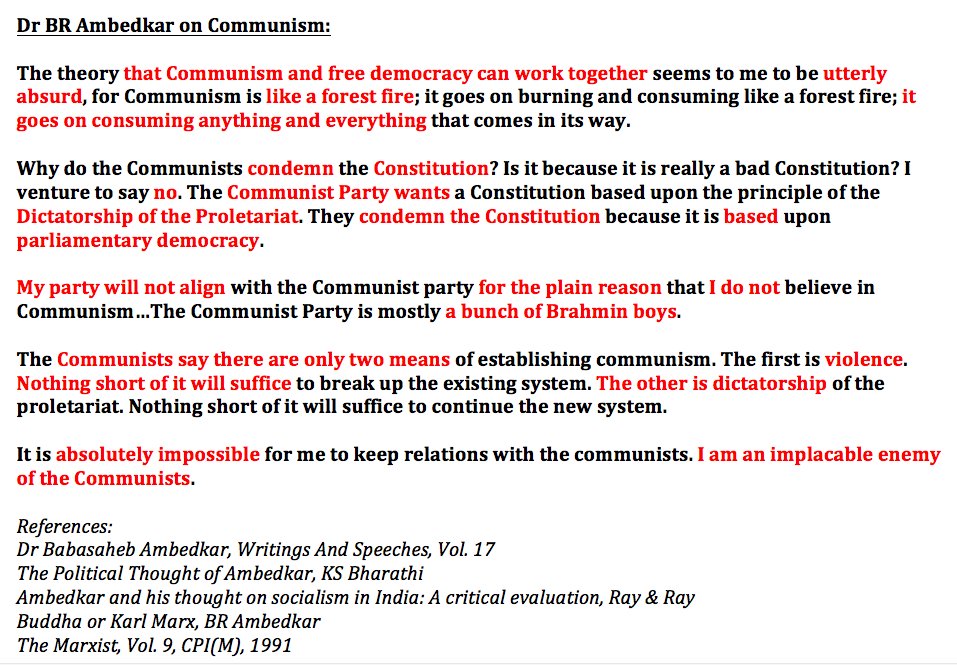
CPI tried their best to downplay Dr. BR Ambedkar who emerged as an independent and prominent Dalit Leader. He was criticized by the communists as a separatist leader, divider of working class, pro-imperialist and opportunistic person. Ambedkar in turn was a bitter critique of Communists. He called himself an “implacable enemy of the Communist” and said that ” It is absolutely impossible for me to keep relations with communist”

Anand Ranganathan on Twitter: "It is absolutely IMPOSSIBLE for me ...
BR Ambedkar on Communists and Communism. Source : Anand Ranganathan

One of the CPI’s founding father E.M.S Namboodiripad called Poona Pact a great blow to freedom movement. He further alluded the caste system to be “a superior economic organisation”. An article in Outlook Magazine reveals the following:

When Ambedkar pushed for the Poona Pact in 1932, demanding separate electorates for Dalits, the Indian Left kept its distance from the issue. Symptomatically, E.M.S. Namboodiripad wrote: “This was a great blow to the freedom movement. For this led to the diversion of people’s attention from the objective of full independence to the mundane cause of the upliftment of the Harijans.”

Borrowing crudely from Marx’s understanding of the history of slavery, EMS found the caste system, despite its exploitative structure, to be “a superior economic organisation”, which facilitated organised production through a systematic allocation of labour.


SOURCE : The Left’s Untouchable, Outlook India

Collusion with Muslim League

Communist Party endorsed the league and backed the demand of Pakistan in order to forge a Hindu-Muslim unity and precisely everything ended up in chaos.

An article titled “COMMUNISTS IN THE MUSLIM LEAGUE” published in Proceedings of the Indian History Congress, 69, 563-573 authored by historian H. Manzer in 2008 serves as an important resource for studying the political relations between Muslim League and the Communists. Some of the important points from the article are mentioned below:

  • The demand of Pakistan by Muslim League was supported by communists with inference to Stalin’s thesis on nationalities.
  • CPI adopted a resolution which declared the movement for Pakistan as “progressive” and urged Muslims to join Muslim League.
  • Communists believed that the demand of Pakistan was not a communal one.

A resolution was passed by CPI in 1939 titled “Pakistan and National Unity” which was not only an endorsement of the demands of IUML but also reflected the willingness of the CPI to back the demand of Pakistan.

Condemning the Constitution

BR Ambedkar criticized the Communist and Socialist party for their condemnation of Constitution. He said that Communist want a Constitution on principle of Dictatorship of the Proletariat and they don’t want a parliamentary democracy.

The condemnation of the Constitution largely
comes from two quarters, the Communist Party and the
Socialist Party. Why do they condemn the Constitution?
Is it because it is really a bad Constitution? I venture
to say no’. The Communist Party want a Constitution
based upon the principle of the Dictatorship of the
Proletariat. They condemn the Constitution because it
is based upon parliamentary democracy. The Socialists
want two things. The first thing they want is that if they
come in power, the Constitution must give them the
freedom to nationalize or socialize all private property
without payment of compensation. The second thing
that the Socialists want is that the Fundamental Rights
mentioned in the Constitution must be absolute and
without any limitations so that if their Party fails to come
into power, they would have the unfettered freedom not
merely to criticize, but also to overthrow the State

-BR AMBEDKAR

Source : Prasar Bharti


Betrayal of National Interest

CPI has several times betrayed the National interest for accomplishment of their own ideology. Top three instances of their ‘betrayal of national interest’ are listed below:

CPI holds that entire border has never been defined, forgets to mention MacMohan Line and endorses the Chinese claims.

The Communist Party had a in dilemma in taking sides during the 1962 war. Betrayal of Communists during the Sino-India conflict and their support to Maoism is very well documented. A detailed and documented account can be found in the following article: The story of GREAT BETRAYAL

  • Betrayal during Bengal Famine(1943): Bengal Famine of 1943 caused 2.1 to 3 million deaths in Bengal only. This was a time when the AITUC was completely taken over by Communists with the help of British. Amidst the crisis Communist took a ‘soft’ approach over the crumbling and unsatisfactory government efforts. DN Gupta mentions in his book “Communism and Nationalism in Colonial India, 1939-45” the following:
Communism and Nationalism in Colonial India, 1939-45
  • Collaboration with British Imperialism : CPI supported British Imperialism during the Second World War. The Nazi attack on USSR was the reason due to which the comrades declared the ‘People’s war’ all over the world and even didn’t hesitate to collaborate with the Imperialism. CPI was officially against the Quit India Movement. In his book ” The Political Role of International Trades Unions” , Gary K. Bosch mentions that “Britain’s only allies in the India were the Communists” and “The British made money and supplies available to CPI to start papers and journals in India; the largest was the English-Language People’s War”. This was the same “People’s War” which ridiculed Subhash Chandra Bose as “the running dog of Japanese General Tojo” .
The Political Role of International Trades Unions : Gary K. Bosch
Cartoons ridiculing Netaji Bose published in People’s War (Source: Organiser)

Gandhi and Gandhian view of Communist

Mahatma Gandhi welcomed non violent version of Communism but was against the violent version. Mahatma Gandhi said “Communism of the Russian type, that is communism which is imposed on a people, would be repugnant to India. If communism came without any violence, it would be welcome. For then no property would be held by anybody except on behalf of the people and for the people. A millionaire may have his millions, but he will hold them for the people. The State could take charge of them, whenever they would need them for the common cause.”

Mahatma Gandhi’s letter to P.C Joshi on 11 June, 1944 on How Communist betrayed Labour Leaders is also an important source.

Correspondence Between Mahatma Gandhi and P. C. Joshi

A large section of Gandhi’s followers disliked the Communists. A striking example is mentioned in the English textbook of CBSE of 12th Standard named “Flamingo”. This is an extract from the book “My years with Boss” authored by the prominent Tamil writer Jagadisa Thyagarajan known by his pen name “Asokamitran”.

My Years with Boss: Asokamitran

Conclusion

Several historical sources, of which a few are mentioned here, shows a strong hypocrisy of the Communists and the Communist Party of India. They stand as a professional failure at all the fronts where their dare to question the Nationalists and try to trap the youth of our country in their propaganda. Their propaganda had severe consequences in past as well as in present. They are a living contradiction to the term liberalism. At many times they have choose to serve their communist masters and have betrayed National Interest. These people deserve to get exposed by their own methods. It’s an urgent need of the hour for the nationalist youth to step up against their vicious propaganda.

Can COVID-19 bring a behavioral transformation and help tackle climate change?

0

Nature created humans to cohabit with millions of other species and share this beautiful planet that could well be a cynosure of all other extra-terrestrial bodies. However, since evolution and aided by a superior ability of thinking, reasoning, intelligence and competence, mankind embarked on a journey fueled by an unstoppable desire to stamp its superiority on everything else and marked by a never-ending greed and extreme selfishness completely disregarding the laws of nature. For hundreds of years now, humans have trodden the mean path of so-called development and advancement not giving two hoots about the balance of nature that is now under complete peril. 

The sudden emergence of a human-killer virus and its aftermath is not a rare occurrence. Viruses like the Nipah, West Nile, Ebola, SARS, MERS have all reminded us from time to time how vulnerable we are as a race. So, what makes the Coronavirus or COVID-19 as the popular name goes, different? It’s a virus that originated in an animal market in Wuhan, China in Dec’19 and has infected and killed humans across the globe decimating the invincible aura that it had falsely associated itself with. The virus, now declared a pandemic by WHO, has consistently proliferated and spread to as many as 206 countries with 12.03 lacs confirmed cases and 64,743 deaths across the globe sending a panic wave hitherto unseen with an incomparable geographic outreach. It has thrashed economies of the world’s richest and most developed countries causing irreparable losses and is gradually pushing the world into a recession it is unsure of recovery anytime soon. The USA leads the chart with the highest number of reported cases at 3,11,635 followed by Spain, Italy, Germany, France & China, all trillion-dollar economies. Italy leads the death toll figures with 15,362 cases so far. These numbers are rising rapidly as I write.

Clearer Venice Canals manifest positivity: Italy is one of the worst hit countries in the world by COVID-19. However, with no human intervention since March 10th, the canals of Venice now boast of crystal-clear water. With things like motorboats effectively grounded, sediment churning and other water pollutants have dropped dramatically. During these tough & uncertain times, such a phenomenon is sure to bring a smile on every Italian’s face.

Sea Turtles lay eggs on empty Odisha beach: With India going into a 21-day lockdown on March 25th, over 4.75 lacs endangered Olive Ridley Sea Turtles came ashore and laid nearly 60 million eggs on a desolate Odisha beach. This is something unthinkable in the normal course and will go a long way in preserving the ecological balance.

Telecommuting helps the planet & businesses stay afloat: With the world going into an ineludible lockdown, companies are now realizing more than ever that their businesses can stay afloat by allowing their employees to work from home. Without the need to commute to workplace daily, people have been able to drastically reduce carbon emissions and traffic congestion thereby contributing to a healthy environment. On top of that, employee productivity has soared, attendances have regularized, and the number of leaves have come down. Overall, the work-life balance has picked up considerably.

But any number of benefits derived from this calamity cannot actually be a justification for the crisis that has befallen humans with millions impacted and thousands of dead. Humans cannot remain indoors forever, industries have to be operational again, transportation needs to commence, businesses must bounce back. Lives of billions are dependent on them and it would be a fallacy to expect mankind to return to primitive ways in 21st century to preserve the balance. But this virus outbreak does provide an inflection point for us to rethink about behavioral transformation, personal consumption, travel habits etc.

To survive and flourish on this interconnected planet, we have to learn to subordinate the needs of the market to our own needs. It is tempting to say that humans are a virus on this planet. That where we recede, nature rebounds. But this would be the wrong climate lesson to take from the pandemic. Humans are part of nature and not detached from it. Any human activity that hurts the environment also hurts us. And humans must understand and realize that they share the planet, not own it.

Countries across the world have taken radical steps to protect and help each other during the crisis. The speed and extent of the response is a clear testimony that swift action could also be taken on climate change if the threat it poses was treated as urgently. Once the pandemic perishes, the real challenge for the world would be to create a functional economy that supports people without threatening life on earth. Covid-19 has taken a massive toll on human lives, economies, health services, jobs and mental health. But it has also shown the difference that communities can make when they look out for each other and collaborate and that’s one lesson that could be crucial in tackling climate change. Lockdowns and distancing may not save the world from warming. But this crisis surely has given us a chance to build a better future.

The un-VICE NEWS, Article 14 and Subramanian Swamy

Vice News, on its YouTube channel, recently published a video titled ‘India Burning (Clip).’ While you may have come across the IGTV video of the same on the Instagram stories of newly formed and very honest Instagram ‘influencers’, who also happen to be the most deserving humans, alongside their utter disgust for our upper parliamentary house, that it constitutes of someone like Dr. Subramanian Swamy.

“How can a ruling party leader say that Muslims are not equal to other humans?”

“This hate-mongering is what leads to communal violence.”

“Ashamed to be an Indian today.”

Hold it there, my ignorant radical leftist screwballs, be honest for once, and try to understand the elaborated position of Dr. Swamy, which he has been reiterating in the house and the media like a beating drum. In the description of the YouTube video, Vice writes that this video clip is part of an investigation to the ‘growing fear that Hindu supremacism may undermine secularism and relegate India’s Muslims into second-class citizens.’ That is justified, right? After all, in the video, Dr. Swamy answers a question by saying, “There is no such thing as equal rights, they are not in a[n] equal category” while referring to illegal Muslim immigrants from Pakistan, Bangladesh, and Afghanistan. Whether this is ignorance of the journalist asking the questions or her mere leftist hypocrisy, she has failed to understand the answer.

Dr. Swamy is not, in the slightest part of his mind, trying to suggest that Muslims are inferior to Hindus in India. Nor is he asserting that a Muslim immigrant is inferior to a non-Muslim immigrant. He simply said that they are not in an ‘equal category,’ so as to say, that inequality does not necessarily mean subordination; it is just different. Non-Muslim Immigrants from Pakistan, Afghanistan, and Bangladesh come to India for a fundamentally different situation and reason. So putting them in the same category as Muslim immigrants from the three countries is misleading to the constitution. It is understood that non-Muslims flee the three countries for avoiding religious persecution i.e. for being non-Muslims. Whereas, the same standard cannot be applied to the immigrating Muslims, as they will not be persecuted for following their religion i.e. being Muslims in the 3 countries. And Dr. Swamy tries to explain his position but was interrupted by the interviewer, so now we cannot know whether he was allowed to elaborate because the clip is trimmed. 

The different or ‘unequal’ (and not subordinate) category of Muslim and non-Muslim immigrants from the relevant three countries is of great emphasis to the application of Article 14 of the Indian Constitution. Article 14 says, ‘The State shall not deny to any person equality before the law or the equal protection of the laws within the territory of India’, often cited as ‘Equality before law.’ Plainly, the article seems to suggest that any person within the Indian territory has equality before the law. So, the apparent imperative is that Muslim and non-Muslim immigrants from the relevant three countries should be equal before the law and for protection of the laws. CAA prioritizes Hindu, Sikh, Buddhist, Jain, Parsi, and Christian immigrants, over Muslim immigrants, by removing them from the category of ‘Illegal migrant’(in the Citizenship Act of 1955) and easing the naturalization rule of 11 years to 5 years. So Article 14 is being violated as this is the inferior treatment of Muslim immigrants.

As Dr. Swamy points out in the video, this is a misinterpretation of Article 14. Article 14, along with its particular case Article 16, has been in perusal by the courts down the ages. And so, understanding the underlying principle is of high relevance in its application. One of the intelligible judgments can be that of Judge Jaswant Singh in Ramesh Prasad Singh vs State Of Bihar, 1978 in the Supreme Court coupled with the citation of State Of Mysore & Anr vs P. Narasing Rao, 1968 used in its judgment. Judge Jaswant Singh in his judgment directed towards the endmost and quoted,

It is well-settled that though Art. 14 forbids class legislation, it does not forbid reasonable classification for the purposes of legislation. When any impugned rule or statutory provision is assailed on the ground that it contravenes Art. 14, its validity can be sustained if two tests are satisfied. The first test is that the classification on which it is founded must be based on an intelligible differentia which distinguishes persons or things grouped together from others left out of the group; the second test is that the differentia in question must have a reasonable relation to the object sought to be achieved by the rule or statutory provision in question. In other words, there must be some rational nexus between the basis of classification and the object intended to be achieved by the statute or the rule’.

Two tests were given in application Article 14 to an ‘impugned rule’. Here, the rule can be seen as the Citizenship Amendment Act or the CAA. The first test requires the classification (here the classification of Muslim and non-Muslim immigrants) must be based on an intelligible differentia, which here is religious community. The second test requires the differentia, here religious community, to have a reasonable relation to the object of procurement, here Citizenship ease. And this where we reach the heart of the issue, the only reason for having a distinction based on religion is because the immigrant’s religion itself puts him in a different situation.

Non-Muslim immigrants, when were in their original country i.e. one of Pakistan, Afghanistan, and Bangladesh, were persecuted for being non-Muslims. So their immigration to India situates them in a different position within the territory of India than the immigration of Muslims form the relevant three countries. And this in line with the statement that comes later in the quoted judgement i.e. ‘there is no denial of equality of opportunity unless the person who complains of discrimination is equally situated with the person or persons who are alleged to have been favoured‘. Since the Muslim and non-Muslim immigrants from the relevant three countries are not equally situated, ease in citizenship procurement for the non-Muslim immigrants is not a ‘denial of equal opportunity’.

The video started with a clip of about 5 seconds, where Dr. Subramanian Swamy is addressing the issue of the CAA in the house. And in the same very address of 10 minutes, Dr. Swamy elaborated his position on Article 14 and cited A.R. Antulay vs R.S. Nayak & Anr on 29 April, 1988, which explains the same.