Home Blog Page 790

Will our academia be ever free of hypocrite liberals?

0

Recent reports of furore over a planned Yajna before the kick-start to a symposium titled Nationalistic Journalism in Current Scenario: Media and Myth, at Delhi’s Indian Institute of Mass Communication (IIMC) on May 20, has once again laid bare the hypocrisy of left liberals, who continue to occupy Indian academia exercising disproportionate influence in the public sphere.

Looking to find more details about the event, I stumbled upon a pro-RSS writer Prathak Batohi’s Facebook post, which gives a good background on the event. Quite clearly, the organizers have an RSS background and conducting Yajna might indeed be their idea of Hindutva assertion in a left dominated IIMC but doesn’t it exposes the hypocrisies of  advocates of free speech that instead of countering the content of symposium itself, they chose to target Yajna, exposing their virulent hatred for anything representing Indian culturalism. And this while shamelessly participating and organizing the Iftar parties across the Universities during Ramzan.

It is also ironical, those who raised slogans demanding Azaadi from India and later from RSS (a change in script as advised by sympathetic news traders) and vowed to fight with all their might to this effect, are suddenly getting scared by a simple Vedic practice of Yajna.

It is the time to say enough is enough to this abhorrent hypocrisies of the left liberals. They have occupied our places of learning for far too long oppressing ideas in conflict with theirs, turning campuses into battlefields by getting into confrontation, often violent, with differing ideologies while conveniently blaming the others abetted by media shops. The seats of intellectual openness have become stifled where dissent is shouted down as saffronization and fascism. And yet claim moral high ground on free speech, tolerance etc.

It will only be proper that the revolution which brought the voice of ordinary and non-privileged people to the forefront and made it the mainstream of this nation’s discourse also finds its way into our academia and truly democratizes those spaces. Sooner the better.

PM Modi’s Make in India- Building the new economic super power in Asia

0

India’s economic growth for 2016-17 stands at a staggering 7.3% yet the country cannot create enough jobs to lift its people from poverty even when having a labor force of 500 million people. Yet 49% are employed in the agricultural sector which only contributes to 14% of the country’s economy.

It’s these contradictions that Prime Minister Narendra Modi wants to change under the Make In India project. This initiative seeks to transform India into a manufacturing hub for vehicles electronic systems pharmaceuticals as well as a hub for hydrocarbon and nuclear energy. This colossal task is the greatest economic reform in modern Indian history that seeks to unleash country’s true potential. Yet change comes at a price. In this report we will analyze the make in India initiative and explain what obstacles the Prime Minister faces and how he intends to solve them.

Primary purpose behind the make in India initiative is not just to transform the economy but to create new jobs. This is one of PM Modi’s top economic priorities. In a land of 1.2 billion people it should come as no surprise that every month nearly a million citizens enter the job market. This makes managing unemployment in India a daunting task. PM Modi’s plan to stimulate economic growth starts with reforming the labor legislation. Presently Indian labor laws make it very hard for companies to accelerate growth thus even though the economy grows at a pace of 7%, it has not yielded more jobs. As a result instead of seeking formal jobs the majority of Indians turned to the informal market. This includes jobs with no fixed incomes and systematic work conditions; such as construction workers mechanics shopkeepers. Currently about 80% of Indians (500 million labor force) is employed in the informal economy.

Ironically Indian labor laws which were meant to protect workers in a formal economy have actually hurt the job market and stimulated an informal economy and poverty. Hence, PM Modi is seeking to pass several legislation that would reform the labor laws. He has already reduced a number of labor laws from 44 to just 5 core legislation, improving the ease of business in India. For example, company registration has become super fast with digitization of whole process. However, the Prime Minister has reached a political dead end. For instance, in September 2015, labor unions affiliated with the political opposition party, Indian National Congress, who represent about 150 million workers launched a nationwide strike. Since then, PM Modi has backed down and there have been no signs that further the core labor laws will change anytime soon. Since his labor laws reforms have reached a political stalemate.

But PM Modi has shifted to stimulate growth by manipulating the monetary policy, in other words, by cutting the interest rates. But here too, PM Modi has reached an impasse. Raghuram Rajan and Urjit Patel the former and present chief executives of the Reserve Bank of India have refused to lower the interest rates below 6.5%. Both men argued that by cutting interest rates Indian banks would give out more loans creating more jobs and small businesses but it would also devalue the currency, meaning inflation would rise. Though, many will argue that leaders must focus on long-term objectives.

However, as an elected official while these actions have electoral consequences, many of his objectives tend to focus on short-term policies. On the other hand Rajan and Patel as appointed public officials have the freedom to focus on long term objectives. So even though PM Modi fully understands that inflation will hurt the economy in the long term, he needs to present short-term results. Rajan resigned from his office in early September yet before he left he established the monetary policy committee. This group consists of six people is responsible for setting the interest rates. Thus even in the absence of Rajan, PM Modi will have a hard time adjusting the interest rates. Ultimately though monetary manipulation is not a substitute for genuine growth.

PM Modi’s desire to reform the economy also depends on the business environment which requires a decent infrastructure and clear tax regimes. According to the government’s five-year plan India needs to invest about one trillion dollars to modernize its railways ports roads highways bridges, digitizing its economy and more. This estimate for 2012 to 2017 amounts to 200 billion dollars annually. However India’s national budget for 2016 stands at 289 billion dollars. In other words, New Delhi does not nearly have enough money to modernize the infrastructure by itself instead. This needs to be funded by the private sector to raise the necessary funds. PM Modi must rely on foreign direct investment.

The attempts to acquire more investment is already yielding results. In 2015, India received a record 40 billion dollar in foreign direct investment, which is an increase of 30 percent compared to the previous year. Yet as high as this amount is not sufficient to fully modernize the business environment India requires. An annual foreign direct investment of at least 100 billion dollars, in fact, the total amount of required foreign direct investment is even higher when one considers the other segments of the economic reforms. The make in India initiative also seeks to increase the manufacturing sector share of the economy from 16% to 25% by 2022.

The government believes that this would yield in at least 100 million jobs in the manufacturing sector and this is where the Make In India initiatives comes full circle for India to achieve such goals and to attract the necessary foreign direct investment. New Delhi must perform its labor and land acquisition laws as well as its tax regimes as improving the business environment also depends on land acquisition laws, better tax system with GST and digitizing of various process. Government of India has made securing Intellectual Property Rights completely digital one superb example is Trademark Registration, which is online and is processed in a few days.

Currently India’s land acquisition law of 2013 requires companies to obtain approval from at least 70% of the local residents before acquiring the land. Since nearly 70% of Indians live in villages the acquisition law complicates matters for companies seeking to expand their base of operations in India. PM Modi is trying to adjust the acquisition law but since the legislation has a direct impact on the majority of Indians it’s an extremely difficult task. One more legislation that the Prime Minister is seeking to adjust is the Goods and Services Tax bill, also known as GST bill. Basically the legislation seeks to introduce value-added tax in India which is a common consumption tax in Europe and many other countries. For outsiders this is hard to imagine. But in India every state has a different tax code as a result one cannot freely transport goods within India. Instead one has to stop at the state borders and pay the entry tax. The biggest complication with these tax regimes is not the tax fee but the dreadful paper work which can take up those several hours.

Obviously, this hinders further economic growth. PM Modi is successfully able to pass GST bill which is most revolutionary tax change in India ever since its independence. This will further boost Indian economy.

भ्रष्ट देशद्रोहियों से निपटने में मोदी सरकार नाकाम?

वरिष्ठ कांग्रेसी नेता और पूर्व केंद्रीय मंत्री पी चिदंबरम के सुपुत्र कार्ति चिदंबरम लन्दन भाग गए हैं. लन्दन भागने के बाद कार्ति चिदंबरम पर प्रवर्तन निदेशालय (ईडी) ने केंद्रीय जांच ब्यूरो (सीबीआई) द्वारा दर्ज भ्रष्टाचार के मामले के आधार पर उनके खिलाफ मनी लांड्रिंग (धनशोधन) का एक मामला दर्ज किया है.

ऐसा पहली बार नहीं हुआ है कि जब कोई व्यक्ति पहली बार देश छोड़कर भागा हो. इससे पहले ललित मोदी और विजय माल्या भी लन्दन भाग चुके हैं और इन दोनों को भी सरकार पकड़कर वापस लाने में पूरी तरह नाकाम रही है.

कार्ति चिदंबरम पर आपराधिक साजिश रचने, धोखाधड़ी, भ्रष्ट या अवैध तरीके से फायदा उठाने, सरकारी अधिकारी को प्रभावित करने तथा आपराधिक आचरण का आरोप लगाया गया है. सवाल यह उठ रहा है कि पी चिदंबरम, कार्ति चिदंबरम और लल्लू यादव पर जो हालिया छापेमारी हुई है, क्या उसके मद्देनज़र सरकार और सरकारी एजेंसियों को पहले से ही इस बात का अंदेशा नहीं हो जाना चाहिए था कि यह सब लोग या इनमे से कोई भी व्यक्ति देश छोड़कर भाग सकता है. क्या सरकार ललित मोदी और विजय माल्या के भागने से कोई भी सबक लेने को तैयार नहीं है? जब इतने बड़े पैमाने पर छापामारी किसी व्यक्ति पर की जा रही है तो जाहिर है कि उसकी पूरी और पक्की खबर सरकारी एजेंसियों के पास पहले से रही होगी. अगर खबर पहले से थी, तो इन लोगों के पासपोर्ट जब्त क्यों नहीं किये गए. क्या हमारी सरकारें छापामारी करके इस बात का इंतज़ार करती रहती हैं कि जब यह व्यक्ति देश छोड़कर भाग जाएगा, फिर उसके खिलाफ मामला दर्ज़ किया जाएगा, ताकि यह भी लगे कि सरकार कार्यवाही कर रही है और अपराधी का भी बाल-बांका न होने पाए.

हालांकि पी चिदंबरम का यह कहना कि उनके बेटे कार्ति चिदंबरम जल्द ही वापस लौटेंगे, लेकिन खुद पी चिदंबरम कब तक भारत में रहेंगे, फिलहाल तो उसी पर संशय बना हुआ है.

सोनिया, राहुल, लल्लू, चिदंबरम, माया, मुलायम जैसे लोगों ने कोई नया कारनामा नहीं किया है. इनके किये गए पुराने कारनामे ही वक्त-वेवक्त इन्हे भारी मुसीबत में डालने के लिए काफी हैं. लेकिन वह मुसीबत आने से पहले ही होता यह है कि जब तक भी इन जैसे लोगों पर कोई सरकारी एजेंसी अपना शिकंजा कस्ती है, उससे पहले ही यह देश छोड़कर जा चुके होते हैं. यह सब एक सोची समझी साज़िश के तहत नहीं होता है, इस पर यकीन करना मुश्किल लगता है. अगर सरकार की नीयत साफ़ है तो ऐसे सभी लोगों के पासपोर्ट जब्त क्यों नहीं कर लेती, जिन पर इस तरह के संगीन आरोप लगे हुए हैं, ऐसे लोगों को सिर्फ उन्ही देशों कि यात्रा करने की इज़ाज़त मिलनी चाहिए, जहां से इन्हे वापस बुलाना आसान हो.

सरकार का निकम्मापन सिर्फ इसी मामले में दिखाई नहीं दे रहा है. कश्मीर में सरकार जो कुछ भी कर रही है, वह किसी भी समझदार व्यक्ति के गले नहीं उतर रहा है. हुर्रियत के आतंकवादियों को पाकिस्तान सरकार पैसा भेज रही है, उस पैसे से पत्थर बाज़ों को भुगतान किया जा रहा है. हुर्रियत के इन्ही लोगों पर खुद हमारी सरकार भी करोड़ों रुपया पानी की तरह बहा रही है. जिन लोगों के देशद्रोही होने में किसी को भी संदेह नहीं है, उन्हें हमारी सरकार जनता से वसूले गए टेक्स के पैसों से ऐयाशी करवा रही है. हुर्रियत,मुफ्ती और अब्दुल्ला बाप बेटे कब तक इस देश की जनता के खून पसीने की कमाई पर गुलछर्रे उड़ाते रहेंगे, इसका जबाब भी मोदी सरकार को जल्द से जल्द देना है.

Did Catch News outsource its take on 3 years of Modi sarkar to the Congress social media team?

We get it. The good folks at Catch do not think highly of Prime Minister Modi.  It’s no surprise then that Catch would carry an article titled  “Dear Mr. Modi, the only growth you have achieved is in propaganda“.

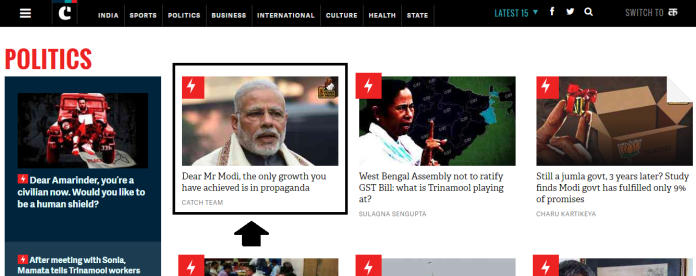
But there is something curious (sinister?) going on with this article. First, I want you to take a look at the article as it is advertised on Catch-News main page.

catch1

As you can see clearly in the screenshot, the article has been written by “Catch Team”.

At this point, you might ask. So what? What’s the big deal about a news website posting its take on 3 years of the Modi government?

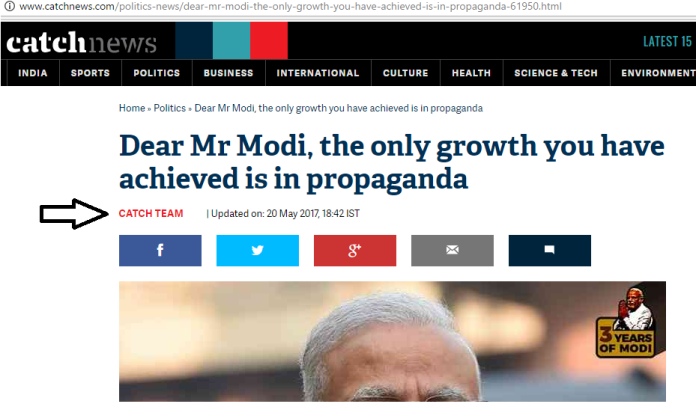
Give me a moment then to click on the article and see what comes up. Here’s the screenshot.

catch2

Well, no surprises here. The expanded view only tells us that this article was posted by “Catch Team”, last updated at 18:42 IST on May 20, 2017.

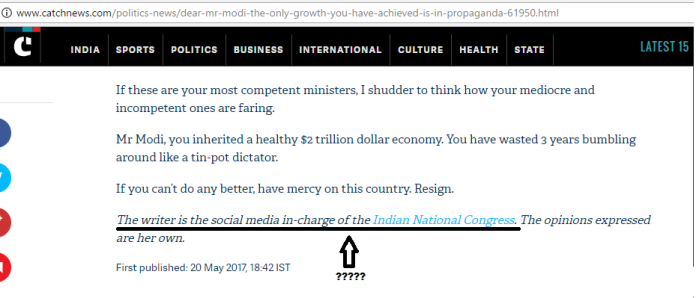
Now the fun begins. Scroll down to the bottom of the article. Here’s what you get.

catch6

It now says that the writer is the social media in charge of the Indian National Congress and also says that the opinions are the personal views of the author. Even the times mentioned at the top and at the bottom of the post are identical : May 20, 2017 at 18:42 IST.

Only the author has changed from “Catch Team” at the top to “social media in charge of the Congress” at the bottom.

So who really wrote this? Did the Congress social media in charge write the official take of “Catch Team” on 3 years of Modi government? Or was it the other way around?

Or maybe they wrote it together? Did “Catch Team” sit down with the social media cell of the Congress party and prepare a joint statement on 3 years of Modi government?

We might have stumbled on to something here … and it seems to be very interesting.

I am sure a reputed and honest organization like Catchnews will have a simple and satisfactory explanation for this. I am sure they will clear all our doubts. And we can go back to treating Catch as a trustworthy news source. Like always…

Pro TipYou can’t delete stuff from the Google web cache.

How Indian economy reacted during the last six months after Demonetization

0

The Turning Point

Before the demonized memories of people standing in long queues outside ATMs and the awe and confusion of the banking activities fades off, let’s recall the Modi’s revolutionary verdict.

On November 8, 2016, the government of India implemented demonetization by recalling Rs. 500 and Rs. 1000 notes which were in circulation. Deadlines were given to exchange the old notes with the new one. Simultaneously, the idea of going cashless is put forward aiming at digitizing the Indian Economy.

Government’s Vision

The Government in its union budget for 2017-18, has outlined various recommendations for promoting cashless transactions, to ease out the mass anguish.

Moreover, various discounts and freebies were discussed and implemented for digital transactions. The emphasis on a cashless economy is outraged to the majority of Indian people who are still outside the banking sector.

However, the government under Modi-ship had taken a series of pre- planned steps. They implemented “bank account for all” mission, yet a majority has not enrolled in the scheme.

Only a few are aware of the ‘going cashless’ methods, literacy in digitization is yet to be earned for a majority. The relevance of the topic stands between such illiterate majority and the benefits for the nation in a cashless economy.

Economy: Going Cashless

India is on its way of becoming a Cashless economy. It will have an economic system where the transaction of money is in digital form other than transacting them in cash.

For example, purchasing a mobile phone using debit or credit card or even through a net/mobile banking transaction comes under the former category and buying it with cash is the latter.

In short, cashless transaction means money is being credited to the account of the seller by debiting the account of the buyer. Only numbers are getting transacted with the approval and one number is being transacted from one account to another. Here, the mobilization of liquid cash is nil.

“Demonetization”: A Boom

Let us navigate through the effects of India going cashless since last six months,

  • Transparency
    Each and every transaction is being accounted. It not only enhances the transparency of transactions, rather curbs corruption and criminal activities which is rampant in the country.
  • Black Money
    The scope for money laundering is limited. Moreover fake currency which accounted to a 1/7th of the total currency was swept off from the system.
  • Better deployment of Government Funds
    The government can channelize its resources. In 2015, Rs. 25 billion were spent on printing currency notes
  • Tax Transparency
    Collection of Tax has improved. Majority of the transactions are being made through banks, the government agencies scrutinizes each transaction and verify if the appropriate tax proceeds are received.
  • Handling Cost Minimized
    The risk and cost of handling currency is minimized. Rather focus on automated banking services has increased manifolds.
  • Regularization of Government policies
    The scope for parallel financing is curbed. The government is now investing in welfare schemes, subsidies, providing aids and grants without any misappropriations.

Transparency International, a global consortium reported that owing to cashless economy drive the crime rate dipped in Sweden, in 2011.

The Real Challenge

With a sudden outbreak of the verdict for a radical change in the transaction mode caused a mass unrest. But the brighter side to it was that the nation had taken a leap towards a cashless economy.

The usage of debit/credit cards in December 2016 almost doubled compared to the previous months and is progressing. However, the allegations are still alive that the Government has not envisaged the limitations in India for practising cashless transactions to a core level.

Some challenges are,

  • Digital divide
    Only 35% are using internet in India. There is lack of uniform access of internet facility across the length and breadth of the nation.
  • Illiteracy
    According to Price Water Hoopers, more than 200 million people are still outside the purview of the banking sector. Neither have they opened accounts nor are using it regularly. Moreover, people are unaware about the usage of debit and credit cards.
  • Resistance to change
    Due to lack of knowledge and access majority of the people are not comfortable in using digital transactions. Moreover, added charges on banking transactions, fuel surcharge etc. demotivate people from going cashless.
  • E-Governance
    The government have to adopt more stringent policies or laws to govern digital transactions. It is alleged that the prevailing laws and regimes are not appropriate in handling cyber crimes.

Though the freebies and discounts available for promoting digital economy are available, the approach of the public for going cashless values more in this context. If the practice of usage of plastic cards or online transactions cannot be visualized in reality, spending nature of individuals may adversely affect particularly for spendthrifts; and they may pull back from such transactions eventually.

The implementation of more POS machines, campaigns on digital transactions and rework on the fundamentals may ease the transactions, the improve its usage and paves the way to the economic stability of the nation.

The author is affiliated with QuickCompany which deals in Company Registration, Trademark registration and Other Legal Activities.

Hindu Astrology: The forgotten science

0

Astrology needs no introduction. Its used in almost every important walk of our life. This science has been passed onto us by our ancestors who themselves were great practitioners and expert predictors. In fact, astrology is also an important part of Vedangas, meaning this knowledge was imparted by Gurus to their Shishyas in ancient India, which ensured its continuation.

In the course of time, our country faced many invasions, and the subsequent establishment of foreigners’ rule, which systematically tried to erode our culture and practices by replacing it with their own. Although damages were done, they were not significant enough to totally wipe out our culture. The fact that astrology is still practiced today is a testament in itself.

Now, there are proponents and objectors of this science. Why I am calling it science is because astrology is based on mathematical calculations, based on which planets are aligned and after which predictions made. Proponents say this is a gift from our ancient Rishis, while those against it say this is pure superstition that does not hold water in our modern world. The problem is that the latter have not provided solid arguments to defuse the backers of astrology. The only premise on which they are basing their argument is that astrologers often go wrong in making predictions and that the astrologers’ community do not concur among themselves. Here lies the problem. Those against astrology have always run into ‘pseudo-astrologers’ and not genuine ones. Had they come across real ones, they would have found it difficult to counter them. Moreover, genuine astrologers are very difficult to find nowadays. BV Raman, KN Rao, etc are some of the astrologers who have done extensive original research in the area of astrology and also made fairly successful predictions.

The point here to make is that astrology as a subject should not be disputed, but astrologers must be. Astrologers making wrong predictions does not mean that astrology is a fake science. Its the astrologers who must be taken to task for misguiding the people and bringing disrepute to this ancient science. The stupid daily predictions supposedly based on one’s zodiac sign that we see on our idiot boxes (TV) everyday must end. This has done serious damage to the profession of astrology. But that does not even seem to be on the horizon. And this continues to give more ammunition to the opponents to target and tarnish astrology.

The current govt. must seriously think about introducing astrology as a subject of study. It must also devise ways to end this stupid everyday predictions that has done more harm than good to astrology. Courts have already given a favourable verdict to astrology, so there is no need to worry from that end. The only thing the govt must ensure is that people should have access to genuine astrology and astrologers. That will certainly preserve the science and will also attract more students towards it.

Women are worthier than just producing kids after marriage

0

I cannot change things which I don’t approve of, but I can try not to do the same myself. The problem is people won’t let me try, because we love to talk about changes, but hate to be the change agent. We see quality life-changing films, and come out of theatre talking about what food to eat next rather than discuss what’s really wrong with our society and how we can fix it; basically, convenience over applying any sense. The mentality of the majority is the by-product of our socio-political condition, we dare not think something different from the majority, and hope to succeed, because that works only in scripted movies and some astray cases, not in real life.

I cannot live a life similar to this or that person, I want to carve out a new path for myself, I don’t care if it doesn’t have a precedent, because I know I have the willingness and dedication to walk on my path. Tomorrow, whatever happens will be a result of my decision and I won’t blame anyone but myself for my failures, and for the fear of failures I cannot live a default scripted lifestyle cut out for women. People who love me will remain by my side, and people who chose to judge me and leave me cos I followed a different path never loved me in the first place.

I love children but I don’t see myself as a mother figure (currently), and I feel that this should be an enough reason for people to stop popping the “when are you planning to take a kid” question, but sadly these things don’t matter to people. What matters to them is age, society and the fact that they need a toy to play with. I cannot just produce a kid because others want a grandkid, cousin or niece. I don’t think I am cheating my husband if I don’t want to have a kid, as I still do love him, and I don’t think that making a kid together is the essential prove of my love. Here I am trying to bridge the gap between me and my spouse, trying to build a new foundation, trying to eke out a decent living, do things which I was never able to do because of lack of money, time and so many things, and on the other side of the spectrum people are busy asking me for good news.

It sometimes feel that my worth is nothing if I don’t produce a kid at an appropriate time. Why can’t I just live for myself, follow my dreams and live according to my wish for some time. I know there is no end to wishes and dreams, but frankly speaking I have not covered even 10% of my dream list. I have made it till here all by myself, and I think I will be able to take the decision when to stop the relentless pursuing of dreams. What is there not to understand in such a simple thing? I don’t want a kid since I am not ready, and if I am not ready then who the hell will feed, nourish, trim and prep my kid for the world? How can people not understand something as basic as that and still ask you to get pregnant because the clock is ticking.

Well, fuck the clock! I am selfish, sallow and self-absorbed. I am afraid I won’t have time for myself, I am afraid my body will change, I am afraid of the pain , and there is nothing wrong in me when I think about myself. I am not some altruistic saint, and I don’t want to be on. To all the “clock ticking” lecturers; what if I go through with giving birth, banking on suddenly having all of my feelings changed as soon as that child is in my hands, but the feelings don’t change? Now I’m stuck being a mother, when that’s really not what I want to be. I’d rather not be a mother at all than be one who deeply regrets it. Not only would I be miserable, but my child would be too.

Why does everything needs to be time bound? If I am supposed or destined to have a kid I will have one, so I don’t need to listen to your “wait till you get older” shit. Suppose hell falls on me and, tomorrow I am not able to conceive, big deal! Why can’t I adopt one? I will love him to no ends, because I don’t need the “coming out of my womb “ feeling to love that kid like a mother.

All the above in no way means that I will never want a kid in future, cos live changes and along with it changes your priority. Oh, I guess I’ll have a kid or two at some point of time, but right now, I don’t know what exactly this means . As of today, I don’t want one, but I still want to feel loved, not considered selfish, or less worthy of being a women.

The rising girl power in India

0

In my school days (I passed 10th standard in 1992 under the state examination system of Odisha, India), I often observed that girls would outshine boys in the school board exams in terms of passing percentage. However, their representation among the top-ranking students used to be extremely low. It was invariably and overwhelmingly dominated by boys. However, steadily over the last couple of decades, girls have displaced boys in the toppers’ list. Moreover, there has been a steady visible increase in female presence in the higher learning institutes of India. These are welcome trends, especially in a country which has been largely a male-dominated society.

Now, let us contrast it with the Indian society’s attitude towards the girl child. One of the indicators through which it can be examined is sex-ratio, i.e., number of females per a thousand of males. As per the last census in 2011, the sex ratio of India is 940. This is an improvement as this figure had hovered around 930 for last four decades. Nevertheless, India’s sex ratio is abysmally low when compared to other regions of world. Sex-ratios in Europe, North America, Latin America, Caribbean, Sub Saharan Africa, and South East Asia are all 1000 or more, showing a greater degree of gender equity. In general, women outlive men because of their greater resistance to disease and death. Due to their higher life expectancy, in a gender-neutral society, women tend to be more in number compared to men, particularly in the older age group.

India’s low sex ratio is only comparable to the Arab world or that of China. The more disturbing figure for India is that the child sex ratio (0-6yrs) has been on a continuous decline since the last half-a-century; from 976 in 1961 to 914 in 2011. Child sex-ratio shows the underlying socio-cultural setting of a society, especially in its attitude towards the girl child. A falling child-sex ratio indicates increased preference for boys which is manifested in the prevalence of female foeticide, infanticide, abandonment of female babies, and neglect of girl children.

All the same, I do believe a turnaround is possible. The key to this possibility is greater female education at all levels. The correlation between Kerala’s high female education (it has the highest female literacy among all states and UTs) and favorable sex-ratio (Kerala’s sex-ratio is 1084) is not a mere coincidence. At its minimum, rise in female education would lead to improvement in the quality of life for women.

Educated women will be able to assert their position both within and outside the family. There has been an improvement in female basic literacy in the last two decades. As per the census data, male-female literacy gap, which remained consistent at about 25% points from 1961 to 1991, declined to 21.6% in 2001 and to 16.7% in 2011. This gap should further decline in the future. My hope comes from my recent field study in Odisha’s rural areas, where I have witnessed groups of young girls cycling to their schools and colleges. I see a similar scene every morning, when scores of girls traverse the road in front of my institute gate that leads to M.S. Ramaiah groups of institutions, Bangalore, India. Be it a remote village in Odisha or a colony in Bangalore city, girls are gradually not only outnumbering boys in educational institutions, but also outmatching them in performances.

Women well-being is complementary to the development of a society. Prof. Amartya Sen, the Nobel laureate in Economics, has advocated in his book ‘Development as Freedom’ the notion that societies need to see women as active participants and not as passive recipients of help. Women education is instrumental in preventing population explosion and improving quality of both individual and family life. Literature shows positive effects of female education on fostering economic growth and combating poverty and child mortality. Women in control of their household’s resources spend more on basic necessities and on the development of their children’s potential than men do in similar circumstances. This feature has been demonstrated in women self-help-groups and studies show this to be valid in larger public spaces and affairs.

With steady improvement in educational status for women, India’s future can only be better. The cascading benefits of women education would get reflected in girls’ performance in all walks of life and other socio-economic development indicators. I believe, in two generations’ time, the majority of important posts in India will go to women. And more power to females would be certainly healthy for the society. After all, contrary to the common belief, the female, with her tougher immune system, is actually the stronger gender.


The author is an Assistant Professor at National Institute of Advanced Studies (NIAS), Bangalore. Currently he is a Visiting Fellow (Subir Chowdhry Fellow 2016-17) at the India Observatory, London School of Economics and Political Science, London.

विरोधियों की चाल पर भारी पड़ते मोदी के 3 साल

मोदी सरकार को बने हुये लगभग तीन साल पूरे हो चुके हैं. 2014 मे जब मोदी सरकार ने सत्ता संभाली थी तो विपक्ष को भाजपा की जीत और अपनी हार दोनो ही हज़म नही हुई थी. एक हारे हुए खिलाड़ी की बौखलाहट विपक्ष के हर नेता में पिछले 3 सालों से साफ साफ देखी जा सकती है. ऐसा कोई षड्यंत्र नही था, जिसे विपक्षी दलों ने पिछले 3 सालों मे अंज़ाम ना दिया हो.

यह ठीक है कि मोदी ने शालीनता के चलते इन षड्यंत्रकारियों पर अभी तक कोई ठोस कार्यवाही नही की है, जिसकी देश की जनता को बेताबी से प्रतीक्षा है, लेकिन विपक्षी दलों के यह सभी षड्यंत्रकारी जनता की नजरों में पूरी तरह बेनकाब हो चुके हैं और पिछले 3 सालों में इन विपक्षी दलों की जनता ने इस तरह से ठुकाई की है कि संसद से लेकर विभिन्न राज्यों की सत्ता भी इन षड्यंत्रकारियों के हाथ से आहिस्ता आहिस्ता खिसकती जा रही है. बिहार और दिल्ली की जनता ने इन षड्यंत्रकारियों के हाथ में सत्ता सौंपकर जो भयंकर भूल की थी, उसका भारी खामियाजा इन दोनो राज्यों की जनता आज तक चुका रही है.

मोदी सरकार ने सत्ता संभालते ही काले धन पर ठोस कार्यवाही करने के लिये एस आई टी गठित कर दी और इस क्रांतिकारी फैसले के बाद सरकार ने तीन सालों में भ्रष्टाचार के खिलाफ ऐसी ऐतिहासिक जंग छेड़ी कि उन सभी लोगों की सिट्टी पिटी गुम हो गयी जिन्होने पूरे देश में भ्रष्ट तंत्र का जाल बिछाया हुआ था. भ्रष्टाचार के खिलाफ जो जंग मोदी सरकार ने छेड़ी, वह विपक्षी दलों को बिल्कुल भी रास नही आई, यह लोग खुलकर तो बोल नही पा रहे थे, दबी दबी जुबान से अपनी नाराजगी जाहिर करते रहते थे.

नोट बंदी तक आते आते इन लोगों के सब्र का बाँध मानो टूट गया और इन्होने दबी जुबान से नही, बल्कि जोर शोर से भ्रष्टाचार के खिलाफ लिये गये इस फैसले का संसद से लेकर सड़क तक विरोध किया. नोट बंदी एक ऐसा फैसला था, जिससे विपक्षी दल और पाकिस्तान एक बराबर और एक साथ परेशान थे. जनता सोशल मीडिया की बदौलत विपक्ष की इस नालायकी को देख भी रही थी और समझ भी रही थी जिसका फैसला उसने अपने चुनाव परिणामों के जरिये सुना भी दिया लेकिन इसे मोदी या भाजपा का सौभाग्य ही कहा जायेगा कि विपक्ष अपनी गलतियों से सबक लेने की बजाये, हर हार के बाद पहले से भी बड़ी गलती करता जा रहा है जिसका सीधा सीधा फायदा मोदी सरकार को मिल रहा है. हाल के चुनावों के बाद अपनी हार के लिये ई वी एम मशीनों को जिम्मेदार बताना विपक्ष को कितना भारी पड़ने वाला है, यह आने वाला वक्त ही बतायेगा.

पिछले तीन सालों में अख़लाक़, रोहित वेमुला,कन्हैया, जे एन यू, लव जिहाद, गौ रक्षा, नोट बंदी और सर्जिकल स्ट्राइक जैसे मुद्दों पर विपक्ष ने मोदी सरकार को घेरने की कोशिश की. अपने चमचों से इन लोगों ने अवॉर्ड वापसी की नौटंकी भी करवाई और याकूब मेमन और अफ़ज़ल गुरु जैसे देशद्रोहियों के साथ भी समय समय पर खड़े नज़र आये. यह लोग समझ रहे थे कि इस देश की जनता का शैक्षणिक स्तर वही है जो आज से 40-50 साल पहले हुआ करता था और यह संसद और सड़क पर शोर शराबा करके मोदी सरकार के बढिया कामों पर पर्दा डाल पाने में सफल हो पायेंगे. लेकिन अपनी तमाम कोशिशो के बाबजूद इन लोगों से यह हो ना सका-अलबत्ता इस कोशिश में यह लोग अपनी रही सही जमीन और जनाधार भी गंवा बैठे.

मोदी सरकार जिस दिशा में आज से तीन साल पहले चली थी, उसी रास्ते पर सरपट दौड़ी चली जा रही है और अपनी आदत से मजबूर विपक्ष अपनी गलतियों से कोई सबक लिये बिना महाविनाश के रास्ते पर उससे भी ज्यादा तेजी के साथ दौड़ लगा रहा है. जब कभी मोदी सरकार के कार्यकाल का इतिहास लिखा जायेगा, यह बात प्रमुखता से लिखी जायेगी कि विपक्ष ने अपनी लकीर बड़ी करने के बजाये, लगातार मोदी सरकार की लकीर को छोटा करने का प्रयास किया, जिसे देश की समझदार जनता ने हर बार पूरी विनम्रता के साथ अस्वीकार कर दिया.

One thing that RSS should change immediately

0

Rashtriya Swayamsevak Sangh (RSS) has always been a soft target of liberal media, which has probably forgotten investigative journalism a long back and only believes in sensationalizing trivial and at times fake news.

Time and again, there have been several instances, the most recent one highlighting how an RSS affiliated organization has issued guidelines to produce “designer and fair” babies.

This news was covered prominently across multiple news channels and digital platforms. A lot of reactions were taken from pseudo secular and pseudo liberal politicians and a self-hypothesized verdict was issued against RSS by biased journalists. A brainwashed army of liberals ensured that no stone is left unturned in broadcasting this news on WhatsApp, Facebook and Twitter.

This is a classic example of “Illusion of Truth”. Many psychologists have conducted experiments on this theory and conclusive evidences have been drawn to prove that if you tell a lie and repeat it again, and again, and again; then it will seem true to a human mind. Some sections of media are simply using this phenomenon against RSS.

A good habit of the TRUTH

The @OfficeofRG had recently posted a beautiful tweet:

Although it was posted in a different context, but would always be applicable on anything we can think of. So it happened, one of the OpIndia contributors Rohit Agarwal wasted no time in exposing the media lies in an article, How fake news about ‘RSS-linked org promising fair babies’ was invented by media. Further, this article also clarifies that the controversial Garbh Sanskar workshop was focused on “Healthy” child and not on “tall and fair” babies as claimed in the media headlines.

Subsequently, a counter view was published on Alt News: The link between Arogya Bharati, that promises genius babies, and the RSS that OpIndia couldn’t find. This article focused on establishing linkages between Arogya Bharati and RSS by quoting multiple tweets, screenshots and snaps of a few people who are probably associated with both these organizations.

At this point, I am not trying to prove or disprove the linkages between RSS and Arogya Bharti. However, the Alt News article failed to clarify the real purpose of Garbh Sanskar workshop.

After the media buzz, the West Bangal Commission for Protection of Child Rights filed a PIL in High Court to ban the Garbh Sanskar workshop. The Hon. High Court then validated the truth (i.e. this workshop is not for tall and fair babies, rather aimed at healthy babies) and termed the PIL as “misleading”. Further, the Court also questioned why such an article was published by The Times of India. A press release available on Arogya Bharti’s website highlights the relevant comments from this judgement.

Unfortunately, as always, none of those news channels and digital platforms has published the truth yet, forget about issuing an apology. Moreover, the social media army of liberals, who made the earlier fake news popular on various platforms, is conveniently ignoring the truth, obviously because it is against their childhood perception of RSS.

How RSS generally communicates and responds:

At times, RSS philosophers and believers join the news debates to counter such false propaganda and reveal the correct perspective. However, as it mostly happens, the news anchors prepare the conclusion even before the debate drama begins and they reserve the right to consider or ignore the views of panelists.

As far as information dissemination is concerned, the RSS some times issues press releases on its websites. The RSS has a twitter handle @RSSorg which was set up in June 2011 and since then it has posted 565 tweets (yes, this is only five hundred and sixty five tweets till 15th May 2017). It also has a Facebook page but very few updates and announcements are posted on it. In nutshell, the digital communication mechanism of RSS has not been designed to address any burning issues in the mainstream media.

What RSS should do?

Today, the digital savvy organizations design integrated (multi-channel) communication strategy, set-up social media command centers, build big data and analytics capabilities, and enable a real-time response mechanism to counter any threats to their brand image.

The RSS does not really need very sophisticated tools and a big team of digital marketing experts. It can start with simple things such as keeping a track of negative and fake news and quickly disseminating the truth through WhatsApp message and Facebook & Twitter posts. The power of internet will do the rest!

For instance, in relation to Arogya Bharti controversy, the RSS could have at least issued a quick clarification to expose the media lies.

If RSS is able to overhaul its communication, then the same can be used to spread tons of good stories about their social services. For example, there are numerous cases of less-publicized disaster relief work (J&K floods, Bihar floods, Chennai floods, Gujarat floods, Andhra and North Karnataka floods, etc. – the list is very long) and social service activities by RSS among backward, underprivileged and tribal sections of society across the country. How about sharing some good pictures and stories of people befitted through such activities or writing about the self-less contribution from its Sevaks?

As Mark Twain said “Progressive improvement beats delayed perfection”! So the RSS must start immediately before another media propaganda goes on air.