The sophisticated art of deducing meaningful information from data i.e. raw facts and figures has become one of the most powerful tools for telling convincing stories. The immensely creative selected few who developed this expertise can portray contrasting shades of pieces of information from the same data points. Although creativity should always be promoted, but practicing this particular skill during reportage defeats the sole purpose of reportage, “generating awareness.”
The so-called fourth pillar of our democracy, Mainstream Media, displayed an unbelievable creativity in their reportage last month. The unfortunate events that occurred in Kerala taking lives of hundreds and wiping out hundred of crores was deemed as an act of god. They not only called it a “natural” flood but also the worst flood in a century. News sources dug in data for the entire century, compared it with different years. Some of them went a step ahead and presented the percentage increase in the rainfall for specific days of the month. As if we humans have a written contract from the mother nature that every year same amount of rainfall will happen on the exact same days. All, literally all the media sources showed processed information like these:
Quite interestingly the data points, the numbers mentioned are correct, however the information conveyed is misleading. How?
After reading statements like: “The rainfall was ‘n’ times the normal or “x” percent more than the normal”, I started wondering what normal is? How is normal calculated? I found a definition for normal:
“Normal” precipitation to a meteorologist is an average of the precipitation values over a 30-year period.”Normal” precipitation does not equal “what you should expect.” Precipitation may very often be either well above or well below the seasonal average, or “normal.”
As per ENVIS Center Kerala Kerala State Council for Science, Technology and Environment (KSCSTE):
Average Rainfall during southwest monsoon (June 1 to September 30) in Kerala is 2250-2500mm. Below is the actual rainfall received in Kerala during the Southwest Monsoon season for past few years:
In 2012: 1551.3 mm against a normal rainfall of 2309 mm
In 2013: 2570.3 mm
In 2014: 2163.3 mm
In 2015: 1514.3 mm
In 2016: 1352.3 mm
In 2017: 1855.9 mm
In 2018 (till date) the actual rainfall is less than 2500 mm.
Now, read the news headlines again (shown in the picture above), especially the one in red rectangle. The news item misleads in the following ways:
“So, far there has been 2346 mm of rainfall instead of the average 1649 mm.” 1649 mm was the normal rainfall and not the average rainfall.
“Kerala received 42% more than usual rainfall.” It is 42% more than normal, which is a mathematical term and cannot be replaced by usual.
The worst part, this particular news clipping is from CWC’s report, but the media source intentionally changed the key words to give it a different face. (You can find the similar looking line here at page 32 of CWC report)
“Average” annual rainfall is different than the “Normal” rainfall and “usual” is an English word. What is the usual rainfall for Kerala? Normal, Usual, Average used interchangeably gave everyone an impression that this amount of rainfall was expected but it rained too much. After this year’s southwest monsoon the “normal” has already increased to 1931 mm. Normal rainfall is a mathematical term and not the “expected” rainfall. Moreover, the mathematically calculated normal 1649 mm for this year is not even 100 mm more than 2012’s (1551 mm rainfall) which was called as drought by the Kerala Government. This proves that comparing rainfall with mathematical normal rainfall is misleading in this context. Further, media also tried to amplify the rainfall in Kerala by comparing it to states like Delhi, which even in ideal scenarios receive approximately one fourth of the rainfall Kerala receives.
Floods in India is nothing new. Every year one or the other state witnesses a flood. We don’t care about the losses incurred because of them. Do we? Please have a look at my previous article on floods and democracy. The floods in Kerala were misrepresented. Why the need to create a tsunami effect out of a flood?
What does anybody gain by exaggerating a flood? Why the need?
I don’t know. This could be a tactic to create pressure on different entities to donate. Money in crores flowing in from all directions; asking for international aid; going to the UN for funds. Like we read 2G,3G, CWG or Coal gate today; we might read about a flood gate a decade later; one of the biggest scam of the century. I don’t know. But, I know one thing for sure; whatever comes out as the reason, nobody would point fingers towards media. Because if anybody would do that, it would be called fascism, undeclared emergency, threat to democracy, targeting media, killing the messenger and what not.
Coming back to issue at hand, having said all this, it is also a fact that there was overwhelming water all over the place. Streets, houses, farms, everything was submerged in water. How did this happen? The answer to this question is available in the report published by Central Water Commission. Surprisingly, neither the state with 100% literacy and most politically active people nor the intellectuals or so had time to go through the report. Perhaps they were busy in Social media trolling, keeping a track of how many states transferred how my crores, humiliating the ones, who dint contribute.
After reading the CWC report on Kerala, a variety of questions came to my mind. Some of the questions are mentioned below. If you find any merit in this article of mine, please stay tuned for my views on the CWC report. Till then be safe, read the newspaper carefully, they are dangerous!!!
Was Gadgil Committee report brought into the discussion to divert the attention from something? Was it a cover-up attempt?
Is it really a global warming issue or something else?
Are government institutes incapable of managing water resources? Has the time come to scale up the public private partnerships in this field?
Is Kerala staring at a real disaster? What happens if rainfall crosses 2500 mm mark in coming years? This time till today it has not reached 2500 mm mark.
It was during the casual talks with my political science professor that we both marveled at the fact that Hitler killed six million Jews and everyone hates Nazism but the communists in USSR marched more than sixty million people on road to starvation, cannibalism and finally a pathetic cockroach like death but hardly anyone knows about it, we never read about it in our textbook and people are still in love with the utopia promised by communism. We indeed wondered why so?
The theories of international conspiracies to keep this information from the general public’s education seemed far-fetched thus ambitious theories were squatted down. But the questions still remained.
Why do we still have communists praising Lenin and Stalin? Why are Indians blinds to the dangers of communism? Below the articulated famine of Holodomor under the communist regime.
famine under the communist regime.Horrific cannibalism that communism had gifted to the world
Do the images resemble equality and a paradise where everyone is happy living in paradise? Why is the keeda of communism still squirming inside the belly of our beloved Bharat Mata? Who is feeding it? Nurturing it? How do we do the gruesome surgery to get rid of it?
I finally found the answers back in 2016 during the American election. 2016 was also the time of JNU student uproar with Kahnaiya Kumar, Umar Khalid Shehla Rashid started rising to prominence, deeply troubled by the state of our nation and absolute helplessness of our government I decided to punch in the words Jawaharlal Nehru University into the search engine of Wikileaks. I am going to post evidence of what I found in those vaults. It took me some time to recover from the shock and absolute pathetic condition our of our nation.
Wikileaks.org is a journalistic venture founded by Julian Assange who now sits captive inside the Ecuadorian Embassy, without any internet access or any and communication visitor privileges. He is help captive by the UK government against two United Nations Rulings for revealing the crimes of US in Iraq, Afghanistan and how American Mainstream Media rigs democracy to favour their chosen candidate, Hillary Clinton.
The following photos are taken from Global Intelligence files of CIA and Public Library of US Diplomacy Cables. These are internal CONFIDENTIAL and CLASSIFIED cables of United States of America leaked by Wikileaks in 2012.
Student unions used by foreign countries to pressurize the democratically elected government. (Following emails are from 1979)
Who does this country belong to? Democratically elected governments or foreign powers who can arouse mass protests and marches by student unions and fake NGOs?
Damning documents CIA files acknowledging fraudulent foreign funds laundered to Universities. What is this nonsense? When all this is public knowledge when will our governments take action against these? What are the journalists doing of India? Sleeping? Why no probes into these matters? Why no stories? Or they are paid by foreign bosses to keep their mouth shut? We know!
Let me get back to the subject I intend to discuss. While I researching US elections and the Wikileaks I came across the name Yuri Benezmov in one the underground blogs I was reading. He was a KGB spy who had defected to Canada and expelled all the secrets of USSR.
He came on Canadian National TV to give blow by blow account of he as KGB agent stationed in India used the methods of ‘subversion’ and ‘DISINFORMATION’ disguised as helping member of USSR government to spread false stories about communist regime.
‘Whoever controls the image of the past determines what and how future generations will think; whoever control the information and images of present (mass media) determines how those same people will view the past. “He who controls the past commands the future. He who commands the future conquers the past!” : GEORGE ORWELL
Yuri Benezmov expelled in interviews and books he gave later that the main aim of KGB was never spying on other countries, but spreading disinformation about their own country. (Following excerpts taken from his interview and book “World Thought Police”)
“At that time the ideologues and experts of the CPSU CC had worked out a new line for the KGB operations which later became known as “active measures.” These measures had little to do with the classic, romantic style of espionage and subversion of Stalin’s era. Reliable sources confirm my estimate that only about 15% to 20% of the time, money and labor force was planned to be used by the KGB’s affiliates such as Novosti for “James Bond” type espionage. The remaining 80% of the effort was directed to the creation of an ideological climate in the target countries which would enable Soviet agents of influence simply to buy (or “borrow”) the required intelligence data, using mostly rather legitimate and overt methods.”
Communists like to believe their ideology will bring UTOPIA on earth! Is this Utopia?
“There is no qualitative change in the Soviet concentration camp system. There are changes in [the] numbers of prisoners. Again, [these are] unreliable Soviet statistics. We don’t know how many political prisoners are there in the Soviet concentration camps. But we sure know from various sources, that at each particular time, there are close to 25 to 30 million of Soviet citizens who are virtually kept as slaves in [the] forced labor camp system. [The] size of [the] population of [a] country like Canada is serving terms as prisoners. So I would say that those intellectuals who try to convince [the] American public that [the] concentration camp system is a thing of the past are either conscientiously misleading public opinion or they are not very intellectual people; they are selectively blind; they lack intellectual honesty when they say that.”
Here’s what he has to say about he used to make fools out of Indian intellectuals!
“After initiation into the secrets of the APN kitchen, I was given extensive training in P.R. activity with numerous delegations of foreign guests of Novosti visiting the USSR. A typical “package tour” would include not only regular visits to “average” collective farms and kindergartens, talking to smiling milkmaids and to nicely-dressed Eskimos who spoke fluent English and played the grand piano in the woods in Siberia. More importantly, every foreign guest must be made a part of the process of deception. And that takes a person like myself: easy-going, friendly, knowledgeable about the country of my guest, with a small weakness for foreign liquors, slightly cynical about the thugs in the Politbureau, able to crack an anti-Soviet joke at an appropriate moment, but above all, able to arrange meetings with newsmakers, people who are usually unavailable to an average journalist.
This is a better picture, which reflects the true ‘spirit’ of the Soviet childhood. This picture was printed in a Canadian government publication by mistake. In the middle, you can see children playing on a small courtyard. And the caption goes, ‘This is a typical kindergarten in Siberia.’ What these idiots didn’t understand [was] that it is not [a] kindergarten at all. It is a prison for children of political prisoners. But there was not a single [mention] that what they were visiting actually was an area of concentration camps. And [it was] the job of people like myself, to help them not to notice that they are actually talking to prisoners. Most of the children were dressed, especially on the occasion of the foreigners’ visit. Of course there were no corpses on the ground. There were no machine gun guards. And well it looks not very pleasant as you see; it looks dull, but obviously does not create an impression that this is actually a prison.
On October 27, 1967, I brought a large group of editors and publishers of India’s leftist and Communist papers to the Central Committee to meet comrade Yakunin; and later comrade Ulyanovski, a boss in Agitprop. The Indians had just finished a three-week tour of the Soviet Union. I showed them all the “typical” collective farms and kindergartens Novosti could arrange, and the comrades were full of impressions and “provocative questions.” They were what we call “unscared idiots” and “truthseekers,” who wanted to show they took our propaganda seriously and expected us to do what we preach. They looked as if they believed they were invited to Moscow to exchange opinions”
You can see here in [the] Kremlin, I am [the] second on the left, with a group of Pakistani and Indian intellectuals. Most of them pretended [that] they don’t understand that we are actually working on behalf of the Soviet government and the KGB. They pretended that they are actually being guests—VIP intellectuals—that they are treated according to their merits and their intellectual abilities. For us they were just a bunch of political prostitutes to be taken advantage [of] for various propaganda operations.
Therefore you can see perfectly well the senior colleague of mine on the left doesn’t really have that much respect on his face, and [me] with a very skeptical smile, [a] typical KGB sarcastic smile, anticipating another victim of ideological brainwashing.
This is how a typical conference in [the] Novosti headquarters in Moscow [looks]. Sitting in the middle is Boris Burkov, the then director of Novosti Press Agency, [a] high-ranking Party bureaucrat in the Department of Propaganda. I am standing next to a famous Indian poet, Sumitranandan Pant. He was famous because he was the author of a famous poem, [entitled], ‘Rhapsody to Lenin.’ That’s why he was invited to [the] USSR, and everything was paid [for] by the Soviet government.
Pay special attention to [the] number of bottles on the table. This is one of the ways to kill the awareness, or curiosity of foreign journalists. One of my functions was to keep foreign guests permanently intoxicated. The moment they landed at Moscow Airport, I had to take them to the VIP Lounge and toast to friendship and understanding between the nations of the world. [A] glass of vodka, then a second glass of vodka, and in no time my guests would be feeling very happy, they would see everything in [a] kind of pink, nice color, and that’s the way I had to keep them permanently for the next fifteen or twenty days.
At [a] certain point in time, I had to withdraw alcohol from them, so that some of them who are the most recruitable would feel a little bit shaky, guilty, trying to remember what they were talking [about] last night… That’s the time to approach them with all kind[s] of nonsense such as ‘Joint Communiqué’ or [a] statement for Soviet propaganda. That’s the time they are the most flexible. And of course what they didn’t understand—they didn’t realize or pretended not to realize that [I], who was drinking together with them, was not drinking at all; I had ways to get rid of alcohol through various techniques, including special pills which were given to me by colleagues. But they were taking it seriously; in other words, they would consume quite a large [volume] of alcohol and feel quite uneasy [the] next morning.
This is the first stage of befriending a professor. You can see [me] on the left, with the same James Bond smile. On the right is my KGB supervisor, Comrade Leonid Mitrokhin. And in the middle: a Professor of Political Science in Delhi University.
The next stage would be to invite him to a gathering of [the] Indo-Soviet Friendship Society.
Everything is paid [for] by the Soviet government. He was made to believe that he is invited to [the] USSR because he is a talented, sober-thinking intellectual. Absolutely false: He is invited because he is a useful idiot, because he will agree and subscribe to most of the Soviet propaganda cliché[s], and when he [comes] back to his own country, he is going for years and years to teach the beauties of Soviet socialism, to newer and newer generations of his students, thus promoting the Soviet propaganda line.
I would bet that if, in some distant future, all the “progressive” Indians would get together, they might discover a lot in common about their trip to the USSR.
Look how Indian government was made fool by KGB agents:
In Bangladesh, it was nothing [to do] with grassroots. Most of the Awami League party members—Awami League means ‘People’s Party’—were trained in Moscow in the high party school. Most of the Mukti Fauj leaders—Mukti Fauj in Bengali means ‘People’s Army.’ [It’s the] same as SWAPO and all kind[s] of ‘liberation’ armies all over the world, the same bunch of useful idiots. They were trained at Lumumba University and various centers of the KGB in Simferopol and in Crimea and in Tashkent.
So when I saw that India—Indian territory—[was] being used as a jumping board to destroy East Pakistan… I saw myself thousands of so-called ‘students’ traveling through India to East Pakistan through the territory of India, and [the] Indian government pretended not to see what was going on. They knew perfectly well, the Indian police knew it, the intelligence department of [the] Indian government knew it, the KGB of course knew it, and the CIA knew it.
Anyway, so East Pakistan was doomed. One of my colleagues in the Soviet consulate in Calcutta, when he was dead drunk, he ventured into the basement to relieve himself, and he found big boxes, which said ‘Printed Matter to Dhaka University.’ (Dhaka is the capitol of East Pakistan.) And since he was drunk and curious, he opened one of the boxes and he discovered not printed matter; he discovered Kalashnikov guns and ammunition in there. Anyway, it’s a long story.
When I saw the preparations for the invasion into East Pakistan, obviously I wanted to defect immediately. The only thing [was that] I couldn’t at that time make up my mind [about] when and where and how.
What worth was our freedom? What worth is our democracy and journalism? If you have a problem believing any of this is true google the name of Malcolm Murridge. He was a journalist for Manchester Guardian who exposed these practices of Soviet back in 1930 and lost his job and reputation for speaking the truth. The world only acknowledges his contribution now. Google Holodomor Famine and see for yourself. Also there have been many spies who have defected bearing the same story as Yuri. Aleksandr Solzhenitsyn’s Gulag Archipelago, two thousand and seven hundred page book details the prisons and camps built by Lenin and Stalin. Other defected spies such as Ladislav Bittman, Vladimir Bukovsky wrote books such as Deception Game, The KGB & Soviet Disinformation and To Build A Castle : My Life as Dissenter.
Read further to know how communists manipulated Indians:
Another frequent assignment was coverage of “press conferences” with visiting Indian VIPs. I remember when, in July of 1966, Mr. Kumaraswami Kamaraj, an outstanding member of the Indian National Congress Party and an opponent of Indira Gandhi’s faction, came to Moscow. The Kremlin wanted to cultivate him, as he might win the intra-party struggle for leadership and become the prime minister. On July 30, Novosti and Foreign Affairs staged a marvelous farce in the grand hall of the Metropol Hotel.
The Indian guest pretended not to notice that “media representatives” asked him only questions which already contained answers, and most of the answers were in favor of Soviet foreign policy. Every Novosti person, including myself, prior to arriving at the Metropol, had been given his “questions” typed on a piece of paper, to memorize, or to read aloud if memory failed. My question was about the positive effect of the spirit of the Indo-Pakistani peace conference of Tashkent on the establishment of stability and mutual security on the Indian subcontinent. Getting Mr. Kamaraj’s affirmative answer, I simply incorporated a few of his words into an already typewritten “report” on the press conference.
This is how they took care of Moraji Desai back in the 60’s:
Slander, defamation or libel directed against a foreign person– a politician, writer, publisher, etc.– preferably an influential and anti-Communist (conservative, patriotically-minded person), resisting Soviet influence in his own country. The list of most desirable targets for the Novosti-KGB-orchestrated process of character assassination includes virtually every prominent public figure of the Free World daring to criticize Soviet foreign policy or Soviet practices at home. In India during my career with the Soviet embassy, such [a] target was Mr. Morarjee Desai, leader of “conservative opposition” to Indira Gandhi’s ruling National Congress party. With financial and ideological encouragement from Novosti, collaborators in the leftist liberal media poured gallons of venom on that person, describing him as a “reactionary, fascist, ultra-right-wing fanatic, lackey of Western imperialism, etc.” Apart from name-calling, Novosti-sponsored radical tabloids published bits and pieces of rumors, half-truths and pure fabrications, designed to discredit this politician. It is difficult to distinguish, sometimes, a locally created hate campaign against a conservative politician from a Novosti-orchestrated one.
In reality, the main emphasis of the KGB is not in the area of intelligence at all. According to my opinion and [the] opinion of many defectors of my caliber, only about 15% of time, money, and manpower [are] spent on espionage as such. The other 85% is a slow process, which we call either ‘ideological subversion,’ or ‘active measures’—‘[?]’ in the language of the KGB—or ‘psychological warfare.’ What it basically means is, to change the perception of reality,
It’s a great brainwashing process, which goes very slow[ly] and is divided [into] four basic stages. The first one [is] demoralization; it takes from 15-20 years to demoralize a nation. Why that many years? Because this is the minimum number of years which [is required] to educate one generation of students in the country of your enemy, exposed to the ideology of the enemy.
See any similarities?
Closing:
“My first assignment was to India as a translator with the Soviet [Economic] Aid Group, building refinery complexes in Bihar State and Gujarat State. At that time I was still naively, idealistically believing that what I was doing contribute[d] to the understanding and cooperation between the nations. It took me quite a number of years to realize that what we were bringing of India was a new type of colonialism, [a] thousand times more oppressive and exploitative than any colonialism and imperialism in [the] history of mankind. But at that time I was still hoping that well, maybe it’s not that bad, [it] could be worse, and things may go for [the] better. And I even tried to implement the beautiful Marxist motto, ‘Proletarians of all the countries unite!’
Yuri in India
Second, when I started working for the Soviet embassy in India, to my horror I discovered that we are millions [of] times more oppressive than any colonial or imperialist power in the history of mankind, that my country brings to India not freedom, progress, and friendship between the nations, but racism, exploitation, and slavery, and of course economical inefficiency to this country. Since I fell in love with India, I developed something which by KGB standards is [an] extremely dangerous thing. It’s called ‘split loyalty’: when an agent likes a country of assignment more than his own country. I literally fell in love with this beautiful country, a country of great contrasts, but also great humility, great tolerance and philosophical and intellectual freedoms. My ancestors used to live in caves and eat raw meat when India was [a] highly civilized nation, six thousand years ago. So obviously the choice was not to the advantage of my own nation. I decided to defect, and to entirely disassociate myself from the brutal regime.”
This was the work of one of the HUNDREDS of Soviet spies working inside Indian Government machinery.
And the final nail in coffin.
Back in the late 70’s there was a huge scandal that ruffled some feathers. It was regarding history textbooks of NCERT containing questionable material such as ‘Brahmins eating beef’ written by Romila Thapar.
When you punch in the name ‘Jawaharlal Nehru University’ into the search engine of Wikileaks, hundreds of emails pop up! Thats when you realize the highly disproportionate amount of foreign policy advisers and politicians are from JNU. I dare people do look into it!
Above! Disgraced Romila Thapar goes begging to West to pressurize the government. Does India belong to one billion Indians or few intellectuals sitting on their high horses.
The Communist Party of India was MN Roy and Abinath Mukherjee by the blessing of Lenin in USSR. Abhinath was shot dead in the great purge in USSR under the rule of Stalin
Do we dare connect all the dots?
So many of the current writers of NCERT are from JNU. People who are writing our textbooks can be found protesting with the likes of Shhla Rashid, Kahaniya Kumar
Below!
Jarius Banaji Speaks “The culture of political Fascism” at #IstandWithJNU
You can find his name inside the NCERT books. Look at the number of people worked at JNU and people who are still faculty of JNU writing our history textbooks!
Tanika Sarkar one of the contributors to NCERT textbooks talks about the importance of anti-nationals!
Chief Advisor for NCERT history textbooks Neeladari Bhattacharya with Shehla Rashid
List of professors and ex JNU students who have contributed to NCERT history textbooks. This should raise some eyebrows!
10th Std
Brij Tankha, Professor, Department of East Asian Studies, University of Delhi (graduate education from JNU)
G. Balachandran, Professor, Graduate Institute of International Studies, Geneva (M Phil from JNU)
Janaki Nair, Professor, Centre for Studies in Social Sciences, Kolkata (Now teaches at JNU. Wrote and article in Indian Express supporting Kahaniya Kumar)
Tanika Sarkar, Professor, Centre for Historical Studies, Jawaharlal Nehru University, New Delhi
Udaya Kumar, Professor, Centre for Studies in Social Sciences, Kolkata (M. Phil from JNU)
11th STD
ADVISOR
Narayani Gupta, Professor (Retd), Department of History, Jamia Millia Islamia, New Delhi
MEMBERS
Jairus Banaji, Visiting Professor, Jawaharlal Nehru University, New Delhi
Arup Banerji, Professor, Department of History, Delhi University, Delhi (Phd and Graduate studies from JNU)
Sunil Kumar, Associate Professor, Department of History, Jawaharal Nehru University, New Delhi
Shereen Ratnagar, Professor (Retd), Centre for Historical Studies, Jawaharlal Nehru University, New Delhi
12th STD
ADVISORS
Kumkum Roy, Associate Professor, Centre for Historical Studies, Jawaharlal Nehru University, New Delhi
TEAM MEMBERS
Farhat Hassan, Reader, Department of History, Aligarh Muslim University, Aligarh, UP
Jaya Menon, Reader, Department of History, Aligarh Muslim University, Aligarh, UP
Kunal Chakrabarti, Professor, Centre for Historical Studies, Jawaharlal Nehru University, New Delhi
Muzaffar Alam, Professor of South Asian History, University of Chicago, Chicago, USA. Muzaffar Alam is a historian trained at Jamia Millia Islamia (New Delhi), Aligarh Muslim University and Jawaharlal Nehru University
Najaf Haider, Associate Professor, Centre for Historical Studies, Jawaharlal Nehru University, New Delhi
Partho Dutta, Reader, Department of History, Zakir Hussain College, (Evening Classes), University of Delhi, Delhi (Currently teaches at JNU), PhD (Department of History, Jamia Milia Islamia), 1999.
Rajat Datta, Professor, Centre for Historical Studies, Jawaharlal Nehru University, New Delhi
Ramachandra Guha, freelance writer, anthropologist and historian, Bangalore
Vijaya Ramaswamy, Professor, Centre for Historical Studies, Jawaharlal Nehru University, New Delhi
The death tolls: Communists top with a bang!
If communists are writing the history textbooks of our nation no wonder the youth is misguided into becoming communists and Urban Naxals. We are not taught the deadly communist history which has led to the death of around 100 million people, close to twenty times what Nazism has said to have killed.
India has hundreds of good universities! Why is JNU given such preference? What is the agenda? Are rest of the universities useless? Who will provide the answers? These are the answers the nation actually wants to know!
The Sarsanghchalak of the RSS, Shri Mohan Bhagawat ji’s recently held Samvad in Vigyan Bhavan with a large diaspora of people, specially intellectuals in the country appealed to many as his speech is more inclusive, more balanced and more articulate that no one could raise any controversy over what he said in his three-day series of lectures. Some of the journalists pointed out that the cadres are not walking the talk. Barring that there was no buzz.
Of course, people who heard eulogized him. The only person who passed snide comments on the talk was the Hyderabad M.P. Assaduddin Owasi. He quoted as usual from Shri Golwalkar’s ‘Bunch of Thoughts’ about what Shri Guruji said about the Muslim and Christian minorities. And also, about Shri Savarkar’s formulation of Hindutva. Mohan Bhagwat ji unequivocally says in his speech that the Organisation RSS has moved with the change of time and situation in the present-day- contemporary scenario of the country.
Owasi’s questions on the RSS’ founders’ bygone sayings that have no relevance now. Doctor ji (Shri KB Hedgewar) and Savarkar were pre-independence revolutionary leaders. Their thoughts pertained and were more relevant to that time and situation where Congress was almost kneeling down before the All India Muslim League to placate the party so as to fight the freedom struggle. Gandhi ji’s support for Khilafat is a fact. Why then, Muslims of pre-independence associating themselves with what was happening in the Caliphate in Turkey? Why Gandhi ji associated Muslims of India to the Muslims elsewhere in the world and showed sympathy for the Khilafat movement? Similarly, the Mopla movement also. Why Jinnah asked for separate land Pakistan exclusively for Muslims if they had not had a separatist tendency then?
Change is the law of life. Now we are in a post-independence era. With more than 70 years of Independence much water has flown. Muslims of now are an integrated whole in Indian culture. They are not paying much attention to the international affairs in other Islamic countries. For instance, when US president Donald Trump declared Jerusalem as the capital of Israel recently, Indian Muslims did not take in any Dharnas as they had done during Khilafat. In the same way as a mark of joining in the mainstream, they themselves have asked for the removal of instant triple talaq. This country cannot progress by alienating nearly 20% of its Muslim population, is a fact.
If Owasi had to ask about the past of the RSS, some tough questions are in store for him. That leads to bitter arguments even which he had to face. For example: What is his opinion now on Qasim Rizvi’s Razakar movement in Hyderabad? Why it became so difficult for Nizam’s Hyderabad state to get integrated with the rest of India after Independence? Owasi is the torch-bearer of the same Razakar party Majilis Itehaddul Muslimeen (MIM). So, the onus lies on him to answer. Razkars killed, nay, literally mowed many Hindus during that Razakar-movement- time.
Sardar Vallabhai Patel had to intervene with all vigour. He cordoned Hyderabad state with his Police Action and eliminated Razakars and integrated the state into India. Thus, Patel integrated many princely states and galvanised the whole country into Indian Republic. Can Owasi hold a brief for Sardar Patel, the first Home Minister of India? Before asking Bhagawat ji what his opinions on RSS founders’ views of yore which in any case he clarified, Shri Owasi should make clear his answers whether what Qasim Rizvi had done, was correct? Does he still support his MIM founder? Why he had not changed the nomenclature of his party etc.
His questioning of Bhagawat ji is like the pot calling the kettle black.
If we want to compare the leadership quality and character of the two of India’s Prime Ministers, i.e., Narendra Modi and Manmohan Singh, certainly no one can beat Mounmohan Singh sorry Manmohan Singh with reference to how shamed India with several allegations of scams.
PM Modi chants Bharata Mata Ki Jai while Manmohan Singh chants Sonia Mata Ki Jai. Modi believes in merit and democracy but Manmohan Singh loves to follow the cult of dynasty and wants to promote merit-less-ness.
When we can credit BJP for running the first corruption and scam free government since independence, Manmohan Singh alone can claim the exclusive title (at least at the perception level) for running the most corrupt and scam filled government since independence.
Modi when focus on skill India concept, Manmohan Singh has filled India with scams to a proportion that no one can beat him in future. When BJP tries to make India scam free, Manmohan Singh alone can claim the right and title for making India corruption rich. Modi when converts adversity into opportunity, Manmohan Singh has pleaded to India about his coalition compulsion as the possible reason for scams. When Modi empowered people to propagate the mission of development and sab ka vikas, Manmohan empowered 10 Janpath to develop the dynasty and its vikas.
The question is why Manmohan Singh as PM has proven disastrous to India when the same Manmohan Singh who reformed and re-shaped India from an imminent economic chaos when he was the finance minister of Narasimha Rao Government? The answer is simple. When Manmohan Singh was the Finance Minister it was democracy that was ruling India whereas when the same Manmohan Singh became the accidental Prime Minister of India, it was the dynasty that was ruling him and supervising him.
Under democracy Manmohan was a grand success and under dynasty the same Manmohan Singh has gone disaster. People of India must now decide whether they want dynasty or democracy in 2019.
Dynasty can easily perish even a man of exemplary quality and performance potential like Manmohan Singh whereas democracy can flourish even a person of such humble origin and tea seller as Prime Minister of India. Democracy favours merit while dynasty favours sycophants and servants.
When Narendra Modi promotes the idea of New India, the party of the accidental Prime Minister was promoting the ambition of the dynast to become Prime Minister of India.
When PM Modi talks about Sab Ka Vikas, Manmohan claimed the first right of the resources of India to Muslims. Modi created policy vibrancy and dynamic governance; Manmohan Singh gifted policy paralysis and death of the governance. Modi made India proud through the mission of New India Manmohan Singh made India to bury its head under shame and humiliation due to several allegations of scams and scandals.
The governance record of Manmohan Singh as Prime Minister of India cannot be beaten by anyone other than him.
Modi cannot be a match to Manmohan Singh with reference to mal governance, scams, policy paralysis etc. No Prime Minister of India, why even the dynast won’t be that loyal to Sonia Mata like Manmohan Singh. But for Modi, it is India and India comes first. It is the agenda of new India, development and sab ka vikas is the mantra of Modi unlike the development of the dynasty agenda of Manmohan Singh.
Every Indian must ask what India need, the dynasty or democracy, merit or coterie of sycophants who have the only agenda to severe the self and not the nation.
India needs development and Sab Ka Vikas. India need a leader who was born in poor family, who knows the pain of penury, hunger, discrimination so he work for Sab Ka Vikas and not the person who born with silver spoon in his mouth and knows nothing to utter other than what is tutored to him by his sycophants.
Let us be wise in our decision, let us value our vote as it has enormous power to shape and define the destiny of New India and Sab Ka Vikas.
India needs Narendra Modi to re-invent its lost glory. India needs Modi to make the country to an economic super power; India needs Modi to bring humanity among human beings where the society is eroding spiritual values due to its rush towards materialistic means of life.
As part of a worsening trade war, President Trump on Monday, September 17th, 2018 announced a slew of new tariffs on imports worth $200 billion from China. A 10% tariff will come into effect later this month which will then rise to 25% from January 2019. Not to be outdone, China too has responded with tariffs on $60 billion of US goods that includes meat, nuts, alcoholic drinks, chemicals, etc.
These announcements come in the midst of an already expanding trade and sanctions regime that has already engulfed the EU, Mexico, Canada, Iran and Turkey in its wake. But the response from most nations have been predictable. Fully understanding the potential threat to their vulnerable economies, Mexico and the EU quickly sued for peace. Canada too is in advanced negotiations to resolve outstanding issues. That leaves behind Iran and China in the cross-wire.
This has sent shock waves in stock and currency markets all over the world. Many national currencies have tumbled, including India’s Rupee. But the collateral damage will be broader and deeper and continue to strike at the very root of “free trade” as we understand it today.
Several pundits have faulted Trump for his ‘aggression’ on China and have blamed him for what many see as the coming collapse of international trade. While one may disagree with the way Trump has executed the tariffs, he is absolutely right on taking on China. In fact the US has been very late in getting its act together on China.
A patient review of the events and facts may suggest the urgent need to hit the reset button on China. China is, by no means, a saint and has been violating every bilateral and multilateral agreement to further its trade. In fact many nations, particularly the smaller economies in the developing world have long complained of dumping of Chinese goods on their markets that led to the decimation of local businesses in these countries.
US too has long been wary of China stealing civilian as well as military intellectual property for several decades now. Further, China’s scant respect for international law – from its defiance of the International Court of Justice on the South China Sea judgement to coveting its neighbor’s land – is all well known. If the international community has very little regard for China as a responsible world citizen, it has only itself to blame.
China may be believing it has arrived on the world stage as a super economy and a super power. That probably is the reason it decided to defy the US and impose counter tariffs. The ground reality, though, is that the US is still the largest economy with the most powerful military in the world.
Unlike China, the US has the power and means to impose sanctions and enforce it. The sanctions on Iran is a case in point where it has successfully prevented other nations from buying oil from it.
The Chinese on the other hand have a false sense of their international influence and authority. Their recalcitrance at the negotiating table earlier with the US has indeed surprised many. They seem to have played their hand wrong to their own detriment. The bottom line is that in the current trade war with the US, China will be alone as no other nation will openly defy the US to support them.
As regards the sustainability of the trade war, it is anybody’s guess as to how long this will last before a diplomatic resolution is negotiated. But given the asymmetry in trade – China exports over $200 billion compared to $80 billion of imports from the US – it is more vulnerable and will cave in sooner than later. China’s defiance is ill advised and amounts to a hara-kiri. Delay in arriving at a negotiated settlement will be a punishing setback for China and will undo decades of economic progress.
It must be mentioned here that international trade as we understand today is built on the twin pillars of economic pre-eminence and military might. These two pillars are then artfully packaged and deployed using sophisticated diplomacy to gain maximum commercial and economic advantage. Countries endowed with both emerge leaders and winners. That is the winning formula and all nations understand this very well. But for China to pretend it is on the same footing as the US is indeed churlish.
We must note here though, that history is a mute witness to the fact that when push comes to shove, the true intentions of nation states have emerged. The US and its allies have a track record of not hesitating to weaponize their trade relations and impose sanctions, which really is a proxy for their overwhelming military might, to ‘straighten’ things out.
Of course, this is not to suggest that the current crisis will transmogrify into open armed conflict. Far from it. But the consequences could be as devastating. However, in international relations, the dynamics and power equations keep changing depending upon the underlying economic fortunes of the country. The EU for example, given its weak fundamentals, may not be able to stand up to China. But the US, on the other hand, buoyed by a booming economy, has staying power.
For China, a prolonged face off with the US can have disastrous consequences at home. From unprecedented levels of unemployment to internal unrest and rebellion, anything in between may be a potential outcome.
The ongoing trade war between the US and its major trading partners has powerful lessons for India. India is caught between the US on one side and some of its own major trading partners – Russia, China and Iran – on the other. How India manages to successfully maneuver its way around these treacherous waters of international sanctions will determine – to a large extent- the survival and long term growth of India. But it certainly cannot adopt a confrontationist approach vis-a-vis the US. A collaborative approach will take it places, literally. Prime Minister Modi seems to be on the right track.
This article is an Open Letter to Shri Ravi Shankar Prasad, Union Minister for Electronics & Information Technology as well as to the Indian media and the people of India.
On September 12th, Thursday the European Union voted to approve the copyright reforms that has been in the works since 2016 and this new law can change the internet entirely for users in Europe and all over the world. Although they will have to receive a final approval in January to be made applicable, it is expected they will be passed.
The reform which is known as European Union Copyright Directive or EUCD for short, is meant to protect content creators and has received some support in the artistic and media communities. However, critics argue that the reforms food hamper the free flow of information turn Tech companies into content police.
The session held in Strasbourg, France saw the approval of the updated version of the EUCD with 438 lawmakers voting in favour, 226 voting against and 39 abstaining. The most controversial parts of this new directive are Article 11 and Article 13. These are also the article that are more likely going to change the internet.
Article 11 calls for news aggregators like Google Yahoo et cetera or in case of India, a news aggregator like the popular app ‘Inshorts’ to pay media companies a so-called “link tax” when sharing their content. The intention of this article is to give publishers and papers a way to make money when companies, like Google, link to their stories, allowing them to demand paid licenses. Article 13 requires that platforms such as Twitter, Facebook, Reddit proactively work with copyrights holders to stop users uploading copyrighted content. The only way to do so would be to scan all data being uploaded to sites like YouTube and Facebook. Essentially Article 13 mandates that platforms develop a sort of “upload filter” that prevents users from sharing any copyrighted contents.
The consequence these two Articles is that the “Link tax” in Article 11 will make sharing news or reporting on reports of other outlets difficult. Obviously, the ones to be hit most easily are news aggregators, as mentioned earlier but others will also be hit. Let’s say ‘OpIndia’ wishes to counter an article published in ‘The Wire’ or ‘The Wire’ wishes to counter an ‘OpIndia’ article. In that case, the publications will have to use a link to the article/story that they are trying to counter and in doing so, they will be forced not only to incur an expense in form of this so-called charge, making reporting more expensive, they will also be funding their competitor and rival. In other case also, such as, for agencies like ‘The True Picture’ or ‘AltNews’ etc. that report on news reports by others will have to incur costs as well as pay the organization/agency/people who, in their opinion, are propagating fake or inaccurate news. Such a tax is prohibitive and prevents new and/or small entities to enter in the domain of news reporting which, on the internet is theoretically supposed to be cost free or of having negligible cost when it comes to putting out content.
Due to the “Upload filter” mandated in Article 13 platforms will be made responsible for the content their users share. Simply put, it creates an obligations on companies like Facebook, YouTube and Twitter to go through every thing their users upload, and see if what they are attempting to share is copyrighted and not allow them to share it. This would imply that such platforms will have to develop and use AI capable of scanning and identifying millions and millions of uploads by the users of these platforms everyday. Not only is this expensive and cost prohibitive to small entities and new entrants but also turns private companies into content police and censors.
An easy way to understand this Article and its implications is through memes. Maybe you have already seen messages like “Let’s make the EU flag into a meme, so they have to ban themselves” or something to that effect. Essentially, all memes are either some sort of relateable or an inside joke using images or videos from other sources but with a changed context. Thus, by their very nature, memes use copyrighted content but because changes are made in one form or the other, they fall under “Fair Use”. However, algorithms cannot distinguish between what is and is not Fair Use of Copyrighted materials. Even if AI could distinguish Fair Use, the EUCD will be making private entities arbiters to what we can and can not express.
And therein lies the problem. All of a sudden, you can not share that Donald Trump meme because the video used in it is owned by some news channel, you can’t share the Modi joke because the video in that is owned by BJP or you can’t share the funny Rahul Gandhi video because, you guessed it, the video is owned by Congress(Indira)! It is for this reason these new Copyright Directives are being reported as EU banning memes, which although technically is not what EU is doing (given that the exception for Fair Use exists in Copyright Laws) but it is nevertheless, what these directives will result in.
At this juncture, you might be thinking that India is a sovereign nation and the laws made by European Parliament don’t apply here. And you are right. These laws do not and will not apply in India. But these laws do and will apply to companies that operate in Europe. You might remember the “We have updated our Privacy Policy” messages after the Cambridge Analytica scandal came to light and the European Parliament directed companies to improve their privacy policies. Therefore, although the laws don’t apply to us and Article 11 may or may not affect India, Article 13 will surely affect India since companies like Google, Facebook, Twitter etc. will have to comply with those laws if the EUCD is passed in January.
Now the question arises, what can we do? There are multiple options. The first, and the most unlikely to come to fruition, is to have the Indian Parliament pass its own set of laws governing the internet companies and these aspects of the internet. For this to happen before January, we will all have to call (repeatedly) to our Members of Parliament to raise this issue and legislate on this. But given that India is soon about to enter election mode and the Parliament is not in session, it is near impossible that any decent and effective law can be drafted, proposed, discussed, improved and passed.
The second option is, obviously, that the Government brings in through Ordinance or Notification a much needed Internet Policy for India that clears rules of operation for internet companies. For this we need to write, repeatedly, to the Prime Minister Shri Narendra Modi, Union Minster for Electronics & Information Technology Shri Ravi Shankar Prasad. The media must also raise this issue strongly.
The third option is to migrate from Europe and America based companies/platforms to domestic platforms. There are platforms like Gutrgoo etc. that can replace Twitter etc. if their users increase. Similarly, new ventures can rise like how Anand Mahindra had Tweeted a few months ago his interest in creating a challenger to Facebook (what became of that is unknown).
The last option is to not do any of the above and pray, that, as unlikely it may be, the vote in January falls short and EUCD does not pass. Or if it does end up passing, like it is expected to, it fails to be implemented due to the practical impossibility in enforcing these directives. If and when that happens you can celebrate by sharing memes on the hilarious failure of the EU. However, whether or not the EUCD is passed, whether it impacts India or not, the fact remains that India lacks a reasonable, clear, concise and effective Internet Policy to deal with issues of the internet. And this cannot be solved by Shri Ravi Shankar Prasad thundering in Press Conferences and threatening Mr. Mark Zuckerburg. The truth is that we need a policy and we need it now!
If we compare the reasons behind Ravan’s abduction of Sita with the coronation of the dynast as the president of the party, we can draw several similarities.
In fact, the sister of Ravan, Surpanaka wants to marry Lakshman, the brother of Lord Ram. When Ram and Lakshman refused to entertain the desire of Surpanaka and cut her nose, Surpanaka got angry, wild and wants take revenge upon Ram and Lakshman.
The above situation can be compared with the person who was not born in India but wants to become Prime Minister of India some years ago, it was not entertained by the divine avatar Purush – Dr Subramaniam Swamy and the then President of India Dr. Abdul Kalam.
The victim exhibiting the emotions like frustrations, pain, anger, feeling of revenge are quite natural if the refusal of Ram and Lakshman to Surpanaka or the divine interventions by Dr. Subramaniam Swamy and the then President of India barring the foreign born person to become Prime Minister of India is understood purely from the emotional frame of mind than from facts and merit of the case.
Surpanaka due to her anger and frustration for not getting Lakshman, went to her brother Ravan, instigated him, pursued him, enraged him and mesmerized him with the beauty of Sita and further muddled his mind by saying that Ravan was the most suited husband for Sita and not Ram.
The above situation can be compared with the coronation of the dynast as the leader of a party despite knowing fully well that the dynast has not even grown as a fledgling as he is a nestling chick in Indian politics and does not have any merit or wisdom to lead the party. The unfulfilled desire of the mother wants her son to fulfill her dream so the son was coronated. The mother also would have used the Prime Minister legacy of the family to claim such right.
The question is why Ravan decided to abduct Sita? Several interpretations have been thrown up by different scholars. Ravan would have got infatuated with Sita and hence abducted her and Surpanaka has indeed nurtured such desire in him.
Another reason is also being given by the scholars. Ravan was believed to know the truth that Ram was the avatar of Lord Vishnu and his purpose was to kill Ravan. Therefore to attain Moksha, Ravan had abducted Sita so Ram would kill him. This is being also interpreted differently. Ravan never wants to get killed by Ram. Sita was the weakness of Ram so Ravan wants to use Sita as a possible shield to protect him from getting killed by Ram.
The above narrative can be perfectly compared with the coronation of the dynast.
When the dynast is made the king of the party, naturally the post of PM of India if the party wins the election or other regional parties extend support, will goes to the dynast. Like how Ravan would have thought to save his life by using Sita as a shield, the dynast also would have thought the post of PM would give enormous power and immunity to safeguard all alleged ill-gotten wealth and past misdeeds. Power will give strength against those who can initiate legal action against the dynast. The easiest way to ensure the PM post is to become the king of the party.
Mythology is so clear that neither Surpanaka nor the Ravan could succeed in their sinister design and finally Lord Ram killed Ravan and rescued Sita.
We can compare the plight of India with the plight of Sita.
Anger, revenge, pain and the legacy that has ruined India should not be allowed to abduct or hijack the agenda of development and Sab Ka Vikas of the Prime Minister Narendra Modi.
Following economic statistics from PTI/RBI, 7/9/18 indicate somewhat healthy economic status. current account deficit (CAD) as a % of gross domestic product (GDP) declined marginally to 2.4% in the April June qr. of fiscal 2019 against 2.5% in the corresponding period previous year. Retail inflation has eased to 4.2% in July and wholesale inflation, to 5.1%. Private Equity/ Venture Capital exits increased to $21.9 billion this year so far from $17 billion in the whole previous year and less than $10 billion in the preceding years. Private transfer receipts, mainly, remittances by Indians employed overseas has increased by 17% compared to previous year. The net foreign direct investment at 9.7 billion dollars in the 1st qr. of 2018-19 was higher than 7.1 billion dollars in the year ago period. However, portfolio investment recorded a net outflow of $8.1 billion in Q1FY19 as compared with an inflow of $12.5 billion in the year ago period. This is of some concern.
Again, recent headline quoting SBI says-Weak Rupee to Cost India about $9.5 Billion More to Repay Short Term Foreign Debt. Notably, 85% of our exports are invoiced in the greenback despite shipping only 15% goods to the US. ET Bureau on 6/8/2018 mentioned that nearly $222 billion of short-term debt is due to mature by the end of March 2019, which is more than half of India’s foreign exchange reserves. Much of this, however, could be rolled over, although the cost of fc borrowing has now gone up. Further, the falling rupee and rising crude oil prices (about 11% so far) will combine to push up India’s annual crude oil import bill by about $26 billion in FY19 as per The Hindu.
Increasing CAD, elevated oil prices and an emerging-market sell-off have conspired to push the rupee to below 72 per dollar last week, taking its decline since the beginning of the year to almost 12 percent, the worst performer in Asia.
All this is likely to lead to even higher CAD and increasing inflation which in turn puts pressure on Re exchange rate. There is already pressure on foreign currency reserve. One of remedial measures therefore, may be turning to wealthy non-resident Indians to replenish foreign-currency reserves.
What is hurting us most is the threat of punitive sanctions against Iran, one of our biggest suppliers of crude oil, and the economic crisis in Turkey, Argentina and South Africa. Further, the strengthening economic outlook in the US has prompted the Fed to hike interest rates seven times since the end of 2015. Importantly, over the same period, it began unwinding its quantitative easing (QE) by increasingly selling treasury securities and mortgage-backed securities. This prompted investors to pull money out of emerging markets (EMs) and plough it back home.
Investors will often attempt to withdraw their money en mass if there is an overall erosion in confidence of an economy’s stability. This is when capital flight occurs. Once investors have sold their domestic-currency denominated investments, they convert those investments into foreign currency. This causes the exchange rate to get even worse, resulting in a run on the currency, which can then make it nearly impossible for the country to finance its capital spending.
The RBI raised its benchmark rate to a two-year high of 6.5 percent last month and is likely to follow through with more policy tightening in the coming months, pricing in the swap markets show. The six-member monetary policy committee will make its next rate decision on Oct. 5.
The trade war is another new weapon. India, with its past experience of relying on higher duties to curtail imports, could use it to curb the current-account deficit, as Indonesia recently did.
The RBI can even open a special swap window for oil marketing companies like it did in 2013. That would take a sizable amount of dollar demand off-market and boost the rupee.
The right level for the rupee is 68-70 per dollar, with 72 being “perhaps an outer limit or beyond the reasonable outer limit for depreciation,” Economic Affairs Secretary Subhash Chandra Garg told the Economic Times in an interview this week. It means RBI should hold it at around 72, otherwise, there may be flight panic.
The market is looking for a clear direction on the fiscal deficit as far as the rupee and the current account are concerned. The government’s commitment to maintaining macroeconomic stability — fiscal deficit and exchange rate are very major components of that — is expected to be total. Even if at some stage the oil price burden has to be shifted, something would have to be done to ensure that the fiscal deficit is not breached.
The government on Friday announced a plan to check “non-essential imports, boost exports and initiate measures to attract dollar inflows into the country. Govt. and RBI have thus started working for fiscal prudence and exchange rate stability at the earliest to prevent any flight of capital and a run on Re.
As per a news source: “As many as 107,487 people died due to heavy rains and floods across India over 64 years between 1953 and 2017, according to Central Water Commission data presented to the Rajya Sabha on March 19. Damage to crops, houses and public utilities was reported to be Rs 365,860 crore — or as much as three per cent of the country’s current GDP — the data shows”.
India, a country flooded every year with a vast variety of protests and demonstrations but does not witness a protest or demonstration concerning floods. Professional or full-time protesters, NGOs, Environmentalists, self-proclaimed intellectuals and many more can discover reasons to protest in anything; demonstration for reservation, movie scene, somebody’s extra comments or somebody’s missing comments, Tomato/Onion prices or even imaginary aspects like an undeclared emergency, and so on. But how many protests did we see highlighting foundering drainage capacity, haphazard reservoir regulation and incompetent flood control structures deemed as vital antecedents for floods? Have you seen candlelight march for the people died during floods? Why is this so? A question we should be asking ourselves.
In fact, the irony of the situation is that a 100% literate state like Kerala that just bore the brunt of a flood tragedy participates in a demonstration “Bharat Bandh” targeting weakening of Indian currency. It is an irony because it is one state that benefits the most from a weak Indian currency. The state receives foreign remittances worth more than one-fifth of the state’s GDP. To put it succinctly, they protested against their own benefit, the money that will be useful in rebuilding the state could be reduced drastically if the government listens to them.
What can conceivably be a better measure of the level of ignorance on the part of citizens of world’s largest and fully functional democracy? If there exist any such measures Indian protesterswould stand tallest.
What can be done about this? Merely criticizing what is happening won’t solve any problem. Would it? First and foremost, before jumping to the solutions, we need to acknowledge the problem. So far we don’t even see or rather want to see it is as a problem that we can actually fix.
How do you react when your tiny toddler spoils your telephone directory with his/her priceless modern art? How long do you play along when he with his glittering eyes along with gestures with tiny, little hands covered with different crayon colors, try to reason in his shaking soothing voice that a “coloring fairy” flew in and did the drawing with her wings? What do you do? Maybe for once, you let it go, but by any means preferable, by stories or actions, the message is conveyed that he isn’t supposed to draw on any flat surface that looks like a sketchbook. If you continue buying whatever child offers then, as the child grows the “coloring fairy” morphs into a “biased teacher” who sets up of syllabus question paper and then to an “imperfect system” or an “ineffective government” and even to the “mother nature.”
Isn’t it the exact same situation now? As soon as floods are spoken of “angry mother nature” is held accountable for the disaster. Its nature’s fury punishing mankind for its sins. As and when Climate Change or Global Warming are introduced in the discussion, the discussion diverges to a path which ends up in a technology vs nature debate. Since in this high-tech century neither you nor I can survive without technology, we drop the ball.
Is it true? Can we do nothing to avoid floods? What do you think?
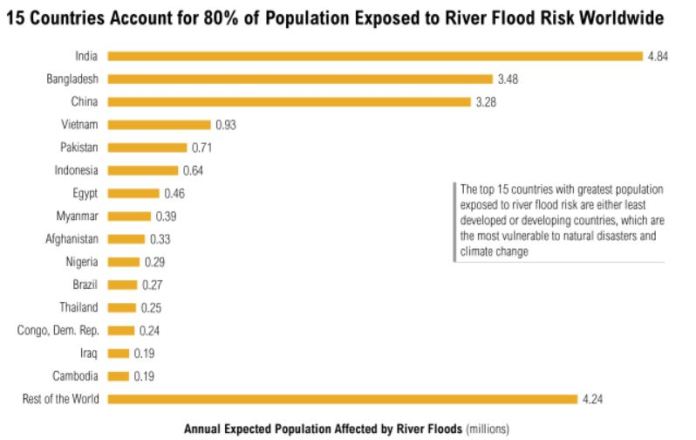
I think we definitely can and in fact a lot of countries are already achieving success in their flood control endeavors. World Resource Institute says that 15 countries account for 80% of the population exposed to river flood risk worldwide. Somehow the “Global” issue does not affect the developed countries have a look:
Further, India also lists in the list that indicates the countries whose GDP is impacted by floods noticeably.
Simply the fact that other countries especially the more developed & technologically advanced ones are able to control these issues, indicates that we can do too. But first, we will have to stop hiding behind “Global Warming is the root cause of all the issues” mannequin. Once we are on the same page and agree that we can and we should make efforts to control floods at least most of them, we have already taken our first step in this direction and can move forward.
Flood types like coastal floods, hurricanes or tsunami, etc. are rare in India. Most of the floods occur because of overflowing rivers due to excess rainfall. Therefore, this should be our utmost priority. In one line, currently we are not able to get rid of the huge amount of extra water without destroying the place. The peculiar aspect of rainfall in India is that when one part is flooding the neighboring state is witnessing a drought-like situation (Jharkhand & Odisha as an example). This is how the monsoon behaves in India.
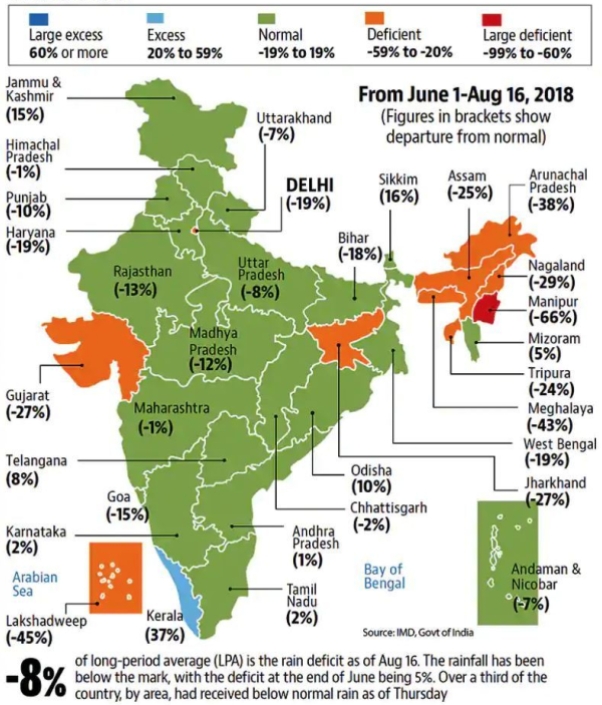
River interlinking through artificial methods seems a reasonable way to avoid floods and droughts. But since the professional protesters pay more attention to “who” rather than “what” the scheme gets overshadowed because of the people who push it. The Indian National Congress’ president Mr. Rahul Gandhi said in 2009 that the entire idea of interconnecting of rivers was dangerous and that he was opposed to interlinking of rivers as it would have ‘severe’ environmental implications. A lot of other popular personalities, writers, environmentalists claim interconnecting rivers would submerge hectares of land under water along with displacing a large number of people. Isn’t exactly the same happens when it floods? Aren’t people in Kerala displaced? Isn’t the land there submerged under water? Shouldn’t people be asking these questions to those popular personalities now? Drought and floods at the same time, doesn’t it sound weird? With 42% of the country receiving deficient rainfall and is staring at the drought-like situation, could different artificial canals interconnecting different rivers have prevented floods in Kerala?
Isn’t prevention better than cure?
Sweet rainwater is a boon and should at no cost be wasted, especially when there are cities and states struggling for drinking water. We are at fault when we are unable to build a system robust enough to use this boon. It is a shame for us that in a high-tech century where we are capable of transporting anything anywhere, we are incapable of transporting water from one state to another. It is also not that we cannot; it is solely that we don’t think we should. We have different set of priorities, like becoming a certified backward community and joining the list of distinguished freeloaders. Caste System is portrayed as one of the gravest social issues in India. How many people in India are displaced due to Caste issues? Haven’t Floods caused more damage to India, its reputation, its growth, its people so on and so forth than the castes issues? I am reasonably confident if floods were associated with any caste or community or to say “a vote bank”, there would not have been a single person suffering because of them.
If you are a humanitarian, think about the people who lost their lives, loved ones in the floods which could have been avoided. The amount of distress they went through in the relief camps. Your charity/donations help you more than it helps them; can it bring the lives or lost crop or the lost time back? If you are money minded, think about the billions that were washed, which could have been used for creating something new and useful.
There is no dearth of creative people in India; there can be a countless number of ways different rivers could be connected, not only surface canals but also something like underground tunnels. Infusing artificial intelligence in water resource management and eventually getting rid of human dependency could prove more accurate, precise, efficient and error free. This is an opportunity, an opportunity to engage the youth of the country in a constructive & productive activity; an opportunity to raise the standard of living; an opportunity to create employment. A wide variety of skills would be required to build a robust system; PhD/Master thesis topics, industrial research, whitepapers, architecture designs, feasibility analysis and so on and so on. There will be different solutions for different places, by the time that one feasible solution is realized after scurrying through tens and hundreds of different ideas, several other problems would have been solved. We don’t have to do everything today, but we have to change our approach. Protests are not only to burn the nation; they can be used in a constructive manner as well. People should wake up from their shackles of slumber and start pushing the authorities towards these kinds of activities. Democracy is not just a license to shout out loud. It is a big responsibility for its citizens, they are responsible for setting the priorities. If they think flood is a priority government will have to work in that direction, if they think keeping or not keeping a photo frame in a university is worth protesting, this issue would be taken forward. Democracy gives us a right to choose our battle.
I had wrapped up my planned interview sessions at IIT Delhi by the afternoon and had few hours to spare. Since I did not know how long the interview sessions would go on, I had booked late night return ticket. I was wondering about the best way to kill few hours in Delhi, certainly waiting at the airport was not one among them. I thought of advancing the ticket but that had its own logistics.
“How far is the JNU campus from here?” I asked my cab driver. The incidents at JNU were making headlines those days. I was curious to visit the place as it was being shown on all TV news channels.
“It is quite close, may be 10-15 minutes,” responded the driver.
“Ok, let us go there,” I thought I would at once see how this most talked institute looks like. I have been to many of the premier institutes like IITs and IIMs but for some reason I was more curious to visit this unique place that was known more for its political protest than research, at least in the last few years.
“Sir, who do you want to meet there?” the driver asked again.
“No one, I just want to go around the campus, spend some time there before heading back to the airport.”
“But they don’t allow visitors these days, there is very strict checking. You will have to tell the name and hostel of the person before entering the campus. One student of the university is missing since few days and there are lot of protest happening. The security guards are quite vigilant,” replied the cabbie.
We reached the JNU gate. The driver was right. The security guard conducted thorough checking of the car and later turned to me – “where do you want to go?”
I had thought of an answer already. “Ganga Dhaba,” I replied. This was the only place I had picked up from various protests happening in the campus. The security guard did not ask anymore question and allowed us to go in after making an entry in the register.
The campus was vast and expansive, with lot of open space. I remember someone telling me on a good day you can sight peacocks on the road. The hostels could have been maintained better possibly. There were lot of Dhaaba kind shops where students were busy in the small chit chats. I could not believe that these could be the same students who were shouting ‘break India Azadi’ slogans. I stopped at one of the canteens and walked around. The notice board is a good place to sense the student atmosphere. There were several pamphlets, caricatures and hand written notes.
One of the notices I read was about some student condolence march for death of Fidel Castro. Really, I thought? Of all the issues and talk of revolution these students had interest in someone who died in Cuba, something that most of the newspapers skipped or mentioned that as a side note. Then I looked at the other notices and pamphlets, almost all of them had similar messages – protests and more protests. For a moment, I recalled the notice board I had just seen at IIT Delhi, it spoke about an aeronautics summit, forthcoming exams and other details related to academics.
Even with my few hours of stay at JNU, I realized that this was a different world altogether. Everyone probably believed in some imaginary revolution and that is why ‘Azadi’ song was so popular. Among many anti-national activities, it was alleged that some students had celebrated the killing of CRPF Jawans by naxals and breaking up of the country.
I was surprised – the illiterate villagers living in some remote region can possibly be brainwashed with revolutionary communist ideas, but how was that possible in the heart of the capital, just a few kilometers from the Indian Parliament?
This is where ‘Urban Naxal’ – the book by Vivek Agnihotri is so insightful. Some of the universities being the hotbed of radical leftist idea is not surprising, but what Mr. Agnihotri does in his book is to explain the modus operandi of the same. He calls them ‘intellectual mafia’ – an over ground cadre of the dangerous Naxalite movement. They are the soft power of Naxals in intellectual garb.
The book is well researched and presents facts with an alternative narrative – something that makes the mainstream coverage of these incidents look motivated. The intellectuals from many walks of life be film industry, literature, NGOs, activists or media join hands to present a sympathetic view of the Naxal movement, more as a victim of state oppression. Naxals, Mr. Agnihotri claims are not interested in the emancipation of the poor or their well-being. Their only objective is to take control of the Indian state by force. It is an ideological war that has changed its character from the first struggle of Naxalbari.
What I liked most about, is the story of the book itself than the story in the film. I have a feeling that if the film directors write about making of their film it could be at times more interesting than the film itself. The book starts with very innovate out-of-the-box approach on ideation, funding, casting, shooting, distribution and marketing. The director starts with a shoe-string budget and solves each and every problem one by one. The author faces several setbacks at each stage only to overcome it later. It is a story that if one has the right conviction things can fall in place by design. It the end it is a story of hope, of resurgence and success.
One of the sad learnings is how the same Bollywood industry that Mr. Agnihotri was integral part of, turns its back once they know that the narrative does not suit their agenda. They, in fact block him at each and every stage. They use their influence to sabotage the film, since it does not fit their ideologies. “I have mentally resigned from Bollywood,” says Mr. Agnihotri. This also tells us why our movies are so unidirectional, why all of them repeat the same stories ad nauseum, why certain type of people are cast as stereotypes, where does the raw creativity dissipate, why we call our movies as “entertainment, entertainment, entertainment”? Our Bollywood movies are escapist, they only let us forget ourselves for few hours and they are not about real people or incidents around us.
The writing style is fact based, plain and simple. The good thing is Mr. Agnihotri does not hold his punches and goes all out wherever necessary. In the today’s world of political correctness and pseudo liberalism, this is a welcome change. The author is prepared to call a spade a spade without blinking. He is not embarrassed of his right wing inclinations and carries it with pride.
In spite of numerous struggles, it is a story of hope in a very positive subtext. The author does not run away from the situation but fights back to eventually succeed. It is not a rant about everything that is wrong with this country and how nothing can be done about it or that we need a grand revolution to solve it all. It talks about many good things and solutions that people have provided.
Finally, the book is about the courage and conviction to tell one’s own story – ‘everyone has to find his own sun.’ It does not matter if some of the people don’t support the idea as it does not suit their narrative, there is always a world out there that is waiting to hear the genuine stories. The stories must be told without fear and favor.
Incidentally, the book is fore-worded by Prof Makarand Paranjape, a professor at JNU. I remember meeting him last year at Bangalore literary festival. I spoke about my recently published book. He briefly discussed about left radicalism in JNU. He was part of a panel discussion with Kanhaiya Kumar, his student.
“I think today’s session will be explosive,” I said.
“Let the fire come out, I am looking forward to it,” he replied.
Later in the day the session was really explosive. It was not even first few sentences in the panel discussion when Kanhaiya kumar stood up from his seat, raised his fist and repeated few ‘Azadi’ slogans. The crowed loved the antics with huge applause and cheers. For a moment I wondered how Prof Paranjape was managing hundreds of these students daily in his class. But he was calm, he responded with equal grit and some good humor to counter Kanhaiya Kumar. Some among the audience appreciated that as well.
I thought, may be Prof. Paranjape was right – let the fire come out. If the discussion is held in open like this – for every destructive idea scores of constructive ideas will gain momentum, bit by bit.