Home Blog Page 545

From Archives – M.K. Gandhi’s reactions on Mob-Violence

0

A satyagrahi will always try to overcome evil by good, anger by love, untruth by truth, himsa by ahimsa. There is no other way of purging the world of evil-M.K. Gandhi YI, 8-8-29, 263

On 30th January 1948, while Mahatma Gandhi was going to attend prayer meeting, a young man killed him by firing three bullets at point-blank range. The Assassin was later identified as Nathuram. He was sentenced to death on 8 November 1949, and was hanged in the Ambala Central Jail on 15 November 1949.

Few Observations:

Justice G D Khosla who was involved in the Gandhi murder case trial, mentions in his book The Murder of the Mahatma,

“I have no doubt that had the audience of that day been constituted into a jury and entrusted with the task of deciding Godse’s appeal, they would have brought in a verdict of ‘not guilty’ by an overwhelming majority”.

Justice Khosla’s observation about the audience points to a specific direction, that there were many Indians of that time who were resentful of the prevailing circumstances and the role Gandhi played in those trying times in the run up to his tragic killing. It is a matter of inquiry, why an overwhelming majority of that time held assassin ‘not guilty’. After all he had committed a heinous crime of cold blooded murder of Father of the Nation and a Mahatma. Unfortunately, the tragic killing of Gandhi diverted attention from those uncomforting questions.

As the old proverb goes there is no smoke without fire, there must have been something controversial and provocative in testimony and trial proceedings of Nathuram Godse, which triggered successive Congress governments in Delhi and states to censor it for nearly 30 years. Later, Congress governments also banned memoirs of Gopal Godse that was published in 1967. Gopal Godse was co-accused and sentenced to life in prison.

Since 1989 till 2013, a Marathi play Me Nathuram Godse Boltoy by Pradeep Dalvi remained at receiving end of secular Establishment, though it continued to remain popular among audience.

From 1948 to 2019, many generations remained ignorant of actual events that led to Gandhi’s assassination. They had limited exposure to above documents due to censorship and were mostly brought up reading government dictated one sided history. It is worthwhile to note that tons of paper and ink has been used before and after transfer of power from British to Congress to assiduously build image of Mahatma as Mahatma we know.

It is a fact that school and college going students in particular and public in general were only fed Congress Government/ Establishment dictated version of greatness of assassinated, while keeping a tight lid on assassin’s point of view. Quite an effort must have gone into keeping darker side of belly under wrap.

Recently during peak of 2019 election season, when Sadhvi Pragya Thakur, a monk falsely accused in Hindu-terror conspiracy of Congress, remembered Nathuram Godse as a DeshBhakt –Patriot, it was natural that old controversy would again ignite passions of people sitting of both sides of fence.

Yet again, a section of audience whom Justice Khosla called overwhelming majority, came forward to support Sadhvi Pragya Thakur. This opinion of overwhelming majority was basically always Anti-Establishment in nature. This opinion was neither in tune with Congress government of 1948, nor in tune with opinion of BJP Government and Prime Minister of day in 2014. That it has survived for 71 years against overarching powers of Establishment is puzzling and surprising at same time.

So it would be prudent to re-examinee the historical events from authentic sources, and analyse the most prominent events having important bearing on civilizational existence of Hindus that occurred during Gandhi’s active political lifetime. As a towering leader of India’s struggle for Independence, Gandhi’s attitude, response and reactions to these events carried indelible impact on psyche of affected. It is hoped that this re-examination might also lead us to source from where this overwhelming majority opinion has been deriving strength, in spite of continuous attempts to stifle it.

Dr. Ambedkar on Gandhi:

In year 1945, Dr. Ambedkar wrote and published a well-researched and well-quoted book PAKISTAN OR THE PARTITION OF INDIA. His critique and analysis of Islam in PART IV- PAKISTAN AND THE MALAISE of this book has stood the test of time and remains relevant even today to understand Psyche of Muslims not only in India but across the globe.

However it is quite intriguing that hardly any critique, commentary, writings or speeches of Congress leaders of that time, including Gandhi are available in public domain on Islam and Muslims psyche. While same Gandhi and other Congress stalwarts have done innumerable critique of Hinduism in their writings.

This hypocrisy of Gandhi (and Congress) is exposed by Baba Saheb Dr. Bhim Rao Ambedkar, statesman par excellence, in his candid interview to BBC in February 1955, full seven years after Assassination of Gandhi. He explains how Gandhi used to publish two papers, namely ‘Harijan’ in English language for consumption of world and English speaking people, portraying progressive image, as opponent of caste system, untouchability and votary of democracy. Whereas in his Gujarati paper ‘Deenbandhu’ he becomes an orthodox man, supporting caste system, Verna and dogmas that kept India down for ages. In this Interview, Dr. Ambedkar tears apart the very image of Mahatma assiduously built by Congress among Indians.

What Dr. Ambedkar explains in 1955, is well argued and well noted by Anand Ranganathan in his article ‘Dismantling Sainthood: Ambedkar On Gandhi-Swarajya magazine, Apr 14, 2018’. Mr. Anand sums up Gandhi’s true character, “In the contest between Ambedkar and Gandhi, the man who truly was a Mahatma fought a man pretending to be one.” If written in straight English, it would mean Mahatma Gandhi was not a Mahatma, rather he was epitome of Hypocrisy.

Gandhi’s Support for Khilafat movement and 1921 Moplah riots

Satish Viswanathan in his article, in Swarajaya Magazine describes in great details Gandhi’s support to radical Islamists of Aligarh Muslim University and Muslim leaders of Indian National Congress, namely Shaukat Ali, Maulana Mohammad Ali Jauhar and Maulana Abul Kalam Azad (Maulana Sayyid Abul Kalam Ghulam Muhiyuddin Ahmed bin Khairuddin Al-Hussaini Azad) for Khilafat Movement- A call of from these radical Islamist leaders to Hindustani ummah for re-establishing of Caliphate in Turkey. A well educated person of that time, who understood history of Islamic invasion of Bharatiya civilization and having adequate knowledge of Islamic theological concepts of Jihad and Gazwa-E-Hind would have desisted from supporting any radical Islam inspired movement that supported Islamic Caliphate. Mr. Viswanathan argues that Genocides Armenians in Ottoman Empire were deliberately ignored by Gandhi and Congress, while supporting Khilafat movement. Later Congress whitewashed and sanitised this Jihadi-movement from history books using pseudo-historians like Bipan Chandra  and Irfan Habib. He writes

“Leftist historians view the Khilafat movement rather favourably. Bipan Chandra argues that the movement brought urban Muslims into the nationalist movement and there was nothing wrong in taking up a demand that affected Muslims only. Irfan Habib says that it was necessary to support Turkey in order to fight European imperialism. But none of them have ever described the Khilafat movement for what it truly was – an agitation which backed one of the worst genocidal regimes in the history of human kind and a movement which reinforced the religious identity of the Indian Muslim.”

Finally like many other radical Islamists supported movements, Khilafat movement also turned into violent Jihad against Kafirs of Moplah, (Moplah is a Malabar region of South India, now part of Kerala). Genocide of non-Muslims in Moplah started in August 1921 and continued unabated for next six months. Under leadership and provocation of Khilafat proponent Variyan Kunnathu Kunjahammed Haji, Muslim mobs did mass murder and rape of Hindu and Christian neighbours, matching or superseding brutalities of Tipu-Sultan’s Genocide of Malabari Hindus in year 1783.

Wikipedia page Malabar rebellion, sub-heading Nature of crimes lists the kind of brutalities committed by Muslim mobs against men, women and children of other faiths. The nature and types of brutalities committed in this genocide are well documented in a book by Gopalan Nair ‘The Moplah Rebellion 1921’ published in 1924. In recent times Jihadi brutalities that have been documented from ISIS camps against Yazidis, match the level cruelties against non-kinsmen in Moplah. Page 52, Appendix IX of this book captures the nature of the atrocities as listed below-

(a) Brutally dishonouring women,

(b) Flaying people alive,

(c) Wholesale slaughter of men, women and children,

(d) Forcibly converting people in thousands, and murdering those who refused to be converted in utter cold blood.

(e) Throwing half-dead people into wells, and leaving the victims for hours, to struggle till finally released from their sufferings by death.

(f) Burning a great many and looting practically all Hindu and Christian houses, in the disturbed area, in which even Mopla women and children took part, and robbing women, of even the garments on their bodies, in short reducing the whole non-Moslem population to abject destitution.

(g) Cruelly insulting the religious sentiments of the Hindus, by desecrating and destroying numerous temples, in the disturbed area, killing cows within the temple precincts, putting their entrails on the holy images and hanging the skulls on the walls and roofs.

Mr. Gopalan Nair describes in pages 53-72 of book, gory and ruthlessness of twenty eight instances of Islamic style mass murder, mass rape, plunder of Hindus and Christians including British officers.

Gandhi’s reaction (interview) on this genocide by Muslims in Moplah Tragedy, December 8, 1921, Young India , (VOL. 25: 27 OCTOBER, 1921 – 22 JANUARY, 1922 page15-16), is quoted here:

“17. How do the forcible conversions of Hindus and pillage of Hindu homes reflect upon the unity of Hindus and Mohammedans in India?

Gandhi: They have put a severe strain upon Hindu patience, but it has stood the strain and its survival proves that the unity is based on knowledge. No Mussulman approves of the Moplah fanaticism.

  1. What is the actual cause of this rupture of Hindu-Muslim unity in Malabar?

Gandhi: There is no rupture of the unity in the disturbed area. The Moplahs could not at any time have considered Hindus as their brethren. The causes of the violence are that as in the Punjab in 1919. So in Malabar now the message of non-co-operation was only vaguely delivered when its progress was arrested by the authorities. The Moplahs were never particularly friendly to the Malabar Hindus. They had looted them before. Their notions of Islam were of a very crude type. They were kept in utter darkness by the Government and neglected both by Mussulmans and Hindus. Being wild and brave but ignorant, they have mistaken the mission of the Khilafat and acted in a savage, inhuman and irreligious manner. It is quite improper to judge Islam or the Mussulmans of the rest of India by the present conduct of the Moplahs.

  1. Can you say what made you to couple the Khilafat with the Punjab wrongs?

Gandhi: The Khilafat wrong was born before the Punjab wrong, and I made it my own in the year 1918 at the Delhi War Conference (vide my open letter to the Viceroy). Non-co-operation was conceived at Delhi in 1919 before the Punjab wrong had taken definite shape. The latter was tacked to the Khilafat, when it became clear that it required as drastic a remedy as the Khilafat.

  1. Can you say why the Mohammedans of India are so demonstrative for the Khilafat, when the Mohammedans of other Islamic countries do not seem to care for it?

Gandhi: I do not know that non-Indian Mussulmans do not care for the Khilafat, but if they do not and the Indian Mussulmans do, for me it is proof enough that the latter have developed greater religious consciousness than the former.”

So here is Gandhi, no Mahatma, rather a wily and shrewd politician, who did not even empathise with Hindus and Christians killed in Riots. He bluntly claimed they were themselves responsible for this genocide. Gandhi also mentions that Moplah Mussulmans did not represent Islam or the Indian Mussulmans. This would sound familiar even today, as liberals and secularists of all hues always claim that Fidayeen and Jihadis do not represent peaceful nature of Islam or moderate Mussulmans.

Gandhi’s Support for Ottoman Empire and ignoring Armenian Genocide

As quoted from Armenian National Institute website

“The Ottoman state existed from 1300 to 1923, variously called Turkey or the Turkish Empire, was governed according to Islamic law which relegated non-Muslims to second class status  In a series of genocidal massacres repeated in 1895-1896, 1909, 1915-1918, and 1920-1922, the Armenian population of Turkey was annihilated.”

By supporting Khilafat movement, Gandhi and Congress supported re-establishing of Ottoman Caliphate, in spite of facts brought to his attention that Muslims around the world did not support Ottoman/Caliphate. It would be foolish to believe that Mahatma Gandhi and Congress leaders were ignorant of Armenian Genocide at hands of Ottoman rulers. They supported re-establishment of Caliphate from Indian soil in spite of having full knowledge of its past antecedents.

Gandhi’s response on Swami Shraddhanand, and other Hindu Arya Samaji murders:

On 23 December 1926, Swami Shraddhanand, was murdered by a Jihadi Muslim Abdul Rashid. Swami ji was quite a threat to Islamists as he was actively involved in re-conversion (ghar-wapasi-shuddhi) of Hindus who converted to Islam under threat of Sword in Moplah and other places.

Dr. Ambedkar lists out such murders carried out by Muslims for Jihad, in CHAPTER VII of his book PAKISTAN OR THE PARTITION OF INDIA, HINDU ALTERNATIVE TO PAKISTAN [Mr. Gandhi’s tenacious quest for Hindu-Muslim unity]. He argues that Gandhi never protested against Muslims responsible for these cold blooded murders including gruesome Moplah carnage. (Quoted below)

“Mr. Gandhi has been very punctilious in the matter of condemning any and every act of violence and has forced the Congress, much against its will to condemn it. But Mr. Gandhi has never protested against such murders. Not only have the Musalmans not condemned these outrages but even Mr. Gandhi has never called upon the leading Muslims to condemn them. He has kept silent over them. Such an attitude can be explained only on the ground that Mr. Gandhi was anxious to preserve Hindu-Moslem unity and did not mind the murders of a few Hindus, if it could be achieved by sacrificing their lives.”

Dr. Ambedkar’s above observation is also substantiated in Gandhi’s condolence message delivered in Guwahati session of Congress on 25 December 1926, after Swami Shraddhanad murder. Gandhi’s message in this session is foremost proof of that he was a hypocrite who had no sympathy for murder and genocide of Hindus. (Quoted below)

“If you hold dear the memory of Swami Shraddhanandji, you would help in purging the atmosphere of mutual hatred and calumny. You would help in boycotting papers which foment hatred and spread misrepresentation. I am sure that India would lose nothing if 90 per cent of the papers were to cease today. . . Now you will perhaps understand why I have called Abdul Rashid a brother and I repeat it. I do not even regard him as guilty of Swamiji’s murder. Guilty indeed are all those who excited feelings of hatred against one another. For us Hindus the Gita enjoins on us the lesson of equi-mindedness; we are to cherish the same feelings towards a learned Brahman as towards a chandala, a dog, a cow or an elephant.”

Gandhi never sought condemnation from Muslim leaders, rather he kept studied silence on heinous murders, rapes and other brutalities committed by Jihadis on both Hindu spiritual leaders and common people during his entire political life.

Gandhi’s reaction during and after Direct Action Day Massacres of Hindus.

Great Calcutta Killings started on 16 August 1946, (Also called direct action day, a seemingly secular name given by Islamists leaders of Muslim League to Islamic call for Jihad), led to at least 5,000 persons killed and more than 15,000 wounded.  This pogrom continued in various Muslims majority parts of Bengal and of rest of country including Punjab and Sindh. It reached its Moplah style culmination of brutalities in form of murder, arson, looting, rapes and conversion of Hindus in town of Noakhali, Chittagaon. Naokhali riots are well documented for direct involvement abetting by Muslim Leagues leaders including Huseyn Shaheed Suhrawardy, the Prime Minister of Bengal since his call for direct action day. Historian Devendra Panigrahi, in his book India’s Partition: The Story of Imperialism in Retreat, page 300 writes

On 13 August 1946, the Muslim League mouthpiece, Star of India, gave detailed instructions to the Muslim League and Muslims in general on how to conduct themselves on 16 August, the Direct Action day. Muslims were in the middle of Ramazan fasting and Star of India reminded them of the month of real Jehad of God’s grace and blessings, and spiritual armament and moral and physical purge of the nation. . . “Muslims must remember that it was in Ramazan that the Qur’an was revealed. It was in Ramazan that the permission for jehad was granted by Allah. It was in Ramazan that the Battle of Badr, the first open conflict between Islam and Heathenism, was fought and won by 313 Muslims and again it was in Ramazan that 10,000 Muslims under the Holy Prophet conquered Mecca and established the kingdom of Heaven and the commonwealth of Islam in Arabia. The Muslim League is fortunate that it is starting its action in this holy month.”

Devendra Panigrahi concludes in page 302 of above book

The communal holocaust was a sound warning of what was likely to happen if Jinnah’s Pakistan was not granted. Although Jawaharlal Nehru bravely argued that ‘we are not going to shake hands with murderer or allow it to determine the country’s policy’, he accepted that it was a grim reality ‘that one may have to face the assassin’s knife at any time’.182 The situation had dramatically changed after these events. Lord Mountbatten observed: ‘Don’t forget Direct Action day in Calcutta which was a warning of what he [Jinnah] can do just as a demonstration and I think he has the capacity to cause civil war if we didn’t meet him half way.’ Mountbatten further remarked: ‘Jinnah . . . all he was interested in was power – and protect [sic] the Muslims.’

Another detailed article written by Jaideep Mazumdar in Swarjaya Magazine dated 16 August 2017 ‘The Butcher Of Bengal’ And His Role In Direct Action Day”  clearly mentions that Great Calcutta killings were instigated by well-educated top leaders of Muslim league as Direct Action Day, where real intent was Jihad. It was similar or larger in scope and brutalities to Moplah Riots instigated by educated Muslim leaders in the name of Khilafat movement which was actually Jihad.

History books are full of details of deliberate inaction not only of British Empire officials, who were preparing to pack their bags, but also of whole Congress leadership under Nehru and Gandhi. They did not do anything substantial except controlling retaliatory riots by Hindus in Congress ruled provinces.

Below are Details reproduced about peace mission taken by Gandhi in November 1946, full three months after Direct Action day and call for Jihad started, after much of genocide of Hindus in Muslim League governed Bengal had already completed.

Gandhi’s stay in Noakhali was resented by the Muslim leadership. On 12 February 1947, while addressing a rally at Comilla, A. K. Fazlul Huq said that Gandhi’s presence in Noakhali had harmed Islam enormously. His presence had created a bitterness between the Hindus and the Muslims. The resentment against Gandhi’s stay in Noakhali grew day by day. Towards the end of February 1947 it became vulgar. Gandhi’s route was deliberately dirtied everyday and Muslims began to boycott his meetings.

Mahatma Gandhi discontinued his mission halfway and moved to Bihar on 2 March 1947 at the request of the Muslim League leaders of Bengal. On 7th April 1947, more than a month after leaving Noakhali, Gandhi received telegrams from Congress Party workers in Noakhali, describing attempts to burn Hindus alive. He responded that the situation in Noakhali required that the Hindus should either leave or perish. A headline in New York Times carried this last observation of Mahatma Gandhi.

Various speeches and writings of Gandhi are documented in below three available sources whose dates concur with Direct Action Day and his Noakhali visit and return

  1. THE COLLECTED WORKS OF MAHATMA GANDHI – VOL (92): 9 AUGUST, 1946 – 6 NOVEMBER, 1946
  2. mahatma-gandhi-collected-works-volume-93 7 NOVEMBER, 1946 – 16 FEBRUARY, 1947 page54
  3. mahatma-gandhi-collected-works-volume-94: 17 FEBRUARY, 1947 – 29 APRIL, 1947

Writings on page 54 of Volume 93, clearly show that Mahatma Gandhi was fully devoted to his ill-conceived theory of one sided non-violence, and was forcing Hindus to sacrifice their life in Jihad in non-violent way by facing death bravely and not running for life from Muslim dominated area. These three volumes are full of Mahatma’s sermons to Hindus for bearing this sacrifice in Muslim majority area. He was not ready to accept that violence unleashed by Muslims was Jihad that needed to be resisted and retaliated.

It is worthwhile to mention here a particular Gandhi’s meeting with Noakhali and East Bengal refugees mentioned in collected works volume 98, Page8, where he is seen giving lofty sermons about peaceful nature of Islam to traumatized, refugee Hindus who had abandoned their homes due to Muslim League/state sponsored genocide in Muslim majority areas of Bengal :-

  1. TALK TO REFUGEES, LAKSHAM, November 7, 1946

(Note- Laksham is sub-district of Chittagong, Bangladesh)

Why should they be afraid of the cry of “Allaho Akbar”? The Allah of Islam was the protector of innocence. What had been done in East Bengal had not the sanction of Islam as preached by its Prophet. Who could dare to dishonour their wives or daughters if they had faith in God?

Clearly, Gandhi was more interested in saving the image of Islam rather than saving the hapless Hindus slaughtered and converted by jihadi mobs.

Conclusion:

Since 1920 when Gandhi took leadership of Congress, till his death in 1948, a clear contradiction can be observed between, much publicised theory of Non-Violence and his actual position on various instances of mob-violence. Directly or indirectly, he supported violence of Muslims against other faiths while preaching non-violence to victims. We may doubt and debate if Gandhi understood meaning of taqiyya and kitman. But his commentaries, observations and reactions during this period do indicate that he practiced these to perfection.

Trump-stick politics of congress, the tale of worth of the worthless 

0

The sudden mushroom like emergence of the dynast from nowhere to make a demand to Modi that Modi must answer to the comment of US President Donald Trump that Modi has sought his help to mediate the issue between Indian and Pakistan. The above demand made by the dynast speaks a lot about the truth made by the TIME magazine that the dynast is ‘Un-teachable’. When people go totally worthless and hopeless, they never feel shy to latch onto anything to make noise irrespective of the reliability of the borrowed stuff. In fact by questioning PM Modi over the farcical statement of Trump, all those political parties in India are fiddling to the interest of Pakistan and separatist. As soon as the statement that was made by Trump, it was summarily denied by US authorities by stating clearly that the issue between India and Pakistan is bilateral.

Trump is known for making several thoughtless utterances in the past and also known for making unverified statements. On the other hand Modi is very measured in his expressions, die hard patriot, born honest and incorruptible.  Even a child in the womb can confirm that Modi will never make any such requests, that too to Mr. Trump, apparently an inconsistent leader.

It is funny and at the same time looks awkward that the dynast is using the Trump-stick to make his political lung-breath.  The demand of opposition parties is that Modi should personally deny the claim of Trump. Placing such demand by dynast itself is so self-defeating as people of India knows the credibility and assertiveness of Modi and that is why people of India have given even a bigger mandate to Modi in recent parliament election.

The dynast on the other hand has a proven history and great past displaying how naïve and unwise he was and Wiki leaks cable released by The Hindu several years ago clearly tells how the dynast has understood Indian politics, Hindu terrorism etc. Further the dynast also has proved his enormous wisdom in public when he reasoned out the problem of unemployment to the origin of ISIS, from foreign land. Considering the wisdom and sense of the dynast, what else India can expect from the dynast other than asking Modi to counter Trump.

Trump is not United States of America. Most of the Americans are repenting for electing Trump and had the opponent of Trump was not Hillary Clinton, Trump would not have won the last presidential election in US. Similarly several world leaders are quite amused by the behaviour of Trump and therefore they consciously dismiss the effect of Trump because USA is not Donald Trump. Therefore Modi countering to the utterance of Trump is not necessary and further Modi should focus more on improving the relationship with US by dismissing the statement of Trump.

An open lie by a responsible person like Trump should be ignored because such people not just lie or demean others through such lies but demean own dignity and the dignity of the country that they represent.

The dynast and other tukde tukde gangs in India do not have any ideology and no new offering to India. They are not only bankrupt but also find no one around them to offer some political advice.  So they are left with no other choice than use Trump-stick to attack PM Modi. In fact all those use Trump-stick are not attacking Modi but are harming India by indirectly supporting the agenda of Pakistan and separatist.

It is so unfortunate that still India has some space for such political parties to harm India and its reputation as such misadventures however may look politically beneficial. For Modi, India comes first and not BJP or politics, therefore we the Indians should stand with Modi and must lend our unconditional support.  Indians also have great responsibility to defeat all those negative forces from Indian politics.

S Ranganathan

Why it was imperative to restore the sacred structure of Sri Vyasa Tirtha of Brindavana that was vandalized recently

On 18 July, the Brindavana of Sri Vyasaraja, a revered guru from the Madhva (Dvaita Vedanta) tradition was desecrated and razed to the ground – reminiscent of an uncomfortable past of the Hampi area that all Hindus are familiar with. For Madhwas near and far familiar with the height of this great muni, this was nothing short of devastating. However, his legacy is not limited to a particular strain of Vedantic thought, and I wanted to take some time to introduce him to the broader Hindu community and his contribution to Sanatana Dharma in a few words and with that, hope to strengthen the greater cultural bond that unites us all, one that we seem to forget now and then. Maybe this essay will reach the hands (and more importantly the hearts) of the miscreants behind this heinous crime one day – and maybe the weight of this act will hit home like a ton of bricks.

He was born around the year 1460 in Bannur, in the Mysore District of present-day Karnataka and was named Yatiraja during his Upanayana. He was brought up by Sri Brahmaya Tirtha, a guru of the Madhva order and was ordained to Sannyasa by him. The name he bestowed on the young sannyasin speaks of how impressed he was with his attainment – Vyasaraja. Soon after his succession as the head of the mutt owing to the death of his guru, Sri Vyasa Tirtha went to Kanchi to study and there he acquired deep learning in Vedanta and the Shastras. After this, he went to learn under the great Sripadaraja at Mulbagal. He soon became a renowned pandit and around this time, he was entrusted with the worship of Lord Venkateshwara at Tirumala – and was the Rajaguru to the King of Chandragiri.

Sri Vyasaraja is undoubtedly one of the greatest contributors to philosophical thought that our country has produced, and I do not use those words loosely. Surendranath Dasgupta (an eminent historian of Indian Philosophy and Sanskrit Scholar) in the History of Indian Philosophy – Vol. 4 writes in the preface: “In my opinion Jaya Tirtha and Vyasa Tirtha present the highest dialectical skill in Indian thought…… particularly of Vyasa Tirtha will realize the strength and uncompromising impressiveness of the dualistic position.  The logical skill and the depth of acute dialectical thinking shown by Vyasa Tirtha stand almost unrivaled in the whole field of Indian thought.”

His works like Nyayamruta, Tatparya Chandrika, Tarka Tandava and Mandara Majiri are gems in the world of Sanskrit literature and pillars of Madhva philosophy. In terms of the importance of philosophers in Madhva thought, he’s among the foremost next only to Madhwacharya himself, and Sri Jayatirtha – part of the Munitraya. Dr. BNK Sharma, an esteemed Madhva scholar writes – “We find in his works a profoundly wide knowledge of ancient and contemporary systems of thought and an astonishingly brilliant intellect coupled with rare clarity and incisiveness of thought and expression.” His depth of knowledge and dazzling intellect were recognized by all his contemporaries and every student of Indian Philosophy after him.

Perhaps the legacy of his most well known to people is his influence in the great Vijayanagar empire and is the Guru to the mighty Krishna Deva Raya – this was noted even by foreign visitors to Hampi. It was his brilliant performance and scintillating victories over his opponents in the court of Saluva Narasimha in Chandragiri – the most famous one being a thirty-day long debate with Basava Bhatta of Kalinga (present-day Orissa). Under his guidance, the Vijayanagar empire reached its zenith, and the glory of Hampi was recorded by foreigners and Indian travelers alike as is well known. Krishna Deva Raya’s reverence for Sri Vyasa Tirtha was so great, that the king considered the guru his Kula Devata. For a long time, Vijayanagar withstood the onslaught from Muslim sultanates but eventually succumbed after Sri Vyasa Tirtha’s death, when Hampi is said to have burned for days. It is a matter of deep irony that even at that time, the attackers spared Anegundi, the location of the Navabrindavana of which his is one.

Sri Vyasa Tirtha’s role as a social reformer is also monumental, as the visionary who kick-started and provided institutional support to the Haridasa movement in Karnataka and adding a new dimension to the Bhakti movement of India. He was the guru that gave Deeksha to both Purandara Dasa, the Pitamaha of Carnatic music and perhaps the greatest singer-saint that graced Bharatakhanda, and Kanaka Dasa. Their songs in  Kannada spread the message of Bhakti and the complex tenets of Madhva philosophy to every household in Karnataka irrespective of caste or creed, and through Carnatic music practically to millions around the world. He himself composed some beautiful songs in Kannada under the pen name Siri Krishna – like Krishna Nee Begane Baro, and Gajamukhane Siddhidayakane.

Sri Vyasa Tirtha also established a university of eminence that became dizzyingly famous around the country and scholars came here from all directions to learn under the great guru producing giants like Vijayeendra Tirtha, Vadiraja Tirtha Narayana Yati and others. His was perhaps the first example of a composite university anywhere in the world. Also, he appointed scholars at prestigious institutions around the country, including Udupi, Gaya, Kashi, and Haridwar.

During his lifetime, he established over 732 Hanuman (Mukhyaprana) temples around the country. He is said to have provided food to over one lakh Brahmanas every day and set up countless Agraharas. He was a statesman of the highest order, an intellectual and scholar par excellence, a social reformer whose heart was with the poor and needy, a glorious son of India and above all a great devotee of Sri Hari and a beacon light of Dvaita Vedanta till today. This most unpardonable and detestable act that we have witnessed in Anegundi should now pierce at our hearts even more and should be a haunting reminder that unless we protect and nurture our cultural treasures, they will slip away in front of our very eyes.

धर्मो रक्षति रक्षितः

References: 

  1. https://en.wikipedia.org/wiki/Vyasatirtha
  2. http://www.dvaita.org/scholars/vyasaraja/
  3. http://www.nyayamruta.org/index.php?option=com_content&view=article&id=3&..
  4. History of Indian Philosophy, Volume 4 – Surendranath Dasgupta
  5. http://madhwamrutha.org/shri-vyasarajaru/

Why the Hindus revere the cow and try to ban cow slaughter and Beef in India

0

With Swami Vivekananda saying ancient Hindus ate beef, Hindus relishing it’s taste today – even owning slaughterhouses – rest seeing it as freedom of eating culinary delicacy and the cow seen as just a four legged animal that gives milk and leather, and even causing a nuisance when old, there seems to be no reason why the dumb animal should be regarded as a mother – let alone worship it or make laws against killing it/eating its flesh in a secular India.

Even if the view of the ‘rest’ is left alone, a cursory look by anybody, at the reasoning given, would make him/her concur with the idea.

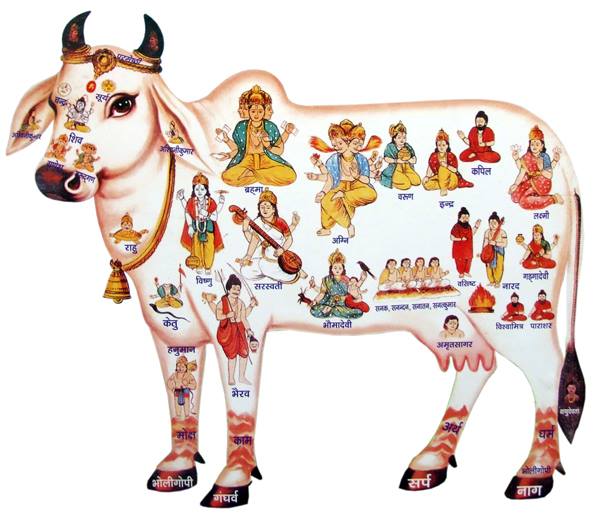
mother cow worship
Cow mother worshiped by Hindus

But then, why is the cow so important for the Hindus?

Status of cow in Hinduism:

Yes ‘it gives milk so Hindus see it as mother’ pontificated the pizza- slice logic using Western India expert during the Raj and Hindus followed it as the gospel truth. But then buffalo isn’t less used and Gandhi was happy just with goat’s milk alone. Furthermore, almost supporting the saying ‘it’s every part is useful’, unlike the medicinal camel’s urine her urine is a spirit and puja purifier too. Yes both can have their skins utilized after death, but when alive, the smell less cow dung alone is used for floor cleaning and fuel at home, and as a prime and innocuous fertilizer in the field outside.

Yes, described as the best of creations, and filled with and worshiped by a complete set of divinities (you may call it 33 groups or millions), these descendants of Kamadhenu are non-aggressive humble beings. Unknown to many, they offer similar emotions to the joys and sorrows of their owners like the man’s best friend – the dog. Also, like a missed Ganesh worship invalidating a puja, a missed cow ghee disqualifies any Vedic sacrifice. Being best of donations in addition, donating 1000 cows was a routine by the ancient ones with blue blood.

With the prized dharma – ahimsa – like martyrdom in Islam – guaranteeing heavenly abode, vegetarianism is seen as a Hindu ideal. While its disregard itself doesn’t bring spiritual laurels, going against aghyna (inviolable) ahi (not to be killed) and aditi (never to be cut into pieces) as is said of the cow brings about severe punishment both here and hereafter. Yes mistranslating and misquoting texts to rule over yet to be civilize Indians while the Western Ideologists did have a field day with ‘ancient Hindus ate beef’ the Hindus became tuned listeners. Thus, in addition, despite the above Vedic injunctions, if Swami Vivekananda indeed say ‘ancient Hindus ate beef’ that knowledge is not from the Vedas or his meditations but from the then Encyclopaedia

The cow mother
Full set of deities in a cow’s body

Britannica. Funnily enough, almost reminding the aliens and us humans, Hinduism does not seem to be alone. Its rival, the takers of India’s North East also produce Issaih, chapter 66 verse 3 that offers security to the bovine’s life. As if not to be left out, the 14% minorities bring in their Prophet’s uneasiness with beef diet in Tabarani and Mustakrak al-Hakim. However, when atheism promoting sinful secularism is favored as a battle cry by them, divine and prophetic dictations lose their merit. Hindu businessmen don’t seem to be doing any better, either. In fact, with the incoming cash being more luring than the outgoing fear of God, spices making it a delicacy and the rise of the Chinese middle-class guaranteeing global beef boom like for the old whine and the UK’s addictive new chicken tikka masala, Hindus owning slaughter houses don’t surprise. So long as freedom remains part of that dosh traveling to the making of temples, won’t be a surprise either.

Cow slaughter and beef laws:

Although American reporters don’t, secular Indian reporters using free speech feast on ‘What about the minorities?’ Or ‘State intruding into our kitchen tables’, when laws barring beef is being formulated. Hindu intellectuals struggle to remain dry.

Although, the French Revolution’s, ‘Right of man’ glamorized rights as opposed to duties, in terms of a nation duty is still paramount. Also, a nation is formed out of its majority’s choice – who’s ways form the national ethos, not that of the minority. Latter learns to live with the majority. If that is hurtful, in the cherished democracy itself the losers i.e. the 49%, who don’t like the rulers, have to grudgingly accept the majority’s rule. Thus, each country has rules that have to be followed. Reserving that right the Muslim majority countries impose pork ban, and their minorities have to recognize that sensibility of the majority and accept it. Migrant Indians cannot demand pork in Dubai or Syria. Similarly the Judeo-Christian-Protestant ethos tracing US, without objections, says no to dog’s meat. This is, despite it being a delicacy of its minorities from the Far East with huge business potential. Interestingly, when Taiwan saw the light and banned dog’s meat, pets started vanishing!

In India’s case, although ‘secular’ has crash-landed on its constitution out of the blue via Indira Gandhi, its vivisection into Hindu and Muslim countries, writings in its constitution, official modus operandi and its majority makes India a country with Hindu ethos. It, therefore, can follow the nation principle as said above or the US and ME’s practice. In its case, it even has the go ahead from its founding fathers.

Effect on global warming:

It was never an issue in earlier times when there were many cows. But, with the free man inebriated with rights becoming the biggest enemy of the world, now global warming issue is big. Yes, cow’s gut bacteria emit methane that’s 20 times more toxic than co2 but a sea weed feed mitigates it. With grazing alone enhancing carbon trapping and her dung use avoiding fertilizers that emit 300 times more toxic nitric oxide and it even endlessly enhancing production, the bovine species actually very much helps the environment. Thus it’s not milk alone that makes her a mother.

What about the older cows?

When milk alone is given credence, yes older cows are seen as not really useful to those eyes. Even then, while to care for only when any entity is useful airs a selfish trait that is closer to the glamorized rights; but to look after an entity till the very end heralds sacrifice, duty and civilization. Despite the animal/human split arrogance, with us sharing the old age with cows, for that matter any being, it’s very natural that embracing of the former philosophy makes our elderly feel lonely, un-cared and un-respected. And of course for our elderly, alcohol becomes the available friend and death comes closer.

Even if that ontology is stubbornly adhered to, as aired above, unlike us the cows are productive till the end of their lives. That is of course if prudence is used. Thus, even if her spiritual expect is omitted, she probably qualifies as a mother. In addition, if there is such a thing as creation, does she qualify to be the best? let the jury be out!

A womenspowerbook.org article

Monsoon and the three colour TV channel

0

It was a beautiful day and the clock was touching 8 am. Monsoon had just woken up, a little later than usual because her staff had served her bed-tea late. She yawned, stretched her chubby frame and straightened her disheveled hair.

As she slipped into her beautiful Chanderi kurta – a generous gift from the owner of an uppity lifestyle label, she felt a sense of achievement. After all, she was no less a celebrity. She had done well for herself. Starting off as a young journalist covering the Gilkar War, she had risked the life of many in the bargain, including the soldiers!

All was going well with her till the infamous Roidea tapes, that showed her in poor light — as a power hungry wheeler-dealer. Her shine had dimmed.

In the year 2014, the new regime that got elected actually worked to blunt the claws of her ilk. From the effortlessness of power, she had to now get accustomed to the mundaneness of being slotted amongst the ordinary. Life just wasn’t rosy anymore.

Then came a fabulous opportunity. A well-known politician, ace liar and an aspiring poet, started a TV channel. Mr. Sibka was desperate to influence the minds of the masses after the routing defeat his party had faced in the last elections.

Fake news was a good business in the current milieu. Big bucks were being spent on all media platforms and he felt that this could be his cosy corner and instant ticket to an influentially comfortable retired life. His sharp mind had realised that the tide had turned forever and opportunistic legal eagles like him would face troubled waters ahead. So, he started the Three Colour TV Channel.

And what a poignant name that was! Not only did it represent the colours of his brand of nationalism, the channel itself streamed news tinged by three prominent shades – burnt orange for the pseudo-spiritual urban naxals, murky white of the translucent dealings of the citizens of Lutyensland and the dirty green, that reflected appeasement politics and hypocrisy of pseudo liberals, who preferred to represent their vote bank – ‘Peacemuls’ – a group of citizens that were not peaceful at all!

The nattily drawn sphere at the centre of the muddy white represented the incestuous nature of his party eco-system. After all, they had all evolved together, ‘Grandii kutumbkum’ meaning those from the famous Grandii family were the only real family! Hail Grandii and Grandma!
Oh! The joys of familiarity.

Sibka needed someone who understood what was to be done, and Monsoon was the most obvious choice. She was perfect for his Channel. Popular and ‘con-troversial.’ Soon they were a team, and the channel had a happy start.

However, the reportage was mediocre, and the fake news factory was hardly able to make a dent.
A few months down the line, things just broke down and Sipka and wife decided to pull the plug on the Three Colour TV Channel.

Monsoon had no idea that a storm was brewing. People were fired and severance packages were curtailed to the bare minimum. She was jobless once again. To find support and solace, she took to social media.

The country watched in awe, the mud-slinging match between the two sides. A lot of beans were about to be spilled and bouncers were deployed to collect them. Outside the office of the Channel, monsoon showers displayed their fury, inside, Monsoon stood drenched in tears.

As she sat huddled in despair, a small voice spoke to her. It seemed to come from far away, yet it was familiarly close. Falling like soft drops of dew, it addressed her with love and concern — ‘’My child, this is Kaliyug. The age in which the war is not of the victory of good over evil like in Tretayug, or for that matter of dharma over adharma as in Dwaparyug. It is now a battle of truth over falsehood. And falsehood is sure to kill falsehood while those who strive to walk the path of truth will watch from the ring-side, mere witnesses and spectators.

The laws of Nature and karma are impartial. You have sided with those who have believed in lies and hypocrisy and somewhere you too got corrupted by the power vested in you. Today, you stand in solidarity 24×7, helpless and powerless to go against the clique’ you all so carefully built. Only truth can deliver you, and truth is simplest for the honest and most cumbersome for the dishonest. Take the leap of faith, become righteous, and the ‘right’ shall welcome you rightfully!”

Barkha bairan zara tham ke barso….’ Monsoon knew, her time was up. She had to get ‘modified’ or lose her self into oblivion.

She had to be ready for a quantum leap.

UGC should introduce online Ph.D. thesis evaluation

0

University Grants Commission (UGC) has called for proposals to conduct a study on the “Quality of Ph.D. Theses in Indian Universities”. Inspiringly, UGC has received nearly 150 proposals for conducting the study, and Dr Bhushan Patwardhan, UGC Vice-Chairman, is hopeful that the study would reveal the real quality of the theses, the gaps and the areas of improvement. Although the idea of studying the quality of theses is indeed praiseworthy, there are more areas that UGC needs to take into consideration than just studying the theses. The initiative for studying theses suggests that UGC is extremely worried about the condition of research in Indian universities and also exposes that the higher education regulator is yet to find a viable way out of the problem. If high-quality research output is the serious expectation, then UGC may have a close look into the thesis evaluation process because the roots of lack of quality research are not just in the thesis but in the thesis evaluation process as well.

It is pertinent to pay attention to the thesis submission and evaluation procedure that most universities and institutes currently follow. A research scholar submits the synopsis of thesis to the research supervisor who then forwards the synopsis to the Departmental Research Committee (DRC) or the Departmental Postgraduate Committee (DPGC). Then the Chairperson of DRC or DPGC forwards the synopsis to the office of the Vice-Chancellor (VC) or the Chairperson of the Senate Post-Graduate Committee (SPGC). In most universities, the Controller of Examinations (CoE) handles the submission and evaluation procedure on behalf of the VC. From the date of submission of the synopsis, a stipulated time is given for the submission of the final thesis. Time for thesis submission varies from university to university, generally thirty to ninety days. At the time of submission of the synopsis or the thesis, the research supervisor in consultation with the DRC or DPGC submits a panel of at least eight names for Ph.D. thesis evaluation. From the panel, at least two names are selected as evaluators. Then the thesis is sent to the external evaluators and generally a time of forty-five days to ninety days is given to the evaluator for the submission of the evaluation report. All of these are official procedures.

UGC needs to pay critical attention to the general practices behind thesis evaluation process. The list of the panel that the research supervisor submits raises big questions. The panellists, presumably, are well acquainted with the research supervisor. What seems to be happening is that most often before putting a name in the panel, the research supervisor gets in touch with her/his academic acquaintances, discusses the research and gives hints about the expected report. In most cases, the evaluator sends a favourable report. This evaluator puts the name of the research supervisor (whose research scholar’s thesis he/she has received for evaluation) in the panel when her/his research scholar submits the thesis. Then he/she sends a favourable report. Sending a favourable report seems to be a mutual understanding. Sometimes, the research supervisor suggests the research scholar some books and articles for citation and instructs to project these books and articles as outstanding research because the author of the books and articles would be one of the panellists and citing the author would facilitate getting a favourable report. In most cases, it seems that getting a Ph.D. thesis awarded depends upon the research supervisor’s network of acquaintance in academia.

Also, UGC might need to take note of the time the thesis evaluator takes for the submission of evaluation report. Acceptably, there are Ph.D. thesis evaluators who submit the thesis evaluation report right on time, and it is equally acceptable that some evaluators delay the submission of the report for no valid reason. After the deadline gets over, the CoE or SGPC sends a reminder letter or email. I have heard amusing anecdotes about the manner the external evaluators prepare their thesis evaluation report. Sometimes, the Ph.D. thesis evaluator starts reading the thesis after receiving CoE or SGPC’s reminder. Some evaluators hastily submit a report making generalized comments just by going through the introduction and the conclusion.

The present Ph.D. thesis evaluation procedure is single-blind, that is, the identity of the evaluator is not revealed to the research scholar but the evaluator comes to know the name of the research scholar, name of the research supervisor and the research scholar’s institution. I suggest that Ph.D. thesis should undergo double-blind evaluation, that is, the identity of the scholar, the evaluator and the institution should not be revealed to each other. It should be noted that anonymous reviews and comments promote better research. My ideas about the advantages of double-blind evaluation are based on the assistance I got from anonymous reviewers during my contribution to international journals and on my experiences as a reviewer for international journals.

In order to facilitate the double-blind evaluation of the thesis, UGC needs to create an online portal for thesis submission and evaluation and appoint portal admins based on the subject area. All eligible research supervisors in Indian universities and institutes can be invited to create an account providing details about their area of specialization. After registration, all research scholars may be requested to create an account providing details about their research area and should upload a tentative research outline. The portal admin can forward the outline to the area experts for comments and suggestions. After successful completion of coursework, when a research scholar starts writing, he/she can submit the chapters using the online portal without any author identifying information for comments and suggestions from area experts. Working on the comments and suggestions would lead to the improvement of the quality of the thesis.

Also, once the chapters are submitted online, multiple plagiarism checks can be conducted and the menace of plagiarism can be minimized to a great extent. A research scholar should be instructed to submit the main thesis without any identifying information. After final submission, he/she should get an email confirmation of the submission with a unique thesis-identifying number. The portal admin can seek consent from interested evaluators sending request-for-evaluation email and then assign evaluators for thesis evaluation with a deadline. In case the deadline is over, an evaluator, only after assigning a valid reason, can apply for an extension. The research scholar may log in to the portal and can check the status of the evaluation. However, in the prevailing thesis evaluation procedure, the research scholar remains completely in the dark about the status of the evaluation.

Delay in submission of the thesis evaluation report is a serious problem and no one has yet raised voice against this pressing issue. If a research scholar is awarded right on time, then he/she can take up further research which would lead to the growth and development of research in the country. The online portal can easily track the progress in evaluation.

Many research scholars have made me aware of their encounter with their research supervisor regarding methodology. Some have told that their research supervisor doesn’t hold adequate knowledge about research methods and documentation techniques, yet he/she takes coursework classes and offers research supervision. Surprisingly, even in the thesis evaluation report, some thesis evaluators sometimes make wrong comments on research methods and documentation techniques. These hearsays of the research scholars need verification and UGC may conduct a study on the thesis evaluation reports. Indeed, we have full faith in the thesis evaluator’s scholarship in preparing the thesis evaluation report, yet cross-checking of the evaluation report might reveal areas where extra attention is required to strengthen research.

The online portal can facilitate the cross-checking of thesis evaluation report by other area experts. After the thesis is awarded, the reviews and comments can be made available on the portal to other scholars who can learn about the stages of evolution of research ideas by reading the thesis and the comments alongside. The online portal can be connected to different e-resource databases which is going to benefit both the research scholar and the evaluator: a research scholar while writing the thesis can consult different sources for improving the depth of the research and a thesis evaluator while evaluating a thesis can consult different sources, check the citations and suggest further sources for the improvement of the quality of the research.

Asserting autonomy granted to the universities for becoming institutions of global excellence, UGC should adopt effective measures for improving the quality of research. I want our country Bhāratavarṣa to be a highly developed and high-performance research output can give Indian universities a better place in world rankings (QS World University Rankings or Times Higher Education). Serious research reformation is the need of the hour and online thesis evaluation would revolutionize research.

Author Bio:
Sayantan Chakraborty has published research articles in reputed international journals (Scopus Author identification number https://www.scopus.com/authid/detail.uri?authorId=57201589487) and assists international journal as a reviewer. He is Assistant Professor of English at KL (Deemed University), Vijayawada.

Why crumbling smart city mission needs urgent intervention from PM Modi

0

The ambitious Smart City Mission was one of Prime Minister Narendra Modi’s key electoral promises in 2014. The scheme, launched on June 25, 2015, aimed to develop 100 cities across the country, making them citizen-friendly and sustainable.

The total proposed investment in the selected cities under the scheme is over Rs. 2.05 lakh crore. But according to government data, a mere 33 per cent of the total 5,151 Smart City Mission projects have been completed or are under implementation, utilising 25 per cent of the envisaged investment.

Under the Smart City Mission, it was decided to form a company for each smart city in which the State/UT and the Urban Local Bodies, will be the promoters having 50:50 equity shareholding. With so much Government money involved in these projects, it was expected from the Ministry of Housing & Urban Affairs that it will keep a close watch on the implementation of the Smart City projects, but unfortunately ministry has miserably failed in monitoring the smart city projects. It seems that Ministry of Housing & Urban Affairs is under the wrong impression that once the Company for implementation of the Smart City Project is formed, its responsibility for monitoring the operations of that company is over.

The question is who will be responsible if the company formed for the implementation of smart city project is not working as per the guidelines, advisories and instructions issued by the Ministry?Since all the smart city projects are Government funded and a huge amount of more than Rs.2 lakh crore is involved in its implementation, the Ministry rightly issued an advisory on 9/3/2016 for appointment of Independent Directors on the Boards of these Smart City Companies from the panel of independent directors maintained under section 150 of the Companies Act, 2013. The purpose of this instruction from the ministry was to ensure better corporate governance and transparency in the operations of the smart city projects.

However, most of the smart city companies have not appointed Independent Directors defying the instructions from the Ministry and are using all the Government money in the arbitrary manner as the transparency measure and corporate governance missing altogether from the system.

The most shocking and surprising fact is that the Ministry of Housing & Urban Affairs is indifferent and at all not concerned whether any smart city project is following their advisory for the appointment of Independent Directors. In an RTI Application, information was asked from the ministry as to the number of smart city companies, who have appointed Independent Directors on their Boards as per the Advisory Instructions issued by the Ministry. In response to an RTI Application, the Ministry of Housing has given the following reply: “The implementation of the Smart Cities Mission is to done by a city level Special Purpose Vehicle (SPV) incorporated under the Companies Act,2013 in which the State/UT and ULB are promoters having 50:50 equity shareholding.

The SPV will plan, appraise, approve, release funds, implement, manage, operate and monitor the smart city development project. As such the information regarding the appointment of Independent Directors may be had from the concerned city/SPV.” This reply clearly indicates that Ministry of Housing neither has the information about the appointment of independent directors by smart city companies, nor they are willing to know this crucial detail, which is the only mechanism available with the ministry to ensure the better corporate governance and transparency in the operations of the Smart City Projects. Since the ministry does not have these details, it means, the smart city projects are not being monitored by the Ministry and it has been left open to smart city management to utilize the huge fund of more than Rs.2 Lakh crores in the arbitrary manner, without following the prescribed procedure, guidelines, advisory and instructions.

The Ministry has issued an advisory instruction that each and every smart city company must appoint Independent Directors from the prescribed Panel of Independent Directors as per section 150 of the Companies Act, 2013. After issuing this advisory instruction, the ministry thinks that its responsibility is over and the smart cities themselves will do the monitoring work which the ministry is supposed to do. When the ministry has given certain instruction to the smart city company, then Ministry is duty bound to ensure whether the instruction given by it, is being strictly followed or not. But that is not happening and the huge amount of Government money is being spent by the smart city companies without any transparency or corporate governance mechanism in place.

For the reasons explained above, this ambitious project of PM Modi needs urgent intervention from PM himself, before this results in some scam after few years. If funds are left at the disposal of the local Government, without ensuring the transparency and corporate governance measures, scams are bound to happen.

Even Kamsa and Ravan had their time in power – JDS-Congress delay floor test

0

People of Karnataka are frustrated and are boiling with anger over the greed of JDS-Congress alliance to hang on to power by delaying the floor trust. The alliance does not have the number but still wants to continue in power with the hope that they could engage in horse trade and somehow can cobble up support. Soon the fall of JDS-Congress would happen and certainly such fall also would script the obituary column of both the parties in Indian politics.

Look at Hindu epic Ramayana where Ravan continued his rule of terror and obsession for several years. It took several years and only then Ravan was killed by Lord Ram, the avatar of Lord Vishnu. So were Kamsa and Hiranyakashipu. All evil forces and demons had have their days uninterrupted and unchallenged and millions of mutiny yawning for a change has been answer at the end by the entry of Lord in the form of Ram or Krishna or Narasimha and then destroyed all those demons.

The day is not far away the misrule and corruption in Karnataka would end. The greed to be in power has an expiry although the JDS-Congress combine is pulling on their minority government with the help of speaker who appears to have reduced his office to favour the greed of HD Kumarasamy.

All angry people of Karnataka especially the youths must preserve their anger in a positive way and must defeat both JDS and Congress totally and completely from Karnataka politics. The defeat must scare all political parties in India not to attempt such dirty politics that is being played by JDS-Congress alliance in Karnataka.

People of Karnataka also must own the responsibility to spread across India about the importance of a stable government and how the state can be ruined by two political parties fought with each other before election and then form an alliance to come to power just to stop the mandate of people, to the world at large. People of Karnataka also must highlight the greatness of  PM Modi, scam free governance, dedicated to development and sab ka vikas. Like in India how BJP is the only political party people wants, in Karnataka too, BJP alone should be supported and no space should be given to JDS and Congress party in future. Only if people of the state determined to defeat unholy alliance between JDS and Congress and support BJP, instability, horse trading, corruption etc., can be eliminated. 

India should recognize the political stalemate in Karnataka and the mal-governance of JDS-Congress as an indicator of how India can be ruined if people elect tukde tukde gangs and give indecisive verdict.

Like how people of India elected PM Modi with massive majority again in 2019, people of Karnataka also must elect BJP with massive majority and must pledge that BJP alone should be elected in Karnataka for another 5-6 terms and by the time the congress and JDS would be eliminated from Karnataka politics.

The attempt of JDS-Congress to delay trust vote is quite bizarre. How long can they prolong? How much money is being wasted for such prolonged assembly session and where is governance?

People of the state also must accept the responsibility for the present plight in the state. Had they voted BJP with decisive majority, the state would not have faced such situation. Along with PM Modi the state would have marched ahead and also would have contributed to the vision of New India as envisaged by PM Modi.

Time has come, every state in India must in letter and spirit recognise the absolute truth that BJP alone can develop the state and achieve sab ka vikas. Most of the tukde tukde gangs are interested only in promoting dynastic politics, nepotism and wants to engage in corruption.   Let us take the sad situation in Karnataka as our last learning and let us support PM Modi and BJP and save India.

S Ranganathan

A fort that once was a Mandir

0

Kurumbera (কুড়ুমবেড়া) Fort, once built as a Mandir, is situated in a remote village of Gaganeshwar off Keshiari, south Medinipur, West Bengal. History says Sri Ram Chandra & Sita Mata had spent some time nearby during their 14 yrs of exile, A Tapovan, Rameshwar ShivaLinga, ancient huge anthills… bear the testimony of our ancient times.

Inside the fort

In the 15th century, a Vaishnavite Utkal King Gajapati Kapilendra Dev built the Kurumbera Mandir. The courtyard had three huge domes with Lotus emblems, there were lined pillars which supported a lotus shaped roof. Gajapati Kapilendra Dev’s kingdom spread to Bengal’s Hoogly River. His title was Shri Shri Gajapati Gaudesvara Naba Koti Karnatotkala Kalbargesvara, where Gaudesvara means literally The King of Gauda (a part of Bengal). The Mandir had a SaptaRath Shikhar Deul (Fane) construction, The main Mandir was of 60 ft in height, there was a school, a secret tunnel and a deep well. There was also a dais in the center of the courtyard. Similar architecture can be seen in Odissa’s Raibana Fort.

Some glimpses of the temple

Two centuries later, Aurangzeb came to Bengal. His commander Mohammad Tahir attacked the Mandir & damaged the domes & pillars. He desecrated the Mandir with Cow blood. Then he built three Masjids in the courtyard & converted the Mandir to a fort. His army damaged the huge SinghaDwar made of solid iron too.

Part of the fort

Then the Marathas came to Bengal. Bhaskar Rao Holkar and Raghuji Bhonsle took over the Mandir, they even tried to reinstate it. But once a Mandir has been desecrated by blood of Go-mata, it can never be reinstated. Islamic invaders cared nothing for Hindu Art, their bigotry destroyed Hindu structures everywhere they went.

Not many Bengalis know about this place. It has been lying abandoned since Marathas tried to revamp this place. No one visits this spot. Archeological Survey of India has done some effort to protect the structure from collapsing. But no mention of the destruction it faced on the hands of tyrant Aurangzeb!

There are no Pratimas inside the Mandir, maybe the destructive army of Mughal Badshah Aurangzeb damaged the Deities, maybe the Mandir priests could save the Deities from being destroyed, no one knows for sure. But this Mandir has witnessed the violence of a cruel & oppressive Mughal ruler Aurangzeb.

sources: http://archives.anandabazar.com/archive/1130524/24med1.html

http://mogalmari.blogspot.com/2014/07/kurumbera-fort_96.html

https://en.wikipedia.org/wiki/Kurumbera_Fort

माखनलाल विवि का सत्रारंभ: मोदी को बताया लोकतंत्र और पत्रकारिता के लिए संकट

0

भोपाल। माखनलाल पत्रकारिता विवि में नई सरकार के गठन के बाद से ही कांग्रेसीकरण शुरू हो गया है। उसका असर अब विश्वविद्यालय के सत्रारंभ कार्यक्रम में भी देखने को मिला। सोची समझी रणनीति के तहत मोदी विरोधियों को उद्बोधन के लिए बुलाया गया था। नए छात्रों को पत्रकारिता की चुनौतियों से निपटने की बजाए प्रधानमंत्री नरेंद्र मोदी और बीजेपी को चुनौती के रूप में पेश किया गया। पूरे सत्र के दौरान मोदी को खलनायक के रूप में पेश किया गया। द वायर की पत्रकार अरफा खानम शेरवानी ने तो पूरे संबोधन में मोदी को ही मुद्दा बनाया और पत्रकारिता के संकट के रूप में पेश किया। उन्होंने कहा कि आज मीडिया में 98 प्रतिशत लोग मोदी के गुलाम है। सिर्फ अरफा खानम और उनके जैसे चंद लोग ही ईमानदार हैं। उन्होंने कहा कि मोदी के कार्यकाल में लोकतंत्र को हाशिये पर ढकेल दिया गया है। गरीब, दलित और अल्पसंख्यकों को सताया जा रहा है, महिलाओं को प्रताड़ित किया जा रहा है। उन्होंने कहा कि आज मोदी मीडिया के लिए खतरा है। उन्होंने माखनलाल के मंच के माध्यम से द वायर, द क्विंट आदि के एजेंडे को बढ़ाने की बखूबी कोशिश की।

बेशक अरफा मोदी को टारगेट करें, उनके खिलाफ जहर उगले, लेकिन क्या उसके लिए विश्वविद्यालय के मंच को इस्तेमाल करना सही था? क्या एक साजिश के तहत छात्रों के बीच मोदी को घसीटा जाना सही था? क्या कुलपति और मध्यप्रदेश सरकार विश्वविद्यालय की स्वायत्तता पर चोट नहीं कर रही है? सिर्फ अरफा खानम ही नहीं मंच तो पूरी तरह मोदी विरोधियों से सजा था। अभिसार शर्मा ने तो जानबूझ कर छात्रों को योगी सरकार और तत्कालीन रमन सिंह की सरकार के खिलाफ वीडियो दिखाया। यहीं नहीं अभिसार शर्मा ने तो सुरक्षाबलों के ऑपरेशन पर भी सवाल खड़े कर दिए। छत्तीसगढ़ के नक्सल प्रभावित क्षेत्रों में जान हथेली पर रख कर ड्यूटी करने वाले जवानों पर ही सवाल कर दिए। क्या इसके लिए विश्वविद्यालय के मंच का इस्तेमाल करना सही था। दिलीप मंडल ने तो फेक न्यूज़ का पूरा दोषारोपण सरकार पर कर दिया।

ये बात अलग है कि सोशल मीडिया और डिजिटल मीडिया विषय पर उद्बोधन देने आए दिलीप मंडल को ये भी नहीं पता था कि फेसबुक कब आया। जिस अजेंडे के तहत विश्वविद्यालय के मंच का इस्तेमाल मोदी को बदनाम करने के लिए किया गया, विश्वविद्यालय के नए छात्रों को गुमराह और केंद्र सरकार के प्रति नफ़रत फैलाने की साजिश की जा रही है, यह विश्वविद्यालय के लिए घातक हैं। लोकतंत्र और भारतीय पत्रकारिता के लिए घातक है।