Home Blog Page 365

Srinivasan calls Shashank Manohar anti-Indian; Said- He reduced India’s influence in world cricket

0

Former President of Board of Control for Cricket in India (BCCI) N Srinivasan has called Shashank Manohar anti-Indian. Shashank Manohar resigned as chairman of the International Cricket Council (ICC) on Wednesday. Srinivasan has claimed that he has not stepped down, he is running away. Srinivasan said that BCCI President Shashank Manohar did a lot of damage to Indian cricket and reduced India’s influence in world cricket.

Srinivasan told The Times of India, “Shashank is aware that under the new leadership of the BCCI, he cannot represent India in the ICC and not use it as per his convenience. He knew that he had no chance (to continue in office) and so he had given up.”

Shashank Manohar took over as the chairman of the Global Cricket Association of Cricket (ICC) for the first time in 2015 as chairman. He stepped down on Wednesday after two two-year terms. The ICC statement said that he did not want to extend his two-year term for the third time. As per ICC rules, Shashank Manohar could hold his post for two more years, as a maximum of three terms is allowed. A lawyer by profession, Shashank Manohar was the President of BCCI from 2008 to 2011.

Also Read: ‘India should choose Rishabh Pant over Wriddhiman Saha in Test cricket’ – Brad Hogg

Srinivasan said, “My personal view is that he has caused so much damage to Indian cricket that every person involved in Indian cricket will be very happy to leave his ICC.”

Srinivasan said, “he fled to the ICC when the BCCI was engulfed in trouble in 2015. When the whole world is facing a Corona crisis, he resigned from the post of ICC President. “

Srinivasan said, “he has hurt India’s prospects in the ICC. His stance was anti-India. He has reduced India’s impact on world cricket. He is now running away from the ICC because he knows that the current Indian leadership will not bow down to him. He has done heavy damage to cricket. “

Also Read: Shahid Afridi once again spread fake news on social media; Make false allegations against the Indian army

For more cricket related news please visit The Cricket Fever(thecricketfever.com)

https://thecricketfever.com/

How movies, web-series, books and media are working to erase Hindus

0

Hindus are the most tortured people, they have been slaves for almost last 1000 Years and now when India has freedom, they are living like second class citizens in their own country.

Every movie in India has a religious angle or a Hinduphobic angle in it. A few days ago I was watching Mangalyan movie of Akshay Kumar, there were more actors and actresses and one of them was Vidya Balan, a sidekick of Akshay in the movie. Her son was reading the Quran and his father were angry about it. I don’t understand why they added this thing in the movie. Hindus respect everyone and they are the first who said “World is a Family” still these Bollywood people keep spreading wrong things about Hinduism.

Same happened with PK, Kedarnath, Bajrangi Bhaijan and many more. I want to say that if there is something wrong in the society we must condemn it but why only one-sided condemnation?

Many movies make fun of Babas and Sadhus, these type of thinking leads to mob-lynching of Sadhus. These people should learn something from Hollywood, they make better movies without insulting any faith.

Web-Series

There are many video streaming sites in India ex: Amazon prime, Ullu, Mxplayer, Netflix etc. I have noticed a patern in them. Every Indian web-series you watch, you will just find two things: Sex and Hinduphobia.

A few days ago a web-series was released named Rasbhari, starring Swara Bhaskar. In that series there are many scenes where they are clearly insulting Hinduism and Indian culture in the name of entertainment.

There many more web-series which were made only to mock Hinduism, we have a huge Anti-Hindu population in India and that’s why these web-series are being made again and again.

A web-series Krishna and His Leela were released on Netflix a few days ago, where a man named Krishna has sexual affairs with many women and one of them were Radha. People were upset about it on twitter but who cares?

These type of web-series successfully propagate their agenda and everyone acts like nothing is happening. That’s why we see people saying Hindus are superstitious and Hindus believe in 330 Million Gods, I want to request to everyone that whatever you see in these web-series about Hinduism is not true.

Books

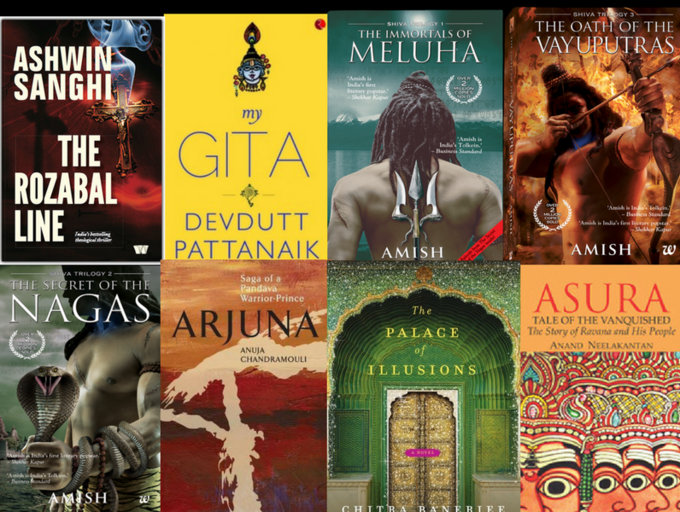
Indian mythological-fiction books one must read | The Times of India

Rajiv Malhotra (researcher, author, speaker) said in an interview about how some fiction writers are converting Indian History into Myths. Ramayan is just a story for them and Mahabharat is just the longest poem.

There is a new genre which is popular in India, Mythological-Fiction. Which is used to convert History into myth and fiction. Draupadi and Sita are feminist for these authors, Karna was a victim of the Caste system and Ram was an insecure guy according to these intellectual authors.

They say Hindusim’s God and Goddesses are just mythology and fictional characters. The same thing happened with Greek and Egyptian Gods, now they all are used in Hollywood movies.

These people will write about Islam, Christianity or any other religion because according to them, Heaven and hell, Djins and Angels are true and Yoga, Ayurveda, Bhagavad Gita are Myths.

Media

Anti-Hindu Agenda of India Today! – Priya Jayagopi

There are many Media sites and Channels which are funded by ( Unknown for a reason ) type of people against Hindus. Some mainstream media groups in India are teaming up with Christian Missionaries.

Some media groups are so talented they can convert any news into a piece of HINDU TERROR news. Some journalists are so busy fighting for humanity that they can sell their country for it.

Uhhh!… we all know about it.

Conclusion

When a common Hindu gets insulted everywhere for his belief and traditions, he starts to disconnect himself from his Dharma. They start calling themselves atheists or agnostics in front of their friends.

Majority of Hindus don’t read their own holy books like The Vedas, Upanishads and Bhagavad Gita. They are always in doubt and confusion. When he gets disconnected from his culture, then people like missionaries try to convert him or radicals try to hunt him. When he doesn’t fall in their trap, someone gives him a book of Marx, after reading that, the same guy stands against his own country and people.

People from the west are turning to India for Inner peace and wisdom. They are reading Gita while we are busy reading mythological fictions. They are doing Yoga while we are going to the Gym. They have patents of Gau mutra medicines while we are busy in making fun of Ayurveda.

Think about it before it’s too late.

Covid-19 professional development for teachers

0

“Learning never exhausts the mind.”- Leonardo da Vinci

There’s no end to learning. It doesn’t end after completing education and starting to work. Individuals that want to upgrade and upskill to become more proficient at their jobs will always do so through continuous education and training. When it comes to schools, teachers need to go for professional development as it not only helps them teach their students better but also makes them effective and efficient, in all aspects of their professional lives. During COVID-19, professional development of teachers is needed more than ever before.

Why should teachers pursue professional development?

Professional development for teachers is important because teacher’s usage of new knowledge in the classroom has a direct impact on students- classroom achievements and productivity increase when teachers participate in professional development. It only helps teachers sharpen their skills and improve their craft, but it also leads to better student success. In my own experience, I have seen the rigorous training programs conducted by Orchids The International School to ensure teachers feel more empowered & belonged to the institution. Relevance with the world & the need of integrating technology in learning is where the need of the hour is.

Here are five reasons why professional development is important for teachers

  1. It improves students learning

The days of getting knowledge from books are long over. Today, students have access to better tools and services like the internet. Besides, curriculum standards are constantly changing and this makes it challenging for teachers to keep up with new trends and industry best practices. Professional development makes it easy for teachers to create relatively significant and customized instructions for students.  

  • Teachers learn new ways to teach

When teachers pursue professional development, they get equipped with new teaching strategies. With these strategies, they can make changes to the way they teach in the classrooms. Professional development exposes teachers to new delivery methods and evaluation styles. 

  • It helps new teachers with skills

Most new teachers may not have the required skills to teach students. While it’s true that they are trained to teach students as part of their teacher education program, that’s insufficient as they lack in several classroom skills. With on-the-job professional training, teachers are skilled and reskilled.

Most experienced teachers have the resources to learn on the job as they spend their whole careers developing new skills, but new teachers don’t have that luxury. This is where professional development comes handy as it gives them the much-needed experience.

Professional development can help both new and experienced teachers learn the skills they need to teach today’s students.  

  • It helps with the growth mindset

Professional development improves student outcomes and helps promote a growth mindset.

It helps teachers become active participants in their own learning and with this, they are eager to pass on that learning to the students. With professional development, teachers understand that their work is being valued and the school wants them to grow.

  • Prepares them for success

Teachers must know their personal strengths and weaknesses and it’s difficult for them to acknowledge that most of the time. Professional development helps teachers to reflect on what they lack and helps them to improve on that. 

Students want their teachers to be subject matter experts which means teachers should be capable of answering any questions that students may ask at any point. Professional development programs enable teachers to widen their knowledge in more than one subject area.

Retribution time for China has come

Couple of decades back while on a trip to Japan, I had taken my mother along with me. One of my Japanese friends there invited us to his home for dinner together with all his family. We both being strict vegetarians, our hosts had taken utmost care to ensure that only vegetarian food was cooked that day and all were served vegetarian food only. Over the dinner my mother was given a piece of tempura that was very chewy. So she told me in Kashmiri that it feels like there is some meat in it. I told her that she can just go to the restroom and spit it out. Looks like somebody, probably one of the kids had brought in tempura from the market although asking only for vegetarian but had erroneously been given a piece of octopus tempura along. Those of you who know Japan well and many places in west, will know that mostly the people there do not really understand the concept of strict vegetarianism and are generally ambivalent about such food preferences. And unfortunately this octopus tempura piece got served to my mother.

It is a small mistake that happened in-spite of the hosts taking utmost care in ensuring that they only made and ordered vegetarian food. But the hostess of the house was so distressed and remorseful that she began to sob at this inadvertent mistake and kept on apologizing to my mother. In-spite of telling her it is alright and not a big deal but throughout the evening she was extremely sad and kept profusely and continuously apologizing to my mother. Then my mother had to literally hug her to get her to relax.

Now back home in India, even if we touch another person mistakenly by foot, we immediately touch them with our hands and ask for forgiveness. The reason for that is, we believe that the same divinity resides in every person and hence we seek immediate remission even though the mistake was unintentional.

In Indic civilization we believe in “Karmic laws, that basically means “what goes round comes round” or “what you sow is, what you reap”. So we are extremely aware of any wrongdoing done and know the retribution will come and hence are immediately repentant.

While it largely depends on the culture, similar such examples can be seen from across the globe. But what amazes me is the deep disconnect of the Chinese regime with the basic and fundamental human values. They, in their hunger for hegemonic control of the world, inflict miseries on the rest of the world and may be even on their own people, but do not even show an iota of self-reproach for their actions, that too out of their own volition. It is something that is unthinkable that a regime can be so cruel and brutal. All the indications show that the Corona pandemic was a well planned strategy to cripple the world and then start the dance of dominance when the world is at its weakest point both from the health and the economic point of view.

As of now hundreds of thousands of people have already lost their lives because of this induced biological warfare. Many more are falling prey to this pandemic every day. The world has come to a stand still and yet China has not even a whimper of remorse. And on the contrary is going about its expansionist plans with full fury and urgency.

Couple of days back I logged into a professional network portal and was shocked to see the amount of job loss messages coming from around the world because of forced retrenchment due to the pandemic. Millions have already lost their jobs and are struggling to fend for themselves and their families. Yet, China is busy bullying everyone around the world and continuing to act as defiant as ever.

What do you call such a belligerent attitude? It can be nothing else but pure evil.

So, will inflicting such misery on a vast population go without reparation? Will imposing a vast collective trauma on people go without punishment? Will the sighs of unguarded and helpless people go unanswered?

The answer is no as Karma will catch up. The seed you have watered will bear its fruit.

While everything has its own time for fruition, I think the time for punishing China has come. Our scriptures say when evil has reached its pinnacle a higher power will manifest and take control to ensure that the evil is punished and destroyed.

Right now China seems to have crossed all the limits of vileness and the retribution will follow. This time round it will be India that will give the lesson of the century to China. India is already leading the effort of cutting this bully to its size. While many countries may not be able to pitch in with the help in material terms, but the wishes of all the people of this world are with India while it is carrying out this dharmic duty.

Already Indian soldiers have given a befitting reply to Chinese PLA at Galwan for their deceitful attack with weaponry on our unarmed soldiers by inflicting more than double the casualties on the PLA side. And while they were still nursing their bloody nose, Indian government has banned their snooping apps from India that will not only cut their economic gains but also cut the constant stream of Indian people’s personal data that they use for psychological warfare. While they are still reeling from this digital surgical strike, government ministries have announced banning or revoking of the contracts with Chinese companies that were involved in infrastructure building within India.

This time around, China has messed up with a wrong entity. India is not anymore stuck in the colonized leadership of 60s that would be cowed down to a bully. India was never weak but this time around the leadership of the country is in the hands of a visionary leader who knows how to treat a treacherous bully. I am sure the government is working on the detailed plans to dismantle this rouge regime and it’s hegemonic plans but if rest of the world supports, it might be the best time to liberate Tibet, East Turkestan, Southern Mongolia, Manchuria, Yunnan and other lands in the South China sea from the Chinese forced occupation.

Since it is not just India that is affected by China’s belligerence, I would appeal to all the citizens of a world that believe in peaceful coexistence, at the very least to boycott Chinese products and help in fight against this treacherous bully economically.

The process has begun, but it going to be a long drawn affair with multiple pronged approach including militarily, economically, diplomatically and socially. We as countrymen should be ready to stand up together and support our government and ensure that we personally boycott Chinese products even at the cost of some inconveniences. Being a greedy regime, the economic hardships will hurt China very badly.

Though the coming of retribution might seem a bit slow, but it surely is and that too mighty hard.

A dilemma- should we take religion with us if we can go to Mars?

0

“It’s important that you read this paragraph as it talks about how everything that is to follow is an experiment which may get the author to be banned from this platform however I will tell you that, all that is to follow, falls under my freedom of speech and if you are offended by the use of “unparliamentary language” you must leave now.”

“sounds pretty usual? Isn’t it, just keep scrolling things will get bit edgy”

My entire point of writing such an opening is to warm you up for a question that I have been pondering upon since the time चंद्रयान went up. I have been thinking about this a lot what if we are actually able to land on some planet and if it’s possible should we take religion with us?

I am not talking about any specific religion but all of them I’m saying would it possible to do something like this? As far as this amazing feat of human landing on some other planet is concerned it would be possible only with science, no amount of Pope’s blessings or prayers or wishful thinking but only through science. We have seen how cruel can religion get (crusades) and entire dark age in the west, and I don’t have to remind any of you what religious extremism has done to our land starting with Muhammad bin Qasim, no amount of ink can cover the entirety of the destruction it had caused and the ripple effect it sent out which is still reverberating throughout the history. I don’t believe that people completely understand the damage Islamic rule had on the history. We don’t have enough data available to understand how our civilization worked before Muhammad bin Qasim knocked every last shred of Dahirs kingdom into dust. (“Well…it’s just something”, but go on”)

Coming back to my original dilemma, should we take religion with us if we can go to Mars for example.

Please let me know about your thoughts because no body seems to have any answers (and yes I have asked all of my other personalities)

“Well…I did tell you things would get edgy…now it’s just something that author has been trying to make people interested in history, he starts with something else to get your attention and then throws in what he really wants to say” Cheers!!

Note : The above is an experiment to show that “we” understand the value of discussion. I mean if you think you have the answer please share.

Why Sharad Pawar supported Modi, slammed Rahul Gandhi on China

He is trying to recreate The old Third Front in a new avatar and defeat Narendra Modi in 2024. 

Sharad Pawar surprised everybody when he reminded Rahul Gandhi of the 1962 China war and Congress Government’s failure to protect Indian territory. But then this is not the first time when he has backed the central Government. Neither is he the only regional satrap who has backed the Government on issues of National Security. After the all-party meeting in Delhi on 19th June, even Mamata Banerjee did that. And so did Arvind Kejriwal and Mayawati. And this is the second time in less than three months when opposition parties other than Congress have stood by Modi. Even when Rahul Gandhi was going hammer and tongs at Modi for Lockdown, Pawar supported him wholeheartedly. So why are these Opposition parties supporting Modi on Chinese incursions? 

Primarily, because popular sentiment is with Modi. And these days there is always a danger of being branded as ‘Anti-National’ for opposing him. But more importantly, all these third front politicians generally, and Sharad Pawar particularly is trying to dislodge PM Modi in 2024. Or to use the reference of yesteryears, he is trying to do what Vishwanath Pratap Singh did to Rajiv Gandhi.

If you think I am crazy, won’t blame you. But have patience and read on.

Till 1989, but for a brief aberration of 1977-79, it was Congress all the way. In 1984, post Indira Gandhi’s assassination, Congress under Rajiv won a massive mandate of 414 seats. Symbolising the popularity of Gandhis and Congress hegemony. This happy picture was disturbed when the Supreme Court, in 1985 against Muslim Personal Law, decided to award alimony to a widow, Shahbano. 

This led to a series of blunders by Rajiv.

1985: To please enraged Muslim clergy, he overturned the Shahbano’s Supreme Court’s judgement.

1986: Fearing backlash from Hindu Right, Rajiv unlocked the Ram Janmabhoomi gates.

1987: Moving V P Singh to Defence Ministry from Finance. 

1989: Allowed VHP to perform a foundation stone laying ceremony (Shilanyas) at the Ram Janmabhoomi. 

This cynical flip-flop on religious issues by Rajiv dealt a serious dent to Congress party’s credibility. 

Going back to 1984, when Rajiv Gandhi began his tenure as PM, old loyalist, V P Singh was handed over Finance Ministry. Where he tried his hands at little economic reforms, but mainly was busy going after super-rich through Enforcement Directorate. Such as Lalit Thapar, Dhirubhai Ambani and Amitabh Bacchan. So draconian was V P Singh’s regime as FM, that the term ‘Raid Raj’ was invented then. Which, in hindsight, one can say was part of a bigger plan to project his anti-rich image and target Rajiv. When there was outrage over this, he was shunted out of Finance. And intriguingly, give Defence. Where he started digging defence deals, such as HDW Submarine and Bofors. And word began to spread that Gandhis got a kickback in Bofors deal. Rajiv, already under pressure from Hindu Right for bowing to Muslim clergy on Shahbano, was losing popularity. 

Ultimately this struggle within the party led to the resignations of two ministers, Mufti Mohammed Sayed and Arun Singh. Rajiv forced Amitabh Bacchan to resign from his Lok Sabha Seat and ordered a probe against Ajitabh Bacchan. And finally in July 1987, expelled Arun Nehru and V P Singh from the party. 

With Rajiv popularity on the wane and V P Singh, seen to be fighting rich, mighty and corrupt, it gave the much needed boost to his image. A testimony of which was, his byelection victory from Allahabad in 1988. Finally, in October 1988, by merging Jan Morcha, Lok Dal and Congress (S) he formed Janata Dal. On the backdrop of Bofors allegations, it became very popular, as a party fighting corruption. Janata Dal went on to form an alliance of like-minded regional parties (Third Front) such as DMK, TDP and Asom Gana Parishad. This was no mean achievement. But the remarkable thing what V P Singh did was, getting ideologically opposed BJP and far Left – CPM, to fight Rajiv, alongside him. 

1989 was the first election where Corruption at high places occupied the biggest mind space of voters. It was mighty, all-powerful, corrupt Gandhis versus this coalition of upright Lohaities (Third Front), far-Left CPM and BJP representing Hindu Right. Jointly known as the National Front. And this ragtag alliance of parties with incoherent ideologies, in 1989 did humble mighty Rajiv Gandhi. 

So how did this happen? In 1984 when Congress won the highest ever 414 seats, it secured 48.4 % votes. In 1989, this dropped by just 9 %  to  39.5 %. But it lost more than 50% seats and came down to 197. This impossible looking task was achieved through once in lifetime Opposition unity.  All opposition parties ensured that they will not cut each other’s vote and maximise the anger against Congress. 

Sharad Pawar, just like V P Singh, is busy creating a rainbow coalition of Third Front parties with different ideologies. And he is going to have everybody, starting with ‘Hijab’ sporting Mamata to ‘Babri destroying’ Shiv Sena.

Find this farfetched? Modi is too strong? 

You will be surprised to know Sharad Pawar is already practising. He has done it in Maharashtra, by creating an alliance between Congress, NCP and Shiv Sena. If fierce ideological opponents like Congress and Shiv Sena can run a Government, any compromise is possible. Power is too strong a glue! Anti-Modism is strong enough alibi for party workers who hate BJP and Modi.For most party workers power matter more than ideology. 

What about voters? Well, voters only matter once in 5 years. By then, perhaps they can fall back on caste formulas to entice voters. 

In the eighties, Congress represented upper-caste Hindu along with OBC and even Dalit voters to a large extent. Not to mention Mulsim vote. By raising the demand for Ram Janmabhoomi, BJP had started slicing away Mandir (Hindutva) vote. V P Singh took away the Mandal vote from Congress. 

Sharad Pawar by backing Modi on issues of National Security and Corona Pandemic is ensuring he is seen the be moving away from Congress. And at the same time, he is getting ready to appropriate Modi vote. Raj Thackeray tried the same thing on a regional level when he changed his flag to Saffron.  A rude reminder on a few data points at the end will be useful. When Rajiv was defeated in 1989, his vote share was 39.5 %. BJP in 2019, clocked 37.36%. Even if you consider NDA vote share, it’s 41%. From here how much upside BJP can see? Before answering that consider some more facts.

Even with Rahul Gandhi’s 27*4 comedy show, Congress vote share is not dropping below 20%. Second most of the regional players also holding on to their share. And lastly, with economic growth refusing to pick up, forget increasing vote share. Holding on the current one can be a challenge. So mathematically, it’s possible to defeat BJP. Recently, Arun Shourie mentioned this formula. It worked in 1989. Can work again. Just imagine how much, weathercock Politicians like Ram Vilas Paswan, Chandrababu Naidu, Nitish Kumar, Jyotiradiyta Scindia would love to switch again just before 2024. And by combining their old captive vote with newly acquired ‘Nationaslitic’ vote, defeat Communal BJP and Authoritarian Modi! I bet they must be salivating at the prospect. 

In coming months watch out for the Third front Politicians taking more Centrist positions and supporting Modi more openly. Importantly, watch for an 80-year-old new kid on the block from Maharashtra giving one last dash to capture the Delhi throne. 

Taxes, the Bhagavad Gita, and the Bible

Obviously the Bhagavad Gita- the guide to human life and the people of Bharat explained by God himself- would profess Social Justice by seizing power from the hands of the wicked and centralizing it with the moral perpetrator of the land i.e. a virtuous government. There is no doubt that it would proclaim a system of forced donations from the rich to the poor.

This reminds me of President Trump speaking at the Freedom Concert in Washington D.C., shortly after signing an executive order to ease the Johnson Amendment- which prevented Tax-exemption to politically partisan religious-like institution; he said, “Bureaucrats think they can run over your lives, overrule your values, meddle in your faith; and tell you how to live, what to say, and where to pray. But we know that parents, not bureaucrats, know best how to raise their children and create a thriving society…and we know that families and churches, not government officials, know best how to create a strong and loving community. And above all else we know this, in America we don’t worship government, we worship God.

As a matter of self-spirituality- religious freedom and assistance to its cause are deeply personal. Whether that assistance comes in the form of labor, goods, or money. The state charging tax on the income made by unilateral intra-community donations and bilateral sale of goods for religious symbolism and utility, to redirect it on any other cause- which may conflict with the religious community- is a great infringement of religious liberty. The framers of the Constitution had this possibility in mind when they came up with Article 26 and Article 27. The former ensures full autonomy in religious matters and administration of property to every religious denomination. The latter restricts Government action of the use of tax funds from a person of one religious community to endorse another religious community.

Yet somehow, it is darkly present in Independent India history, as if the atrocities of the East India Company and the British Government on Hindu Temples were not a lesson to learn. From the Madras Regulation VII (1817) to the Tamil Nadu Hindu Religious and Charitable Endowments Act(1959), the tyranny of excess Government involvement is too substantial undermine. The absurdity stretches out when the Big Government Tax Champions invoke the Gita, ‘Hindu Socialism’, and Jesus Christ to call out for false hypocrisy of complaining Hindus and Christians. Not only is this heretical to Church hermeneutics and Temple Donation, but absolutely bizarre to the exegesis of scripture. 

Eric Wolf writing in his book Peasants – Foundations of Anthropology points out,

 “…many Middle American Indian groups who have abandoned their traditional Catholic folk rituals– with their great costs paid out in the support of religious organization and events -and have turned to a sober Protestantism for which such expenditures are not required.

While talking about peasants resisting ceremonial expenditure for their community. Max Weber had famously contended this apparent differential theological application- between Protestants and Roman Catholics -in everyday life. Weber wrote in The Protestant Ethic and the Spirit of Capitalism
the difference of the Calvinistic from the mediæval asceticism is evident. It consisted in the disappearance of the consilia evangelica and the accompanying transformation of asceticism to activity within the world”; to suggest that the Christian Reformation ideology of ‘Salvation through faith alone’, in other words, Salvation is not achieved by human works but by the decree God- rendered Christians to infiltrate accumulation of wealth in the name of God. Whether it is the ‘Ceremonial Expenditure’ of Eric Wolf or ‘Consilia Evangelica’ of the Roman Church- these clauses are not mandatory. Moreover, they are devoid of State control. For if it were the ‘Holy Sacraments’ and the ‘Funds of Rent’ of Wolf, State control would even have a credible case in the life of a Christian.

Ignorant Socialists like Bernie Sanders- who get up on stage at a Christian University and quote from the Bible to make a case for Socialism being the essence of core Christian belief -not only have not read the Bible but are perverting it for the sake of their political agenda. Paul writing his second letter to the church in Corinth- 2 Corinthians-says,

 “Each of you should give what you have decided in your heart to give, not reluctantly or under compulsion”. 

And Yahweh God in all his might and knowledge warned the Jews through Moses in the 19th chapter of the Book of Leviticus- Leviticus 19-by saying,

 “Do not pervert justice; do not show partiality to the poor or favoritism to the great, but judge your neighbor fairly.” 

For is it my Christian bias, or is God warning us against the postmodern ‘Social Justice Warriors’ who want to occupy the Wall Street while taxing the rich till all income for everyone vanishes? I guess Jeremy Corbyn can answer my question in his Labor 10 Commandments. 

In the 17thChapter of the Bhagavad Gita- Arjuna, in his curiosity of salvation, asked Krishna about the people who have faith in God but do not follow the scriptures. Krishna told him that there are three kinds of nature of the mind of man – Righteous, Passionate, and Ignorant; and the faith of the man conforms to the nature of his mind. Krishna then goes on to categorize major human activities in the aforementioned particulars. So the manner in which a person chooses to carry out an activity would be in reverence to the nature of his mind i.e. branded with the same category. After discussing three kinds of food, sacrifice, and penance – Krishna moved on to donations. Krishna says:

Charity given to a worthy person simply because it is right to give, without consideration of anything in return, at the proper time and in the proper place, is stated to be in the mode of goodness.

But charity given with reluctance, with the hope of a return or in expectation of a reward, is said to be in the mode of passion.

And that charity, which is given at the wrong place and wrong time to unworthy persons, without showing respect, or with contempt, is held to be of the nature of nescience.”

Gita contends that when a donation is given with contempt to ‘unworthy persons’, it is deemed dull or ‘nescience’ by God; and so a donation held ‘Good’ by God is the one given voluntarily- for the sake of righteousness-to a ‘worthy’ person. The determination of a ‘worthy person’ is to be done scripturally with his individuality as the basis. Unlike a centrally controlled fund distribution system with the individual’s intersectional group identities as a basis for beneficiary involvement – that is the case with a federally handled progressive taxing system. Too bad for Sitaram Yechury, who wants to quote from a book that he has not understood, but this is what Krishna said.  

From Nehru’s Socialism launchpad model for India in the 1950s, the 97.75 percent marginal tax rate (including surcharge) for the highest slab in the 1970s, and the tyrannical Wealth Tax, we have come a long way.

Sin, sinners and redemption

“Any story about revenge is ultimately a story about forgiveness, redemption, or the futility of revenge.”
Nick Wechsler

Since ages, humanity has delved into the nuances of human emotions which produce intense and surreal reaction. The idea of sinning and sinful existence of humans had propelled the individual and society at large in pursuit of path to realize the condonation from sin, error, or evil, even when it endures sufferings and pain to them. As Patti Smith puts it, “The idea of redemption is always good news, even if it means sacrifice or some difficult times”. The complexity of human existence and the individual and social actions associated with it has propelled injustices committed both to other humans as well as on the nature itself. It has led to bloodshed and gory wars with the ultimate desire of establishment of coveted power structures in place in the society.

But the ensued labyrinth of death, destruction and sufferings generated in the process has also stirred the human consciousness to seek atonement and redemption for their acts. The search of happiness and inner peace has galvanized mankind to seek redemption for themselves. This is echoed by Walter Benjamin as “Our image of happiness is indissolubly bound up with the image of redemption. The same applies to our view of the past, which is the concern of history… There is a secret agreement between past generations and the present one.”

But the moot point is; is seeking redemption enough? Does it salvage our pride in judgment of human race and the principles it represents? Humans tend to seek redemption but loath on the idea of seeking forgiveness for the errands committed. Indeed, the conscience of the one seeking restitution of the self has indelible impact on the process in achieving the desired objectives. Between the radiance of a clear conscience and the darkness of a conscience defiled by sin lie many shades of gray where blemished humanity subsists. This may not be an impeccable position but not beyond redemption. 

Indeed, some even delve on other unexpendable factors which are a prerequisite to attain salvation. As sermonized by Pope Francis, “The fragility of our era is this too: we don’t believe that there is a chance for redemption; for a hand to raise you up; for an embrace to save you, forgive you, pick you up, flood you with infinite, patient, indulgent love; to put you back on your feet. We need mercy.” Any efforts of redemption cannot replace the inculcation of sense of pity and kindness in the actions of the mankind. Death and destruction can only be suffered and at most forgotten, but their indelible scabs do have the potential to arouse the sense of retribution in the generations to come. Human history has indeed established that the trails of scars they leave behind are the crux of all the tensions and conflict throughout the ages.

“When you destroy somebody, you are destroying yourself meanwhile. Maybe right now you are not alert, but one day you will find that the same ditch that you have dug for others has proved your own grave. So it is always very very essential to feel, to know, to be certain”, pronounces Osho.  Indeed, unnecessary and unchosen suffering wounds us. But then it is upon the individuals not to allow these to scar them for life. Sufferings cannot be allowed to mark us, alter us forever and strangulate the humanity within us. But then it requires a level of emotional and philosophical grounding to be inculcated in the society which is sensitive to the ultimate goal of mankind to attain happiness and contentment for all.  

In the postmodern society where we owe our existence, this may seem a far flanged goal. The constant ups and downs of everyday life do indeed fade the prospect of distinguishing between sinning and surviving. The idea of redemption therefore seems a distant dream which is way down the list of human priority, both in the realms of individual and society. Even if the relevant idea exists in any corner of public discourse, it is full of cynicism and greeted mostly with sense of dilemma. “Any fool can be happy. It takes a man with real heart to make beauty out of the stuff that makes us weep.” exclaims Clive Barker. The ultimate goals of search of happiness in modern times do have a twisted inference in our minds and conscience. In common parlance redemption implies rescue, being saved from the ugliness of societal flux.

Clearly, redemption as a tool of proscription of our acts is a welcome indication in this world where your status is mostly judged by your material possessions and the moral values are given a pass. But the awareness of being watched by someone and answerable for ones act does sits in the corner of human conscience. A noble act does not wash out the bad, nor does a bad act the good. Each has its own ramifications, its own consequences. It is arguably sense of delineation to assume redemption as a personal goal, seeking it while meandering through the dusty lanes called life, in search of human spirit that defines our existence. To sum up Evinda Lepins pens down a beautiful quote “Your current circumstances are part of your redemption story He is writing.” 

Impact of Hinduism and Buddhism in Southeast Asia

0

Southeast Asia is a sub-region consisting of 11 countries. It covers an area of 4,545,792 square kilometers. With a population of 655,298,044, this region is one of the most populous regions in the world. Islam and Buddhism are the two most prevalent religions in Southeast Asia. Apart from them followers of Hinduism, Animism, Tai folk, Taoism, Vietnamese folk live here. 42% of this region’s inhabitants have now embraced Islam, numbering about 242 million. On the other hand, number of Buddhists in the region is about 190-205 million. Compared to these two religions, the number of people of other religions in this region is much less.

The influence of Indianness on Southeast Asia was most noticeable from 290 BC to the 15th century. kings of India’s north eastern coastal region maintained trade relations with southeast Asian countries such as Burma, Thailand, Indonesia and Cambodia which led to cultural, social, economic as well as religious exchanges between these two regions. Thus the ‘Indianization’ or ‘Sanskritization’ of this region took place under the direct and indirect influence of India. Kingdoms that were formed in this region under the influence of Indianization were initially Hindu and Mahayana Buddhists. Examples include Champa kingdom in Central Vietnam, Sriwijayan in Sumatra, Funan in Combodia, Khmer in Indochina, Lankasuka in Malay Peninsula, Medang, Majapahit and Singhasari Kingdoms in Java, Bali and Philippines. Hinduism and Buddhism as one of the elements of Indian culture have significantly influenced the languages, literature, culture, calendar, traditions belief system of the civilizations that have developed in this region.

The history of mainland India’s connection with Southeast Asia has been narrated in Puranas. According to Ramayana, Ramachandra sent Sugriva’s Vanar Sena to Yawadvipa, the Island of Java, in search of Sita. This region had a lot of contact with South India in particular. This connection was exacerbated when the Chola dynasty of India conquered Southeast Asia. The kingdom of Tarumangara or Taruma, which was established in West Java in 400 BC, was also influenced by Indianness, the Taruma kings were worshipers of Vishnu. The Kalingaa kingdom that was established in Central Java in the 6th Century was also named after the Kalinga province of India.

Today, Southeast Asia is home to large number of Indian diaspora, mostly Hindus. Apart from them, Balinese and Tenggerese minorities of this region are also Hindus. The Balinese are about 4.2 millions in number, or 1.7% of Indonesia’s total population. The Tenggerese tribe has a population of over 1 million. A large part of the people of the Cham tribe are Hindus. They number about 4000 in Bangkok and Thailand combined. There are currently 80,400 Hindus living in Myanmar. According to the 2005 census, there are 52,631 Hindus in Thailand. Although not declared by the government, about 50,000 Hindus live in Vietnam. Hindus make up 6.3% of Malaysia’s population, numbering nearly 1.78 million. Similarly, 5.1% of Singapore’s population is Hindu, numbering about 1.58 million. 1% of people in the Philippines practice Hinduism.

Therefore, it is true that the association of this region with Hinduism is very ancient. The common form of Hinduism here is basically Shaivism, i.e. their deity is Shiva. The second largest form of Hinduism here is Vaishnavism . The disciples of the God Vishnu are called Vaishnavas. This region is also home to worshippers of the Brahma deity. It is said that the old name of Myanmar ‘Burma’ originated after the name of Brahma . The region was later influenced by Tantra, which was associated with both Hinduism and Buddhism. The Khmer Kings were worshipers of ‘Hari-Hara’, an amalgamation of Vishnu and Shiva. Statue of this deity have been found in Badami cave in North Karnataka, India, which is a clear indication of the close ties between India and Southeast Asia in ancient times. Hari-Hara was worshipped mainly in Cambodia, one of the countries of this region. Statues Of Ganesha, Skanda, Nandi (Lord Shiva’s bull), Garuda (the Eagle mount of Vishnu), Lakshmi have been found in various parts of Southeast Asia. The existence of another mixed god like Hari-Hara has been found here, namely ‘Ardhanarisvara’, a combination of Shiva and Parvati.

Just as the Hindus consider the waters of the Ganges to be sacred, so the water of the river flowing from the Phnom Kulen hill was also considered sacred in this region, according to various inscription. To the Shaivites, Shiva was mainly worshipped as a Linga or Lingam, is an abstract representation of Lord Shiva. The Shaivites of this region believed that Shiva’s two wives were Uma and Ganga. The significance of Shiva in this region can be understood by visiting the Prambanan Temple in Jakarta, Indonesia. Although there are temples of Vishnu and Brahma here, the main Shrine is dedicated to Shiva. The Hindu God Indra bears a resemblance to the Thagyamin deity worshipped in Myanmar. In Myanmar, Lord Shiva was known as Paramizwa and Vishnu as Withano. In this country, Thurathadi is worshipped as the Goddess of Knowledge, with whom Saraswati is found to be similar. In the same way, the resemblance of the Goddess Lakshmi to the Goddess of wealth in Thailand, Nang Kwak, is remarkable.

Apart from religious field, the has been heavily influenced by Hinduism in terms of culture. Different elements of Hinduism by folk artist have spread in different parts of Southeast Asia from generations. And these elements have blended aptly with the core culture of this region. The Hindu epics Ramayana and Mahabharata are prevalent in almost every country in this region. In addition to the main stories of the epics, some of the scattered events and anecdotes from respective regions have been added. As the stories spread, they gradually became an integral part of the life and culture of the local people. The name of Ramayana in Malaysia is ‘Hikayat Seri Rama’, in Cambodia it is known as ‘Reamker’. The Thai version of Ramayana is called ‘Ramakien’ and Myanmar it is also known as ‘Kama Zatdaw’. In Indonesia the Ramayana, performed by movable ‘Wayang’ leather puppets, very popular with the masses.

Various Indian Hindu festivals are celebrated with great pomp in southeast Asian countries. For example, Diwali is one of the most celebrated festivals in Singapore. Another influence of Hinduism on the public life of this region is seen in the application of Sanskrit language. In ancient India, Brahmins were experts in astrology, in addition to this, they were also admired for their sharp political knowledge. The kings of Southeast Asia used to invite Indian Brahmins to appoint themselves as chief advisors. All these Brahmins appointed as advisors used Sanskrit language in royal affairs and administrative works . They were the ones who spread Sanskrit as a written language in this region.

Influenced by the Sanskrit language, the scripts of the local languages were created, resulting in a wide range of similarities between the alphabets of these languages and Sanskrit alphabet. Sanskrit is the earliest form of the written languages currently used in Laos, Myanmar, Cambodia and Thailand, various ancient scripts and documents bear witness to this. At that time Sanskrit was used in all legal documents and in other minor fields only local languages were used. Even the legal framework of these Countries were very much similar to the legal framework of India . Even today, Sanskrit words are associated with the names of the inhabitants of this region, especially Indonesia. Sukarno, for example, is a very popular name in Indonesia. Despite Indonesia being a Muslim-majority country, the country’s national symbol bears the symbol of Garuda, The eagle mount of the Hindu God Vishnu, even the national airline of that country is known as ‘Garuda International’.

In the social sphere too, the influence of Hinduism in this region is immense. Manusmriti has been translated into various regional languages here, with original theme unchanged but various sub-stories attached to it. Main theme of Manusmriti is the caste system, which was observed in Cambodia during the Khmer dynasty. Most of the people under this hierarchical system were farmers and fisherman. The Kshatriyas were elite people including kings, warriors, army Chiefs. Brahmins or Priests also existed in the system, they were highly respected in the society. The lower classes of the society consists of various workers, potters, blacksmiths, masons, and others. Among the Brahmins and Kshatriyas, the influence of caste system was greater than that of the lower castes. But, the inferiority of women as described in the Manusmriti was not followed at all in the Southeast Asian countries. Women were especially powerful here. Inheritance of kingdom like in India was determined not only on the basis of paternal lineage, but also on the basis of maternal lineage.

The ‘Sdok Kak Thom’ inscription, which is the main document of antiquity in the social and cultural spheres of Cambodia, mentions many kings who inherited their Kingdom according to their matriarchy. In those days women held important positions, many religious and charitable projects were developed with their interest and donations. Indra-laksmi, Kambaja-raja-laksmi, Jayraja Devi and other influential and powerful women of that time are known from the script. Although Manusmriti was not followed, it cannot be denied that this practice of empowering women has been adopted from Indian version of Hinduism. As women empowerment was practiced in South India, Southeast Asia is thought to have followed that tradition.

In terms of architecture, sculpture and art forms, Hindu influence is clearly visible in this region. Hundreds of Hindu temples can be seen in almost every country of this region. The two most notable temples are the temple of lord Jonggrang, in Indonesia built in the middle of 9th century, popularly known as Prambanan Temple and the Ankor Wat Temple, constructed in the mid 20th century, also located in Indonesia.

The Prambanan Temple is located in Jakarta, Indonesia. It has 250 smaller temples in the complex, the highest being the Shiva temple which is 47 meters high. There are also temples of Vishnu and Ganesha. A princess, lord Jonggrang has her own temple, who is sometimes identified with Durga in that region. The story of Ramayana is engraved on the temples in the form of paintings.

Like Prambanan, Hindu architectural style has been followed in Ankor Wat. Remarkably, it is the largest Hindu temple in the world. King Suryavarman II built this temple and dedicated it to Vishnu. Needless to say, the main deity worshiped in the temple is Vishnu. Apart from Ramayana, Mahabharata, Bhagavata Purana, Harivamsa Purana also engraved in the form of mythological paintings on this temple.

The Murugan Temple in Batu cave in Malaysia is one of the most iconic Hindu architectural monuments, with a 42.7 metre high statue of the God Murugan. Just as Diwali in the worship of Kali, Navaratri in the worship of Durga are celebrated with razzle-dazzle, so the Murugan festival or ‘Thaipusum’ is celebrated with equal grandeur in this temple. The Besakih Temple or ‘Temple of Mother’ in the Indonesia is the most important, the largest and holiest temple of the Hindu religion in Bali. Its height is nearly 1000 meters, the whole temple complex consists of 23 small temples. Also worth mentioning the ‘Nat Hlaing Kyaung’ temple of Vishnu in Myanmar, which was established in the 11th century. Aside from temples, the walls of various government and private buildings in this region are engraved with images of Hindu mythological characters of Ramayana, Mahabharata as well as Nagas and Garudas of Puranas. These indicate southeast Asia’s long-standing relationship with Hinduism.

The popularity of Hinduism has been declining since the 13th century. On the other hand the popularity of Buddhism was gradually increasing. In the beginning there was no significant difference between these two religions, Buddhism was practiced in Hindu places of worship. Successively, the extent of Buddhism became apparent over time. From 11th to 13th centuries, the golden age of Buddhism continued to the this region. Later, the lion’s share of this religion converted to Islam. Currently, there are a large number of Buddhists in this region, second only to Muslims in terms of numbers, but the number of Hindus has decreased a lot than before.

There are currently about 190-205 million Buddhists in Southeast Asia, making it the second largest religion in this region after Islam. 35%-38% of Buddhists worldwide have settled in this region. Thailand has the largest Buddhist population. 95% of the country’s population is Buddhist, numbering 63.75 million. The number of Buddhist living in Myanmar is 48 million, which is 89% of the total population of the of this country. Buddhists make up half of Vietnam’s total population, numbering 44 million. 95% of Cambodia, or about 14 million citizens, are Buddhist. 20% of Muslim-majority Malaysian are Buddhists. The 5 million people in communist Laos are Buddhist, accounting for about 70% of the countries population. Although Indonesia is an Islamic state, Buddhists make-up approximately 2% of the countries population, numbering 4.75 million. Nearly 65000 or 13% of Brunei’s citizens are Buddhists. About 2 million Buddhists live in Singapore which is 33% of their total population. 1% of people in the Philippines practice Buddhism .

Different types of Buddhism are observed in different regions. Inscriptions from the southern part of southeast Asia were written in Pali, indicate that this region was largely devoted to Theravada Buddhism. The inscriptions from the north, on the other hand, were written in Sanskrit. The inhabitants of this part believe in Mahayana Buddhism. Tantrism was influential among the believers in the Mahayana Buddhism of Southeast Asia. Theravada Buddhism first spread from India to Sri Lanka, then to Cambodia, Laos and the southern part of Myanmar. On the other hand, Mahayana Buddhism spread from India and China to Southeast Asia in the 1st and 2nd centuries. Mahayana Buddhism expanded by sea and became very popular in Vietnam under Chinese influence. Just as Theravada Buddhism originated from South India, North India is the birthplace of Mahayana Buddhism.

In 250 BC, the Indian empire of Mourya Dynasty, Ashoka sent Buddhist monks to Myanmar or former Burma to propagate Theravada Buddhism. The Mon kings of Burma welcomed them and many people in their Kingdom voluntarily converted to Buddhism. Thus began the journey of Theravada Buddhism in this region. The Ceylonese monks later maintained this trend. In the 3rd Century BC, there was disagreement amount Ceylonese monks about the differences in practices between some councils of Bhikkhu monks and Vajjian monks. Since then, these two branches of Buddhism have become quite separate.

Three different regions of Southeast Asia have been influenced differently by Buddhism. The three regions are Malaysia and Indonesia, Myanmar and Mekong Delta and Vietnam, respectively. It is believed that King Ashoka sent two of his envoys, Sona and Uttara, to the Malaysian peninsula or any part of Indonesia to propagate Buddhism, known as the ‘Land of Gold’ or ‘Suvarnabhumi’. Before the 5th century BC, the Indian monk Gunavarmana successfully preached Buddhism in this region. In the 7th century, the Srivijaya kings played a pivotal role in the spread of Buddhism. The Shailendra kings patronized and propagated Mahayana and Tantric Buddhism from 7th to 9th century.

The Myanmar-Mekong delta is the second part of this region where Buddhism flourished. The local Mons and Burmese, however, claims that this is the real Suvarnabhumi, where Ashoka sent his envoys to preach Buddhism. Conservative Hinayana Buddhism was first practiced in this region, but later in the 12th and 13th centuries, under the patronage of King Jayvarman VII, Mahayana and Vajrayana Buddhism was introduced. The Theravada reforms that began in Sri Lanka after the 11th century gradually overwhelmed this region, which remained intact in the 20th century also. In the 1st millennium CE, Buddhism reached Vietnam by sea trade from China. At that time, Vietnam was under Chinese rule. However, Mahayana and Hinayana Buddhism spread to the two Indian-influenced States of Champa and Funan in Vietnam. But Buddhism was not propagated in these areas in any organized way. Buddhism was propagated in Vietnam on a long-term and organized basis through Zen and Pure Land tradition, which came from China. Gradually Tantrism, Daoism and Confucianism entered Vietnam. When Communist regime began in Vietnam, many Buddhist monks turned to self-immolation in protest during the reign of Ngo Dinh Diem. During this time, obstacles were created for Buddhism, but Buddhism remained in its glory.

A review of the history of southeast Asia reveals that the monarchy has been in place for a long time, with Buddhism playing a major role. Because Buddhism explains a cosmology where ‘Chakkavattin’ or the king is the Central figure in society and the whole community depends on him . Buddhism promotes the existence of kings and provides spiritual explanations. Such images have been found in texts such as ‘Agganna Suttanta’ and ‘Digha Nikya’. These texts further state that the king is the protector of all because he ruled The Kingdom following the ‘Dhamma’, so the king mast be a ‘Khattiya’, or lord of the fields. If the king’s authority is maintained uninterruptedly, peace will prevail in the kingdom, in which case the Buddhist monks will be able to survive, and the ‘Nibbaba’ or Nirvana will be achieved through austerities.

The history of these cordial relationship between the king and the Buddhist monks is evident from the construction of various Chaityas, Viharas and Stupas in this region, which were formed by the grace of the king. These are found in large numbers in ancient cities like Borobudur, Ankor and Bagan (Pagan) . During the reign of the Shailendra kings in the 9th Century, the stupa of Borobudur was built in the present city of Jakarta, which is one of the oldest examples of Buddhist architecture. The Mahayana influence of this period is known through the depiction of stories like ‘Lalitovistara’, ‘Divyavandana’, ‘Jatakamala’ etc. in this architecture. There are 72 perforated, hollow stupas on three huge circular scaffoldings in which Buddha statues are curved. This relationship between king and Buddhism is more evident in the architecture of Ankor, Cambodia, especially through the presentation of Devaraja (God King) concept. It was built by Khmer King Jayavarman II. At that time Shaivism was the State religion, that is why Linga was made here.

The concept of Devaraja took Buddhist form during the reign of king Suryavarman I. This idea came to fruition during the reign of King Jayavarman VII, who built the famous Bayon Temple, one of the finest examples of Buddhist architecture. Thus the idea of Devaraja practically culminated in the idea of Buddha Raja. There are about 4000 Buddhist stupas in the Bagan region, which are outstanding examples of Buddhist architecture. Among the few impeccable architectures built under the influence of Mahayana Buddhism is the Sulamani Temple built by King Narapatisithu, the Gawadapalin Temple constructed by King Sithu I and King Htilominlo, Anand Temple built by King Kyanzitthu and many more.

In modern Times, Buddhism continued to face a variety of problems in southeast Asia. These problems were exacerbated after the colonial powers entered the region. This region was mainly colonized by Britain and France. Since 1830, Christian missionaries from Europe have been arriving and preaching Christianity. Western modernity posed a challenge to Conservative Buddhist culture. Under the influence of modernity a number of reform programmes were adopted in Buddhism as well.

Buddhism has played a significant role in overthrowing colonial rule in countries like Thailand, Myanmar, Cambodia, Laos, at the same time it has played an instrumental role in the development of nationalism as well. The contribution of Buddhism in conducting the freedom movement of this region in various ways is huge. Myanmar’s Young Men’s Association or YMBA played a direct political role in countering colonial powers. Take, for example, the ‘No Footwear Controversy’ of 1918, where this association forced Europeans to enter Buddhist Shrines and Pagodas without wearing shoes, which was previously denied by European colonial masters. There was a monk named you U Ottoma who was imprisoned for calling for a boycott of a government-funded election.

A monk named U Wisara, who sacrificed his life in prison by fasting for the freedom movement. Apart from playing an important role in independence movement, the role of Buddhism in nation building process is also memorable. When U Nu became the Prime Minister of Burma in 1948, he placed Buddhism at the center of all political activities. He developed Buddhist socialism by abandoning Marxism prevalent in that region at that time. Similarly in 1960 Buddhist monks in Vietnam hastened the fall of Diem government. Later under the leadership of Tai Quang and Thich Thien Minh, the ‘United Buddhist Association’ began to play a significant role in the Vietnamese State affairs. In Cambodia King Sihanouk followed Buddhist socialism in his political activities. In Thailand, Vijruvadh called for nation building following Buddhism and introduced Buddhist-centered education system.

This means that Buddhism in this region was not only limited to the personal affairs of the people as a domestic religion. Historically, this religion has greatly influenced the lives of the people of Southeast Asia extending from social sphere to the political sphere.

The history of Hinduism and Buddhism is very ancient, and it no exaggeration to call Hinduism the oldest religion in the world. India is generally considered to be the source of these religions. Before the advent of Christianity and Islam, the two most prevalent religions in the world, Indian civilization influenced various civilizations in different parts of the world by its own religions. It is mainly through Indian religion that Indian culture, languages, foods, customs and lifestyles gradually penetrated into various civilizations of the world and became integrated with them. This is how Indianization or Sanskritization took place. Southeast Asia is one of the most influenced parts of world by India. Although India does not share borders directly with any of the Southeast Asian States except Myanmar, the influence that India has had on these countries through religions remains intact for thousands of years.

References
Dumarcy, Jacques. 1986. The Temples of Java. Translated by Michael Smithies. Singapore.
Hinduism In Southeast Asia. 2020. Encyclopedia. Retrieved from https://www.encyclopedia.com/environment/encyclopedias-almanacs-transcripts-and-maps/buddhism-buddhism-southeast-asia
Hinduism is Southeast Asia. Wikipedia. Retrieved from https://en.m.wikipedia.org/wiki/Hinduism_in_Southeast_Asia
History of Indian influence on Southeast Asia. Wikipedia. Retrieved from https://en.m.wikipedia.org/wiki/History_of_Indian_influence_on_Southeast_Asia
Brennan, Elliot. 2014. Religions in Southeast Asia : Diversity and the threats of extremes, The Interpreter. Retrieved from https://www.lowyinstitute.org/the-interpreter/religion-southeast-asia-diversity-and-threat-extremes
Hindu Influence and Southeast Asia. 2011. Asia Sentinel. Retrieved from https://www.asiasentinel.com/p/hindu-influence-and-southeast-asia
The spread of Hinduism in Southeast Asia and the Pacific. Britannica. Retrieved from https://www.britannica.com/topic/Hinduism/The-spread-of-Hinduism-in-Southeast-Asia-and-the-Pacific
Murphy. Anne. The Religions of South Asia. Center for Global Education. Retrieved from https://asiasociety.org/education/religions-south-asia
Pillalamarri, Akhilesh. 2018. How India Influenced Southeast Asian Civilization. The Diplomat. Retrieved from https://thediplomat.com/2018/10/how-india-influenced-southeast-asian-civilization/
Sengupta. Jayshree. 2017. India’s cultural and civilizational influence on Southeast Asia. ORF. Retrieved from https://www.google.com/amp/s/www.orfonline.org/expert-speak/indias-cultural-and-civilizational-influence-on-southeast-asia/
Buddhism in Southeast Asia. Wikipedia. Retrieved from https://en.m.wikipedia.org/wiki/Buddhism_in_Southeast_Asia
Tai Thu, Nguyen. 2008. The History of Buddhism in Vietnam. Washington DC : The Council for Research in Values and Philosophy.
Lester, Robert C. 1973. Theravada Buddhism in Southeast Asia. United States : Ann Arbor Paperbacks.
Inspiring Heritage of Indonesia. TWC. Retrieved from http://borobudurpark.com/en/home-2/
Marado, John. 1976. Buddhism in the Modern World. New York : Macmillan
Buddhism in Southeast Asia. The Buddhist World. Retrieved from http://www.buddhanet.net/e-learning/buddhistworld/southeast.htm
Berzin, Alexander. Spread of Buddhism in Asia. Study Buddhism. Retrieved from https://studybuddhism.com/en/tibetan-buddhism/about-buddhism/the-world-of-buddhism/spread-of-buddhism-in-asia
Buddhism : Buddhism in Southeast Asia. 2020. Encyclopedia. Retrieved from https://www.encyclopedia.com/environment/encyclopedias-almanacs-transcripts-and-maps/buddhism-buddhism-southeast-asia
Buddhism- Southeast Asia. Britannica. Retrieved from https://www.britannica.com/topic/Buddhism/Southeast-Asia

A requiem for unsung victim: Bengali Hindus of Bangladesh

Even on the peak of COVID pandemic, when every person across the world is desperate to save their own life, a verified social media account reports series of instances of minority bashing taking place in several parts of Bangladesh. Not many eyebrows are raised, it is rather taken in normal stride.
Contrast it to the enactment of Citizenship Amendment Act (CAA) in India, presumably meant for the same oppressed minorities who had to flee Bangladesh. Hell broke loose. Quarters who had never known Bengali Hindus and the kind of oppression they underwent since partition, seemed to resist the marginal benefit on offer. Perhaps, nobody bothers for the agony of Bengali Hindus any longer, it has simply dissipated from public memory.

Indeed, one of the most underreported cases of persistent ethnocide in the post-colonial period had certainly been with the Bengali Hindus of East Bengal. In terms of magnitude of brutality and spread on scale of time, it has hardly had any parallel in contemporary history. Starting with one-sided massacre in collusion with the changed administration, vandalizing religious places on slightest pretext to use of rape to impregnate as a tool to proselytize (much before the world came to know of it in Bosnian carnage) Bengali Hindus of East Bengal seemed to have withstood it all and away from public glare.
The most important part is its documentation or the lack of it. It is ostensibly perceived that whatever partition and refugee related literature, film or documentaries have come up, incidentally, revolved around a central theme of ceaseless struggle of a refugee life, but having started off from the premise of Sealdah Station – a place where they used to flock after being driven away from their ancestral place in East Bengal.

But there is very little credible document presently available in public domain that would go on to chronicle the events that brought those hapless, persecuted refugees to the Sealdah Station in the first place. A handful few like, Pak Bharoter Rupokatha – Prabhas Chandra Lahiri, Jaile Trish Bachor – Trailokyo Nath Chakraborty, Udbastu (Refugee) – Hironmoy Bandopadhyay, Shikorer Sandhane (In search of roots) – Kaliprasad Mukherjee, essentially commentaries on the grisly onslaught, had long gone out of print. Obviously, most of the first hand victims or eye witnesses have perished by this time. A scanty few, who still survive, have got too scattered around to create an acceptable account for them to a bigger assembly. Thus, in effect, every concerted effort was consciously made, over a sustained period of time to write a pre-mature obituary to an unmatched cruelty. 

In a similar situation, to a more recent past in 1990, Kashmiri Pandits, too, were driven out from their own ancestral place. With savage killings around, their womenfolk ran with their children in arms to save their faith and lives. The same infants, now with the passage of quarter of a century today, grew up like a phoenix, fortified themselves with letters and then came back successfully to bring their ordeal out before the international platform.  Much of the recent positive development on the Kashmiri front was largely due to their successfully building up of a credible recital, by persistently telling their side of story to various international fora. Ironically, their tormentors, through successive generations remained with guns as earlier, and thus have easily lost the plot in a changed scenario.

Coming back to the eastern front, one of the biggest setbacks for the Bengali Hindus of East Bengal was the unexplained indifference to their plight from their first cousin just across the border. Historically speaking, there are various instances of expression of solidarity from distanced kin from around the world that actually helped to rein in atrocity in a troubled spot. Till Shyamaprasad was alive, there was a semblance of resistance from across the border. But after him, it was all over for the literally orphaned Hindus in East Bengal. No denying, Bengalis, by doing so, had woefully betrayed their long-cherished rebel image that once dared to take on, almost single-handedly, the might of English colonial masters.
Later still, an elemental redemption came from the plain-speaking of few international journalist-activists, who, with little emotional connect, started writing for the distressed Bengali Hindus of Bangladesh. Yet, these contemporary commentators like Richard Benkin (A Quite Case of Ethnic Cleansing: Murder of Bangldesh’s Hindu), Joseph Allkin (Many Rivers, One Sea) or Garry Bash (The Blood Telelgram), never got the minimal moral support from the Bengali establishment from the other side.

So, where do we go from here? Just a couple of years back, Shashi Tharoor, in his famous Oxford speech, highlighted the need for some kind of reparation from England for their heart-rending economic exploitation committed on the Indian shore.

An yearn for atonement has to start afresh. Without attempting to decode the psychological refrain of the fellow Bengalis, simply for the sake of justice for humanity, this forgotten chapter of human misery of the Bengali Hindus of Bangladesh must be brought back to the mainstream narrative.

A travel down may commence by retelling the present generation of Bengal the tale of unspeakable horror their forefathers had survived through. From re-printing of the lost first-hand portrayal of the refugees to selective translation of available material in vernacular for a wider global audience can be the stepping stone for resurrection of a tortured soul. Lest we forget…..