हाल ही में समाजवादी पार्टी ने अपना चुनावी घोषणा-पत्र जारी किया जिसमें लिखा है कि अगर उनकी सरकार दिल्ली में बनी तो ऊँची जाति वाले अमीर लोगों से अलग से कर वसूला जायेगा। केवल जाति और मझहब के गणित पर आस लगाए सत्ता पाने की आस लगाए मायावती-अखिलेश गठबंधन से यह घोषणा होना कोई अचंभा नहीं है। हालांकि संवैधानिक रूप से किसी जाति के लोगों पर जज़िया जैसा कर लगा पाना संभव नही है, किन्तु देश को जाति के नाम पर बांटने का कैसे षड्यंत्र रचा जा रहा है यह साफ दिख रहा है।
असल में मायावती और अखिलेश का चुनावी मंत्र ही जातिवाद आधारित वोटबैंक की राजनीति है। इस प्रकार अगर ये लोग कोई घोटाला भी कर जाएँ तो भी इनका वोट बैंक डगमग नहीं होता क्योंकि इस आधार पर चुनी गयी सरकार को फर्क ही नहीं पड़ता कि प्रदेश की प्रगति के लिए कुछ काम किया जाए या नही। बस लोगों को अपनी अपनी जाति या मज़हब पर वोट डालने के लिए बहला-फुसला दो, जातियों को एक दुसरे का दुश्मन बना दो या कोई डर दिखा दो और अपनी सरकार बार-बार बनाते रहो। इसपर मुझे अपनी एक पुरानी कविता याद आ गयी:
जाति में ख्याति है, ख्याति में है वोट। जो नाम ले जाति का, समझो उसके मन में खोट।
यहाँ ख्याति से मतलब पहचान से है। जबतक आप खुद को जाति की पहचान से मुक्त नही करते आप उसपर ही वोट करेंगे। पर जब समझ आएगा कि समाज बदल चुका है और जाति का औचित्य खत्म हो चुका है तो आपको कोई बहका नही सकता। यूपी में आज एक जाट, ठाकुर व् यादव दुकान भी चला रहा है, बनिया नौकरी कर रहा है, दलित अफसर बन रहा है, और पंडित वेदों से कोसों दूर है। समाज में पुरानी जाति व्यवस्था बस नाम की रह गयी है, काम की नही, पर जाति के नाम पर सत्ता सुख का सपना देखने वाले कैसे जाति को विलुप्त होने दे सकते हैं? यह समाप्त हो गया तो वोटबैंक वाली राजनीति का क्या होगा?
उत्तर प्रदेश का महागठबंधन नौकरी देने की बजाय, अमीरों से लूट कर गरीबों में बांटने का सपना दे रहे हैं। सबसे खतरनाक बात यह है कि ऐसी समाजवादी/कम्युनिस्ट स्टाइल की घोषणाएं समाज में असंतोष व् अलगाव ला सकतीं हैं और पूरा प्रदेश अन्धकार में डूब सकता है क्योकि ऐसी घोषणाओं से व्यापारी वर्ग पलायन कर सकता है। रूस ने इस प्रकार की सोच से कब की तौबा कर ली है और अब तो चीन भी बस नाम का कम्युनिस्ट रह गया है।। समाजवादी सोच से उपजी हिंसा ने रूस, चीन, कम्बोडिया, आदि देशों में लाखों लोग मरवाये हैं। ये लोग गरीबों के मसीहा बताकर सत्ता में आते हैं और फिर सबसे पहले गरीब ही मारते हैं वो भी लाखों के संख्या में। इन लोगों को इतिहास से कुछ सीखना चाहिए और ऐसी घोषणाएं करने से पहले भविष्य में समाज पर पड़ने वाले बुरे प्रभाव के बारे में सोचना चाहिए।
Enacted in 1958 the Armed forces (special power) Act (AFSPA), 1958 has been one of the highly contentious acts of the parliament. Time and again it has been questioned and criticized but has held its ground. Recently a major political party (the Congress) has pitched to dilute AFSPA in their manifesto. But how prudent would it be to dilute the provisions of AFSPA.
Armed forces require a law endorsement and protection without which it would not be easy for them to operate in their full potential and capacity. AFSPA was applied in Nagaland in 1958 first time for the very same reason. Now any attempt to dilute the AFSPA would first of all turn down the morale of a soldier on ground. It would restrain him to perform his duty and would make him reluctant to operate with efficacy, which in turn would result in worsening of the situation in the disturbed area.
The personnel deployed in the affected areas are usually from different parts of the country. Any case registered against them as a result of dilution of AFSPA would be disastrous for the soldiers. Imagine a soldier travelling long distances every month to attend the court hearing. This would amount to nothing less than his mental harassment as he would be paying the price for merely performance of his duties.
It is also noteworthy here to note that Indian armed forces act in as restrictive manner as possible. If we look at our immediate neighbor Pakistan, its army has not been as much benign in its operations. It’s Rah-e-Nijat operation against Tehrik-e-Taliban alone displaced more than 3.5 million people in South Waziristan and manner of its operation in Balochistan is not something unheard of. Other countries like Israel has not been merciful in dealing with insurgency either. In another sharply contrasting example, the Indian Armed forces have rarely used its Air power in dealing with insurgency and terrorism which has been a commonly used by Armies across the globe. Hence any attempt at diluting the provisions of the AFSPA would be extremely impolitic.
So where does the solution lie? It is conspicuous that dilution of AFSPA is nowhere near an option. If situation demands, AFSPA can simply be revoked from any area or the state government can simply request the central government to revoke the AFSPA from any part it desires and let the local police handle it. The AFSPA has been removed from Punjab in 1997 Mizoram in 2015, Meghalaya in 2018 and recently from some part of Arunachal Pradesh. So, this option is always open.
So, we conclude that where withdrawal of AFSPA from an affected region is always an open option any attempt to dilute it would not be prudent. Simply putting we can’t tie the hand of a soldier and ask him to fight. Its far better to not deploy him on ground per se.
It’s a well-established fact that an independent judiciary is vital for the success and functioning of any democratic country. In India, over the years, the Congress has stressed on the importance of the independence of the judiciary as well. However a close look on the stance adopted by the Congress in various judgements of the Supreme Court in fact reveals that they are more for a judiciary which is in sync with their political opinions rather than an independent stream of thought.
There are several instances which are indicative of the same. The most recent being the judgement delivered by the Supreme Court in the Loya case as well as the Aadhaar judgement. In the Aadhaar judgement when Justice Chandrachud gave a dissenting judgement, the Congress agreed with this verdict. Coincidentally, Justice Chandrachud was also a part of the three member bench in the Loya Case, where the judge had died of cardiac arrest in Nagpur when he had gone to attend the wedding of a colleague’s daughter.
The Congress party demanded an inquiry into his death and a strenuous effort had been put in by the party and its ecosystem to pressurise the judiciary into ordering a probe on this issue. When the Supreme Court dismissed these pleas while stating that there was no reason to doubt the statement of four judges leading to the circumstances of the judge’s death, the Congress Party went on to term the decision of the judiciary as a sad letter day in India’s history as it did not tow the party line.
Similarly, the Supreme Court in May 2018, ordered an immediate floor test for the BJP to prove its majority in Karnataka slashing the 15 day window given by the Governor previously. The Congress Party President went on to praise the verdict of the Apex Court’s three judge bench of which Justice Sikri was a part. The double standards of the party and its selective approach towards the judiciary were evident, when the Congress Party President cited a report on Twitter which stated that Justice Sikri who was a part of the three member Selection Panel which transferred Alok Verma as CBI Chief received a ‘plum posting’ as a member of the Commonwealth Secretariat Arbitral Tribunal (CSAT) implying that his vote on the selection panel was influenced by the posting he received.
This brings the judiciary into disrepute for two reasons being that there is no monthly remuneration offered as it was not an assignment on a regular basis, secondly the decision to even appoint him to the CSAT was in fact taken in December 2018 and the judgement which recommended him on the Selection Panel was delivered on the 8th of January, 2019.
In all these cases, the judgements which have been delivered by the judges are on the basis of the merits and demerits of each case with every judge acting on his own accord. The Congress however have maligned these judges for political gains when the judgements delivered did not favour them. In a democracy, there are often disagreements with judgments delivered by the courts, such disagreements must remain civil however it is a cause of concern when these civil disagreements turn to mudslinging against the judiciary, endangering the third pillar of democracy itself.
The Congress Party, as evident in the recent examples have displayed a dangerous trend when they have tried brow beating the judiciary or have even resorted to attempts to impeach the Chief Justice of India, when judgements were not delivered in their favour. These are brazen attempt by the Congress party to provide a warning bell to other judges to tow their party line as well or else…
It’s often that only when one’s guilty, they seek to shout the loudest to tar someone else with the same. This makes me ponder that the argument devised by the Congress that the democracy is in danger is a convenient way to hide their own actions about their chokehold over the judiciary.
The pictures of Islamic green flags being waved at Wayanad in Kerala by supporters of IUML during the nomination of the Congress President Rahul Gandhi are disturbing. Srinagar also witnesses open display of ISIS flags after the Friday prayers on a frequent basis. Is multi-culturalism/pluralism under threat in India? Is our liberal secular democracy on the verge of collapse? Attacks on the institutions of democracy like the judiciary, the Election Commission and RBI, attacks on minorities and the individual freedoms, the unrest among the Dalits and the spread of hatred among different communities do not augur well for the future.
Rise of rabid identity politics, globalization, terrorism, technology and mass migrations/ demography change have caused panic not only in India but also in USA & several countries of Europe which are witnessing a drift towards xenophobia & jingoism, majoritarianism and white nationalism. Immigrants are being looked at with suspicion and are being accused of causing cultural pollution and multiplying like rabbits to outnumber the local population. Terrorist attacks have increased in Europe and the social fabric has ruptured because the immigrants want to be governed by Sharia and are not bothered by the niceties of liberal democracy.
The rise of the Modi phenomenon has struck the last nail in the coffin of secularism; one of the pious works of every right thinking Indian should be to contribute in the peaceful demise of secularism. Had it not been for the rise of BJP in the nineties, by now, a good portion of the country would have been Islamized and under Sharia. Even today, Hindus are not allowed to celebrate their festivals in parts of West Bengal that are Muslim dominated. Hindus in Kerala, West Bengal, Assam and Kashmir are demographically losing out against the rapidly multiplying Muslims.
Since the dawn of the civilization, India has been very receptive towards immigrants as can be seen in the arrival of Greeks, Parthians, Huns, Mughal, Arabs, Turks, Afghans, Jews and Parsis etc at various stages of her history. Vasudhaiva Kutumbakam has been the long cherished value of Sanatan Dharma. The migrants have not only been welcomed but also embraced and assimilated in local customs and traditions. Take the case of Kushans. The names of its earliest rulers were Khadphises 1 and 2 but as time passed, the Kushans started adopting Indian names. Vasudeva was one of its rulers in the later phase. How can pluralism be a problem for us now? Pluralism becomes deadly when identity politics seeps into it and all the communities/political parties commence playing their own tunes.
Historically speaking multicultural societies/nations have seen a lot of infighting and situation can only improve if the focus is towards integration and assimilation of all communities by finding common grounds. Most of the multi cultural democracies of the world do not have mixed neighborhoods but ghettos of different communities who feel comfortable in their own zones; these democracies are perceived to be liberal and secular.
Liberal secular democracy is not ideal for India as it divorces us from our moorings, culture and civilization; it is just a European thought embedded in the concept of nation –states. It is a recipe for anarchy and wiping out of Hinduism. It is the duty of the Indian state to protect the Hindu culture and civilization as India comprises 80 percent Hindus. Whenever Hinduism has come in contact with an alien idea and has been challenged by it, its influence zone has diminished. Afghanistan was once a flourishing centre of Buddhism but look what happened to it! Pakistan has been the cradle of Indic civilization but now, it persecutes Hindus. Indonesia, Burma, Tibet & Bangladesh were all under the matrix of Indic civilizations but have been gradually freed from Hindus.
The solution to India’s woes lies in the establishment of Hindu democracy. When I say Hindu democracy, it does not mean Hindu articles of faith but one that allows the simultaneous prospering of different belief systems tied to a common philosophical core that accepts that truth is one but there may be different paths to reach it. Buddhism, Jainism, Sikhism and Hinduism are basically Indic religions with no conflict with the core Hindu philosophy. It is this underlying philosophy that allowed Hindu India to accept the idol worshipers and the non worshipers, the believers and the non believers without any discrimination.
For the apex judiciary, Hinduism is not a religion because it has no universally accepted holy book and prophet but a way of life. Diversity is the hallmark of Hinduism. India has welcomed immigrants from time immemorial and even encouraged them to assimilate considering them their own. Today’s multiculturalism in liberal democracies is more about accentuating the identity divides and differences whipping up communal passions and leading to intense contestations with other fellow communities.
It has become a fashion to talk about composite culture & heritage. But the moot point is how you can forge a common composite culture with a religion like Islam which says that its path is the only path to reach the truth. How can there be pluralism in a country which has a significant presence of a community for whom non believers are Kafirs? How can there be multiculturalism in a country where there is no respect for national symbols like anthem & flag in the minds of 16-17 percent of the population? How can there be any acceptance of diversity in the country if religion becomes greater than the nation and the constitution for the minorities?
The entire world understands how a monochromatic Islam & Christianity is threatening diversity and how they eliminated different Pagan cultures from the world in their expansion drives. The beauty with Hinduism is that it accepted all and assimilated them within its umbrella like fold. It didn’t advocate for public lynchings and public burnings. Hinduism has been too diverse to bunch its thoughts in a single book.
Various so called liberal democracies that pride themselves on their track records in dealing with minorities have no inhibition in accepting their Christian faith and singing paeans about the Christian way of life and the list includes UK, USA, and France etc. Why are we apologetic about being a Hindu? If Christian democratic countries can vouchsafe for the safety of minorities, why not a Hindu democracy like India? As far as I can see, Hindu society has a better record in celebration of diversity than say, an Islamic or Christian society. Minorities are safe in India, diversity is accepted as a way of life and politicians are able to do appeasement politics unabashedly not because of the constitution but because of the fact that 80 percent of the Indian population comprises of Hindus.
If the nation has to survive, it has to discard secular liberal democracy and opt for Hindu democracy which will be no less liberal due to its inherent philosophy and spiritualism. Hindu democracy will facilitate nationalism. Nationalism may be a dirty word for the left-Congress eco system but for the Indian masses, it is sacrosanct & non negotiable. Hindu democracy will add a soul to our polity.
Shivaji Maharaj was a famous king who stood for the cultural unity of Hinduism and the associated spirituality. He defended his land and also stood brute and merciless towards traitors and thieves. Shivaji is not just pride of the state of Maharastra but Shivaji Maharaj is pride of entire India as well.
Afzal Khan was the commander of medieval India and was faithful to Adil Shahi dynasty that ruled Bijapur. Afzal Khan was known for his cunningness and treachery. He used to play every trick in the trade without any decency, culture and etiquette to destroy his rivals, all that he wants was power and authority.
At the end, Afzal Khan got destroyed and killed by his own wicked and treacherous ploy proving the proverb “evil to him who evil thinks”.
Afzhal Khan once invited Shivaji Maharaj to his tent in Pratapgad to have a meeting to make peace therefore the invitation went with a caveat that Shivaji should come unarmed. But Shivaji Maharaj was already known of the evil mind of Afzal Khan and therefore wore a metal armor inside his cloth and then went to meet Afzal Khan. It was the wicked plan of Afzal Khan, to use the custom of greeting each other with a hug to suffocate Shivaji to death. But Shivaji Maharaj being himself a great military strategist killed the evil force Afzal Khan and then escaped from his tent. The above narrative is not a story but is part of our history.
Today more or less the same history is coming back in the form of congress manifesto. In the form of Afzal Kahn, the manifesto of congress party has come to people to invite the innocent people to the tent created by Congress. If people of India believe the manifesto of congress that minimum guaranteed income of Rs.72,000/- then the victory would be of Afzal Kahan and not of people.
Over the 70 years of mis-rule, what the congress party has done to India to eliminate poverty should be the question people ask and not innocently believe the promise thrown by the last dynast of the party to people as a piece of bone.
Actually the dynast is tempting and exploiting the poverty and penurious status of people. He believes that by giving a promise, he can easily attract people to vote for congress party. The dynast may be thinking that he can come to voters like Pied Piper of Hameln where poor people would move around him like rats after seeing his poll manifesto.
India has grown and moved ahead in the last 5 years. PM Narendra Modi has not only developed India but also has made Indians to aspire and dream higher heights. The corruption free governance of PM Modi has made India develop and grow in several frontiers and the dignity and quality of life of poor people has been elevated significantly. Cooking gas connection, building toilets, drinking water supply, electrification, integration of poor people with banking sector, direct transfer of subsidies are some of the pro-poor initiatives taken by PM Modi have transformed India.
Similarly, big ticket scams PM Modi has blocked permanently by linking Aadhar where when one wants to buy gold or land or make investment in share, linking of Aaadhar is mandatory. Therefore the scamsters although have several means to loot money but they find it extremely difficult to slash the money in safe heaven. The Benami law also brings more claws to the scamsters so that even pumping the looted money in the account of the nearest relatives is also not that easy. Even the Hawala money is also being blocked by this government.
The NGO route of transaction has been blocked which has really squeezed all doors of scamsters to loot India. All the above measures taken by PM Modi have made several dynastic parties and parties that exist to loot India got shattered and gone hopeless. Today all the Tukde Tukde gangs and political parties of the dynasts are ganging up together to stop PM Modi coming back to power so that they can amok Indian economy, have free run, engaged in scams and nepotism and promote dynastic politics. They have realized that as long as Narendra Modi is in power India will develop, Indians become aspirational, will find overall growth and development, scam and corruption may disappear.
India also becomes economic super power soon if Narendra Modi continues as Prime Minister of India. When India develops and so are Indians, how the dynasts, their family can loot our nation?This is the genuine fear, the fear that is understandable and justifiable from the point of view of all dynastic parties and NGOs who are acting as condos to various political parties. The fear of all those who have reason to fear are spreading fear about PM Modi. But Indians have gown and matured therefore will not care about the dynast or his manifesto which is nothing but a can of lies and falsehood.
Last 70 years Indian got cheated by the congress party. Indians have decided ‘enough is enough, no vote to the dynast for propagating lies, falsehood negativity, fear mongering and hate politics. Development, national security and sab ka vikas initiatives of PM Modi alone would triumph in 2019.
“It is no exaggeration to record that the armies which possess the valiant Sikhs cannot face defeat in war” – Queen Victoria, British Parliament 1897
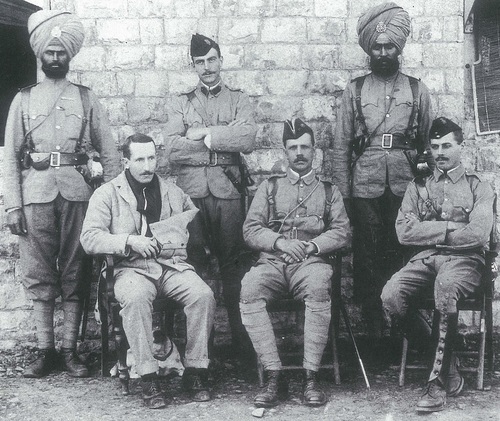
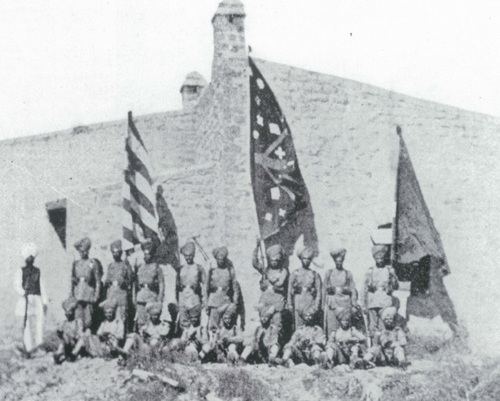
Various ranks of the 36th Sikhs. From left: Jemadar, Havildar, Sepoy and Bugler
Afghanistan! The graveyard of empires. Where Alexander met his match, where the great Soviets had stumbled. But right now, its September 1897. Its the turn of the British empire to take its turn on tragedy. Eventually even they will have to leave without any gains, sapped of strength and ambition. But not so soon.
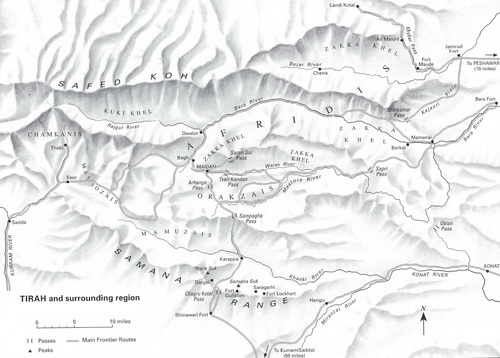
In 1897, the British were keeping their hold onto the border regions, which today we know as Khyber-Pakhtunkhwa Province in Pakistan. These areas were dominated by the Pathans, who swore their allegiance to the Amir of Afghanistan. The Pathans being a feared tribe were brave warriors.
During that time, on 20th April 1894, the 36th Sikh of the then British Indian Army (at present the 4th Battalion, The Sikh Regiment) was raised composed of Jat Sikhs and with 5 companies was sent to man the Samana range, being stationed at Samana Hills, Kurag, Sangar, Sahtop Dhar and Saragarhi.
Defenders of Fort Gulistan with two soldiers of the 36th Sikhs.
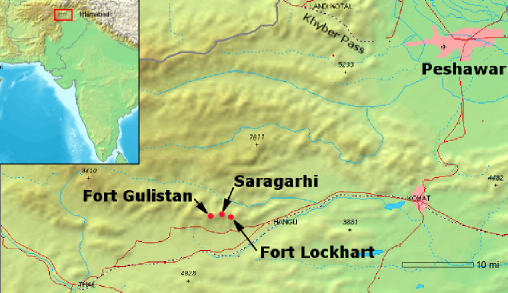
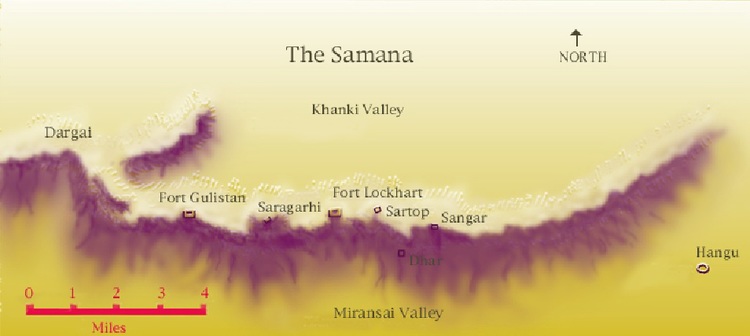
The British were partially successful in getting control of this volatile region, even then tribal Pashtuns continued their attacks on British personnel from time to time. Thus a series of forts, originally built by Maharaja Ranjit Singh, the ruler of the Sikh Empire, were consolidated. Two of these forts were Fort Lockhart (on the Samana Range of the Hindu Kush mountains), and Fort Gulistan (Sulaiman Range), situated a few miles apart. Due to the forts not being visible to each other, Saragarhi was created midway, as a heliographic communication post. The Saragarhi post, situated on a rocky ridge, consisted of a small block house with loop-holed ramparts and a signalling tower.
The map of the battle site
A general uprising by the Afghans began there in 1897, and between 27 August and 11 September many vigorous efforts by Pashtuns to capture the forts were thwarted by the 36th Sikhs. In 1897, insurgent and inimical activities had increased, and on 3rd and 9th September Afridi Tribesmen, allied with the Afghans, attacked Fort Gulistan. Both the attacks were repulsed, and a relief column from Fort Lockhart, on its return trip, reinforced the signalling detachment positioned at Saragarhi, increasing its strength to three Non-Commissioned-Officers(NCOs) and eighteen other Ranks (ORs).
The Heliograph: The instrument used to communicate between Saragarhi and Fort Gulistan.
On the fateful morning of 12th September 1897, Havildar Ishar Singh (the detachment commander) peered through his binoculars from the watch tower of the post, when he saw columns upon columns and rows upon rows of Pathans marching towards their position. Sepoy Gurmukh Singh, the detachment signaller, went up the signalling tower, set up his heliograph and began signalling to Fort Lockhart about their predicament: “ENEMY APPROACHING THE MAIN GATE…NEED REINFORCEMENT”. Lt Col Haughton, Commanding Officer of the 36th Sikhs, attempted to rush his troops to assist the outnumbered Sikhs. However, this action was too late. The Pathans had systematically cut-off the only supply route between Fort Lockhart and Saragarhi. Fort Lockhart transmitted back: “UNABLE TO BREAKTHROUGH…HOLD POSITION”.
As he observed from Fort Lockhart, Haughton could count at least 14 enemy standards (each representing 1,000 tribesmen) facing the 21 Sikh soldiers at Saragarhi. Sepoy Gurmukh Singh passed on this message to Havildar Ishar Singh. After assessing the grim situation faced by him and his men, Havildar Ishar Singh called upon his men to seek their consultation on whether to hold the fort or abandon their post in the hope of surviving. The Sikhs unanimously agreed to hold the position. Saragarhi flashed back to Lockhart: “UNDERSTOOD”.
The burnt out remains of Saragarhi. Fort Lockhart is on the skyline, left centre.
Fort Cavagnari (also known as Fort Gulistan) on the North West Frontier
Fort Gulistan, photographed after its relief. Note the terraced hillside that provided excellent cover to the attackers.
The ruins of Saragarhi
A devout Sikh and fatherly figure to his unit, the men under Havildar Ishar Singh’s command knew well the ability of this NWFP veteran. Havildar Ishar Singh understood the terrain in absolute detail, especially the character and fighting ability of the Pathans. As the Pathans moved in to begin their attack, as per Havildar Ishar Singh’s command one of the Sepoys sounded the bugle and the Sikhs formed two lines abreast, one row in a squatting firing position and the other standing. Havildar Ishar Singh held the order to fire until the enemy closed in within 250m from their position. The .303 calibre was deadly and effective at this range, coupled with the grouping shots formed by the line abreast formation. The first line of the Pathan advance was completely decimated. However, there was no time to reflect upon their success. The leaders of the Pashtun forces reportedly made promises to the soldiers to entice them to surrender. But the Sikhs blatantly refused the promises.
Martini Henry rifles first entered service with the British Army in 1871 and quickly became its mainstay. Colonial units such as the Sikhs and Gurkhas only received them after all the British units were equipped. It had only been a few months since these frontier regiments were equipped with these rifles replacing the venerable Enfield. Capable of firing ten .303 calibre rounds a minute it proved to be more than a match to the antiquated muzzle loading rifles possessed by the tribesmen. The effective range of the Henry Martini rifle was around 600 yards (550m).
The Pathans planned for a massive assault on all flanks – a multi-pronged attack which was designed to divide the outnumbered Sikhs into much smaller groups. The tribesmen then attacked in two formations, one moving towards the main gate and the other moving into the gap in the fort. Sepoy Bhagwan Singh was the first soldier to be killed and Naik Lal Singh was seriously wounded. Naik Lal Singh and Sepoy Jiwa Singh reportedly carried the body of Bhagwan Singh back to the inner layer of the post. Undeterred, Havildar Ishar Singh yelled their regimental battle cry together with his troops “JO BOLEY SO NIHAAL! SAT SRI AKAAL!” (Whoever utters the following phrase shall be fulfilled! True is the timeless being!) The tribesmen’s attack was repulsed once again by the Sikhs. At this stage some tribesmen had fallen just yards away from the Sikh position.
The Sikh soldier’s ranks and ammunition were now beginning to dwindle. Out of the full strength of 21 soldiers at the start of the battle, there were only 10 left to fight. The battle had raged on from 0900 hrs to 1200 hrs with the Sikhs having fought off seven charges by the tribesmen. The ever inspiring Havildar Ishar Singh is still leading his men despite being gravely injured by bullets and sabre slashes. At 1400 hrs, Sepoy Gurmukh Singh signals Fort Lockhart Battalion HQ: “LOW ON AMMO…NEED AMMO…URGENTLY”. Lt Col Haughton attempts to send his personal orderly to try and pass the ammunition to the trapped Sikhs, but to no avail. As the Pathans attacked again, the Sikhs now with less than 10 men put up a stiff resistance and manage to repel the attack once again.
The tribesmen resort to a traditional tactic. They set fire to the bushes and scrubs around Fort Saragarhi. Clouds of smoke blanket the fort, making it impossible for the Sikhs to see the approaching enemy. Soldiers at Fort Lockhart could clearly see the approach of the tribesmen due to their elevated position above Saragarhi. Lt Col Haughton frantically signals Saragarhi: “ENEMY APPROCHING…THE BREACH”. Havildar Ishar Singh is severely injured by this time and orders the remaining Sikhs to fall back into the inner wall. He then orders two Sepoys to drag him towards the breach to buy some time for his men. Out of ammunition all three of them fixed their bayonets and charge the tribesmen. With this act Havildar Ishar Singh provides the final lesson of true leadership to his men.
By this time the tribesmen had breached the fort, with only five Sikhs remaining alive, four in the inner building and Sepoy Gurmukh Singh at the signaling tower. The Sikhs do not give up. Instead they form an all-round defensive position with their backs against each other and their bayonets pointing outwards. In this remarkable display of bravery four more Sikhs fight hand to hand combat inside the fort.
At 1530 hrs Sepoy Gurmukh Singh transmitted: “MAIN GATE BREACHED…DOWN TO ONE…REQUEST PERMISSION TO DISMOUNT AND JOIN THE FIGHT”. Orders came back: “PERMISSION GRANTED”. Sepoy Gurmukh Singh disassembled his heliograph device, picked up his rifle and came down the signalling tower to join the fight. Soldiers at Fort Lockhart saw him disappear into the thick of battle right into the tribesmen line. His last words echoed “JO BOLEY SO NIHAAL! SAT SRI AKAAL!” Sepoy Gurmukh Singh, the youngest of the Sikhs at 19 years old was credited to have taken down 20 tribesmen single-handedly before succumbing. He was the last to fall at Saragarhi.
After destroying Saragarhi, the afghans turned towards fort Gulistan, But they were too late. They had been delayed and by then reinforcements had arrived by the following night. After recapturing the Saragarhi, the British were able to find 600-800 bodies strewn around the position along with the burnt bodies of the 21 Sikhs.
Survivors of the Gulistan sortie party pose with the captured Afridi standards for a photograph by Lt. Col. Haughton. They greeted the relief force by parading these trophies at the gate.
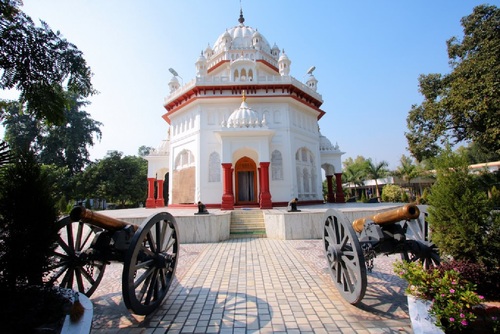
Saragarhi will always be remembered as one of the most phenomenal last stands in human history. All 21 Sikhs were awarded the Order of Merit, the highest honour given to Indian Soldiers under the then British Indian Army. Saragarhi Day is celebrated every year on 12th September by all units of the sikh regiment as their regimental battle honours day. There are two Gurudwaras to commemorate the battle, one in Amritsar close to the Golden Temple, the other in Firozpur Cantonment. It is said that there was a 3 minute silence witnessed in the British Parliament honouring the battle when the news came in.
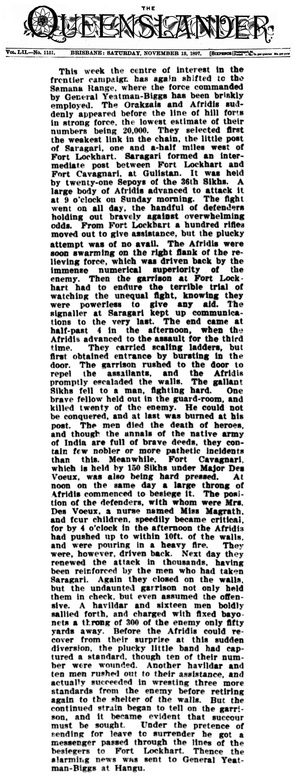
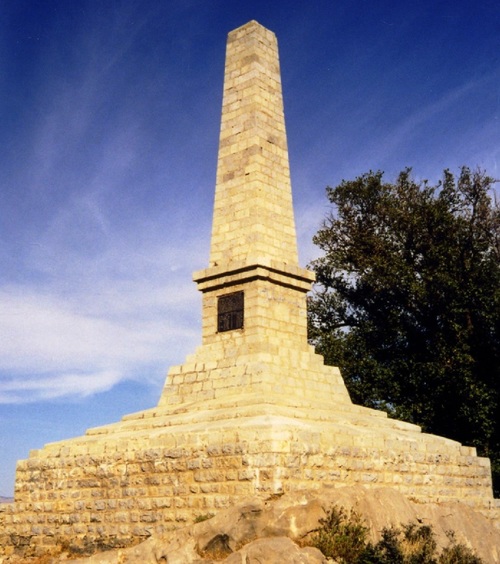
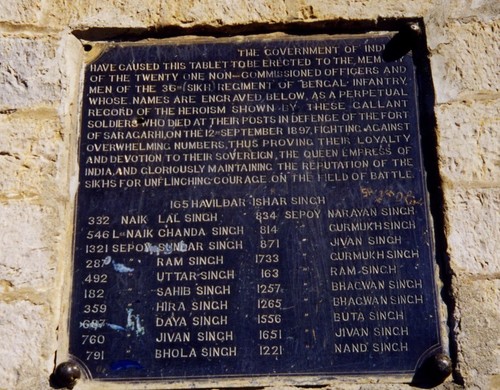
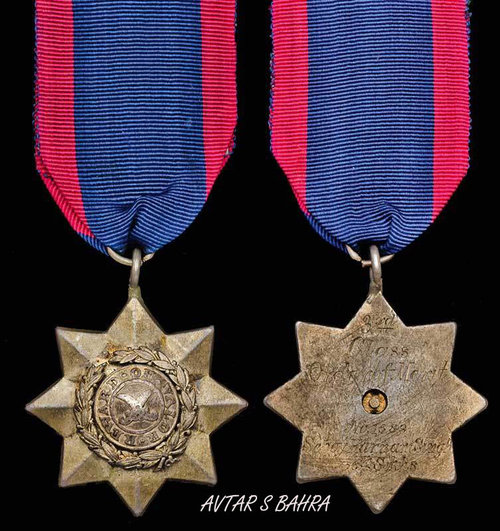
News of the event shot around the world as demonstrated by this article (one of many) in this Australian newspaper.The Saragarhi Monument, Samana Ridge, NWFP, Pakistan.The Saragarhi Monument (inscription).All the 21 Sikh non-commissioned officers and soldiers who laid down their lives in the Battle of Saragarhi were posthumously awarded the Indian Order of Merit. This was the highest gallantry award of that time which an Indian soldier could receive by the hands of the British crown, the corresponding gallantry award being the Victoria Cross.. Medal shown is of Sepoy Harnam Singh also of 36th Sikh Regiment. Medal earned at Fort Gulistan on 13 September 1897. Photo kindly provided by Avtar Singh Bahra from his private collection.The Saragarhi Memorial Gurdwara (Sikh place of worship) in Ferozepur, Punjab is a tribute to the Sikh soldiers who sacrificed their lives at Saragarhi. The memorial Gurdwara, was built by the army in 1904 with stones from the Saragarhi post and has the names of the 21 Sikh soldiers inscribed on its walls.
Saragarhi is an event not to earmark the achievements of the British Indian Army but the true valour shown by Indian troops, in the worst of circumstances, to defend their soil and to protect the honour of their land. The legitimacy of their bravery can be immortalised forever in their efforts to protect the people they have pledged to and the country to whom their names now belong forever.
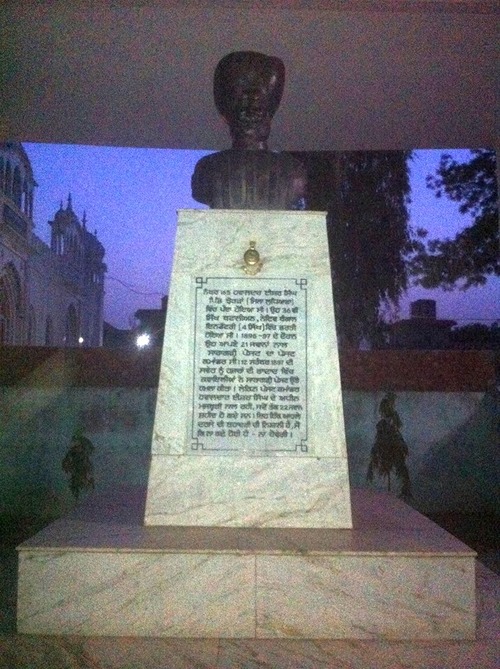
Monument to Havildar Ishar Singh at his birth place. Village Jordhan, Tehsil Raikot, Dist Ludhiana, Punjab. Photo taken by Rupinder Singh SranMonument to Havildar Ishar Singh at his birth place. Village Jordhan, Tehsil Raikot, D ist Ludhiana, Punjab. Photo taken by Rupinder Singh Sran
Sources:
The Australian Sikh Heritage: http://www.australiansikhheritage.com/saragarhi
Yesterday Congress official launched its manifesto for 2019 General Elections. Congress is fighting this election as opposition as in 2014 they were badly defeated on Severe Corruption issue or scams erupted then. Till now they are battling in courts with some of those issues.
I would very briefly Highlight some of the controversial issues of the newly launched Congress manifesto of 2019.
Firstly at the start of their manifesto they gave the moto that “Congress will Deliver” which is more a slogan and less a fact as from past history they have’t implemented much of their promises that did catch an eye of voters. To name a few- Women Reservation promised in 2009, 2014 & now, Health care has always been lip service since 2004, Power to each household was dream sold by many in the congress. Factually they made this promise in 2004, 2009, 2014 and now. Worst was the compromise upon National Security whose modernization was severely affected.
Take very recent example of promises not being fulfilled after winning the state elections of Madhya Pradesh where Rahul Gandhi promised loan waivers to the all farmers upto 2 lakhs* (In MP Manifesto).
Again in 2019 Manifesto Congress has promised many such lollipops to the voters. They have written on page 16 point 07 that as in Madhya Pradesh, Rajasthan and Chhattisgarh after forming governments Congress has waived farmer loans it will do the same for other states as well. Now one wonders how a National Party can bluntly lie to nation when they haven’t waived off any such loans in the ruling state! An interesting point to note is that they did not take name of Punjab which had almost two years after forming government and Punjab Congress claims to have waived off loans of the farmers but according to many reports they still have not waived of loans fully as was promised. So why did they not write the name of Punjab as an example? Perhaps because firstly it has been two years after forming government that they were able to settle more loan waive (in current years Punjab budget) so it would have clearly send wrong signal. Second it might be possible that this would have given opposition in Punjab another tool against Congress in the elections.
Another aspect in their manifesto states that Congress will not allow any criminal proceedings to be instituted against a farmer who is unable to pay his/her debt. Now this is serious as it will weaken the positions of the banks which are coming out of stress due to NPAs. Also their is no clear detail of how this will happen as those public sector banks who are independent can technically choose any action they deemed fit in case by case basis. Also nothing is said how money for such waiver will be made available (-obvious route could be levying more taxes).
Now on jobs creation front which was made one of the biggest issues against the BJP Government. Here also there is nothing concrete being said or shared. In fact it seems onus is being shifted to the respective state governments to fill the vacancies without mentioning of provision of supporting them financially. There is no mention of creating regular authentic job data by independent agency so government can keep up with the deficiencies if spotted. Focus seems on filling of vacancies and less on creating new jobs.
Their announcement of NYAY (Minimum Pay scheme): In this they say to target 5 crore families with ₹ 72,000/- per year Guaranteed via money being transferred to the women’s account. Anyone can calculate that if all the 5 crore families were to be given this much amount per year it will cost hell a lot which would mean clearly increase in Taxes to all other classes of tax payers or closing of current schemes being in service for poor like health care, gas connection, building houses, electricity, sanitation works, etc. will have to take a hit.
But as we dig deep it proves that actually devil is in the details. On page 20, point 9 it mentions that this scheme will be in phases. First phase design of 3 months, Followed by pilot and testing phase of 6-9 months before actual being rolled out. More so later it says that Congress intends to implement NYAY scheme as a joint scheme of state and center governments. But as Congress is only in six states; how it can then be called Congress scheme if BJP states will have to contribute in it. It seems Congress knew the financial impact so they have come up with such condition so later it can be presented as an excuse as not many state are financially sound.
The next is of scrapping GST. In the manifesto page 21- Taxation & Reforms it is said that newer version GST 2.0 will be introduced which will have single rate. As a management student I know this will lead to inflation rise for at least medium run. India as a country can’t be compared to well developed or countries with low populations where poverty is under control as India is developing well holistically bringing all the classes out of poverty at same rate. For all it would mean disastrous in the economy.
Then comes the restricted usage of Aadhaar; (on page 32) keeping it only for subsidies, benefits and services provided by the government. This could be a blow to many startups as it will raise cost of compliance for doing Know Your Customer guidelines in any kind financial services. It will put some burden on companies to keep manpower or outsource this job of KYC and related documents’ verification which is otherwise very quick and easier with Aadhaar, ultimately putting financial burden on corporates especially on financial institutions. On same page they have also stated to investigate Rafale deal even after given clean chit by Supreme Court & Comtroller Auditor General (CAG).
On page number 33 point number 27 another serious issue was scrapped. Congress says that they will Withdraw the infamous Citizenship Amendment Bill, which caused widespread resentment in only some of north eastern states instead to amend it to make it more suitable to such state Congress bluntly calls to scrap it. For those who don’t know it bill deals with very serious Humanitarian issue, it purposes to make illegal migrants who are Hindus, Sikhs, Buddhists, Jains, Parsis and Christians from Afghanistan, Bangladesh and Pakistan, eligible for citizenship as they are being persecuted in their countries.
Another major controversial issue is Congress promises to omit Section 124A (defines offence of ‘sedition’) of IPC reason given is that it is misused. It is prudent to say here that their are many laws in IPC that is heavenly misused like 498A, Sexual harssement laws, etc. the misuse of such laws can be observed from the fact many courts jugements & low conviction rates; but instead focusing more on police reform & making police independent of interference by politicians or in other words instead of correcting the system & its relative processes in place, Congress Presumes India as Developed mature democracy where such things are non existent and do not pose any threat. I am afraid a myopic view of a complex picture of India as whole. In fact courts has already placed many reasonable restriction in place so to avoid its misuse. Lastly outright scrapping section 124A is not best suited in current times as it could well worsen the already delicate societal fabric of India especially when we are dealing with cross border terrorism, Moist movements, Influx of illegal immigrants, various secessionist movements, etc.
Another alarming issue is that congress says that they will amend Code of criminal Procedure & related laws to affirm the principle that ‘Bail will be the rule and jail exception’ it seems Congress party lives in some dream land of their imagination as this purposely clearly has huge potential of being misused to worsen law & order situation of the country. In ideal society which is matured & well prosperous this could be best scenario but one has to look with respect of own country situation. Another points raised by critics or experts of laws is that this should remain as exclusive domain of judiciary only which seems fair.
Similarly Congress proposes to amend the Armed Forces (special powers) Act. This has been criticized by many domain experts their argument is that in disturbed areas it act as a minimal safeguard for the central armed forces as it states that they only need to take permission of respective state government prior registering First Information Report against any Central armed Security forces personal which in most cases are given this act just ensure to filter only fake report & allow only Genuine case to pass through. Also here one should note as situation normalizes AFSPA is revoked like it has been done in North eastern areas.
Another fact is a reference to “Kashmiri Pandits’ and their ethnic cleansing from the Valley is conspicuously absent in the Manifesto which make it odd when a whole separate chapter on J&K is given. Critics says that Congress has always been soft on terror. Late Shri Rajiv Gandhi introduced TADA. Later the Congress revoked it. It revoked POTA. Now it wants to go further soft on separatism and terrorism. Congress also is in view to talk with every party whether separatist which clearly does not want any talks other than separation of the state on basis of religion. Talk that have been failed every time tried by many iconic leaders of their eras. It seems congress want a status quo or happy to see even slight worse situation. There is no talk of DE-radicalization of youth unchecked black money or laundered money via hawala transaction being used for Anti India activities. Their is also no mention of Triple talaq, Section 370, Section 35-A, Population explosion, Common Civil Law, Ram mandir, Promoting Dairy & preserving local cow breeds, etc. Since some of these were even talked about by many supports of congress & all issues are important in nature.
Another funny thing one can spot is Congress acceptance of Electronic Voting Machines which it directly indirectly criticized in more one occasion, in fact where ever congress lost this was made the reason, also all parties of grand alliance were against EVMs. A transparent (to keep eye on black money) yet maintaining privacy way to donating any party is being opposed as Congress purposed to scrap Electoral Bond Scheme. Interestingly Readers must note that Congress Pranab Mukherjee (than finance minister in Congress) himself introduced concept of electoral trusts which was similar concept to eliminate Black Money of any kind to political parties. Congress has shown its stance on AMU & JMI as minority educational institutions rather than as National education institutions.
Congress also says that they will undertake a comprehensive review of the governance structure of PSBs and implement changes to Public Sector Banks. Interestingly readers should note that recent banking scams such as of Nirav Modi or other which used phone banking so we really don’t know what is actual changes they are looking for so voter must ask further questions. They also purpose to amalgamate some PSBs.
Congress also wants National Security Council (NSC) and the office of National Security Adviser (NSA) to come under the control of Parliament. Although it sounds good, there are inherent problems with the issue. This would mean that relative autonomy in taking decisions related to national security may take a blow. National security issues can’t be a matter of political interference. This also has the potential for compromising national security. Congress will hold the District Administration responsible for riots, caste or communal violence, large scale crimes against women, and for the widespread breakdown of law and order, meaning Congress government will start interfering in State Subject of maintaining law & order and blaming DM for everything.
They also want to pass a law to preserve the freedom of the Internet and to prevent arbitrary and frequent shutdowns of the Internet. Interestingly in case of riots because of misinformation being spread, this temporary restriction to internet is used as a tool to prevent any further damages to law & order situation by Local Government or District magistrate but by taking away this tool & holding District magistrate responsible for riots or law & order seems contradictory.
Congress wants to introduce Diversity Index as a metric to assess and ensure diversity in all government bodies, semi-government agencies, public sector enterprises and other public bodies, Interestingly no one for sure know what it may mean, how it will be implemented. Congress wants to remove all provisions stipulating pre-qualifications (such as minimum education) for candidates at elections to local bodies. Congress also want to setup an independent Judicial Complaints Commission now what it will be, how it will work i leave it to experts to interpret. Congress also wants to omit Section 499 such point needs to be explain by experts to the public.
On page 37 point 33 is on Media. They want to amend the Press Council of India Act, 1978 as they say it will strengthen the system of self-regulation, protect the freedom of journalists, uphold editorial independence and guard against government interference.They also wants amend the Cinematograph Act, 1927 to restrict censorship of films to grounds of national security and obscenity. Congress views current scenario in media is being controlled by Business Houses and will refer such cases of suspected monopolies to the Competition Commission of India. They want to pass a law for it.
Lastly Congress is also opposing Niti Aayog which was grand change as it respect true federalism & democratic structure to form policies suggestion. Niti Aayog is a policy think tank of the Government of India. Its aim to achieve Sustainable Development Goals and to enhance cooperative federalism by fostering the involvement of State Governments of India in the economic policy-making process using a bottom-up approach Unlike Planning commission which uses Top Down approach and pushes its decision down the states.
I hope to make aware our people to make a right choice when casting their vote. Any feedback on errors is welcomed.
Disclaimer: All the information is taken from Publicly available sources. Author here expresses his views based on the information available at the time of writing so readers are advised form their own opinions.
Vote, everybody thinks just it’s our right but it’s also our voice, it’s our opinion in democracy. Everybody talks about the responsibility and accountability of people’s representative who contests and wins the election. Nobody talks about the responsibility of Voter. Because enlightening voter is not good for political parties. They can’t control the narrative anymore. So every party wants to portray themselves as messiah of democracy in INDIA. Media who should take this responsibility became mere mouth pieces to the political parties. In this election season being world’s largest democracy we need to understand what vote meant for voter not the nominated candidate. When you look at this perspective the reasons to vote becomes a broad spectrum.
Understand MLA vs MP
No, I am not going to explain their duties but I will try to show you how much impact they can have. We get elections for state assembly and parliament at same time for some states. People who choose the two representatives will vote on same day. Unfortunately political leadership used this to their advantage, now people got so many things to consider to vote. So to make them dumb and reduce their reasons to elect to “constituency development” by the parties. Whenever the nominated candidate promises the development I wonder isn’t that a job duty of MLA, MP by default? Then you can say, one guy dedicated to more development than other. That’s fine, it can be one of the reason to elect the member to state assembly and parliament. Is that enough?
Development is generic term, no political party will be against to it, and so there is not difference of opinion on this topic at all. Idea of India is way more important because without the identity for us no development will take out our inferiority complex. No civilization in the history has prospered, built big cities without a responsible and reasonable mindset, if there was any they didn’t stood that long in the course of time, we are certainly not one of those.
So what’s the difference, main factor is every voter should understand how powerful is that MP,MLA position. How much influence that MLA or MP will have in the law making and implementing. For MLA, you can consider the local issues of that particular constituency, (for example to elect MLA in Tamil Nadu you no need to know his stand on “separate statehood demand for Delhi” because this MLA have no influence on that issue). When it comes to MP the powers are entirely different. Now MP from Tamil Nadu should have a valid national vision for the constituency he represents.
MP cannot say my constituency have negligible minority population hence I don’t need to say my stand on banning triple talaq bill. The MP from Karnataka have a say in anti-conversion bill even though his constituency got no illegal conversion problem. This is where the regional parties who nominate their candidates for MP elections fail to give good reason. Every regional party got single point formula, vote for us so we can fight for our state. Unfortunately they mixed MLA and MP responsibilities to suit their narrative, in parliament an MP from any state have equal share in every law comes of out that house, just because it didn’t effect one state that doesn’t mean that MP no need to worry. Developing the constituency is a default job responsibility, it’s like applying for Java developer and say my strength is application development. Every MP should have national narrative.
As a voter it’s our responsibility to know what your MP candiadate/party vision for nation. Because an MP from Telangana can help in a bill which can influence state of Jammu and Kashmir. So our vote have impact all over the country not just the constituency. When elections held together, regional party have this closed vision for their state, which is good or bad but the same vision won’t help for MP.
Vote for you not for candidate
When the voting season starts and every question posed by psephologists is whom do you vote and why? Almost every reply is related to the party leader who represented the party of the nominated candidate but not on candidate or his abilities. Some go ahead and say “let’s give this guy a chance”. Unfortunately anti-incumbency advantage the only principle opposition party even though it didn’t care much about people in that term. Options gets lesser and any third player is blamed as a covert of either of parties.
Narrative of that election will be just against the CM, but none of the media can explain what are the reasons for the failure of current government?, what new changes going to get if we elect another party MLAs or MPs?, why people have to choose better evil, if there is no choice how can new generation leadership comes out without nepotism? , which party is encouraging that trend? These are the questions media should ask and help public to think, react and vote. Now, it’s merely accusations on each other and telecasting them is such a lazy job for the fourth estate. Every voter has to go through the manifesto of every party, if it’s for MLA check in which direction they want to run the state, if its MP then check for what’s their stand on national issues.
Regional coalition vs National party
If the parties asking votes for a coalition which is neither NDA nor UPA governments then it’s our responsibility to ask them their stand on national issues not just regional chest thumping. For BJP led NDA we have manifesto for BJP which will largely influence the government, same with UPA and congress. When leaders propose third front or federal front without BJP and Congress nobody knows on what agenda that government going to run? Like KCR cannot implement Telangana model all over the country, similarly Mamata cannot implement her Kolkata model. For the BJP and Congress you know their ideological stand, how they want to see India. You know their failures and positives. You know how strong the leadership is for them. When these PM aspirants are campaigning in their states they still talk about just the role of the MP funds and state-central funds. Nobody will ask KCR, Mamata or any other Mahagatbandhan leaders following questions
Will the federal front government have one PM policy or rotation of PM candidate between the regional parties?
What will be the stand of federal front on separate PM demand for J&K,Article 370 and 38A
What will be the stand of federal front on Delhi separate statehood demand
What will be the stand of federal front on Uniform Civil Code and pandits rehabilitation in J&K
What will be the stand of federal front on India UNSC permanent seat
What will be the stand of federal front on Ayodhya Ram mandhir
What will be federal front economic policy and vision for GDP growth
What will be the stand of federal front on river distribution conflicts especially among regional players whose vote depend on these issues
What will be the stand of federal front on tackling terrorism and foreign policy with Pakistan and china
What will be the stand of federal front on distribution of funds among states and helping out the underdeveloped ones and taxation
What will be the stand of federal front on social injustices and crimes on women like Triple Talaq and nikkah halala
What will be stand of federal front on 10% reservation to economically backward and religion based reservations
What will be stand of federal front on Women’s bill and reservation in private sector
Will federal front government treat India as country from 1947 or age old civilization
These are just a handful issues but these regional parties have responsibility to give an idea to people of India about their government vision and mission. Now all the regional players asking for MP seats in their respective states, they neither give us the ideological aspect for alliance nor a clear picture on agenda. I understand it will be the common minimum program they agree on after the election but we as voters have every right to know which way they lean on national issues when it’s their turn. Unfortunately neither of the national parties are asking these questions correctly in the campaigning. Media is just wishing for Modi loss will never ask the regional players the hard and real questions because again that will educate the voter which is very dangerous for their existence.
When we vote for MP think once about these questions, if you have affiliation or leaning towards your regional party for choosing MP then ask yourself what is the ideology of that regional party. Will it ever become a big brother to other states when in need, will it help for idea of ek bharat shresta bharat? Learn from our parents’ generation how bad it was when the government goes to no confidence motion in every Lok Sabha session. Vote for stability, strong leadership and which party have stakes in majority states so they can think once before act. For sure regional player never care for other states when it comes to either their state or other state take less share for National interest.
Finally when you enter in to that polling booth just remember one thing the button you are pressing will have effect on 1.3billion people. For generations we made a mistake for not doing this, Say it to yourself “This is not just my individual right but a collective responsibility”.
In democracy people gets the leader they deserve, be worthy of good leader.
2019 elections is far from over and BJP would do well not to be complacent. To understand this, we have to filter out the noise and focus on specifics to understand what Congress is trying to do. Here are my reasons to believe this is still going to be very close:
Booth level preparation: Congress booth level organisation is way better than 2014. This started from Gujarat 2017 when they got an IPS officer to lead booth level mobilization for them. We saw the same in 2018 in Karnataka and then repeated in MP in late 2018. This has continued through to 2019 through apps and other constituency level connections. Vote share to seat share ratio is improving as we saw in Dec’18 results. I am surprised this is not being talked about but then the MSM being hand in gloves with Congress is knowingly hiding this.
2. Cambridge Analytica: Thanks to Cambridge Analytica, Congress has been targeting constituency level voters through specific messages. Their social media platform which was non-existent in 2014 is potentially ahead of BJP. When combined with MSM and left leaning news aggregators, they are spreading targeted messages through whats app groups and tapping in discontent which may not even have made it to MSM. In MP 2018 this likely played a key role in their victory. BJP IT cell appears to be a shadow of its 2014 self and most Right Wing Social Media handles are non BJP workers trying to mobilize support for BJP.
3. UP strategy: Congress objective is not to win UP but get enough votes to weaken BJP and enable a SP – BSP sweep. By not aligning with the SP-BSP, Congress has avoided Hindu vote consolidation. J. Scindia is hardly campaigning in UP and P Vadra has reportedly asked workers to prepare for 2022. Rahul’s move to Wayanad is probably another piece of the puzzle to make BJP complacent in UP.
4. BJP core voter unhappy: Ram Mandir / Article 370 / Article 35A / Uniform Civil Code / RTE / etc. etc. I can go on – here is a link to a comprehensive article on this. In 2014 each and every core voter came out and voted for Modi while in 2019 that may not be the case. The only thing not covered is why Rahul Gandhi or Chidambaram or Robert Vadra are still not in jail. Arnab had asked this during the interview, the response of- law takes time will hardly fly. Different government but same principle of not going after opposition and demolishing them aka NDA-I may come back to haunt BJP.
5. NYAY impact: There are two things that do impact Indian voters – doles and corruption. Nationalism as far as data is concerned does not play a major role. BJP lost seats even after winning Kargil and Pokhran in 1999. UPA – II lost due to corruption (Indians hate their leaders and use vote as a ‘punishment’ tool aka Bofors) and allure of Acche Din despite getting many times over doles and subsidies from UPA I and UPA II. And that’s because they have a ‘dil maange more’ attitude which is not wrong. Now they see NYAY as a golden beacon from Congress which will make them choose Congress in close fights such as MP/ Karnataka. Worst case, they can always vote BJP next time. ‘Humko Kya Mila?’ is the only thing that matters when the voter is at the booth deciding the fate of Modi. This is potentially why of late, the drive against corruption, Arun Jaitley’s press conferences in tandem with Republic TV debates around Rahul Gandhi / Robert Vadra corruption charges fall in place. Voters have forgotten about corruption of UPA I and UPA II and BJP in a last minute desperate attempt has probably realized this.
6. Noise of Balakot: Pre-Balakot NDA was struggling to get past majority – forget BJP getting it on its own. Balakot raised emotions but only for a short period of time. By April -May, things will be back to what it was pre Balakot. Even the market is jumping the gun just like during Brexit vote in 2016 when the murder of a MP had an impact on the next opinion poll taking Pound / FTSE high but reality showed its face in during day of counting in line with polls conducted earlier.
7. Overall Congress objective: Their objective is to reduce NDA such that even with TRS and Jagan they won’t be able to form Government. Second objective is to get close to a number where they can stake claim to PM seat. In states like Punjab, Chattishgarh, Jharkhand, Karnataka Congress is definitely stronger than BJP thanks to recent performance / alliances.
Amit Shah and BJP would be wise not to be complacent and work on their manifesto to come up with a message to counter Congress. Just shouting the Congress manifesto is not implementable won’t work. In a way 2014 was where BJP won every close contest and every swing vote potentially went in its favour. Come 2019, that may change and unfortunately that may change the country’s fortune.
Politics is a dynamic thing which keeps on evolving as the situation, society, nation and people change. Politics in India changed from the Freedom hangover to poverty to caste to Hindutva to development over the last 70 years.
After the 2014 Loksabha elections, the euphoria of the big win was followed by wins in Haryana, Maharashtra, Jharkhand, even J&K. But soon the honeymoon period got over and the govt. started feeling the weight of its own expectations. While it was busy fixing the basic system and solving unattractive issues, the cry started about the lack of big-bang reforms and intolerance, which led to the worst year for Modi govt. in these 5 years where BJP was defeated by a massive margin in both Delhi and Bihar elections. The only good thing PM did was to make sure the reform agenda continues without worrying about election results which proved to be crucial in the end.
Then came the watershed moment in the political history of India – JNU “Tudke Tudke” sloganeering. If I have to rate moments which impacted Indian politics, I would keep JNU issue above 2014 election result.
Nationalism, suddenly, became the focal point of the country. The whole country got polarized. Students harped on it to gain entry into politics. Politicians jumped into the foray to raise their political stocks. Ideological organizations propagated their own ideologies. JNU alumni, journalists, sportsperson, film stars, academicians, lawyers, civil society – no one was untouched by its influence. Even the defense forces could not keep themselves aloof, such was the impact of the case. Never before in Indian Independent history did a “non-military” issue evoked such Nationalistic sentiments among the people.
Suddenly thousands of questions and counter questions started flying around about Nationalism, Freedom of expression, taxpayers, 30 year old students, activists, state aggression, universities, naxalism, terrorism, and everyone had their own opinion about the issues being discussed. It was not a surprise as India has seen many students led movements in the past. But the biggest differentiating factor in the previous movements and this incident (not a movement in any sense) was this time the popular public opinion was against the students and in favor of the govt.
This was significant because just few months back, the govt. was loosing the “Free Speech” debate with issues like AwardWapsi, Love Jehad, GharWapsi, Beef ban, lynchings, etc. Even the manufactured case like Rohit Vemula was able to portray govt. in bad light. But JNU changed all that. Because it was not about brahaminism, casteism or Hindu-Muslim; this time it was all about “Nationalism”.
The whole episode gave the ruling party an opportunity to highlight the kind of content that was being taught or made available to the students in many universities including JNU, sometimes with the active support of the faculty. The slogans were derogatory enough for the general public to get a shock that how can university students say things like “Bharat tere tukde honge”, “Afzal hum sharminda hai, tere katil zinda hai”. For those who follow campus politics across universities like Jadhavpur, JNU, DU, BHU, AMU, and many others, these slogans were nothing new. In fact, more atrocious things had been uttered in the past with complete impunity. But this was the first time, it became a national issue and masses saw the reality of our universities where in the name of ideology and studies, they are being taught to hate India and work to accentuate its divide lines.
The biggest consequence of the whole controversy was it brought RSS, Hindutva, and their ideology to the consciousness of the masses, the very thing the ecosystem worked all these years to prevent. The “social boycott” put by the media and Luytens ecosystem, which had a strong hold on intellectual space, was finally ended. Young students with RSS and ABVP backgrounds got to portray their views in every forum. (And people were disappointed to find that they were not rowdy, saffron clad, cow piss drinkers who were as uncivilized as the first men!)
Finally the ecosystem that was engineered and nurtured since the late 60s to maintain a strong hold on popular mindset and consciousness through control on education and civil society to enhance their political gains was standing naked with their anti-India, anti-Hindu face exposed and made people more acceptable towards RSS and Hindutva Waadis. It helped put in context the harassment and hatred Narendra Modi received in the last 15 years and thus enhancing the respect people had for him.
Much can be written, and has been written, about the JNU case but it did put focus on Nationalism and brought out the eternal hate of many for Modi and RSS out in the open. This helped Modi in not only getting public sympathy but also made public more vigilant regarding statements and news reports made by many popular journalists, intellectuals and others. This was a huge factor in what happened next.
Though politically 2016 was not an important year for Modi and BJP with those states going into elections where BJP did not have any significant presence but it managed to win Assam by a huge margin which mattered the most, however, 2016 was a year of big bang reforms the whole of India was waiting for – GST, Demonitization, IBC, Surgical Strikes. The momentum and general mood of Nationalism built up through JNU, Assam elections (where main issue was NRC and illegal immigrants) and Surgical Strikes; and fueled by controversies on National Anthem, Vande Matram, Jai Hind, and other nationalistic symbols; was ably used by PM Modi in leading the fight against corruption and black money through demonitization and GST.
After the JNU fiasco, the public was more apprehensive of journalists and intellectuals than Modi. A perception got build that a lot of people are ready to go to the extent of abusing India and compromise India’s interests when it comes to hating Modi. This made public more vigilant about media reports and people started verifying data and facts on their own rather than relying on news media. This helped expose the journalists, intellectuals, liberals even further. Their behavior since then specially regarding Army and Airstrikes has furthered this belief of “perpetual hate for Modi and Hindu”.
Never before in world history you had seen such a “draconian” (due to the number of people it impacted directly or indirectly) decision being rejoiced by the very those who were feeling its brunt the most! Never before you had seen a party, whose govt. had taken such a drastic measure which caused massive pain to millions, getting elected in the most populous Indian state with historic majority. We have seen governments falling in India in the name of Onion prices which causes distress among only a section of society but here the govt was formed even after it inflicted massive pain on most of the citizens of the country. And people say nothing has changed in Indian politics!!
Since that massive win in UP, Modi and BJP have not looked back. They sustained the momentum through wins or gains in many other states and even delivering another watershed moment in Indian politics by decimating the decades long Left rule in Tripura by increasing their vote share from a mere 2% to more than 50% in just 5 years! Modi was also able to beat the massive anti-incumbency in his home state Gujarat to get a respectable majority for BJP.
All these political gains combined with the success of many social schemes and good governance in general, allowed Modi to set the narrative throughout 2017 and 2018. The recent loss in 3 states of “Hindi Heartland” – MP, Rajasthan and Chattisgarh, had put BJP on the backfoot for a few days but the losses were not massive enough, apart from Chattisgarh, to make BJP go defensive especially after the interim budget in early 2019 and Balakot airstrikes.
Congress had a historic chance to show the Indian public that this is “New Congress” and detach themselves from its old sins by giving young leadership of Sachin Pilot and Jyotirao Scindia the chance to lead the state governments in the respective state but they showed that they are incapable of change and Indian citizens would simply have to stop giving them further chances just like Pakistan.
Given the performance in last 5 years, clean image of Modi and his ministers, opposition blunders after blunders, this election seems to be heading just one way – Namo 2.0!









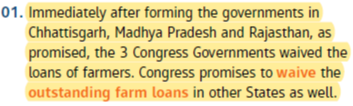 Chhattisgarh after forming governments Congress has waived farmer loans it will do the same for other states as well. Now one wonders how a National Party can bluntly lie to nation when they haven’t waived off any such loans in the ruling state! An interesting point to note is that they did not take name of Punjab which had almost two years after forming government and Punjab Congress claims to have waived off loans of the farmers but according to many reports they still have not waived of loans fully as was promised. So why did they not write the name of Punjab as an example? Perhaps because firstly it has been two years after forming government that they were able to settle more loan waive (in current years Punjab budget) so it would have clearly send wrong signal. Second it might be possible that this would have given opposition in Punjab another tool against Congress in the elections.
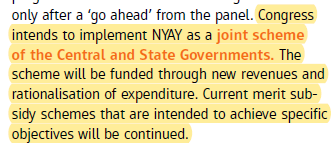 Their announcement of NYAY (Minimum Pay scheme): In this they say to target 5 crore families with ₹ 72,000/- per year Guaranteed via money being transferred to the women’s account. Anyone can calculate that if all the 5 crore families were to be given this much amount per year it will cost hell a lot which would mean clearly increase in Taxes to all other classes of tax payers or closing of current schemes being in service for poor like health care, gas connection, building houses, electricity, sanitation works, etc. will have to take a hit.
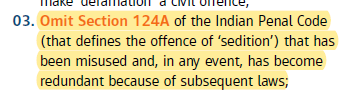 Another major controversial issue is Congress promises to omit Section 124A (defines offence of ‘sedition’) of IPC reason given is that it is misused. It is prudent to say here that their are many laws in IPC that is heavenly misused like 498A, Sexual harssement laws, etc. the misuse of such laws can be observed from the fact many courts jugements & low conviction rates; but instead focusing more on police reform & making police independent of interference by politicians or in other words instead of correcting the system & its relative processes in place, Congress Presumes India as Developed mature democracy where such things are non existent and do not pose any threat. I am afraid a myopic view of a complex picture of India as whole. In fact courts has already placed many reasonable restriction in place so to avoid its misuse. Lastly outright scrapping section 124A is not best suited in current times as it could well worsen the already delicate societal fabric of India especially when we are dealing with cross border terrorism, Moist movements, Influx of illegal immigrants, various secessionist movements, etc.