Home Blog Page 855

The crucial difference between ‘Indian Muslim’ and ‘Muslim Indian’

0

At the outset, I’d like to declare this post does not attempt to criticize any religious entity or blame it solely for the world’s evils that we are witnessing everyday.

So what’s the crucial difference between the two phrases, Indian Muslim and Muslim Indian?

To understand, first let’s discuss a particular element of grammar called ‘adjective’. As per linguistics, an adjective is a describing word which qualifies a noun object and gives more information about it. Here, an object is an entity. Any entity. A flower. A fruit. A human. Every object is defined by a certain set of intrinsic and extrinsic properties. When we say, Tomato is a fruit and not vegetable and Mowgli is a human and not a wolf, we are talking about their objectiveness.

The nature or the God (or whatever name we’ve given to him) had created objects, first in homogeneity. Humans, animals (evolution or no evolution, big bang or no big bang), trees, mountains, seas, rivers. And then it (He or She) tricked them, by taking away the homogeneity and introduced heterogeneity (again through evolution or no evolution). It became impossible for the objects in the same family to define themselves clearly. A Mountain could be a plateau, could be a hill or a plain rock. A tree could be a herb, shrub or a pine. So linguistics provided us adjectives. To describe objects. But adjectives didn’t just describe, they categorized as well. Just like they did to properties – into intrinsic and extrinsic. And all hell broke lose. Humans forgot other objects and suddenly became a white human, black human, brown human and a yellow human. Civilized humans and uncivilized humans. For civilized, atheistic humans and non atheistic humans. Theistic humans became pagan humans, animistic humans, polytheistic humans or monotheistic humans.

As civilizations developed further, human became man and isolated himself completely from other natural objects (by his own sheer stupidity or by God’s will). Man created guarded boundaries, first to safeguard against natural enemies and then unnatural enemies – his own ‘other’ men. Thus came into being, the power struggle to control these defined territories as nature retaliated, drying up resources. The power inflated pride and fame and to gather more ‘adjectives’ for himself, he created politics and nations, the sanctuaries of the evil of power. Still fine till now, though.

But then he proclaimed that the God had ordained him a nation to rule and look after. Heaven broke lose this time as man finally created the religion, to bind objects under a ‘similar’ adjective, to foster brotherhood but most importantly, to keep people’s mind under control and keep ‘God’s nation’ intact. In east and west, alike.

Initially, the concept of nation didn’t have fixed boundaries. It was more of an idea of people under one adjective ‘related’ (similar customs and rituals and language), living together. But soon, they needed more land and required permanency of habitation. Soon, came into being physical nations with name plates like in west, ‘The Hebrew Nation of Israel (quite different in its original terms than the present day piece of land) and in east, India – a ‘Sanskrit Nation of Indus’. There was no concept of conversion and spread of belief yet, precisely because the religion was nation based.

To govern these nations effectively, one needed laws and the code of conducts. With trade and increased interactions, man began to explore new ideas. The rulers realized that their nationalistic rants e.g. ‘We are God’s Israelites’ wasn’t enough to check the intrusion of any unwanted idea. And hence, a complex mix of moral and social laws based on philosophy, myths, fear, pride and promises was developed. Modern Religion was born. Holy books were written. And Man objectified himself into a parallel religious entity.

Soon religion became an inseparable part of a nation’s politics and governance. With religion firmly controlling their objects minds, they didn’t anymore need to sell the idea of a nation separately. Any attack on the nation would automatically become an attack on the religion, which in turn made sure people were ready to give up their lives to protect the nation in promise of a much better afterlife.

The ‘sacrifice’ became a rage. ‘Kings’ became equivalent to ‘Gods’, and nations were now called the ‘Kingdoms of God’. But man was tricked again, like Gollum.

For, heterogeneity made sure a certain adjective ‘Liberal’ became a pain in everybody’s ass, especially the conservatives. Liberal men (the utopian preachers) were bored of the idea of a religious philosophy, restricted by a nation’s physical boundaries under the command of ‘conservatives’. In their extreme prudence, liberals wanted their bubbling ideas to reach every nook and corner known to the mankind and gain control over people’s minds. But, they knew any direct confrontation with politicos obsessed with the purity of races, would mean a certain defeat.

In Jewish nation, liberals got their opportunity when they found about Christ, a person soon to be crucified and dead for proclaiming himself ‘the King of Mankind’ appointed by their dear God himself. Immediately, apostles were dispatched away from the boundaries of Israel to spread the idea. A new idea of a religion was thus formed. Though, a similar example had already been set successfully in the east by Indian liberals in form of ‘Buddha’. The experiment had begun five hundred years prior and bore real fruits only 250-300 years ago. Patience was the key, liberals understood. The idea succeeded in west as well and in next three hundred years, took control of every nation and subsequently their politics and social life too.

Centuries later in far middle east, which was still ruled by nomads and pagans, it was as if they had skipped last thousand years of nation-religions, fighting pettily among themselves, doing trade and developing mathematical and astronomical ideas. But with the latest onslaught of this new religion which was converting people’s mindsets, in promise of a guaranteed salvation despite committing any number of sins, an urgent need arose to stop its progress. The fear of losing their culture and territories was too much. And Arabs knew, they couldn’t wait for 250-300 years. For, the pagan mindset was easier to turn into the intended direction.

Since necessity is the mother of invention, a brand new idea of religion was invented. Unseen and unparalleled in the entire human history and future.

The concept of a religious nation – a Kingdom of Muslims, was to be marketed as something surpassing all previous ideas (proves marketing is not a modern concept). In all prudence, it included almost every idea mentioned in the two existing religious theories, the nation theory and the pure religion theory. Added to it, were a lot more fear and promised bounties, including the ever flowing rivers and greenery that inhabitants of Arab world never had but always yearned for, following their travels to the far east and far west. Idea was clear. If someone would indeed be inclined towards Christianity in promise of a heaven, he’d be interested in Islam as well. If not, the sword would do the further talk. The model, riding on the many wars, got instant success and was further developed during subsequent years to create a new ideology to rule mankind in future.

Thus began the race of conversions in the west and the middle east, that engulfed the whole world in next thousand years. Governments under the influence of these two religions, made consistent attacks on other territories in guise of trade, jihad etc. to collect as much wealth as possible. For, wealth had become the most important instrument to influence man’s mind if ever it wavered away from religion. The further proclamation that the wealth had been given by the dear religious God, it ended any debate, all culminating into a present day chaos where each religion in the world is fighting a battle of supremacy (called the battle of existence by their followers).

Today, the world is again under transformation as religious ideologies, especially the ones which are imperialistic in any form are losing favor. A new thought wants religion to disassociate from the Social and Government structure and become a mere spiritual and personal guidance (shared by most of the current inhabitants). It would solve two purposes. First, the religion, even if it permeates the boundaries of every nation, will never interfere with the social life. Second, it would cease to be a valid reason to expand territorial boundaries in the name of a nation and kill innocent lives.

And that’s why the concept of a Nation and a nationalist identity in its present modern democratic and physical sense, again becomes the most important idea in the modern world. This would bring the man much closer to being the human. A heterogeneous human, an idea that was lost first to the idea of man thousands of years ago and then, to the man made ideologies called religions.

This Neo-nationalism, which is often misunderstood, in reality is more inward looking than outward looking. It never justifies the evil actions in terms of eternal rewards and hence never kills a debate between the validity and invalidity of human actions. Agreed, it is not devoid of its pitfalls, but then nationalism is dynamic, currently fueled by democracy that runs on collective human ideas and participation and not some divine inspiration. And hence, one can challenge it. One can check it. One can stop it. One can steer it.

Now, why nations? Why not open boundaries? Why not simply be a human? One would say. The reason is simple. Territorial boundaries are natural. Coconut trees can’t survive in Himalayas. You won’t find pine trees in coastal areas. Every naturally existing object marks its territories, guided by the nature itself. And hence the concept of territorial demarcations is natural to every living species in the world (again evolution or no evolution). Why governments but? Because the heterogeneity makes sure that in absence of a leadership, chaos merely increases. 7 billion is not a small number.

Finally to the topic, ‘Indian Muslim and Muslim Indian.’ How the above story is relevant? Because, for the two words Muslim and India, we need to understand that in modern context, which one should be the object and which should be the adjective.

In the phrase, ‘Indian Muslim’, ‘Indian’ is just an add on detail, a transitory prefix. The object here is the man made nation-religious identity, it’s core idea of existence. Just like British Indian. In itself, this phrase is alienating and considers the object foreign to the territory belonging to the adjective. Whereas, in the phrase, ‘Muslim Indian’, Muslim is the additional, extrinsic description of the core territorial object Indian – born naturally in the natural region of India, meaning it is, in stark contrast to the first phrase,  inclusive. Same case arises for any other religious identity and any other nation, be it Britain, China or the USA.

Yes, the difference is slight but it is definitely crucial. As Burhan Wani’s school headmaster father said when interviewed if he was bothered about his son:

For me, first it’s Islam then Son. First, it’s Quran, then son.

Ditto about the people who killed Akhlaq, not thinking twice how their over-zealousness for their religious beliefs would affect the larger environment.

It’s apparent how the mindset works. As religions become close, conservatism sets in. If they become open to personal interpretations, every individual can go into any direction he chooses, good or bad. But when we bind people under national laws, carefully made keeping every social, cultural and religion sentiment in mind, we can stop their radicalization and engage them into a consistent debate.

So which part of our identity becomes an adjective and which becomes a noun? Our choice is simple, not easy though.

A former army man explains how South Kashmir is emerging as the hub of ‘New Terrorism’

0

Recently south Kashmir has been in the news quite often. It has witnessed a number of terror acts and encounters in the past 6 months (including Burhan Wani ). One question that must be haunting the minds of many is why all this is happening in south Kashmir alone? The question is justified and needs an analysis. Burhan Wani is credited with unleashing a wave of ‘New Terrorism’ characterized by increase in number of local terrorists, extensive use of social media to extend the outreach of terrorism with south Kashmir as its base, involvement of the locals in terrorism, characterized by huge outflow to attend funerals of terrorists and hampering the operations of security forces and penchant for imaginary ‘azadi’, particularly among the youth. We are here not to discuss Burhan Wani, who like any other terrorist commander was operating based on instructions received from across the LOC from mentors in Pakistan to support the Pakistan sponsored proxy war as an extension of jihadi terror.

The aim is to analyse the advantages south Kashmir affords for sustaining terrorism because of which it has emerged as a hub of ‘New Terrorism’ in Kashmir, not to be confused with home-grown militancy like the Indian Mujahideen (IM). ‘New terrorism’ is part of a well-planned strategy unleashed by Pakistan’s Inter- Services Intelligence (ISI) to keep the pot boiling in Kashmir. The major advantage South Kashmir enjoys over the other parts of the valley is favourable terrain. The terrain is characterized by the Pir Panjal ranges and its various off-shoots, thick jungles, river Jhelum flowing from south to north, running almost parallel to the National Highway (NH), densely populated with large built up areas and towns, well connected internal network of roads.

South Kashmir also has the best surface connectivity with rest of the state across Pir Panjal. NH 44 connecting Jammu with Srinagar through the Banihal tunnel, the Mughal road connecting Poonch – Rajauri via Pir Ki Gali road, Kishtwar-Anantnag via Sinthan Top and broad gauge railway connecting Banihal-Baramullah. The terrain in South Kashmir is being exploited by the terrorists to their advantage. With availability of additional avenues of ingress/egress, the infiltration pattern has changed.

Gulmarg-Poonch-Mughal road-south Kashmir is becoming a favourite route for the reason that it provides a free run to the terrorists across the Mughal Road. Mughal road is being extensively used for smuggling of arms and ammunition as well. Lack of the presence of security forces on the Mughal Road provides the terrorists a free run. It is also being used for spreading the arc of radicalization and Hurriyat ideology south of Pir Panjal, particularly in Poonch-Rajauri belt. There is an urgent need to establish security forces camps on the Mughal road to choke the free movement of salafist preachers, Hurriyat leaders, arms and ammunition and terrorists.

Another avenue available to terrorists for entry/exit is the Anantnag-Kishtwar road. This also enables the terrorists to move into south Kashmir using the International Border (IB) route. Any move to make this road as well as Mughal Road as all-weather by tunneling needs to be strongly resisted because it will facilitate the move of terrorists into and out of South Kashmir throughout the year making it further attractive to the terrorists. Another boon to the terrorists has been the rail. It has facilitated their move between north & south Kashmir. Whenever, security forces exert operational pressure on terrorists in north Kashmir they melt into their hideouts in south Kashmir which also provides the terrorists three escape routes to run away south of Pir Panjal. Forests and jungles are in plenty providing suitable hideouts.

A terrorist without local support is like a fish out of water. Hence popular support is essential for any terrorism to survive. South Kashmir is densely populated with a mix of rural and urban population that is friendly to their cause. Anantnag town with its narrow lanes and vast spread is ideal for urban insurgency. Traditionally, south Kashmir has been a home of large Jamaat-i-Islami cadre with pro-separatist mind-set and sympathetic to the Hizb-ul-Mujahideen. The mushrooming of petro-dollar financed Salafi mosques and Madarasas and emergence of Jamiat Ahlehadith Jammu & Kashmir on the scene has further radicalized the local population, hardening their support to anti-national and pro-separatist ideology, duly backed by Pakistan and ISI.

South Kashmir, abode of Muftis, has been their traditional stronghold and political citadel hence an eye-sore for the rival valley-centric political parties. In addition to various political machinations, these parties have also been clandestinely hobnobbing with the ultras to let the Muftis down and fish in troubled waters. With its proximity to Srinagar, a major educational hub, the literacy rate in south Kashmir is also quite high. This has led to creation of a vast reservoir of educated, tech-savvy, disenchanted unemployed youth who see no ray of hope with limited employment opportunities, feel politically dis-empowered, live with a perceived insecurity of losing special status and being overpowered by outsiders, becoming an ideal material for falling prey to ISI sponsored propaganda and being lured into militancy. This segment was exploited by Burhan Wani through social media. Proximity to Srinagar also ensures presence of large number of media men; local  and national. Media provides them oxygen, vital for survival.

The faulty Rehabilitation Policy launched by the previous government in November 2010 is another contributory factor. Large number of these surrendered ex-militants who returned to the state via the illegal Nepal route settled with their families in different parts of South Kashmir, particularly in Tral, Kulgam and Anantnag areas. They were required to be screened by intelligence agencies after arrival and put through ‘De-radicalisation’ process in specially established camps. None of it happened. Instead they were allowed to merge with others freely. Many of these terrorists returned with 3 to 4 children. No DNA test was carried out to ascertain their parenthood.

Keeping in view the ISI’s track record, the likelihood of these young children being a product of radical madarsas (religious seminaries) and smuggled into India cannot be ruled out. God forbid, if it turns out to be true, the consequences will be unimaginable. Many of these ex-terrorists, including those released from jails because of weak prosecution, have been re-cycled into active terrorism thus leading to the increase in number of local terrorists; another dangerous trend contributing to south Kashmir’s emergence as hub of ‘New Terrorism’.

Dear readers, let us try to reach this concern to the PM and NSA. Jai Hind!

By Brigadier Anil Gupta (Retd.)

Author can be contacted through A Nationalist (@Peacef_Warrior)

Arunachal Pradesh verdict an example of judicial override?

0

It is generally assumed that an elected government with popular majority is supposed to run the state. But given the recent overrides the courts in India have had, we can presumably say that ‘’Let Courts be the Governments’ .  Let it be the controversial judgments of the Courts banning diesel cars in National Capital or be its order questioning the wisdom of the President in recent Uttarakhand verdict. All those cases if closely observed gives you a hint about the power struggle. The struggle for supremacy;  which has led to a big power tussle between Centre and Judiciary that is bad for democracy.

India is a Parliamentary Democracy whereby Legislature, Executive and Judiciary are separated from each other to avoid any conflict between the three. The makers of our constitution believed that in order to ensure that the Government does not acts against the welfare of its people, it is necessary to have an independent judiciary that could stop the government from working in mala fide and uphold justice. Yet, given the recent observations and verdicts of the courts, its style of functioning etc we must admit that the faith of common man in our judiciary is declining day by day. Not far away from today shall a day come when people might start questioning the Courts judgments.

Take the case of Arunachal Verdict. The court has virtually reinstated an unconstitutional government in the crucial border state like Arunachal. In nutshell, the case can be explained that, the Tukki Government became a minority government in the state given the rebellion of its 30 MLA’s (INC). The ruling Congress was left with only 15 MLA’s . Thus, now the opposition which is NDA has 45 MLA’s. Given this scenario, President’s rule was imposed. The INC challenged it in the Supreme Court of India and eventually after hearing both the sides, the court said that Governor was wrong and restored the Tukki Government.  For the first time in history, the court has restored a minority government and asked the majority to sit in opposition.

This case is similar to what happened in Sikkim in 1974. Only difference being, then the Court did not say anything and today its judicial activism has led to people questioning the wisdom of the court. The recent overturns the courts have been doing has made the common man weary. The more the courts intervene in the matters of the executive, the more it makes itself closed to the common man. Courts are meant to give justice to people and not to meddle in five star activism.  Just like the Prime Minister has said that time and again, that the courts are letting themselves be used by the activists who wish to stall India’s progress.

Just some days go the court passed an order inquiring into use of AFSPA by armed forces in Manipur and the areas where insurgency is at peak in North East. The court observed that the state cannot kill militants just because they defy its order and not agree with the State’s policies! State cannot kill militants just because they too are the citizen of this country! By this logic, the State must invite all the militants and insurgents to dinner and let them challenge the Sovereign and the State to remain a mute spectator?

The Court may be wise enough and right enough on humanitarian grounds, but the Sovereign has the responsibility to secure its national interest. The Sovereign cannot and should not leave its citizen open to insurgency just because the court says so! It has to protect its integrity. And according to the principles of sovereignty, integrity and national security anyone; be it even its own citizen, who threatens the three shall not be tolerated!

This is a dangerous trend. The courts delaying the matters of grave importance like FRCA violations by Teesta Setalvad’s NGO’s or even the coal scam but a quick decisions on president’s Rule or Green tax etc are not being appreciated by the masses. The Courts are still looked upon by the masses with great reverence and respect but this over-activism  by judiciary is reducing the goodwill day by day.

In words of Robert H. Bork, a famous American jurist, “Most members of the courts seem to be Gnostics; firmly believing they have the access to wisdom denied the rest of us.’ ’ This he calls Judicial Oligarchy.

The Indian Judiciary must refrain from becoming the American judiciary which creates hurdles in its own progress. Let the executive function the way it does, because it is accountable to the people. And the judiciary must function its own way not by interpreting the Constitution in the way they want but within the framework of Constitution. This nation owes a much to the Indian judiciary for saving the people from misuse of power by the powerful, and having to see the same courts acting just like powerful is not an appreciative stance.

Dear Swaminathan Aiyar, it is time to answer some tough questions on “Rexit”

Has anyone else noticed how a certain name has disappeared from the news cycle? No, I am not talking of names like M K Ganapathi, the police DSP of Karnataka who committed suicide last week leaving after blaming a certain honorable secular minister for his death. There are some names and some “institutional murders” that never make it to the news….

I am talking about Shri. Raghuram Rajan, the greatest economist, the greatest central banker, indeed the greatest human being to ever walk this planet. How did his name suddenly disappear from the news cycle after being in headlines for months?

Is it possible that reality did not cooperate with a certain class of elite analysts?? 

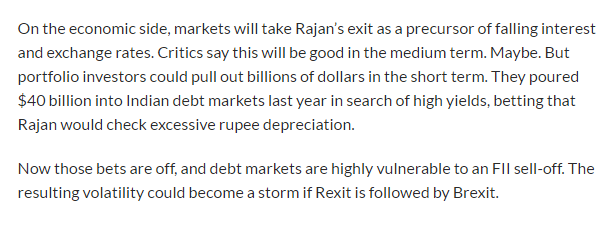
Let’s just pick one, particularly outspoken luminary called Mr. Swaminathan Aiyar. On June 22, writing in the Economic Times, a day before the Brexit referendum, Shri Aiyar made the following predictions in his article titled : “Rexit: This government has just shot itself in the foot“.

Untitled

What did you say, Mister. Swaminathan Aiyar?  Portfolio investors could pull out billions of $$$ in the short term? Note that you said short term, no wiggle room there for you to claim that you were really suggesting that the impact will become visible 3 decades from now. No, my dear sir, you said short term.

And what else did you say on June 22, a day before the Brexit vote? That the “volatility could become a storm if Rexit is followed by Brexit?” Well, the pompously named “Rexit” was followed by Brexit. What is worse is that no opinion poll could predict the Brexit vote, which means the markets were shocked when the results came out. Perfect conditions for storm creation, don’t you think? Except, Mister Aiyar, where is the storm?

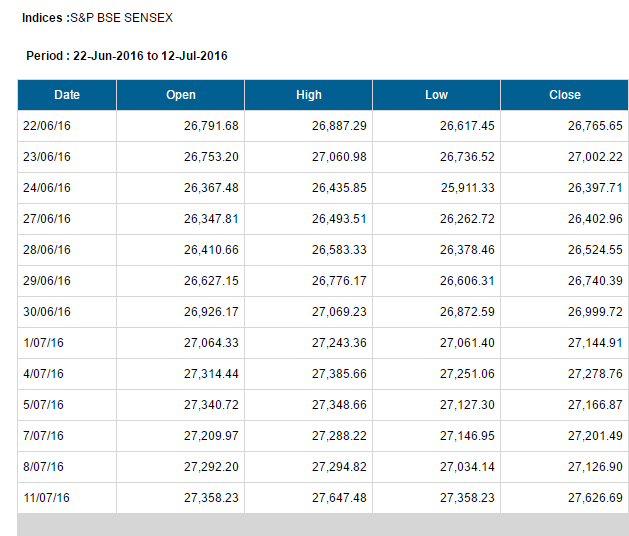
Here is the Sensex since your grand storm warning on June 22, 2016:

Untitled

Up by close to a 1000 points since then…I pray that the Sensex be hit by many more such “storms”. Now it may go down again, but you said that it would be a reaction to Rexit. Well, Rexit was announced around June 18 and it’s July 12 already. We are approaching one month since the horrific news came and still global investors don’t seem to have heard about it. Did you know that cellphones transmit information at the speed of light, i.e. nearly 3 lakh kilometers a second?  Forget cellphones or the internet, thousands of people have flown back and forth from India on hundreds of flights to US, Europe and Japan since Rexit was announced. Surely someone must have told them about the Rexit tragedy in India? Are the global investors getting their news by pigeon courier these days, Mister Aiyar?  Even the pigeon couriers might have reached by now. When will the global investors find out about Rexit, Mister Aiyar?

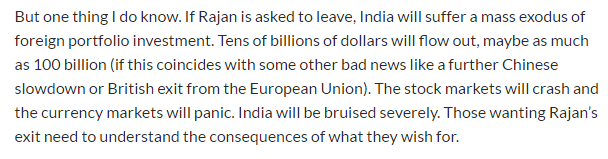
Wait, there’s more. Here is Respected Mister Aiyar writing on June 5, 2016 in his article: “If Rajan exits, so will billions in investment

Untitled

What? Did you say that the one thing you do know is that India will suffer a mass exodus of foreign portfolio investment if Rajan goes? Did you put seriously put the figure at as high as $100 billion? Did you say that the stock markets would crash and the currency markets will panic?

Show us! Yes, Mister Aiyar, show us that any of that actually happened… Oh and you said it yourself, the storm could get worse if it is accompanied by Brexit. Well, you got your nightmare scenario on Brexit. Now, show us the “panic in stock markets” and the $100 billion of outflows… Where is the exodus?

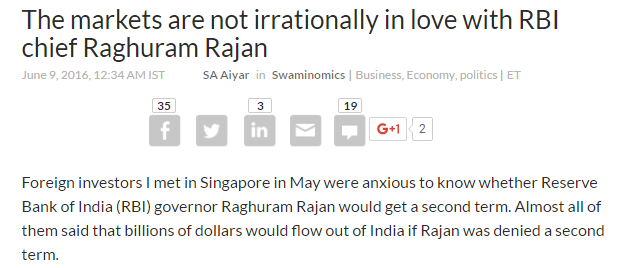
Ha ha, would you guys believe there is still more excrement that Swaminathan Aiyar has buried himself in? Here he is on June 9, 2016:

Untitled

Mister Aiyar, in case you have forgotten, the ISD code for dialling Singapore is +65. Try it, it really works. Call your friends in Singapore and check again now.

But here is a further question. So you don’t deny that foreign investors and markets were in love with investing in India. I am not the one advancing that claim, your headline itself contains that implicit claim. Okay, well now that we have proved that it wasn’t Rajan that the markets were in love with…we have to answer this question:

So who was it that the global investors were ACTUALLY in love with? 

Go ahead. Answer that question:):)  Let us hear you say the name:)

Could it be that the name of the person the investors were actually in love with starts with an “N” instead of an “R”? My guess is that this “N”  person must be Nayantara Sahgal, who kicked off the Award Wapsi campaign. What do you think, Mister Aiyar?

Ok friends, this is perhaps the most important part of this post:

Look, Mr. Swaminathan Aiyar, there is no shame when an honest prediction goes wrong. Every prediction contains an element of risk. Since nobody can predict the future with 100% certainty, do you know how we can tell a genuine analyst from a snake oil selling  propagandist? When a genuine analyst gets a prediction wrong, that person finds in her/himself the moral courage to stand up, step out and make a frank admission of error with due apologies to all. The snake oil selling propagandist goes silent and disappears into a hole hoping that people will forget about the giant mistake. Mr. Aiyar, you wrote passionately about how the markets would collapse if Rajan left. You wrote about it repeatedly; three times in your June 2016 columns: June 5, June 9 and June 22. Since your predictions went wrong, you have gone into a stony silence on this issue. You have published FOUR further blog posts on ET since June 22, 2016 but you have not made a frank admission of your mistake.

So,  Mr. Swaminathan Aiyar, unless your next blog on ET boldly declares that you were massively wrong on the so called pompously named “Rexit”, you know *exactly*  what you are: genuine analyst or …

Listen, Mr. Swaminathan Aiyar, I know that we Modi Bhakts aren’t smart people. Few of us have doctorates in “South Asian studies” from JNU. I don’t know if anyone of us can explain what important words like “heteronormative” and “micro-aggression” mean. We know that we don’t usually ask intelligent questions such as : Is GDP growth in India only helping the Hindu, heterosexual, upper caste males?

But the fact remains that we got it right and you got it wrong on Raghuram Rajan. And if you feel that you are so high and mighty that you are above apologising for blatant mistakes …

A Dead terrorist, inspiration and 72 raisins

When it comes to radicalizing videos, Abu Musab al-Zarqawi, Anwar al-Awlaki, Osama Bin Laden, Abu Bakr al-Baghdadi and Hafeez Saeed lead the list. Now, religious scholar Zakir Naik has joined this gang as an investigation into recent terror attacks in Bangladesh has revealed that terrorists were influenced because of Dr. Naik’s videos.

The surprising aspect is the fact that Abu Musab al-Zarqawi, Anwar al-Awlaki, and Osama Bin Laden are dead!  Out of all, Anwar al-Awlaki’s videos have maximum views.

Deadman is radicalizing people from around the world

Anwar al-Awlaki is the man who scares American security officials even today.  The person in question was born in the US (New Mexico), and was educated at Colorado State University. In 2011, an American drone strike killed him. But, he is still managing to kill people around the world. Yes, most of the bloodiest terror he inspired has happened after his death. The internet has given him life after death. Even today, his messages are available on various video sharing sites.

He is the driving force behind several terror attacks that took place in various countries after 9/11. Boston marathon bomber Dzhokhar Tsarnaev, Syed Farook, psychiatrist Nidal Hasan (the man behind Forthood mass shootings), and underwear bomber Umar Farouk Abdulmutallab followed Anwar al-Awlaki.

Believe it or not, Anwar al-Awlaki was specially invited by the government after 9/11 to lead prayers and was considered a role model by American authorities. Some libtards at Washington post also wrote a story about him and glorified him. No one knows how and when he turned into a jihadi. He was an Islamic scholar. The point to be noted here is that he never used religion to explain why he hates west. Reports suggest he turned into a jihadi because of American foreign policy. FBI started monitoring Anwar as soon as he left for Yemen and joined Al-Qaeda as their top leader.

Those with incomplete or no knowledge about Islam are easy targets

Hatred is such deep that terrorists do not hesitate to turn planes into bombs. They get trained in countries like Pakistan and enter their target nations via sea, underground tunnels, or simply enter the country via broken fences at one of its border areas. Most of the terrorists are highly educated these days. The important question is what motivates these individuals to leave their elite lifestyle and turn terrorists? You might feel astonished, but YouTube is being used as the ultimate tool to create terrorists. Videos create most of the terrorists!

Muslim reformer Irshad Manji recently interacted with Fareed Zakaria during his show GPS. She stressed on some interesting points during this interaction.

“The next time when beheading or bombing occurs in any part of the world, the first thing that you would hear from moderate Muslim individual’s mouth is a statement suggesting that Islam has nothing to do with terrorism,”- said  Irshad Manji during her interaction.

“No doubt that there is some connection between religion and violence. Quran does contain verses that encourage intolerance and violence, but there are verses that promote tolerance, freedom, love, and humanity as well. Jihadis are acting on what they are shown in the Quran. It is easy for terror outfits to brainwash individuals who are not religious. To put it in simple words, Islam is being manipulated, it is being used,”- said the Muslim reformer.

Quran promises 72 virgins to martyrs, is that right? According to Manji, it is not true. Several scholars studying Quran suggest that holy book does not promise 72 virgins, but it promises lush and 72 raisins! So, all these idiots (young leaders, to put it in Barkha’s words) fought for raisins?


Looking At Kashmir From Different Lens

0

The Kashmir valley over the last couple of days has been engulfed in a new wave of protests over killing of Hizbul Mujahideen commander Burhan Wani; also known as the poster boy of Kashmir militancy owing to his unprecedented method of glamorising militancy through social media. Within minutes of the encounter the social media erupted over some tweets by few journalists which were seen as taking side with terrorism. There was an angry outburst over the way in which Kashmiris gathered to receive his body and organised a mass funeral procession.

Till April of this year I too would have sided with them and showcased my disappointment and anger at the current ongoing situation. However, having spent close to forty days in May-June working in Kashmir I see the incident in a whole new light. I still do not justify the act of terrorists by any stretch of imagination and believe Burhan was on the wrong side of it the moment he picked up the gun. However the question that always gets buried and desires a serious introspection is why the youth especially the educated ones are picking up guns and why is there an overwhelming support for militants which is prevalent across the valley cutting across the socio-economic differences. This question gets conveniently ignored every time under the blanket of belief that everyone attending such a funeral procession is a terrorist and deserves akin treatment.

What needs to be understood is the fact that the militancy is Kashmir is significantly different in aspirations than its counterparts in Middle East or any place else for that matter. There was a public ire when Rajdeep Sardesai compared Burhan Wani to Bhagat Singh but sadly inside Kashmir they seek inspiration in their fight from India’s independence struggle and see their heroes in the likes of Bhagat Singh and Subhas Chandra Bose. They gain strength from the fact that if India’s struggle took close to 150 years, theirs is still in its infant stage.

Although one cannot completely deny the fact that religion does not play a role in the radicalisation discourse. A couple of prominent people off the record told me that although their aim is completely political sans any religious considerations, Quran is often resorted to in order to mobilise the youth and give them a collective belonging. However, the same does not stand true for everyone including Burhan who got radicalised at the age of 15 after he saw his brother being tortured at the hands of army officials when they were returning home one evening. If the election of 1987 was the reason behind the insurgency of 1990-1991, the killing of over a hundred youths in 2010 uprising is often cited as the turning point where one can find roots for today’s militancy.

However there is an even more worrisome aspect to the conflict. The current generation has successfully passed the seeds of struggle onto the coming generation. Young children from affluent families are more likely to have knowledge about Geelani than to have heard the name of the incumbent Chief Minister of the State. It is a state which has increasingly felt alienated from India over the time and India has never had a proper policy for Kashmir except for when Atal Vajpayee was the Prime Minister and he is still immensely respected amongst the Kashmiri population for his tenure. One of the reasons why BJP performed decently there is because many expected Narendra Modi to carry forward the work which was left by Vajpayee but unfortunately it did not turn out to be so.

The killing of Burhan Wani and the protests that took place in its aftermath has given India yet another chance to introspect its Kashmir policy. It would be a blunder to consider Burhan and the people gathering in his funeral in isolation. It would be rather wise to analyse the situation under a broader problem of educated youth resorting to violent means and a population that collectively and almost unanimously supports a person who follows that path.

Global Indians and their discomfort with nationalism?

0

Wall Street Journal in their Indian edition used to publish one column – “Global Indian”. The column was guest articles from the Indians settled abroad. The articles were an interesting read about their experience in a foreign country, learning and assimilation in many cases. Most readers however differed (as per the comments) in the characterization and the title of the column itself. Should there anything be called as “Global Indian”? One is either an Indian or an American or British or any other nationality. Is there anything like “global American” or “global British” for that matter? The underlying theme from the editor was that the national boundaries are breaking to create single melting pot of global culture and a new way of life. The global Indians, the authors argued, were at the vantage point of this transformation. The common view in most of those writings were that they ‘enjoyed best of the both worlds’.

The fallacy of Indian by heart (Dil hai Hindustani)?

Many of our friends, I am sure go through the difficult thought process when they adopt a different nationality. Though technically it is only a change of passport or oath of allegiance to a new country, it is adopting a completely new way of life. What comes to their rescue is the thought of “best of the both world” and perhaps more respected stature of “global Indian”. This thinking has persisted for long enough that we have a large Indian diaspora. Even a small population of rich and upwardly mobile in India who could afford permanent residency in US or UK have done so, for themselves and their kids. There is nothing wrong in people aspiring to change their nationality or residential status, it has brought more glory and fortune to the country. But once they have quit a nation, they should just move on and not get entangled in the “best of the two world” fallacy.

Is there anything like “loyalty to one’s country”?

According to the newspaper reports the RBI governor was less affected by the criticism on his approach on key issues like “interest rate change”. Even if the allegations were true, it was more of a performance and efficiency issue. The RBI governor was more perturbed by attack on him for “not being fully Indian” and “working for western audience”. This is more grave and damaging because it raises the “loyalty to your nation” and hence integrity issue. He needed the government to defend this aspect before he offered to withdraw his nomination. /liberal values have reduced national ideologies, globalization has increased mobility but national loyalties are still singular. Is it not a conflicted role in that case – being the head of a key government institution in India while aspiring or adopting a new nationality? The build-up of Rexit fear was also a realization that such global Indians are no longer the favorites for public institutions that need some national loyalties. It was a perceived loss of power for many and hence the anxiety in media and Indian elites. Some of them openly contested that the residency and national loyalties should not be pre-condition to the top government jobs.

Nation states are at the right level of aggregation where a sense of co-operation and competition can be sustained in the most harmonious way. If we go one level below nation, it breaks down to communities that are fractious; if we go a level above to global super-states, it ends up destroying the unique ways of life to one monolithic/liberal value system. The globalization is definitely essential and will help the world with easy movement of people and services. However, it can’t transcend the nation states without being challenged severely. Brexit is an example that beyond a limit people don’t agree with dilution of national identities. Everyone needs one country to relate to, not more not less. No one could ever be a global citizen because there is no such thing – similarly there is nothing like a global Indian.

Role models of success?

The successful globalization run in the past has given rise to corporations that have made the national boundaries look irrelevant and sometime regressive. Many of these large corporations have some national identities, they are somewhat global. Many of these corporations are being run by Indians who are the celebrated role models of success in a global setup. They are the role models as global Indians, many believe. Their corporations have grown more powerful than the sovereign governments and have started influencing the country policies as well. The success of these roles gave them the legitimacy and privilege to make the nationalities look frivolous. The broadside on RBI governor was one off exception to this elitist line of thinking.

So definitely such global Indians would not be comfortable with rising nationalism, in India or in their adopted land. Looking at the recent events world over, however this seems to be the emerging trend. Globalization in it’s current form itself is under threat; it has to re-discover itself. Nationalities have started to feature more frequently in the mainstream discussions everywhere. This is where the global Indians will find themselves at the crossroads – they will have to choose and can’t continue with the “best of the two worlds” option.

For the love of Ganga, don’t leave cleaning the river to the government

0

The sole fact that nature holds supremacy over all constituents of universe, especially human, calls for reverence , and thus if offered any, is reasonable. In India’s context, the deep emotional connection with Ganga is one sure thing that has resonated well through the centuries.

However, proximity with humans, called forth by their reverence, has caused only damage, to the extent that, Ganga is not able to heal itself on it’s own. So a human interference, more vigorous than ever, is necessary to help restore it’s glory.

The previous governments did  acknowledge this need, and had made efforts  to clean Ganga, some were lackluster, some bit more sincere in their approaches, but none of them were close enough to what it requires to help  Ganga really resurrect.

The current government’s efforts with it’s cleverly weaved emotional quotient in it’s initiatives like Namami Gange, Swachh Bharat Abhiyan, by any measures, is far more credulous than previous ones, and hence offers more hope.  The picture shown here is a recent one of Assi Ghat of Varanasi, and one can delightedly examine, that  efforts have started showing up some visible results.

Namami Gange is one major government scheme, which the nation can’t afford to fail. Reports from the ground zero suggest that, government’s appeal for social participation towards cleaning Ganga has worked, and people have volunteered for it in big numbers.

However, volunteering with physical/emotional support only is not sufficient, cleansing ourselves away from dogmatic religious beliefs is rather far more necessary. Cremation on the banks of Ganga is one of the prominent reasons which have led Ganga to the stage that entire nation is now faltering to repair.

My appeal to all Hindus is that, don’t let the need of a funeral journey to Varanasi fall upon you, rather embark on an spiritual one while the subject is alive.

Modi government has done a lot in last two years, here is a snapshot

0

In the hindmost two years the administration has moved from an epoch of policy mobility to an epoch of policy primacy. Indian faction is now admired all around the sphere and now the world is seeing India with immense craving and zest. From expeditious resolution moulding to tactile effort on the deck level, from ameliorated output to India’s stature on the world stage increasing. India is truly undergoing phenomenal transformation for which India chose Narendra Modi.

His ambitious and far-sighted projects such as Jan Dhan, Digital India , Skill India , Beti Bachao Beti Padhao, Make In India, Swachh Bharat, Smart Cities, Ujjwala Yojana, Pradhan Mantri Suraksha Bima Yojana, Ujala Yojana are a stride towards cognizance of the Modi’s Model of India-the India 1.25 cr reckon upon. We are citizens and we are selfish. Governments yojanas can never achieve its aims and ends until and unless the initiative transforms into people’s movement. The previous government “Won Elections and Lost India”. Slumbering at a pitful 4% growth rate & free falling rupee turning into one of the worst performing currency in the world, India under UPA was not a matter for joy. Dr. Singh led government was undoubtedly the most corrupt and vision-less government in the Indian Political History.

From last decades we hoped that we would rise but unfortunately our leaders lacked that vision and intent and we voted for a change. For the first time cabinet reshuffling was based on performance with mantra of less talk, more work. The induction of MJ Akbar (former journalist as MoS in MEA), PP Chaudhury (SC lawyer as MoS in Law & Justice), Anil Madhav Dave (Environmentalist, now Independent charge MoS of Forest and Climate change, Environment), shows that the government is looking to get the right people for the right job to accelerate the process of governance .On other hand Sanwar Lal Jat, Nihalchand, Ram Shankar Katheria, Mansukh Bhai Vasav and Mohanbhai Kundaria were dropped from the union cabinet. Here Modi again stands firm on his mantra “less talk,more work”. Performers have been rewarded.

Prime Minister Narendra Modi made a big bet on Foreign Direct Investment(FDI). The reforms decisions which took place made India the most open economy in the world for FDI. Defence, Pharmaceuticals, Air transport, Information and broadcasting, food processing saw approvals for 100 percent FDI. FDI inflows to India touched $55.46 billion in 2015-16 from $36.04 billion in 2013-14. With the raising of FDI cap in defence would ensure India’s access to the latest technologies available. It is to be noted that despite increasing budgetary allocation by the government ,the sector has failed to keep motion with other sectors. It is essential as most defence products involve use of advanced and state of the art technology which India lacks and can get transferred only when a foreign partner has a long stake in the company. The industrialization has indicated that a country cannot sustain its demands and consumption within its territory. It has to depend for materials, technology on other lands too.
defence equipment available today are vintage and needs replacements.

With a globalized setup and increasing competition between countries defence is one such sector which needs maximum attention. With 100 percent FDI in defence it would invite foreign firms into the country eager to make state of art jets, warships, arms and tanks. India’s sectors such as Defence, Pharmaceuticals, Air transport, Information and broadcasting, food processing would benefit India as “this will bring modern technology, improve rural infrastructure, reduce wastage of agricultural produce and provide cost effective-people friendly solutions”, which is nothing but a step towards a bigger and better India.

Having started the Swachh Bharat Abhiyaan on 2nd October 2014 would have expected a similar response from the Chief Ministers and government of different States. Sadly that was not forthcoming. Swachh Bharat Abhiyan should be a combined effort of both the government as well as the people.
Here Attitude change is more important than the movement.

Clean India campaign and Jan Dhan Yojna will have a profound impact on the country. Jan Dhan Yojna is India’s National Mission to ensure access to financial services, namely Banking Savings & Deposit Accounts, Remittance, Credit, Insurance, Pension in an affordable manner. Guinness World Records recognises the Achievements made under this scheme, Guinness World Records Certificate says “The most bank accounts opened in 1 week as a part of financial inclusion campaign is 18,096,130 and was achieved by Banks in India from 23 to 29 August 2014”. By 1 June 2016, over 22 crore (220 million) bank accounts were opened and ₹384.11 billion (US$5.7 billion) were deposited under the scheme.

On the Labour Day Prime Minister Modi called himself Shramik No. 1 (Labour No. 1) as he launched his government’s ambitious Pradhan Mantri Ujjwala Yojana (PMUY).The scheme aims at bridging gap between the APL and BPL families by providing LPG gas connection free of cost. Similarly other farsighted schemes like Make In India, Krishi Yojna are paving way for a stronger and better India.

In 1841, the British Prime Minister Lord Derby said in the House of Commons “The duty of an opposition is very simple; to oppose everything and propose nothing. This holds true in today’s political situation. The Goods and Service Tax (GST) is a value added tax which is levied on both goods and services, and which will replace all other indirect taxes which are currently in place. GST is anticipated to be a crucial reform in spurring growth in the Indian economy. GST will not only make the tax system simpler, but will also help in boost tax revenues , increased compliance, reduce the tax outflow in the hands of the consumers and make exports competitive. But due to political alignment it has been pending for its enactment. Opposition is more important than the government but at the same time it is the duty of the opposition to not oppose for their own petty personal ambitions and let India realize its true potential.

No suspicion he has push India as the “biggest opportunity” for both business investment and career-building in the current global economy. Nothing has changed except intent and that matters a lot. He is a hope, he is an aspiration, he has committed himself, he has strong convictions, he is resilient, and he has the right intent. Let’s hope for the best.

Failure of Digital India; Another Media Hit Job

0

Recently there is a news article going around in social media about the latest Global Information Technology Report 2016 published by World Economic Forum. According to this report, India has slipped two places to 91 among 139 countries in Networked Readiness Index (NRI) compared to the year 2015. For those who are not aware of this term NRI, it indicates a nation’s degree of preparation to participate in and benefit from information and communication technology (ICT) developments. In other words, it gives a comparative idea about a nation’s digital awareness and preparedness, digital infrastructure, skill, usage and affordability of internet, social and economic impact of it etc.

Supporters of certain political parties are rejoicing by sharing this post which for them is a proof of the failure of one of the pet projects of the govt; ‘Digital India’. Media is also trying to portray this as a failure of Modi govt by showing that how India slipped from 68th place in 2013 to 91st place in 2016. Let’s get into the truth behind all this.

It is no secret that a certain section of media is trying its best to malign the Modi govt by hook or crook. So they started to describe this report as a big failure of the govt by comparing India’s position in 2013 to 2016. It is interesting to see the years chosen by them. Either they are trying to give a sensational figure or trying to hide the failure of the previous govt by not comparing the numbers between the years 2014 and 2016 which would be appropriate as the present govt took over in 2014 May and the report generally comes in June end. Because by doing this they are hiding the fact that according to the report of 2014, India slipped a staggering 15 places from 68th in 2013 to 83rd in 2014!

Now let’s go back a bit and evaluate India’s position in this report in the past 15 years which will give us a statistical idea of India’s performance in the field of ICT. When this NRI ranking was introduced in the year 2001, India was at 54th place among 75 countries. In 2004-05, when the UPA-I govt took over, India was placed at 39th among 104 countries. After UPA-I came to power, India slipped slowly to 54th place in 2008. It is worth mentioning that the National e-Governance Plan (NeGP) was launched in 2006 by UPA-I and the admirers of the previous govt say that Digital India is nothing but remodeling of this NeGP. Nevertheless India improved its position in the 2009 report to go up to 43rd place among 133 countries. After UPA-II came into power in 2009, the real slip started and India, from 43rd place in 2009, came down to 83rd place in 2014; a staggering slip of 40 places! Where were these champions of IT then and why haven’t they asked any question to that govt is a mystery(Or is it?).

Now let’s come back to the current report of 2016. In the first line of the performance overview itself, the report says that India has improved in the fields of Political & Regulatory Environment and business & innovation environment. The drop is mainly attributed to the rapid rise of other countries though domestic problems like lack of infrastructure and low-level of skill among people are also to be blamed. As the ‘Digital India’ mission started in the year 2015, obviously it will take some time to materialize on field. Developing new infrastructure; both for data transmission and electricity, skill development, increasing awareness can’t be done overnight. So let’s leave haters to do their job and hope India will do much better in the future in its mission to become fully e-literate.

References

1. http://www.financialexpress.com/fe-columnist/digital-india-country-slides-on-network-readiness-index/311229/

2. https://www.weforum.org/reports

3. http://reports.weforum.org

4. https://en.wikipedia.org/wiki/Networked_Readiness_Index

5. http://www-wds.worldbank.org/external/default/WDSContentServer/WDSP/IB/2005/11/17/000090341_20051117162002/Rendered/PDF/343090GITR2003.pdf

6. http://cyber.law.harvard.edu/itg/libpubs/India.pdf