Home Blog Page 737

An open letter to Swara Bhaskar

0

Dear Swara,

Your letter to Sanjay Leela Bhansali, made for an interesting read. This not a troll but an attempt to debate the content. I do admire the work you have done as an actress and am at awe with some of your performances. That said, I read your letter, as a letter by a common person.

The first point you make is about context. Your understanding doesn’t seem to come from the meaning of the word as defined in the dictionary

Context – the circumstances that form the setting for an event, statement, or idea, and in terms of which it can be fully understood and assessed

Perspective: a particular attitude toward or way of regarding something; a point of view.

Ergo in light of the definitions, the movie’s context is indeed the “historical setting” and nothing more, for the event must be only understood in the setting of 13th-century social mores. Viewing it through the lens of today’s society is but a perspective. The subtle difference is the context must be objective to be honest to any work of art, if the onus of creating the content is to be placed on the creator. Perspective, on the other hand, is subjective. The onus of this understanding is on the subject viewing it, ergo – you. Hence only you are responsible for inferences you make, Anything else would be a travesty. One sees what one wants to see.

Delving further in, if you were to examine the frame that you have painted based on your perspective, several contradictions emerge.

1. Focus on the act. It is generally agreed that rape is not about sex but about power. In that respect, the desire of Khilji to stamp his authority over a kingdom by violating the queen as a representative of the population is the narrative at play. An inference that could be drawn might be that in his success Khilji and other such rulers over time planted the seed in the Indian man that power lies in violating another human, that eventually led to the encouragement of such behavior in the modern setting. That inference would be inconvenient to a narrative that ties Dalits, Women, and Muslims as victims.

2. The other victim: What aids the above hypothesis, is the other victim that you have chosen not to see. Mallik Kafur represents the third gender, was also raped, converted to Islam but made a different choice, one that you perhaps allude to. His success though breaks your narrative on rape being about a women’s anatomy, The irrelevance of the perpetrator’s religion.

In fact, if you view the big picture, the woman’s anatomy is actually quite irrelevant. The mass sati could be an attributed to the chutzpah on part of the queen denying a despotic tyrant his ability to violate a state using her as a mere prop. There-in lies the reasoning behind the choice. Mallik Kafur also made a statement, albeit in a different way, by exacting revenge over his tormentor and installing a puppet on Khilji’s chair. Both choices show the chutzpah of people who walked this land centuries ago. Equally important would be to acknowledge, that visible examples like Khilji provide a data-point to buttress the narrative of a violent political religion, just as we acknowledge Akbar for his tolerance. sweeping that under the carpet is equally disingenuous.

Bottomline is that we see what we want to see. If one just stepped back to view the whole picture and understand the artists perspective, much outrage would be spared. In a sense, a Karni Sena going on a physical rampage is not very different than going on an online rampage based on a one-dimensional understanding. The self-righteous outrage behind both acts does give space to another view, this imposing violence physical and intellectual on a piece of art. This is something to introspect on both sides of the political aisle.

An Inconvenient Truth: Padmaavat was not regressive

0

Like many of my fellow countrymen- I watched Padmaavat simply to prove a point-a self-styled bandit of goons shouldn’t dictate what I should and shouldn’t watch. I have never been an ardent fan of Bhansali’s over the top cinematic productions, and I didn’t expect this to be any different. Surprisingly, I was greeted by a nearly 3-hour magnum opus with solid performances by very capable actors. I find myself compelled to defend Bhansali amidst the torrent of criticism he has received over these past few days.

Almost everything is viewed through the myopic prism of right and wrong. Let us take the example of the movie’s final scene, which has understandably generated the most controversy. Some critics argue that Bhansali glorified Jauhar (not to be confused with the gruesome coerced practice of sati) and portrayed it in an irresponsible way. While, I respect these critics’ contrarian views, they tend to forget that such criticism stems from a reductive or at best incomplete understanding of context.

In 13th century Chittor (or for that matter Ranthambore or various other instances of Jauhar), the women who faced Khalji’s cascading armies were faced with two grim choices. They chose self-immolation over lives as oppressed sex slaves. Make no mistake: this was in no way an easy choice to make, but undermining it as cowardly without considering context is lazy and patronizing Had they instead chosen to fight back or surrender and be taken alive, that would also have been an equally courageous act, despite the fact that there really is no glory in leading a life of slavery. Viewed in this light, Padmaavat’s end was both deeply disturbing and discomforting. It was not however, disempowering or demeaning.

Another common argument made against the movie is that it propagates an image of valorous Rajputs fighting against their evil Khalji invaders. I will not wade into a raging historical debate on the merits of Khalji-was-not-as-evil-as-you-think. I will however point out, that justifying his track record of cruelty on the grounds that he protected us from the even more insidious Mongols requires me to participate in the Olympics of moral relativism gymnastics. Khalji apologists should note that his battles against Mongols were NOT driven by his love for Hindu culture. I reject the notion that Khalji, a faithless savage invader represents all that we hold sacrosanct about Islamic faith and values.

On the contrary, Bhansali portrays him as a strategist par excellence with strength and courage that contrast his rather naïve opponent-Raja Ratan Singh, played aptly by a meek Shahid Kapoor. Not to mention, his own army seemed fairly surprisingly open-minded about his not so secret sexual relations with Malik Kaffur. Only the valorous Rajputs were shown to mock his bisexuality.

I can go on about the inherent contradictions in the various outraged critiques I have read on the movie, but at some point it is time to move on. After all, the same critics who voice outrage over Padmaavat see nothing wrong about condoning stalking in movies that are actually set in 21st century Indian society.

Meat, Sanskrit and the western leftists

0

One of the biggest myths prevalent in today’s society is that the Hindu tradition requires one to be a vegetarian. In most of the ancient Vedic scriptures, nowhere is the consumption of meat banned. Many of the Yajnas (fire sacrifices) enjoined by the Vedas involve killing animals. The famous Ashvamedha Yajna was carried out by kings who let a horse roam in the neighboring kingdoms. The neighboring kings could either declare their alliance or hostility respectively by either letting the horse roam or restricting its movement. At the end of the Yajna, the horse was sacrificed, along with a great many other animals. Animals, including cows, are part of many other Vedic sacrifices. The Vedas instruct the sacrificers to consume the cooked meat of the animals which are thus sacrificed in the fire.

Our genes carry evolutionary data

From ancient times, humans have found cooked meat to be the most nourishing of all foods. Scientific research has confirmed that eating meat is the reason the human species was able to grow the brain we all possess today. The practice of settling down to practice farming and domestication of animals is only around five to ten thousand years old. Most of the health problems and common diseases of today are linked to mankind’s turn towards agriculture and pastoralism.

Before settling down to grow crops, human beings lived the life of the hunter-gatherer for hundreds of thousands of years. The ancient texts of India (along with ancient myths of other cultures) have stories of human beings living for hundreds of years. One wonders if these stories are memories of some ancient past when humans lived the free life of the hunter-gatherer, living for hundreds of years, free from the restrictions and degeneration caused by agricultural lifestyle.

The human genetic code was developed over hundreds of millions of years as evolution took place beginning with the bacterial soup, going through the sea-dwelling phase, the land-dwelling phase etc. Finally, we find today’s human beings as one of the most advanced products of evolution. Throughout the long genetic evolution of mankind, meat was the only major form of sustenance. Cooked meat provides adequate protein, fat, bio-available vitamins and innumerable other nutrients vital for the healthy development of the body. This fact was known to the ancients.

What the Vedas say

Most of the Vedic sacrifices involve meat, ghee and other extremely nutritious ingredients. The idea behind sacrificing such valuable items into the fire was to propitiate the gods and the forces of nature as well as to form the mental discipline and rigor required to lead a life of Dharma. The idea behind sacrifice is the fact that human beings take on temporary hardships to obtain good results in the long run. The ancient Indians recognized the fact that if they put in the hard work and sacrifice today, they stood to reap rich rewards in the future. The lives of most citizens of pre-colonial India revolved around such sacrifices.

b

It is highly probable that warriors such as Bhima and Hanuman were meat-eaters as they did not have access to the artificial supplements used by today’s vegan bodybuilders

The idea of vegetarianism as a religious practice was originally introduced by the Jains, who hail form one of the most ancient traditions of India. Later on, vegetarianism was also picked up by the Buddhists. Gautama Buddha opposed animal sacrifices and the consumption of cooked meat. From this, one can infer that meat-eating was widely practiced in Ancient India. As time went on, the followers of the Vedic tradition appear to have come under the influence of the followers of the Jain and the Buddhist traditions. The wide-scale adoption of vegetarianism was then undertaken, especially among Brahmins. It is interesting to note that the Brahmins of Kashmir and West Bengal have traditionally consumed meat. One wonders if this practice is a remnant of the ancient Vedic past when meat-eating was widely practiced.

Vegetarians have very few options for obtaining fat and proteins, which are essential nutrients for the healthy development of the muscles and the brain. In the Indian tradition, following the adoption of vegetarianism, the consumption of food was healthily regulated in the Shastras. The Shastras prescribed the use of ghee, fasting, eating only twice a day and other methods. These rules ensured health and well-being.

The Western angle

In the West, the practice of vegetarianism has caught on only in recent times. This has been precipitated by a heady mixture of dubious nutritional research, environmentalism and leftism. As shown by many recent exposés, the field of nutritional science in the U.S. following World War II has been marked by a remarkable lack of scientific rigor and honesty. The nutritional field is today plagued by ideological warriors instead of scientific researchers. This faulty science led to many Western governments to virtually declare war on fat and cholesterol. The propagation of the low-fat diet has meant that in most food products, fat was substituted by a dangerously addictive substance, namely sugar. Because of the overconsumption of sugar (in various forms), diabetes, obesity and heart disease have reached epidemic proportions in the U.S. In India also, these epidemics are slowly becoming causes for massive concern.

On another front, environmentalists and animal activists actively oppose the consumption of meat. Also, large numbers of Western leftists have adopted vegetarianism. It is likely that vegetarian diets reduce testosterone and some vegan foods, such as soy, may even increase estrogen. This is perhaps the reason why leftists, advocating the overwhelming power of the state and the trampling of individual responsibility,  are attracted to vegetarianism. Many practicing Hindus, who happen to be vegetarians, point to low-energy leftists and to dubious nutritional research in order to validate their own erroneous vegetarian beliefs!

Conclusion

The human genetic code developed over millions of years with the consumption of cooked meat. As a result, the overconsumption of grains always leads to side effects. The human evolutionary history and the evidence in the Vedas both stand opposed to the practice of vegetarianism. It is unfortunate that there is a lack of adequate knowledge in India about what the Vedic scriptures say about the consumption of cooked meat. As a result, today, the study of Sanskrit and Vedic traditions, the practice of Yoga etc have somehow been mind melded into also requiring one to be a vegetarian.

Swami Vivekananda, one of the boldest thinkers in the field of dharma, saw these facts and encouraged his followers to be meat-eaters (see Swami Vivekananda, Complete Works, 5.15). He linked the prevalence of dyspepsia and digestive problems to the practice of vegetarianism. He also identified the lack of energy and lethargy which he noticed among the vegetarian Babajis of his time as signs of the quality of Tamas (meaning “darkness” or “dullness”). It is about time that these words are taken seriously and applied to the betterment of the country.

Afghanistan on fire

0

Two back-to-back terror incidents, a hotel attack and a car bombing, have left Afghanistan shattered and shocked. Afghanistan is on fire and the entire region is under the constant threat of a blow-up.

These are the manifestations of sinister designs of the Pakistani establishment that is reluctant to let go of its “strategic” depth and control over the region. It’s evident that threats and criticism of its erstwhile ally USA have not brought about the intended changes. Moreover, the Pakistani establishment appears to be trying to create a “Russia-China-Pak” nexus to dominate the entire Central Asian scenario.

For India, this is a recipe for disaster. It would be a huge blunder if things are allowed to continue to like this. We have been involved in many constructive activities in Afghanistan and thus have a lot of stake in its stability. But unlike USA we have a good image among the people there too. And our “soft” power like that of Bollywood has much appeal there. What we need is an imaginative strategy to achieve optimal results in the region.

We already have the Chabahar port that lends us access to Afghanistan via Iran. We should now push persuasively for a larger scheme of trade and cultural flow in the area by integrating Central Asian countries and Russia. We already are jointly exploring oil and gas resources of Russia with Russia and the Central Asian markets have a lot of potential in terms of trade and investment. We supply grains to Afghanistan via air route and this along with a capable navy can be expanded into a robust grand scheme. By playing this strategic “masterstroke” we can fulfill our energy security demands, strategic priorities and at the same time make Afghanistan the pivot of an economically and culturally symbiotic relationship. This will bring prosperity and stability to the region.

India is a regional and an aspiring global superpower. It should learn to solve the regional issues in a creative manner rather than toeing the line of some other nation.

JAI HIND.

Swara’s Vagina Monologues don’t add up – an open letter to Swara Bhaskar

0

Dear Ms. Bhaskar,

Firstly, congratulations on writing an incredibly bold, thought provoking, and well written criticism at a time when national discourse on the movie is either frivolous or borderline despotic. You’ve had the balls – or dare I say vagina – to exert your influence in constructive ways instead of mindlessly accepting what was being thrown at you as a viewer and for that I commend you. What first read like a beautiful Zoya Akhtar produced Sheryl Sanders-esque monologue ended up being dangerously lopsided upon closer scrutiny.

A woman’s right to life is ‘actually pretty basic’ as you say if not obvious, but for some reason in the midst of discussing this film you’ve jumbled your arguments with irrelevant layers thus invalidating your own points. Firstly, your interchangeable use of the word “Sati” and “Jauhar” is misleading. When you say “Sati and raping women are two sides of the same mindset” and loosely use terms that don’t make much sense such as “a Sati-Jauhar apologist” you are grouping Jauhar with Sati, thus equating it with rape if we were to follow your logic. This is fundamentally wrong to say the least. While the difference may seem slim at first, the underlying reasons for the two vary in a way that is imperative to consider. Here’s a mini history lesson

Sati is when a woman (sometimes involuntarily) is thrown in a fire upon the death of her husband to somehow join him in the afterlife. This was done despite the alternative possibility of leading a decent life sans husband if one weren’t to jump.

Jauhar is a form of suicide en masse conducted by women who were certain of their kingdom’s defeat. It was done to avoid their inescapable eventuality of becoming a sex slave to the enemy as a result of political defeat with little hope for an entire sect of people. Again – they both result in women dying, but the arguments you have proposed for one cannot be exchanged for the other, and here’s why.

Women – raped, widowed, young, old, pregnant, prepubescent have an undoubted right to live and anyone who disagrees with that clear-as-daylight fact needs to be institutionally quarantined and never be allowed back into our world. And while Jauhar in and of itself is nauseating, its causes were overlooked by many of us equally ‘hot blooded’, ‘brave’ and ‘pure’ modern-day liberals – myself included, as I proudly announced my disdain for it during the final credits, before my friends and I headed to drinks, played charades and you know…determine our own fate.

Unfortunately, in 13th-century Chittor, or for that matter Ranthambore, these women were faced by a far more perilous choice that cannot be undermined by easily outraged vanity-van-latte sipping liberals. Choosing between being a sex slave to men who will annihilate your soul or burning alive is hopefully not something that many of us will do and thankfully so. Sure, death over life is not empowering for our urban, credit card swiping generation, but it was to those who did not live our reality. That’s hard to hear and even more difficult to accept, but that’s always the case with a harsh truth.

Additionally, You cannot just brush off Jauhar as an event by saying “These happened. I understand they are sensational, shocking dramatic occurrences” because they weren’t just a segment of breaking news on India TV. These women were not all just mentally sick and suicide loving. Life was sacred then, and it is sacred now. We as a species were reflexively afraid of mortality then, and we are afraid of it now. Instead of painting this whole occurrence with a broad paint brush of regressive ideology, you need to at least try to imagine how it is like to have a giant pit of fire in front of you and Khiljian soldiers ready to ravage your flesh behind (and no I am not telling you to go to some Naxal town and try getting raped so please don’t play that card on me).

I loved your point about “the context of art being the time and place of when it was created and consumed” – but again, your follow up analogy with the 15-year-old Dalit girl and the gang rape horror in Delhi is wrong. The victim in Delhi fought for her life courageously until her last breath. She denied the sexual advances of 6 cowardly sub-human animals who were raised to see women as piles of flesh and nothing else. The 13th-century act of Jauhar you are somehow illogically comparing this to, was a result of defeat in a whole war where it was not only acceptable but also expected for kingdoms to conquer not just other kingdoms, but also their women as property. The morality of it was overlooked, similar to how the morality of unequal pay, arranged marriage, and under the table dowry is often overlooked on an international level in our world today. The context of art IS the time and place it is created and consumed in, but the context WITHIN the art is not.

Ms. Bhaskar, I felt uncomfortable watching the climax too. As a woman, my stomach lurched when I saw the close up of pregnant women and young girls jumping into the fire. But our stomachs lurched because we do not and cannot even fathom the brutalities that were imminent for these women should they have chosen to live. As intelligent, tenacious and empathetic as you are – you are not in a position to unabashedly label things like Jauhar in the 13th century or its portrayal as reductive. You and I as empowered women are a product of the progress women have made through the several feats they have achieved in the last 500 years. We are a product of empowerment, not desperation – unlike this queen and her sisterhood.

All of this being said Ms. Bhaskar, I’m not sure if you’ll even read this or get to the bottom of it, but I want to thank you for expressing your views in an environment of toxic discourse. But I just hope that along with making great use of words, you also exercise some empathy the next time you choose to label history as something it is not. And while you’re at it, I hope you choose not to condone stalking in B grade flicks both set in and consumed by 21st-century society.

I wish you nothing but the best.

Warmest Regards,

Mansi Sharma

Budget Analysis – Indian Media

0

Every year we have this annual  ritual called the  union budget which is presented by the Finance minister. There have been many changes in the way the budget was being presented from the time of the day (evening) to the day (last day of feb) on which its presented. All  changes incidentally are due to the NDA govt. Not to forget merging the entire railway budget with union budget. Congress govt for reasons best known to them like to keep status quo. Also i would like to say I am no economist and would not get into merits demerits of policy decisions but I would like to know as citizen of the country and tax payer what is the implications of the policy on common man (Aam admi).

Now like every year some channels run these pre budget shows where they interview different sections of society and collect wish list of what they would like to see from the FM. Some of them are genuine some unrealistic some are quite bizarre like they ask some one would you like to get concessions in Airfare (I am serious). How can any Democratically  elected govt spend tax payers money on subsiding Airfare is beyond me .But that is just Indian media for you.

Then on budget day they micro analyze FM body language and check how many tea spoons of sugar did FM take before coming into Parliament and calculate what impact that will have on economy i.e. sweet or sour budget.

Then there is the Eco-system which exists and we all know how they operate .Its does not matter if he/she believes in Right wing capitalistic  economics or left wing socialistic economics all of them are united in their hatred of one man the PM .

Now sample this before Budget the stock market goes into a rally. Some of these experts go on saying there is agrarian crisis in the hinterlands and PM is going to Davos and showing off rising Sensex. What is connection between the two is different matter altogether.Then in stunning coup they convince Poster boy of Indian stock market analysis to write this, Most of which doesn’t make any sense but there is one thing which our Self styled analyst wants despite being darling  and voice of the markets .He wants Long term capital gains tax .

Now the budget is presented by FM ,it has many highlights like the New health care scheme for poor, Hike in Minimum Support price for farmers  and lo behold FM decides to tax capital gains but with certain conditions. Now our poster boy should be happy right? No he keeps asking other “experts” what impact  this will have on the market and he holds this move responsible for the stock market falling.

Then there is Good doctor who calls himself neutral but does the job of Congress spokesperson.The moment Capital gains tax is announced our doctor tweets this :

Until then he doesn’t tweet about Health scheme despite being a doctor nor about the Hike in MSP but about Stock market falling. Note when stock market rises its about rural Indian agricultural crisis when capital gains tax is introduced then  highlight stock market falling. Even wolves have better manners.

Finally there is another intellectual who preaches us from abroad who tweets this :

Since he could not find anything else he found that Indian defence allocation has not increased enough .But on other days his other friends keep reminding us that with level of poverty in our country we should not spend so much on defence (Never mind that we have hostile neighbours like china and pakistan)

But no one tries debate if hiking MSP for farmers is good idea or is there better solution to the problem or is the money allocated to health insurance scheme worth it or can it be implemented in better way and where and how will the money come for all this .If the PM has implemented it must be opposed.

The case for decentralisation

0

In the millennia-old history of India, there have been several kingdoms which have existed and thrived in this land. This natural, organic history was disrupted by the bumbling administrators of the British Empire when India became a colonial outpost in the eighteenth century. The colonialists consolidated the entire region, including Burma, under one rule. It is a wonder of modern communications and coordination that with around one thousand bureaucrats, they were able to rule the entire land with the help of mostly cooperative natives.

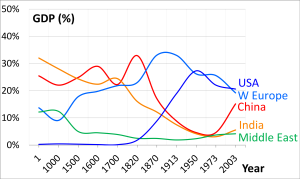
300px-1_ad_to_2003_ad_historical_trends_in_global_distribution_of_gdp_china_india_western_europe_usa_middle_east
Shift of wealth from east to west in around 300 years

In hindsight, it seems obvious why the consolidation happened. They were trying to minimize administrative expense while maximizing the profits squeezed out of the native population. They did this with brutal efficiency as India went from one of the richest lands to one of the poorest in a matter of around 300 years as seen in the above picture.

Legacy of colonialism

Fighting two World Wars drained the coffers of the empire on which “the sun never set”. Now they had no choice but to leave the administration to the natives. For this, the drama of propping up a half-naked fakir as a “father of the nation” was overseen by the departing colonialists.

Another legacy left behind was a class of native intellectuals who were steeped in the Fabian mores of the day. These intellectuals formed part of the ruling class for several decades after independence. They were responsible for the stagnant rate of growth of the economy because of the imposed socialism. Also, talented and creative youth were perverted by leftist propaganda to become hostile to both economic freedom and the ancient Hindu tradition.

Today, the nation stands to somewhat recoup its position in the world thanks to the liberalization of the economy since the 1990s. However, the people continue to suffer because of a corrupt centralized government structure preventing ordinary people from pursuing their economic well being. The recent exercise of demonitisation left the population scarred because of centralized government meddling in the currency. Excessive government meddling in human society produces a huge class of chronically dependent people. This has been seen in every socialist society. In contrast, in all societies where the forces of free market capitalism were left unfettered, such societies have exploded in prosperity for all. One just needs to compare Switzerland to socialist Venezuela (where people have recently resorted to eating stray dogs because they lack food).

Local control is most democratic

The case of Switzerland is all the more interesting because their model is one of a confederation of Cantons under the rule of a federal government. The Swiss model has ensured that the people of the Cantons have full control over how their tax money is spent by the local government. The federal government has some minimal functions such as foreign relations, defense etc. There is a healthy level of respect for the self-determination of the local governments. This ensures that the tax money given by the citizens is spent wisely at a local level under the control of the citizens themselves.

The function of any democratic government is to collect taxes and wisely spend it under full control of the population. The problem with the Indian government of today is it is very big and does too many things. Once tax money has been extracted from the people, the people have little control over where it is going to be spent. In reality, the political and administrative class of India do not behave as public servants, but as little dictators. Corruption is common as a result.

Government in accordance with dharma

The systematic theft of public wealth by the political class is a legacy of socialism and is in direct contradiction to dharma. In the ancient Indian tradition, kings were seen as servants of the people. Their responsibility was to ensure that taxes get spent wisely for the welfare of citizens. The colonial legacy of socialism and the gradual erosion of Hinduism in the political class has damaged the society.

In a democracy, it is the responsibility of the people to ensure that their tax money is being spend in accordance with dharma. Such a thing is only possible with more local control over the government with the local governments having more authority in terms of what gets spent where. This implies a decentralised government with more power in the hands of the local bodies to ensure an efficient allocation of resources with minimal central oversight.

The central government should focus solely on a minimal set of tasks, including foreign relations, defense etc, for which the resources can be allocated by each of the local bodies. This kind of decentralised structure will ensure that the central government cannot impose insane policies on the population. Also, this will reduce the need for a large number of central government entities, thus freeing up tax money to be spent in accordance with dharma by local bodies controlled by the local populace.

Introduction of Internet Based Voting Through e-Postal Ballot

0

Recently, the decision of the government to introduce the e-Postal ballot system was marked as a step towards the introduction of internet-based voting system. On 21st October 2016, a notification was issued which enabled the service voters that is army personnel including their wives to cast their vote in the election through e-postal ballot.

What is e-postal ballot?

e-Postal voting system

In the e-Postal ballot system, a blank postal ballot paper would be transmitted through email. After that, the ballot is used to cast the vote, and after marking the vote the same is returned by post to the same returning officer who issued that ballot. It helps to prevent the delay in two-way transmission of ballot paper by using the postal services. The two-way transmission by postal services was not able to meet the expectations of the service voters especially those armed forces who were serving in remote and border areas. The matter was presented in Supreme Court and was request was launched for creating an effective mechanism for the armed personnel and their families. Then the election commission was approached where the technical team developed a system named e-Postal ballot.

Who can use e-Postal ballot system?

  • The armed police forces of the union
  • All other forces that come under the provisions of Army act
  • The Armed forces of a state who is serving outside that state
  • Anyone who is employed and posted outside the country by Government of India

How is it done?

Postal-ballot

Below mentioned are some steps which will explain the ways by which you can use the process of e-Postal voting system. But it is essential that before the process is started you have to ensure that you come under the eligibility criteria set by the government. Once it is confirmed that you are service personnel then you can proceed with the following steps:

  • Firstly, you have to register yourself as a service personnel.
  • After that, you will receive an e-Postal ballot by the returning officer via email. You will receive the ballot, 14 days in advance so that you enough time to return it back.
  • Once you receive the ballot you have to take a printout of the ballot forms and envelopes and after filling the required details in the space provided, you have to mark your vote.
  • Further, you have to get it attested by any government official.
  • You have to use the envelope that has been sent with a ballot to return it back to the returning official via postal service.

As you receive the mail 14 days ahead, so it is your responsibility that the whole process is completed within the 14 days then only your vote will be considered. The government has taken a good step by involving the internet partially. This has reduced the disappointment of the army personnel to some extent. The voting would become more easy process if it is done through the e-voting app launched by right2vote. In this app, there will be complete use internet which will make voting much more comfortable to exercise.

An Attempt To Commercialize #Metoo Bites The Dust

0

A cosmetic brand Hard Candy failed to own exclusivity of #metoo movement for its products to fight the patriarchy, by withdrawing its trademark application.

The ‘Hash-tag Me Too’ movement captivated the entire social media back in October 2017. The movement was predominantly initiated by the Hollywood celebs to unveil the dark side of the rape culture worldwide.

The Emergence of #metoo

 The # metoo campaign helps to spread awareness of the prevalent sexual harassment and misconduct in the society. In October 2017 the campaign became viral on Twitter to demonstrate the allegations of sexual assault against Harvey Weinstein, a film producer.

However, #MeToo movement was initially created by Ms Burke back in 2007. Tarana Burke is a social activist who helps victims of sexual harassment.

In spite of being under a long usage, the phrase swept the social media like twitter and facebook when Alyssa Milano, a popular actress tweeted to urge all the women across the globe to stand for the cause. The tweet asked all the women who had ever been in such a thin situation to write ‘#metoo’ as their status.

Since then the movement went viral like a fire. Millions of women have been stepping forward to publically denounce their experiences.

 #Metoo soon became a revolution!
The campaign soon laid seeds to nurture an anti-sexual harassment movement led by the Hollywood stars under the name and style of the ‘Time’s Up Movement’.

The efforts of celebs like Eva Longoria, America Ferrera, Reese Witherspoon and Rhimes took off the limelight at the Annual Golden Globe Awards where the Hollywood decided to adorn in black to support the cause of sexual harassment.

Hard Candy’s attempt to Trademark #MeToo
When the public was busy reuniting for the cause, on the other end of the world, Hard Candy attempted to trademark the ‘Hashtag MeToo’ for a collection of its beauty products.

In the attempt to gain from the first mover advantage, of being the first to secure their exclusive rights over the cause, they filed a Trademark application on 20th October 2017.

The Application for trademark registration was filed with the U.S. Patent and Trademark bearing the serial number 87,653,745 under the following classes:

• International Class 3 ( Cosmetics and Cleaning preparations)

• US Classes 1,4,6,50,51,52 (Cosmetics and Fragrances)

This implies if the trademarks were approved, then Hard Candy would become the only company to use such a phrase for its cosmetic products and fragrances.

Hard Candy withdrew its Trademark claims 
Hard Candy is a Cosmetics brand which sells its products through Walmart. The worldwide criticism instigated the company to abandon the Trademark application for #MeToo.

It was the smart timing of filing the trademark, just after the social movement got viral which made the world to criticize the brand. People started to rebuke the efforts of the beauty company to mint profits off a socio-political campaign.

The company slashes down all the allegations of making money by glorifying the anti-sexual assault culture by revealing their intentions. They claimed that they aimed to spread the word further and to donate all the proceeds to the women globally affiliated with the #MeToo cause.

The trend still Continues 
Presently there are four applications to trademark #Metoo with the US Patent and Trademark.

Moreover, constant attempts have been made by companies to link its products to the campaign in the stride to join the cause. A Lipstick named ‘F*ck Hollywood’ was launched by Lip Slut just before the Golden Globe Awards to help survivors of sexual assault by donating all its proceeds to the cause.


Padmaavat review: A visual spectacle with one major issue

0

Today I watched Padmaavat. I love history, especially the Indian history. I always wonder how our ancestors, kings, queens of the past were like, what did they wear, how did they walk, talk, eat, etc. However, history is a very delicate subject and one cannot take the liberty to play with historical figures. I have been fairly disappointed with Bollywood’s previous attempts on historical movies (there has been only a handful of them). Many of the past movies are downright false and offensive. For example, I can bet more than 99% of the people you know think Jodha was Akbar’s wife. She probably wasn’t. She was the mother of Shah Jahan according to many historical texts.


Refer to page-246 Satish Chandra, History of Medieval India, part of NCERT’s old curriculum

This is a controversial issue. Jodha Bai like Padmavati is a part of Rajput’s history and their pride. That’s what made the Rajput community lose faith in Bollywood and one of the major reasons for the whole drama (there are many other reasons but I will not get into that topic).
Coming back to the movie, I have divided my review into positives and negatives.

Positives:

The whole movie is visually stunning. We expect this from Mr Sanjay Bhansali (SB). This movie is worth watching just for the visuals. 3D is surprisingly decent. The movie embraces the history in its most glorious form. The camera transitions make sure you have the best field of view for the whole galore of a particular scene. The attention to details is remarkable. From the Rajputana jewellery, clothing, palaces, swords to Khilji’s clothing, their way of walking, food. Many people complained about the extravagant jewellery shown in the movie. My advice to them is to visit National Museum in Delhi and have a look at Rajput jewellery for themselves. If any, the original Rajput jewellery used to have more precious stones.
The background score is another big positive. It’s spot on and makes you feel like you’re in 13th-14th century Rajasthan. The best part of the score comes at the climax and the departure of Padmavati feels like a Goddess entering into the fire.
The story and the depiction did justice to the Rajput culture, though I am not so sure about the Khilji’s (which I will cover later).
Rana Rawal Ratan Singh (Shahid Kapoor) was the most accurate portrayal. My only disappointment was him getting a bit lesser screen time.
The story of the movie was fairly accurate (considering previous blunders of the Bollywood).
Deepika’s performance as Padmavati was as expected. She manages to create a strong impact in the minds of the audience. Her looks, clothing and her body language and gracious movements greatly enhanced her performance. I still think, there are many lesser-known actresses who would have nailed this performance even better.

Negatives :

The Disclaimer: The movie shows a disclaimer in the beginning which tells the audience that the movie is based on a medieval poem which is considered fictitious by many historians. I know their intention of putting this disclaimer is to avoid any controversy and hurting sentiments, but that was just pure BS. Ratan Singh was a historical figure, Jauhar was a historical practice, Khilji’s were barbarians, murderers, plunderers, rapists with no ethical or moral values. The poem itself was inspired by historical facts. The movie makers could have and should have said, “The movie is inspired by historical incidences and characters. However, we don’t claim it’s historical authenticity. There may be some historical inaccuracies.”

The dialogues: Persian words started mixing with the North Indian languages during those medieval periods. I am sure, the language used by Rajputs that time was devoid of any Persian or Urdu words. I felt the writers could have used pure (Shuddh) Hindi (though Hindi itself was developed later) for Rajput dialogues and the Persian Hindi for Khiljis.

Over dramatization: Many scenes were overly dramatized and cheesy. This, in turn, made the movie longer than expected.

Alauddin Khilji: My biggest issue with this movie. Many reviewers are praising the performance of Ranveer Singh. If this was any other fictional movie, I would have done the same. But it isn’t. Alauddin was a historical figure. As I said before, he was a barbarian, plunderer, murderer, paedophile, rapist, bisexual with no ethical or moral values. This movie shows parts of his characters in brief. Then, why am I complaining?
Let’s take a detour and examine how Ramsay Bolton was shown in the Game of Thrones series. He was universally hated by the audience. He was barbarian, rapist, plunderer. Now comparing to Alauddin, you can say that Alauddin is a hybrid of Joferry and Ramsay (you will get this reference after watching this movie). The movie, however, fails to develop the character of Alauddin in that fashion. Yes, he has been shown as a coward, a lustful barbarian. However, his character development failed completely and didn’t do any justice to the Alauddin of the 13th century. Ask any audience of GoT, how much they hated Joferry and ask the same to the audience of Padmaavat in the context of Alauddin. Considering that a major portion of the audience is a novice, and virtually ignorant or ill-informed about our pasts, this movie will certainly fail to convince the audience that Alauddin was a barbarian. Although SB tried in this regard, but he failed. The major reason for this is the casting of Ranveer Singh. There is a reason, we have specialist actors for negative roles (Amzad Khan, Amrish Puri, Paresh Rawal, etc.). Considering how much our younger generation (which are mostly ignorant about our history) admires Ranveer, his portrayal may create an impression that Alauddin was a romantic, crazy dude who used to live his life to his fullest. He may become anti-hero in the minds of some. Even I wasn’t hating Ranveer much at any point. This for me is the biggest failure of the movie.

It is worthwhile mentioning that SB made a similar mistake in Bajirao Mastani. His character development of Bajirao was flawed and had many inaccuracies. He was shown as a romantic Devdas like character. The director used his own imagination in that movie, especially in the climax. While imagination leads to creativity, it is not recommended to try too much imagination with historical figures. For example, can you show a movie with a romantic affair of Hitler with a Jewish girl?